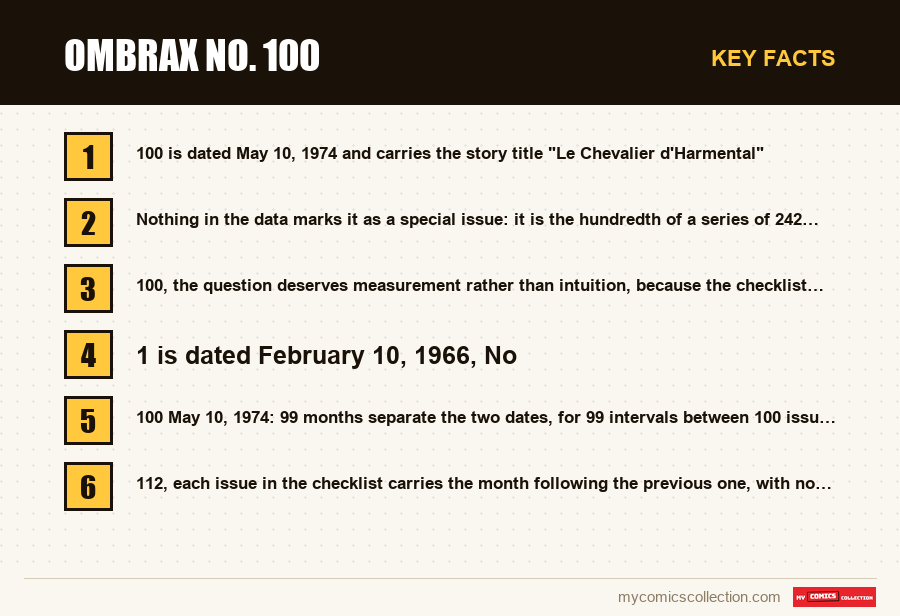
In the checklist, Ombrax No. 100 is dated May 10, 1974 and carries the story title "Le Chevalier d'Harmental". Nothing in the data marks it as a special issue: it is the hundredth of a series of 242 monthly-dated issues, with no anniversary mention. It stands out only through a credits seam (Devi arrives, D'Amy leaves the following issue). What it actually contains has to be read on the copy.
A round number raises a collector's eyebrow: you wonder whether it should cost more, be hunted first, be kept apart. For Ombrax No. 100, the question deserves measurement rather than intuition, because the checklist does answer it, and its answer is more nuanced than "nothing to report".
As always on this guide, only verified information (creators, issue numbers, dates) is stated as fact; the analysis is our own, with no reproduction of panels or protected dialogue.
What the checklist says about No. 100
The entry for No. 100 holds a few fields. Cover date: May 10, 1974. Story title retained: "Le Chevalier d'Harmental". Writing credited to Maurizio Torelli, Roy D'Amy and Devi; art credited to Jean Frisano, Giancarlo Agnello and Roy D'Amy. Publisher of the series in the checklist: Éditions Lug.
These credits are given at the level of the issue, not the episode. Three names as writers and three on art do not mean that three people signed the same story: the checklist does not say who did what. The single title is also a sample: the checklist retains only one name per issue.
The hundredth number in its place in the calendar
The hundredth issue falls exactly where arithmetic places it. No. 1 is dated February 10, 1966, No. 100 May 10, 1974: 99 months separate the two dates, for 99 intervals between 100 issues. From No. 1 to No. 112, each issue in the checklist carries the month following the previous one, with no gap and no duplicate. No. 100 has not been moved forward, delayed or doubled: it arrives in its turn, like 99 and 101.
This regularity has a practical consequence. For this stretch, the cover date is a reliable way to check a position in the series: a May 10, 1974 can only be the hundredth. The checklist gives a day (the 10th) for 198 of the 242 entries; the other 44 carry only the month, all of them between issues 193 and 236. No. 100 is therefore in the best-dated part of the series, and its date reads in full on the entry.
A hundred out of 242 issues is a little over four-tenths of the series: the mark is passed before the midpoint of the collection, which runs to No. 242 dated March 10, 1986. It is neither an end nor a middle.
No field flags an editorial event at No. 100: no anniversary mention, no different pagination, no supplement. The checklist has no field for such things in any case: its silence does not prove absence, it only rules out asserting the opposite.
What the checklist does prove, however, is that the issue follows its neighbors on measurable points: same cadence, same day of the month, and on art a trio (Frisano, Agnello, D'Amy) identical to that of No. 99.
The credits seam around No. 100
If No. 100 is nothing like an event, it sits on a small seam in the list of credits, and that is the only singular thing the data establishes. Three moves follow one another across two issues.
First, Devi appears as writer at No. 100: it is the first entry in the checklist where this name occurs, and he remains credited as writer from No. 100 to No. 110, that is 11 consecutive issues.
On art, he is credited only from No. 101 onward. Then, No. 100 is the last entry in the checklist where the signature D'Amy (written D'Amy or D'Ami, with the first name Roy or Rinaldo depending on the entry) appears: it runs from No. 85 to No. 100 and never returns. Finally, Franco Frescura enters as writer at No. 101.
He remains credited there for 67 issues between 101 and 242, with long absences.
Caution is required with names: the three spellings D'Amy, D'Ami and Rinaldo D'Ami may refer to the same signature or to several, and the checklist does not decide. Counting "one creator" on the basis of a character string is exactly the trap an issue entry should avoid.
Should one see a turning point in the editorial team linked to the hundredth? The measurement counsels moderation. Across the 241 passages from one issue to the next, the writing credits are strictly identical to those of the previous issue in 155 cases; they differ in 86. A change of one name (99 to 100) or of two (100 to 101) is therefore an ordinary event in this series, occurring roughly one time in three. That the threshold of 100 coincides with one of them is observed; that it is the cause is not demonstrated.
The title: a story with no part number in the middle of serials
The other singularity of No. 100 is found in its title. The fifteen issues before it, from No. 85 to No. 99, all carry a "[part N]" marker in the retained title: they are fragments of continued stories. No. 100 carries none, and neither does No. 101; Nos. 102 to 105 take it up again, and No. 106 drops it.
Of the 242 titles in the checklist, only 49 carry this marker. A title without a part is therefore nothing exceptional in itself; what matters here is the contrast with the block before it: issues 85 to 99 read like a chain of stories that carry on, whereas 100 opens on a title that stands alone.
The five issues 95 to 99 each show a "[part 1]" with a different title, and no corresponding "part 2" is recorded elsewhere in the checklist: the checklist does not record the continuation, if any, of these stories. The title is a label, not a contents list.
Do you collect this series?
Track what you own, what you are missing and what your collection is worth. 7-day trial.
Start my trial →
The neighboring issues, from 94 to 106
Thirteen issues in a row, from No. 94 (November 10, 1973) to No. 106 (November 10, 1974), each fall on the 10th of the month following the previous one. No. 94 carries "Les cavaliers du démon" as part 3, and its art is credited to Roy D'Amy and EsseGesse only, without Frisano or Agnello. Issues 95 to 99 form the block of "part 1" mentioned above.
After 100, No. 101 carries a title whose entry keeps an unclosed quotation mark ("Le grand "V'"): proof that the checklist is a transcription, with its accidents, and that the exact wording must be checked on the cover or the contents page. No. 106 is the second number in the 94 to 106 range where Torelli is not credited as writer (the first is No. 94): we find Nicola Del Principe, Bonvi and Devi there, and it is the first appearance of Bonvi in the checklist, as writer and as artist.
No. 100 is surrounded by numbers that resemble it, and it is not the one that marks the greatest break in the range: by its credits, No. 106 is more different.
Recognizing the copy and avoiding the traps
A round number has, in this checklist, no material feature of its own; it is therefore recognized like the others. Three checks suffice: the printed number (100), the cover date (May 10, 1974) and, when the cover or contents page allows, the story title. If all three match the entry, you hold the right object.
The first trap is believing that the roundness of the figure adds anything: paying more because it is called "one hundred" amounts to paying for a figure, not for content. The second is assuming an editorial status for it (anniversary, double issue, supplement) that the data does not carry: an insert or an editorial, if present, is established on the copy and described in the ad, it is not presumed. The third is the homonymy of numbers: other series have their own hundredth, and a "No. 100" with no series name or date designates nothing. The cover date removes the doubt.
What makes the value of a round number vary
The value of an issue depends in particular on: the condition of the paper and the binding, completeness (cover, interior pages, any inserts) and how easy the copy is to find for sale. The round figure adds nothing demonstrated. The checklist says nothing about any market effect attached to the round figure: if one exists, it is measured on sales, not on the entry.
The right estimation method therefore remains comparative: set your copy against sales of copies in the same condition, for nearby issues (95 to 105, for example), and measure the difference, if any, that the "100" brings, rather than assuming it.
Condition and tracking in a list of gaps
In a collection of Ombrax being completed, No. 100 is recorded like any other number: number, date, observed condition (cover, spine, pages, yellowing), and a "particularity" line where you note what you saw while reading it (story title, presence of an insert, any anniversary mention). This line is missing from this checklist: it makes your list richer than the checklist itself.
In a list of gaps, keep two lines apart: No. 100 (May 10, 1974) and No. 101 (June 10, 1974), whose title is mis-transcribed in the checklist. Record both with their date: the date prevents a rank error. Before buying a duplicate, check that your copy carries the expected title. Tracking in the application keeps you from buying the same issue twice and records what you actually observed.
In short, the Ombrax No. 100 is ordinary in what the checklist says about it, and that is what makes it instructive: a hundredth issue with no documented editorial signal, dated May 10, 1974, at the junction of two sets of credits. Its value depends on its condition and on what its contents hold, not on its number.
Frequently asked questions
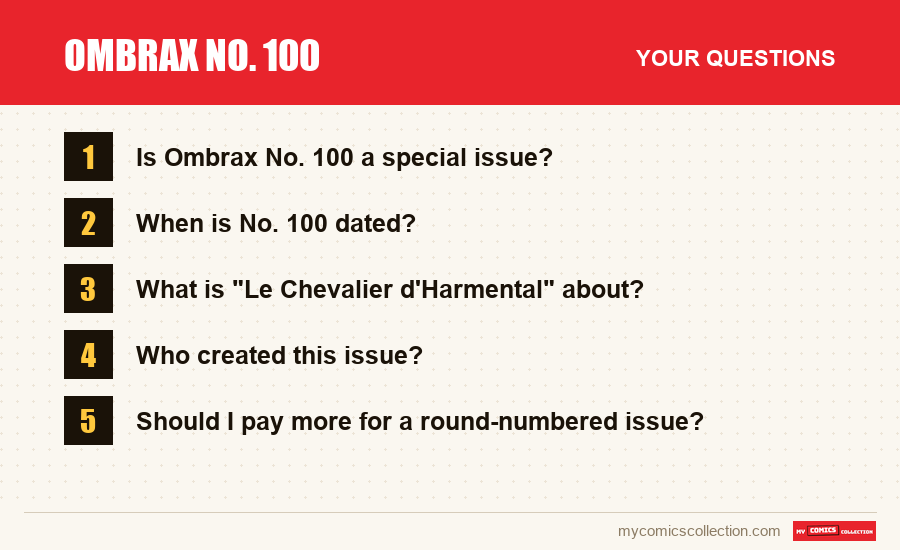
The checklist does not flag it: no anniversary mention, no supplement, no change of pagination appears there. That does not prove the absence of an insert or an editorial, which only the copy can show. Until you have seen it, do not present it as special in an ad.
May 10, 1974 according to the checklist, day included. No. 99 is dated April 10 and No. 101 June 10 of the same year: the series is monthly without interruption from No. 1 to No. 112. The cover date therefore helps confirm the rank of a copy.
The checklist gives only the title, not the story or its place within the issue. For the content, you have to open the copy: this checklist does not describe it.
The issue is credited to Torelli, D'Amy and Devi for writing, and to Frisano, Agnello and D'Amy for art. These credits apply to the whole issue, not to a specific story: we cannot say who signed the story bearing the title. Fine attribution requires reading the signatures.
No data justifies it: value follows condition and how easy the copy is to find. The checklist says nothing about a market effect; one would be measured by comparing sales of nearby numbers in the same condition, not by assuming a premium. Compare before you pay.