Nightcrawler (Kurt Wagner) first appears in Giant-Size X-Men #1, dated May 1975 and on sale April 1, 1975, created by Len Wein and Dave Cockrum in "Second Genesis!", the issue that launches the new X-Men team. His other key issues are his first miniseries, Nightcrawler #1 (November 1985, written and drawn by Cockrum); X-Men Unlimited #4 (March 1994), which makes Mystique his mother; Uncanny X-Men #428 (October 2003), start of the arc that reveals his father, Azazel; X-Force #26 (June 2010), where he dies; and Amazing X-Men #1 (January 2014), which brings him back. Alan Cumming, who played him in X-Men 2 (2003), reprises the role in Avengers: Doomsday, on December 18, 2026.
Kurt Wagner holds a singular place among the X-Men. His appearance is the most "monstrous" of the team, and his character one of the brightest: circus acrobat, devout believer, fan of swashbuckling films, he is often the character who reminds the others why they fight. This contradiction has fed fifty years of stories, and a complicated genealogy that took decades to settle.
This article is a complete character sheet for the collector: the first appearance, what it is worth as an object without putting forward a figure, then the issues that built Nightcrawler, in order. The link with Mystique is treated here from Kurt's point of view; Mystique's universe has its own guide.
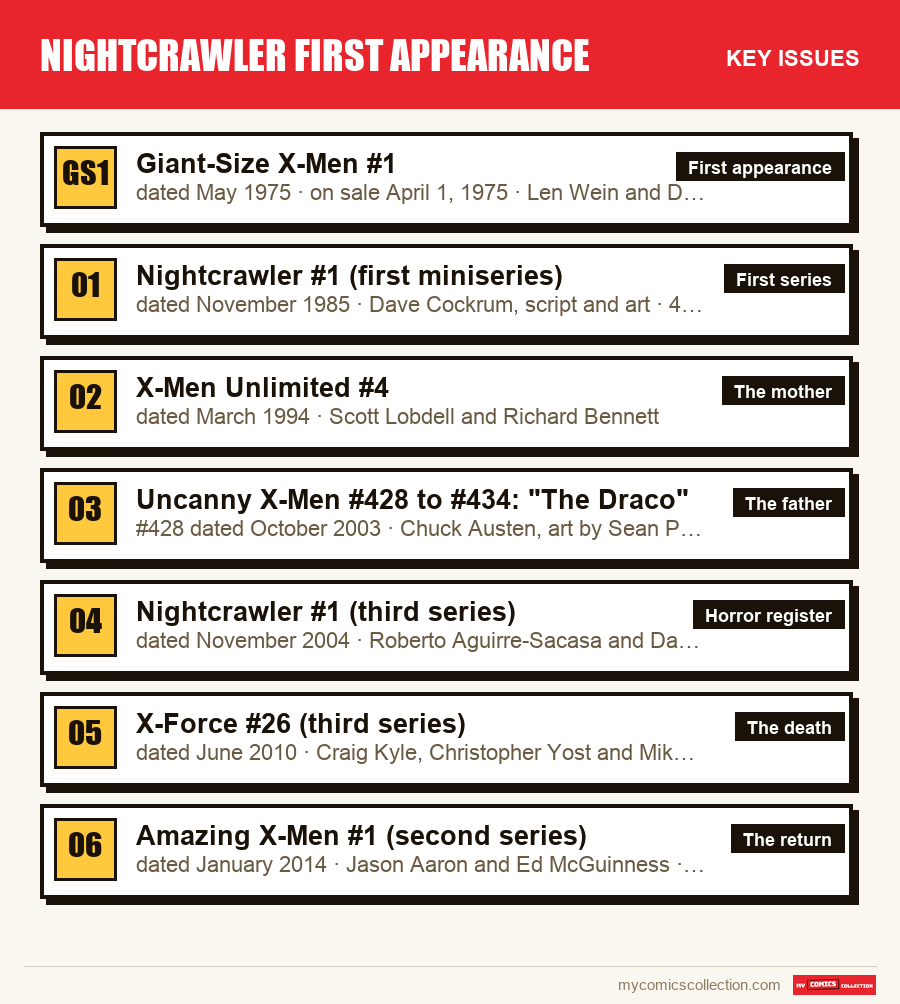
Giant-Size X-Men #1: the first appearance
Giant-Size X-Men #1
"Second Genesis!" gathers an international team to save the original X-Men. Nightcrawler appears there for the first time alongside Storm, Colossus and Thunderbird, and other recruits. In the first pages, German villagers chase him because of his appearance, until Charles Xavier intervenes. The scene fixes the character's theme right away: a being of demonic appearance who proves to be the most human of all.
The date deserves a clarification. The issue is dated May 1975 on its cover, but it was on sale from April 1. It is the usual rule of American comics of the time, where the printed date runs ahead by a few weeks to a few months. In an inventory, note both: the cover date serves to identify the issue, the sale date to place it in publishing history.
What the issue is worth cannot be summed up in one figure, and this guide gives none: no source consulted publishes a dated, verifiable price over the recent period. One can, however, describe its position. It is a Bronze Age issue, in a giant format, very well known, often graded, and carried by several major characters at once. Its demand depends less on a film than on a long-established historic status. For the overall logic of the X-Men, see our X-Men key issues.
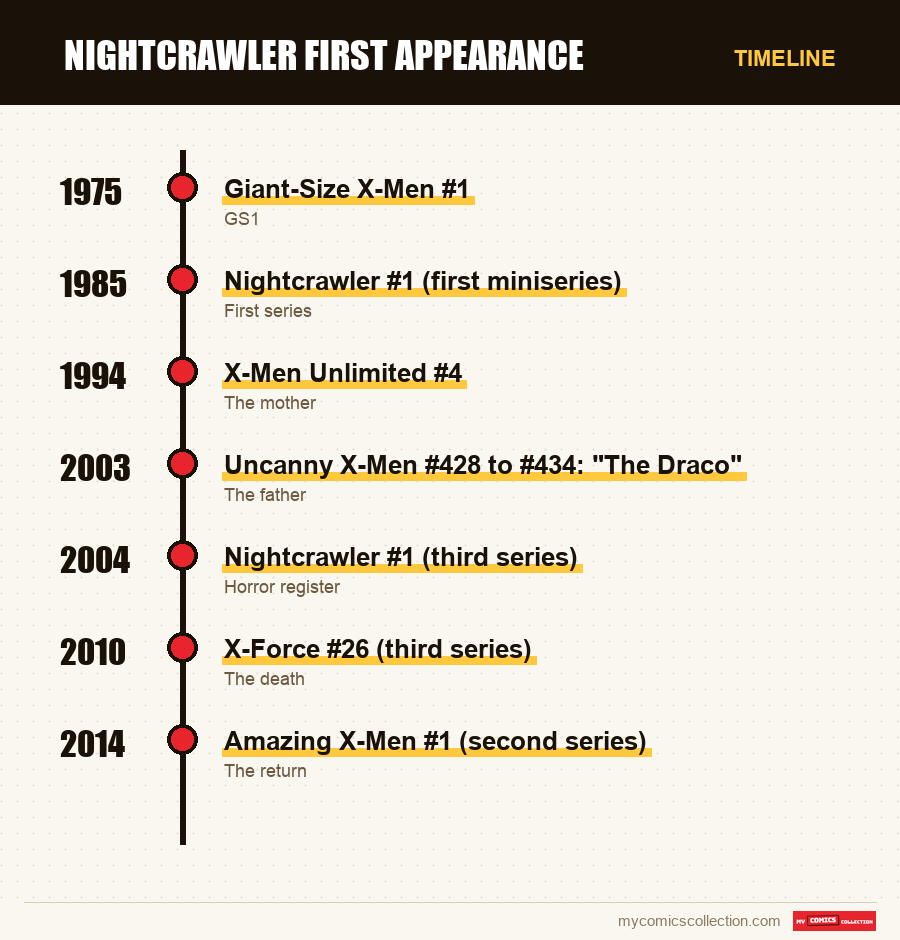
The issues that built Nightcrawler
After Giant-Size X-Men #1, the character settles into the regular series. Here are the documented milestones that changed what we know about him, in order of publication.
Nightcrawler #1 (first miniseries)
Ten years after co-creating him, Dave Cockrum alone does the first series in the character's name, a light adventure through parallel dimensions, with the Bamfs, small creatures in Kurt's image. The tone is the one Cockrum saw in Nightcrawler: a swashbuckling hero, cheerful and theatrical. It is the ideal read for anyone who wants the character without the weight of continuity.
X-Men Unlimited #4
"Theories of Relativity" establishes that Mystique is Kurt's mother, and that she abandoned him shortly after his birth in the Bavarian Alps. The link had long been suggested; this issue makes it official. It changes the reading of all earlier clashes between the two characters. Our guide to Mystique's universe treats this relationship from her side.
Uncanny X-Men #428 to #434: "The Draco"
The arc reveals Kurt's father: Azazel, chief of an ancient race of mutants of demonic appearance. The story was heavily criticized on release, and many readers judge it weak. It remains unavoidable for understanding the character's genealogy, since all later stories take it into account, including to reinterpret it.
Nightcrawler #1 (third series)
"The Devil Inside" steers the character toward the supernatural tale, playing on his appearance and his faith. A short series, interesting above all for its tone, to read after the classics.
X-Force #26 (third series)
During the Second Coming event, Kurt dies protecting Hope Summers. His death weighs on the X-Men for several years, and it is one of the most striking disappearances of the period. The issue is part of a crossover: to read it in context, you need the chapters around it.
Amazing X-Men #1 (second series)
First chapter of a five-part arc that brings Kurt back from the afterlife, with a battle against Azazel and his pirates. Aaron and McGuinness make it a very colorful adventure, the opposite of the tone of the 2010 death. Soon after, Chris Claremont does a new Nightcrawler series, whose #1 is dated June 2014, drawn by Todd Nauck: the X-Men's historic writer finds again the character he wrote the longest.
The Krakoa era: Nightcrawler as priest and seeker of meaning
When the mutants settle on the island of Krakoa, from 2019, Kurt takes on a new place. A believer in a society where death becomes reversible, he questions what this resurrection does to souls and morality. Si Spurrier devotes two series to him: Way of X, whose #1 is dated June 2021, drawn by Bob Quinn, then Legion of X, whose #1 is dated June 2022, drawn by Jan Bazaldua. Kurt seeks there to found a spirituality of the mutants' own, and faces an entity that feeds on the memories lost during resurrections.
It is the character's most ambitious period since Cockrum, because it takes seriously what distinguishes him: his faith. For a reader, it is also the most demanding, since it relies on Krakoa's continuity. Later, in 2023, X-Men Blue: Origins #1 returns again to his birth and his link with Mystique and Azazel: Kurt's genealogy has never really stopped being rewritten.
Nightcrawler in film and in Doomsday
Alan Cumming played Kurt Wagner in X-Men 2, released in 2003, with an opening scene at the White House that remains famous. Marvel Studios announced him on March 26, 2025 in the cast of Avengers: Doomsday, with other performers from the X-Men film series: Patrick Stewart, Ian McKellen, Kelsey Grammer, James Marsden, Channing Tatum and Rebecca Romijn, who plays Mystique, precisely. The film comes out on December 18, 2026. Nothing is known of Nightcrawler's role, and this guide does not try to guess it.
The simultaneous return of Cumming and Romijn makes a renewed interest in the link between Kurt and Mystique likely, which does not exist on screen in the X-Men series films as they were shot. Our guide to the key issues of the Fox films' X-Men facing Doomsday covers all the correspondences, in a few lines per character.
Building your Nightcrawler collection
The first appearance, if the budget allows
Giant-Size X-Men #1 is the only first-appearance issue. It is a major purchase, to be made without haste, comparing copies and their condition. It can be read in collected form if you only want the story.
The two family revelations
X-Men Unlimited #4 for Mystique, Uncanny X-Men #428 for the Azazel arc. These are issues from the 1990s and 2000s, abundant, which give the keys to the genealogy.
The death and the return
X-Force #26 of 2010 and Amazing X-Men #1 of 2014, to read within their respective arcs. Two narrative milestones more than two collectibles.
The series in his name
Cockrum's 1985 miniseries first, for the original tone; then Claremont's from 2014, and Spurrier's two series for the Krakoa era.
To place Kurt in the team's history, our history of the X-Men gives the context, and the X-Men hub gathers the pages of the other members.