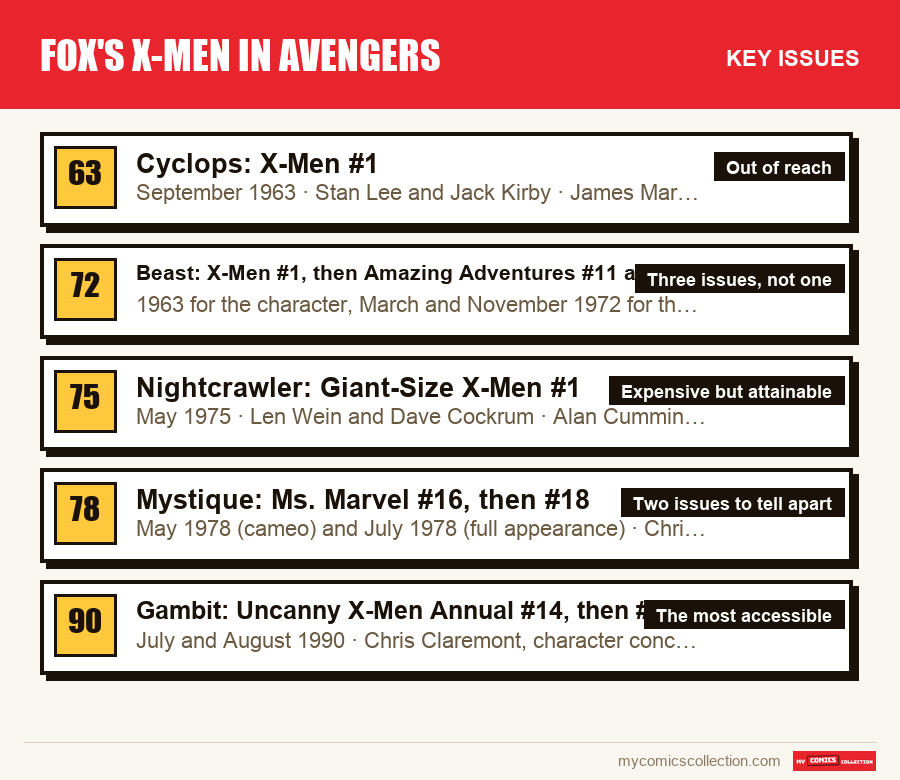
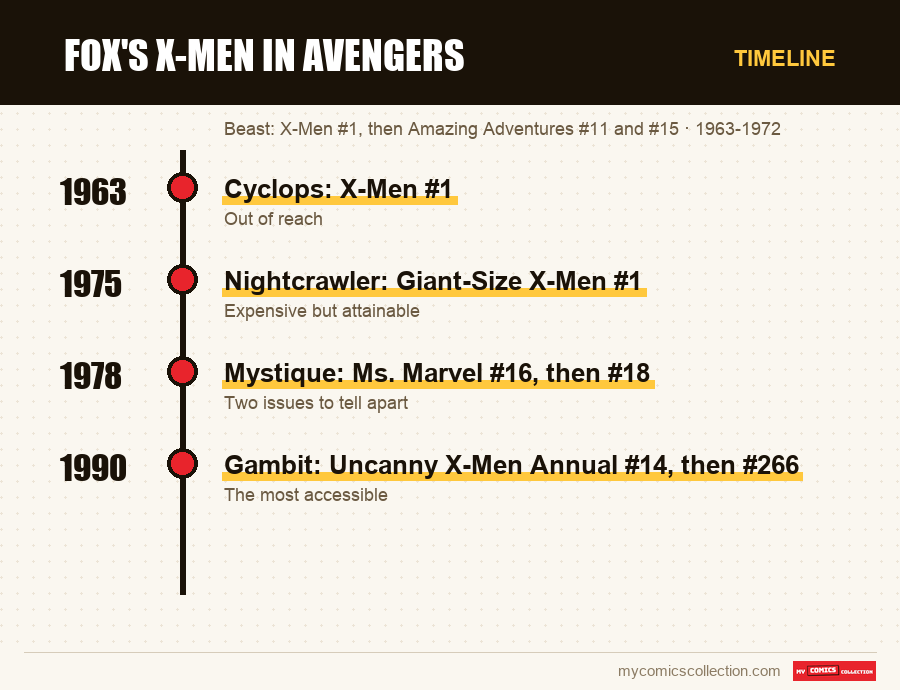
Avengers: Doomsday comes out on December 18, 2026, and brings back to the screen actors from Fox's 2000s X-Men films: James Marsden (Cyclops), Rebecca Romijn (Mystique), Alan Cumming (Nightcrawler), Kelsey Grammer (Beast), Channing Tatum (Gambit), alongside Patrick Stewart and Ian McKellen. On paper, these characters do not belong to the same decade at all. Cyclops and Beast are born in X-Men #1 (September 1963), Nightcrawler in Giant-Size X-Men #1 (May 1975), Mystique in Ms. Marvel #16 and #18 (1978), Gambit in Uncanny X-Men Annual #14 and #266 (1990). In other words: one issue out of reach, one expensive but attainable, and three still accessible. And two numbering traps that this guide details.
A movie poster never says which shelf to file the comics on. When Marvel Studios rolled out the cast of Avengers: Doomsday, the announcement effect fell on the faces: actors nobody expected anymore, back from films shot twenty years ago. The effect on paper is quite different, and much more concrete. Each of these faces corresponds to a specific issue, published on a specific date, and these dates spread across twenty-seven years of editorial history.
It is this distance that makes the subject interesting for a collector. A cast turned toward the Fox films does not point to a handful of contemporary comics, but to four distinct eras of the mutant catalog: the Silver Age of 1963, the 1975 relaunch, the late 1970s, and the production peak of the early 1990s. Prices, scarcity and buying logic are not comparable from one era to another. Putting all this on the same shopping list would be the easiest mistake to make.
This article is written on October 1st, 2026, eleven weeks before the release. The film is not out, nobody has seen it, and the real role of each of these characters on screen remains unknown. What is verifiable today, on the other hand, is the screen-to-paper correspondence: who returns, in which issue he first appeared, and what shape that issue is in on the secondhand market. That is exactly the object of this guide, and nothing else.
The film's calendar, because it conditions everything else
Two dates serve as the frame. Avengers: Doomsday is expected on December 18, 2026, after being moved from a May 2026 slot to the end of the year. Avengers: Secret Wars, the next film, is announced for December 17, 2027. This twelve-month gap between the two releases is not a distribution anecdote: it means the characters introduced in December 2026 will stay in the news for at least a year, since a second film will build on them.
The move from May to December also has a mechanical effect to keep in mind. Every time a release date slips, the period of media attention stretches, purchase lists circulate longer, and the market has more time to absorb demand. That is rather favorable to someone buying to read or to complete a series, and rather unfavorable to someone hoping for a sudden, short price move.
One last framing point, and it is important: the exact makeup of each character's role is not known. A credited actor can have ten minutes on screen or three shots. Until the film is out, nobody can say which of these mutants will really carry the story. Any recommendation resting on the supposed importance of a role would therefore be speculation disguised as advice.
The five screen-to-paper correspondences, issue by issue
Here, for each actor whose return is confirmed, is the issue that carries the character's first appearance in the comics, with the creators and the cover date. Patrick Stewart and Ian McKellen do not appear in this list: Professor X and Magneto are also born in X-Men #1 (September 1963), and we devote a separate guide to them, because their respective key issues number in the dozens and spill far beyond this frame.
Cyclops: X-Men #1
Scott Summers appears in the series' first issue, together with the rest of the founding team. There is therefore no cameo, no intermediate issue, no collector debate: the first appearance of Cyclops is one of the most sought-after issues of the Silver Age, for reasons that have nothing to do with him in particular. It is the same object as the first appearance of Magneto, Professor X, Jean Grey, Iceman and Beast.
Beast: X-Men #1, then Amazing Adventures #11 and #15
It is the most misunderstood case on the list, and the one that costs the most in misunderstandings. Hank McCoy appears in X-Men #1 in 1963, but there he is an athletic human with oversized hands and feet, without fur. The Beast that Kelsey Grammer played in cinema, furry and blue, is a later version by nine years, born in another series.
Nightcrawler: Giant-Size X-Men #1
Kurt Wagner, called Diablo in the French editions and Nightcrawler in the original version, appears for the first time in the issue that relaunches the whole franchise after five years without a new story. He arrives together with Storm, Colossus and Thunderbird, and it is also in this issue that Wolverine, who appeared elsewhere, joins the team. A single object therefore carries four first appearances and a major recruitment, which explains its position on the market.
Mystique: Ms. Marvel #16, then #18
A detail that often surprises: Mystique is not born in an X-Men series. Raven Darkhölme first appears in Ms. Marvel #16 (May 1978), hidden under an assumed identity, without her blue skin or yellow eyes. The silhouette that cinema popularized is only revealed two issues later, in Ms. Marvel #18 (July 1978).
Gambit: Uncanny X-Men Annual #14, then #266
Remy LeBeau is the only one on the list whose actor has already been seen in the role: Channing Tatum played Gambit in Deadpool & Wolverine in 2024, after a decade of a solo film project that was never shot. On the paper side, his first appearance is the subject of an old collectors' debate that is still alive.
Why Beast deserves a paragraph of his own
The distinction between Beast's three issues is not a purist's subtlety: it is the difference between an unattainable issue and two ordinary Bronze Age issues. Let us go back over the chronology in order.
In 1963, Hank McCoy is a founding member of the team. His first appearance is X-Men #1, full stop, and that issue trades at the level described above. A collector who says they have "the first appearance of Beast" is therefore talking, whether they know it or not, about one of the costliest issues of the Silver Age.
In March 1972, in an anthology series that has nothing to do with the X-Men, the character undergoes a physical transformation that makes him permanently non-human. Amazing Adventures #11 is the issue of that turning point, and it is the true birth of Beast as cinema took him up. The object is a 1972 anthology comic, printed and distributed as such: it never had the status of a franchise number 1.
In November 1972, in the same series, the fur stops being gray. The reasons have as much to do with printed color as with narrative intent, and that is precisely why the label "first blue Beast" circulates on two different issues depending on who you ask. The cautious position is to describe what you own in your own terms rather than with a slogan: "first appearance in fur form, Amazing Adventures #11" is a verifiable sentence, "first blue Beast" is not without specifying which of the two issues you mean.
A practical consequence for anyone preparing for the film: the two 1972 issues are, by far, the most reasonable entry point for building a collection around Kelsey Grammer's character. They tell the version he plays, they can be found, and they do not require the budget of a 1963 issue which, for its part, shows a character the film does not depict.
Cameo or full appearance: the rule that holds for Mystique and for Gambit
Two characters on this list pose the same problem in two different forms, and it is worth dealing with it once and for all. A cameo designates a brief presence, sometimes partial, sometimes masked. A full appearance designates the moment when the character is fully shown and identified. Grading services decide, write their verdict on the label, and the market follows that label.
For Mystique, the logic is clear: the cameo of Ms. Marvel #16 hides her under a human identity, the full appearance of Ms. Marvel #18 shows her as everyone recognizes her. The collector who wants only one issue will take the 18, the one who wants the whole chronology will take both.
For Gambit, the case is trickier, because the order of publication and the order of going on sale do not coincide. Annual #14 carries a cover date of July 1990 and issue 266 a date of August 1990, but it is the Annual that reached stores first, ahead of the planned schedule. The debate among collectors is therefore less about the quality of the appearance than about what you consider "first": the first printed, the first sold, or the first where the character is fully presented.
The defensible position is simple: do not try to settle a debate that the market has not settled, and describe precisely what you own. In a properly kept collection, the two issues are distinct lines with distinct notes. If you manage your collection in a tracking app, it is exactly the kind of nuance that should appear in the issue's record and not just in your memory.
Out of reach, accessible, liable to move
Here is the hierarchy announced at the opening, stated without detour. It does not say what to buy: it says which decision category each issue falls in.
Out of reach for almost all collectors: X-Men #1 (1963). The public results cited above concern copies in very high grade, but even copies in modest condition trade at levels that make it a heritage purchase, not a purchase of cinematic enthusiasm. This issue will not move significantly because James Marsden returns to the screen: its price is determined by its absolute scarcity and by the status of the entire franchise, not by a cast. For anyone who wants to understand this issue's place in the catalog's history, our piece on the first appearance of the X-Men puts it in context.
Expensive but attainable: Giant-Size X-Men #1 (1975). The top of the market is counted in tens of thousands of dollars, but the slope is much gentler than in 1963, and presentable copies exist at levels that fit a serious collecting budget. It is the issue on the list that rewards patience the most: it is constantly sought, so it comes up for sale regularly, which lets you choose your moment and your condition rather than endure the supply.
Still accessible: Amazing Adventures #11 and #15 (1972), Ms. Marvel #16 and #18 (1978). These are four widely distributed comics, published outside the most collected series of their era, and that is precisely what has kept them affordable for fifty years. The underlying trend on this type of issue is known: demand rises when the character is on screen, then settles at a level a bit higher than before. These are the issues on this list on which a collector with a normal budget can truly decide.
Abundant, hence not very sensitive: Uncanny X-Men #266 and Annual #14 (1990). These issues come out at the moment when the industry prints the most of its own history. Copies exist in very large quantity, and that is a structural fact that neither a film nor a series corrects. Media attention can create a short move on the high grades, where scarcity is real, but it has no lasting effect on ordinary copies. For Gambit, the right reflex is not to rush on issue 266 in any condition, but to aim for a copy whose condition justifies preservation.
What could really move with the film is elsewhere. The clearest price movements around a release almost never concern the best-known first appearances, already built into the market for decades. They concern the secondary issues that the film suddenly puts forward: a specific costume, a specific team, a specific relationship. Yet these issues are, by definition, unknown before the screening. That is the soundest reason not to build your purchase list now for speculative reasons, and to build it now only for reading and collection-coherence reasons.
What the precedents say, without extrapolating
Two precedents are directly relevant, and they go in opposite directions, which is useful.
The first is the 2000 X-Men film, the one that launched the Fox series with several of the actors discussed here. It durably established mutants in popular culture and helped make the X-Men a top-tier franchise in cinema. Its effect on the comics market, however, was slow and diffuse, spread over years, and not concentrated in one quarter. We detail the gaps between that film and the source material in our comparison 2000 film versus comics.
The second is Deadpool & Wolverine in 2024, where Channing Tatum already appeared as Gambit. That film produced massive, very visible enthusiasm, and thus offers an almost experimental observation: a character's appearance in a very wide-audience film did not transform the status of his 1990 first appearances, because the abundance of copies did not change. Our analysis of the 2024 film against the comics returns to this period.
The lesson common to both cases fits in one sentence: a film acts on attention, not on scarcity. Where scarcity already exists, attention reveals it and prices follow. Where copies are numerous, attention passes and prices come back. This rule is enough to sort the five correspondences of this article without having to guess anything about the film's content.
Building a "Fox cast" collection without getting the issue wrong
Write the list with dates, not with names
"Beast" is not a usable list line, since three issues answer to the name. Write down Amazing Adventures #11, March 1972, and specify what exactly you are looking for. The same rigor holds for Mystique and for Gambit, where two issues coexist under one spoken label.
Separate the four budgets
One 1963 issue, one 1975 issue, two from 1972, two from 1978 and two from 1990 are not funded from the same envelope. Decide from the start which of the four tiers you are aiming at, otherwise the temptation is to buy the easiest and tell yourself you have started the collection.
Check the label, not the listing title
On the cameo and full-appearance pairs, the notation on the grading label is what determines the price asked. Read it before comparing two offers that seem to concern the same object. Our guide on CGC grading explains how these notations are assigned.
Wait for the release for the second wave
The secondary issues the film will put forward are not identifiable today. Keep a share of the budget for January 2027, when we will know which stories and which versions the film actually used. It is the only part of the decision that objectively gains from being delayed.
Keep track of what you already own
On a franchise as long as the X-Men, the most banal risk is the duplicate: buying again an issue you own because the list lives in your head. An issue-by-issue tracker solves this problem once and for all, and it becomes indispensable as soon as you handle pairs of neighboring issues.
What this article does not claim to know
In honesty, here are the limits. We do not know what role each character will play, how long he will be on screen, nor whether the film will take up elements of the comics tied to these first appearances. We also do not know whether other actors will join the cast by December. And we announce no future price guide value: the amounts cited in this article are past, dated public results, which serve as comparison boundaries and not as forecasts.
What is solid, on the other hand, comes down to five verified correspondences, four publication eras, and two numbering traps that many collectors discover after buying. That is already enough of a base to approach December 18, 2026 knowing the contents of your own shelf. For the full list of issues that matter in the franchise, beyond this precise cast, our piece on X-Men key issues takes over, and the rundown on the film's date and cast covers the cinema side.