
X-Men (2000) Bryan Singer launches the mutant saga at the cinema by adapting the heroes born in X-Men #1 (1963) by Stan Lee and Jack Kirby. The film brings together Xavier, Magneto, Wolverine (Incredible Hulk #181, 1974), Tornado, Cyclops, Jean Gray and Malicia, in a story faithful to the spirit of the comics, the theme of difference, but with largely reinvented costumes and plot. Here is the detailed comparison, film versus comics.
A founding film of modern superhero cinema, X-Men brings Marvel's most famous team of mutants to the screen. It draws on nearly forty years of stories by Lee, Kirby, Claremont and many others. Source-by-source decryption.
As in each article in this series, only verified information (creators, distribution, dates, comic numbers) is stated; the comparative analysis is ours, without reproducing dialogue or protected images.
Title : X-Men (2000)
Director: Bryan Singer
Actors: Hugh Jackman (Wolverine), Patrick Stewart (Xavier), Ian McKellen (Magneto), Halle Berry (Tornado), Famke Janssen (Jean Grey)
Exit : July 2000
Studio: 20th Century Fox
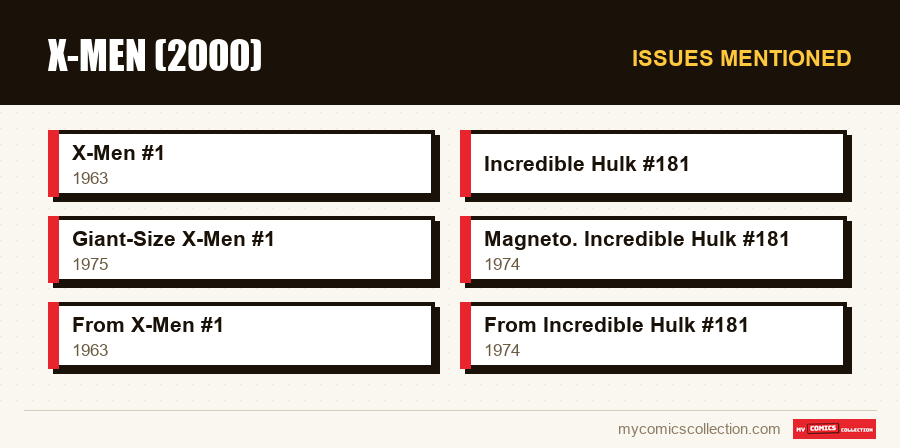
X-Men #1 (1963): 1st appearance of the X-Men and Magneto (Lee & Kirby)
Incredible Hulk #181 (1974): Wolverine's first full appearance
Giant-Size X-Men #1 (1975): the new team (Tornado…)
The theme of difference: mutants rejected by humanity
- Le theme of difference and the rejection of mutants.
- The opposition Xavier / Magneto, two visions of mutant combat.
- Wolverine, his claws and his mysterious past.
- The school of Xavier and his team (Tornado, Cyclops, Jean).
- La Brotherhood of Evil Mutants by Magneto.
- THE black leather suits, far from the colorful outfits of the comics.
- Malicia rejuvenated and deprived of his powers of flight and strength.
- L'plot (the machine to mutate humans) is original.
- Wolverine becomes the entry point of the story.
- The team is tight compared to comics.
X-Men #1 (1963): The Rise of Mutants
The X-Men appear in X-Men #1 (1963), created by Stan Lee and Jack Kirby. This seminal issue suddenly introduces Cyclops, Jean Gray (then Marvel Girl), the Beast, Iceberg, the Angel, their mentor Professor Charles Xavier, and their enemy Magneto. The concept is revolutionary: adolescents born with powers, “mutants” rejected and feared by humanity, trained by Xavier to protect a world that hates them. This metaphor of difference (applied over the decades to racism, homophobia, all forms of exclusion) has made the X-Men one of Marvel's richest and most political franchises.
Bryan Singer's film captures this thematic heart beautifully. The opening, which shows a young Magneto in a concentration camp, immediately anchors the story in the history of persecution. The opposition between Xavier, who advocates coexistence, and Magneto, convinced that a confrontation is inevitable, faithfully reproduces the central dilemma of the comics. This fidelity to the spirit (difference, tolerance, fear of others) is the great success of the film. However, he modifies many details, starting with the appearance of the heroes, swapping the colorful costumes from the comics for more realistic black leather outfits.
Wolverine, entry point to the story
The film makes Wolverine its central character, the point of view through which the viewer discovers the mutant universe. In the comics, Wolverine first appeared in Incredible Hulk #181 (1974), created by Len Wein and Herb Trimpe, before joining the X-Men in Giant-Size X-Men #1 (1975). Featuring an adamantium skeleton and claws, a healing factor, and an amnesiac past, he became the most popular member of the team. The film respects the essentials of the character (the claws, the savagery, the mystery of his origins, his solitary temperament) and the incarnation of Hugh Jackman has become iconic, to the point of defining the role for a generation.
This choice to center the film on Wolverine, rather than on Cyclops or Xavier, is strategic: the character, foreign to the team, allows the viewer to discover the school and the mutants with a fresh perspective. This prominent place, greater than in the first comics where Wolverine was just one member among others, reflects his popularity acquired over the decades. The film thus establishes Wolverine's star status, while remaining faithful to his nature as a lone wolf with a big heart. His emerging relationship with Malicia, a young mutant on the run, gives the story its emotional axis.
Xavier and Magneto, two visions of mutant combat
The ideological heart of the film, like the comics, lies in the opposition between Professor Xavier and Magneto. Both super-powerful mutants (one a telepath, the other a master of magnetism) they share the same observation, the hatred of humanity towards their own, but draw opposite conclusions. Xavier believes in peaceful coexistence and education; Magneto, scarred by the Holocaust, is convinced that mutants must strike before being exterminated. This duality, embodied with masterful gravity by Patrick Stewart and Ian McKellen, faithfully takes up one of the richest philosophical confrontations in comics.
This relationship, made of respect and deep disagreement, escapes the usual Manichaeism of superhero films. Magneto is not a gratuitous villain: he is the dark mirror of Xavier, a man whose extreme beliefs are born from real suffering. The film honors this complexity, making their opposition the common thread of the entire saga. Its main freedom concerns the plot: Magneto's machine intended to mutate the leaders of the world is an invention of the film, with no direct equivalent in the comics. But it serves the purpose: imposing the mutation to prove a point -, faithful to the logic of the character.
Collecting this series?
Track what you own, what you are missing and what your collection is worth. 7 day trial.
Start my trial →The characters, from paper to screen
- Wolverine: Clawed mutant with a mysterious past, entry point to the story, faithful to Incredible Hulk #181.
- Professor Xavier: Telepath and mentor, apostle of coexistence, faithful to X-Men #1.
- Magneto: Master of magnetism, marked by the Shoah, dark mirror of Xavier.
- Malicia: Young rejuvenated mutant, deprived of her powers of flight and strength from the comics.
- Tornado, Cyclops, Jean Gray: Xavier's team, faithful to the spirit of the comics.
Costumes and visual freedoms
The most commented on freedom of the film concerns the appearance of the heroes. In the comics, the X-Men wear colorful and flashy costumes, emblematic of the superheroic genre. The film swaps these outfits for uniform black leather suits, more sober and “realistic”. This choice, motivated by a concern for credibility at the turn of the 2000s, was justified in the film by a line that became famous, gently mocking the yellow costumes in the comics. It reflects a desire to anchor mutants in a plausible universe, even if it means sacrificing the flamboyant visuals of the comic strip.
This aesthetic sobriety reflects the film's general approach: treating superheroes seriously, as dramatic characters rather than colorful figures. This orientation, innovative at the time, profoundly influenced superhero cinema in the following years. However, it moves away from the visual identity of comics, where bright colors are part of the DNA of the genre. For the reader, it is a reminder that adaptation always involves choices: the film favors dramatic realism, where the comics assume graphic spectacle. Both approaches have their coherence, and their audience.
A founding film for the genre
X-Men occupies a crucial place in the history of superhero cinema. Released in 2000, two years before Raimi's Spider-Man, it proved that a serious and adult adaptation of comics could reach a wide audience. Its success revived an entire genre, paving the way for the surge of superhero films of the 21st century. By treating its mutants as complex characters, carrying a reflection on tolerance, the film showed that these stories could have depth and social resonance. He thus helped to legitimize the adaptation of comics to cinema.
For readers, the film was a gateway to the abundant universe of the X-Men. Many discovered, after seeing it, the great stories of Chris Claremont, the golden age of the franchise, the richness of its characters. The film thus played a role as a conduit, connecting the general public to decades of comics. This circulation between screen and paper illustrates the best of what an adaptation can offer: not replacing its source, but making you want to discover it. X-Men launched a nearly twenty-year cinematic saga, while reviving interest in the original comics.
Where to start reading
To extend the film, X-Men #1 (1963) features the birth of mutants and Magneto. Incredible Hulk #181 (1974) marks the first appearance of Wolverine, and Giant-Size X-Men #1 (1975) the new international team. Chris Claremont's grand narratives, beginning in the late 1970s, defined the modern X-Men. This journey covers the sources of a film faithful to the spirit of mutants.
Chronology of comics to know
- 1963: X-Men #1: the first appearance of the X-Men and Magneto.
- 1974: Incredible Hulk #181: Wolverine's first full appearance.
- 1975: Giant-Size X-Men #1: The New Team (Tornado, Nightcrawler, Colossus).
Collection side: what numbers to aim for after the film
X-Men points to major keys. X-Men #1 (1963, first appearance of the mutants and Magneto) is one of the most sought-after keys to the Silver Age, a mainstay of any collection. Incredible Hulk #181 (1974, premiere of Wolverine) is a highly coveted key to the Bronze Age, driven by the popularity of the character. Giant-Size X-Men #1 (1975, new team) is another major target. These numbers cover high budgets but remain pillars of the market. As always, condition and gradation determine value; relying on real recent sales is strongly recommended.
Its place in the saga and for the collector
X-Men launched the mutant saga in cinema by bringing the theme of difference to the screen with seriousness and ambition. For the collector, it permanently revived interest in X-Men #1 and Incredible Hulk #181, major keys. It illustrates the considerable effect of successful adaptations on the market. Beyond speculation, the film invites us to discover the founding stories of Lee, Kirby and Claremont, where mutants embody exclusion and tolerance. By treating his heroes with gravity, he redefined superhero cinema and revived interest in one of the richest universes in comics.
The verdict: a launch true to spirit
- Loyalty: the theme of difference, the Xavier/Magneto opposition, Wolverine and Xavier's team come from the comics.
- Freedoms: the black leather costumes, Malicia rejuvenated and depowered, the plot of the mutating machine, Wolverine as an entry point.
- Collectible numbers: X-Men #1 (mutants + Magneto), Incredible Hulk #181 (Wolverine), Giant-Size X-Men #1.
X-Men launches the mutant saga by bringing to the screen the theme of difference and the Xavier/Magneto opposition with remarkable fidelity of spirit, despite reinvented costumes and a plot. True to the heart of comics, the film redefined the genre. For both the reader and the collector, it is an invitation to discover X-Men #1 and Incredible Hulk #181.
Frequently asked questions
From X-Men #1 (1963), created by Stan Lee and Jack Kirby, which introduces Cyclops, Jean Grey, Beast, Iceberg, Angel, Professor Xavier and Magneto. The film faithfully takes up the theme of difference and the Xavier/Magneto opposition.
From Incredible Hulk #181 (1974), created by Len Wein and Herb Trimpe (after a cameo in #180). He joins the X-Men in Giant-Size X-Men #1 (1975). The film makes him its entry point, played by Hugh Jackman.
A choice by Bryan Singer to anchor the mutants in a realistic universe, contrary to the colorful costumes of the comics. The film even makes fun of it gently with a famous line. This sobriety marked the superhero cinema of the 2000s.
No: Magneto's machine intended to mutate world leaders is an invention of the film. However, it serves the character's purpose: imposing the mutation to prove a point -, faithful to his logic in the comics.
X-Men #1 (1963, Mutants + Magneto) and Incredible Hulk #181 (1974, Wolverine) are two major keys. Giant-Size X-Men #1 (1975, New Team) is another prime target.
Does the film make you want to collect? Estimate the value for free of your issues (X-Men #1, Incredible Hulk #181…) with our tool based on current eBay listings.