X2: X-Men United (2003) Bryan Singer is loosely inspired by the graphic novel “God Loves, Man Kills”(1982) by Chris Claremont and Brent Anderson, confronting the mutants with the fanatic William Stryker . The film introduces Diablo (Giant-Size X-Men #1, 1975) and pushes Xavier and Magneto into a forced alliance. Faithful to the theme of intolerance, he reinvents the plot. Here is the detailed comparison, film versus comics.
An acclaimed sequel to the first film, X2 delves deeper into the theme of mutant persecution by drawing on one of the X-Men's most political stories. It draws on a cult graphic novel and the world of Claremont. Source-by-source decryption.
As in each article in this series, only verified information (creators, distribution, dates, comic numbers) is stated; the comparative analysis is ours, without reproducing dialogue or protected images.
Title : X2: X-Men United (2003)
Director: Bryan Singer
Actors: Hugh Jackman, Patrick Stewart, Ian McKellen, Alan Cumming (Diablo), Brian Cox (William Stryker)
Exit : May 2003
Studio: 20th Century Fox
“God Loves, Man Kills”(1982): Claremont & Anderson
William Stryker: the anti-mutant fanatic
Giant-Size X-Men #1 (1975): Diablo's first appearance
The theme of intolerance: mutants persecuted in the name of a crusade
- William Stryker, fanatical anti-mutant crusader.
- The theme of intolerance and “holy” hatred.
- L'forced alliance between the X-Men and Magneto.
- Diablo, Catholic mutant and teleporter.
- The manipulation of Xavier against his own.
- Stryker becomes a soldier, not a televangelist.
- The plot is largely reinvented around a military base.
- Le sacrifice of Jean Gray announces the Phoenix, addition of the film.
- Diablo is manipulated to attack the president.
- Lady Deathstrike and Wolverine's past are expanded upon.
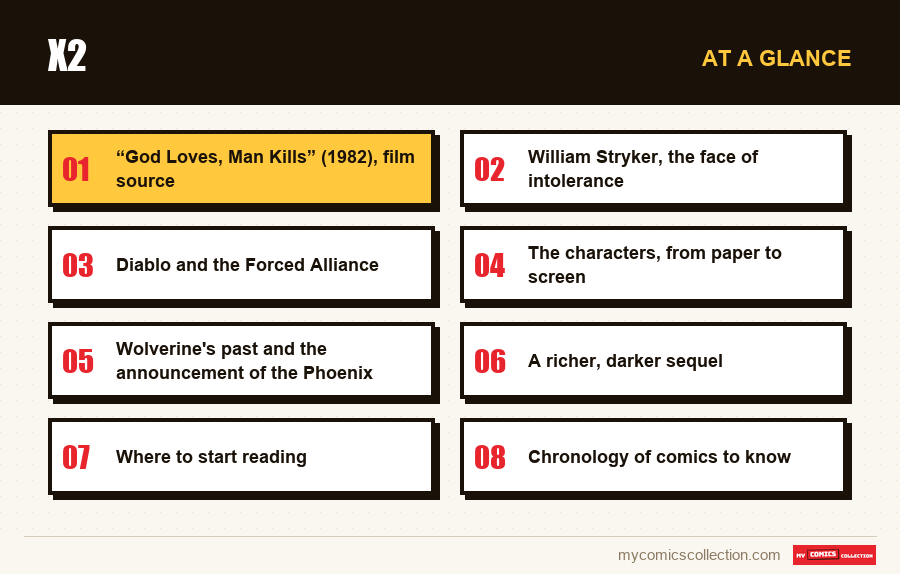
“God Loves, Man Kills” (1982), film source
X2 is inspired by "God Loves, Man Kills" (1982), a graphic novel by Chris Claremont and Brent Anderson, one of the most political and acclaimed X-Men stories. The story features Reverend William Stryker, a fanatical preacher who launches a "divine" crusade against mutants, whom he considers abominations in the eyes of God. This very dark story directly addresses religious fanaticism, intolerance and the dehumanization of others. He even pushes the X-Men to ally with Magneto in the face of a common threat, blurring the line between hero and villain. This is one of the peaks of the Claremont run.
The film takes Stryker's character and the central theme of intolerance, but largely reinvents the plot. The main change concerns Stryker himself: from a televangelist in the graphic novel, he becomes a scientist and soldier in the film, obsessed with eradicating mutants for personal reasons: his own son is a mutant. This rereading shifts the subject from religious fanaticism to institutional and military hatred. The film nevertheless retains the essence of the source: a man convinced of serving a just cause by exterminating a minority, and mutants forced to unite across their divisions.
William Stryker, the face of intolerance
William Stryker embodies, in the film as in the graphic novel, the most insidious threat to mutants: not a supervillain with extraordinary powers, but an ordinary man driven by hatred and moral certainty. This figure of the “respectable” persecutor, convinced of acting for good, gives the story its political force. Brian Cox plays a chilling, methodical Stryker, whose military fanaticism echoes security excesses. By taking up this character, the film anchors X2 in the most committed vein of the X-Men, the one which makes the mutant metaphor a mirror of real persecutions.
The modification of the character, from preacher to soldier, reflects an adaptation to the context of the early 2000s. Where the 1982 graphic novel targeted religious fanaticism and televangelists, the film shifts the threat towards the military and scientific apparatus. This rereading, while moving away from the letter, retains its spirit: the persecution of a minority by those who hold power. The film adds a personal dimension by making Stryker the father of a mutant he sought to "cure", deepening the tragedy. This invention enriches the character while serving the theme of the source.
Diablo and the Forced Alliance
X2 introduces Diablo (Nightcrawler), a mutant who appeared in Giant-Size X-Men #1 (1975). A teleporter with a demonic appearance (blue skin, tail, three fingers) Diablo is also, in the comics, a devout Catholic, which creates a striking contrast between his physique and his faith. The film opens with a spectacular scene where Diablo, manipulated by Stryker, attacks the President of the United States. It faithfully reproduces the powers and appearance of the character, as well as his spiritual dimension, played with sensitivity by Alan Cumming. This character, whose physical difference is extreme, perfectly embodies the theme of acceptance dear to the X-Men.
The film also takes up, from “God Loves, Man Kills”, the idea of a forced alliance between the X-Men and Magneto against Stryker. This collaboration between enemies, one of the most interesting springs of the source, blurs moral boundaries and reminds us that the real threat to mutants is sometimes humanity itself. Magneto, by temporarily uniting with Xavier, demonstrates that their disagreement is over the means, not the cause. This alliance, faithful to the graphic novel, offers the film some of its richest scenes, while preparing for the inevitable betrayal of the master of magnetism.
Collecting this series?
Track what you own, what you are missing and what your collection is worth. 7 day trial.
Start my trial →The characters, from paper to screen
- William Stryker: Anti-mutant fanatic, transformed from televangelist to military, faithful to “God Loves, Man Kills”.
- Diablo: Demonic-looking Catholic teleporter, faithful to Giant-Size X-Men #1.
- Wolverine: Whose past (adamantium, Stryker) is developed.
- Jean Gray: Whose sacrifice announces the Phoenix, addition to the film.
- Lady Deathstrike: Adversary with Adamantium Claws, linked to the Weapon X project.
Wolverine's past and the announcement of the Phoenix
X2 delves deeper into two narrative threads that will mark the saga. First, Wolverine's past: the film connects Stryker to the military program that endowed the mutant with his adamantium skeleton, beginning the exploration of his origins that will culminate in later films. This connection, which draws on the mythology of “Weapon X” from the comics, adds a personal dimension to the confrontation with Stryker. Lady Deathstrike, an adversary with similar claws, embodies the dark side of this experiment. These elements, developed for the film, are based on comic book stories exploring Wolverine's traumatic past.
Next, the sacrifice of Jean Grey. At the end of the film, Jean sacrifices himself to save his companions, deploying unprecedented telekinetic power before disappearing under the water. This scene, an addition to the film, announces his transformation into Phoenix, preparing for the third part. It echoes the Phoenix saga of the comics, one of the most famous stories of the X-Men, without yet directly adapting it. This clever implementation illustrates the way in which the film weaves continuity between its parts. For the reader, it is an invitation to discover the Phoenix saga, of which X2 sows the first seeds here.
A richer, darker sequel
X2 is often considered superior to the first film, for its thematic richness and scope. Inspired by “God Loves, Man Kills”, he anchors the saga in its most political vein, that which makes mutants a metaphor for persecuted minorities. The film addresses intolerance, the fear of others, the temptation of eradication, with rare gravity. It also deepens its characters, from Wolverine to Diablo, and complicates the relationships between heroes and villains. This maturity made X2 a reference, confirming that superhero films could have a substantive message.
This success illustrates the potential of the X-Men in cinema: a franchise capable of mixing spectacle and reflection, action and commitment. By tapping into one of Claremont's strongest narratives, the film honors the mutants' political legacy. For the reader, X2 is an invitation to discover “God Loves, Man Kills”, a graphic novel whose power even exceeds that of the film. He reminds us that the X-Men, under their superhero guise, have always been a vehicle for questioning our relationship to difference and exclusion. X2 brings this dimension to the screen with acclaimed success.
Where to start reading
To extend the film, “God Loves, Man Kills” (1982), by Claremont and Anderson, is the direct source and one of the pinnacles of the X-Men, a must-read. Giant-Size X-Men #1 (1975) introduces Diablo. Claremont's tall tales of the X-Men develop the theme of persecution. This journey covers the sources of a film faithful to the committed spirit of mutants.
Chronology of comics to know
- 1975: Giant-Size X-Men #1: Diablo's first appearance.
- 1982: “God Loves, Man Kills”: the graphic novel that inspires the film.
- 1980s: Claremont's run deepens the theme of intolerance.
Collection side: what numbers to aim for after the film
X2 points to Bronze Age keys. Giant-Size X-Men #1 (1975, first appearance of Diablo, Tornado and Colossus) is a major issue, one of the most sought after in the franchise. The graphic novel “God Loves, Man Kills”(1982) is essential reading, available in many editions. The Claremont run numbers offer other targets to delve deeper into the universe. These targets cover various budgets. As always, condition and gradation determine value; relying on real recent sales is strongly recommended.
Its place in the saga and for the collector
X2 delved deeper into the mutant saga, drawing inspiration from its most political story, “God Loves, Man Kills.” For the collector, it highlighted Giant-Size X-Men #1 and the Claremont graphic novel. It illustrates the effect of adaptations on the market. Beyond speculation, the film invites us to discover the committed vein of the X-Men, where the mutant metaphor questions intolerance and fanaticism. By bringing Stryker and the forced alliance with Magneto to the screen, he honors one of the peaks of Claremont, while preparing the Phoenix saga. This is one of the richest parts of the franchise.
The verdict: a sequel faithful to the committed spirit
- Loyalty: William Stryker, the theme of intolerance, the forced alliance with Magneto and Diablo come from the comics.
- Freedoms: Stryker military and not televangelist, the plot reinvented, the sacrifice of Jean announcing the Phoenix, Lady Deathstrike.
- Collectible numbers: Giant-Size X-Men #1 (Diablo), “God Loves, Man Kills” (1982).
X2 deepens the saga by drawing inspiration from "God Loves, Man Kills", one of the most political stories of the X-Men, by confronting the mutants with the fanatic Stryker. Faithful to the theme of intolerance and the forced alliance with Magneto, the film reinvents the plot and announces the Phoenix. For the reader as well as the collector, it is an invitation to discover “God Loves, Man Kills” and Giant-Size
Frequently asked questions
From the graphic novel "God Loves, Man Kills" (1982), by Chris Claremont and Brent Anderson, where fanatic William Stryker launches a crusade against mutants. The film takes up the character and the theme, while reinventing the plot.
In "God Loves, Man Kills", he is a fanatical televangelist. The film transforms him into a scientist and soldier, obsessed with eradicating mutants, including his own son. The theme of “holy” intolerance is retained.
Nightcrawler, teleporting mutant with demonic appearance and Catholic faith, appeared in Giant-Size X-Men #1 (1975). The film opens with his manipulated attack on the president, and respects his appearance and spirituality.
The final scene is an addition to the film, but it foreshadows the Phoenix Saga, one of the X-Men's most famous stories. X2 sows the seeds of Jean's transformation, developed in the following part.
Giant-Size X-Men #1 (1975, Diablo premiere) is a major key. The graphic novel “God Loves, Man Kills” (1982) is a must-read, the source material for the film.
Does the film make you want to collect? Estimate the value for free of your issues (Giant-Size X-Men #1…) with our tool based on current eBay listings.