X-Men: The Last Stand (2006) Brett Ratner freely adapts two major stories: the Saga of the Dark Phoenix (Uncanny X-Men #129-138, 1980) by Claremont and Byrne, and the anti-mutant "cure" plot (inspired by "Astonishing X-Men", 2004). The film transforms Jean Gray into Phoenix and depicts a heartbreaking choice, but simplifies the cosmic dimension and takes great liberties. Here is the detailed comparison, film versus comics.
Conclusion of the first X-Men trilogy, The Last Stand aims to adapt one of the greatest mutant stories. It draws from the Saga of the Dark Phoenix and the idea of a cure for mutation. Source-by-source decryption.
As in each article in this series, only verified information (creators, distribution, dates, comic numbers) is stated; the comparative analysis is ours, without reproducing dialogue or protected images.
Title : X-Men: The Last Stand (2006)
Director: Brett Ratner
Actors: Hugh Jackman, Patrick Stewart, Ian McKellen, Famke Janssen (Jean / Phoenix), Halle Berry, Kelsey Grammer (the Beast)
Exit : May 2006
Studio: 20th Century Fox
Uncanny X-Men #129-138 (1980). The Dark Phoenix Saga
Uncanny X-Men #101 (1976): 1st appearance of the Phoenix
“Astonishing X-Men”: Gifted (2004): the mutant “cure”
The Beast: historical member and mutant diplomat
- The transformation of Jean Gray as Phoenix, devastating power.
- Le dilemma of those who love Jean in the face of his drift.
- The idea of a " remedy " able to suppress the mutation.
- Le Fawn, historical member and diplomatic figure.
- The question: heal or accept your difference?
- The Phoenix becomes a repressed personality, not a cosmic force.
- No Shi'ar nor the spatial dimension of the original saga.
- Two stories (Phoenix + remedy) are merged.
- Many characters die or are disempowered.
- The plot is condensed and tightened on Earth.
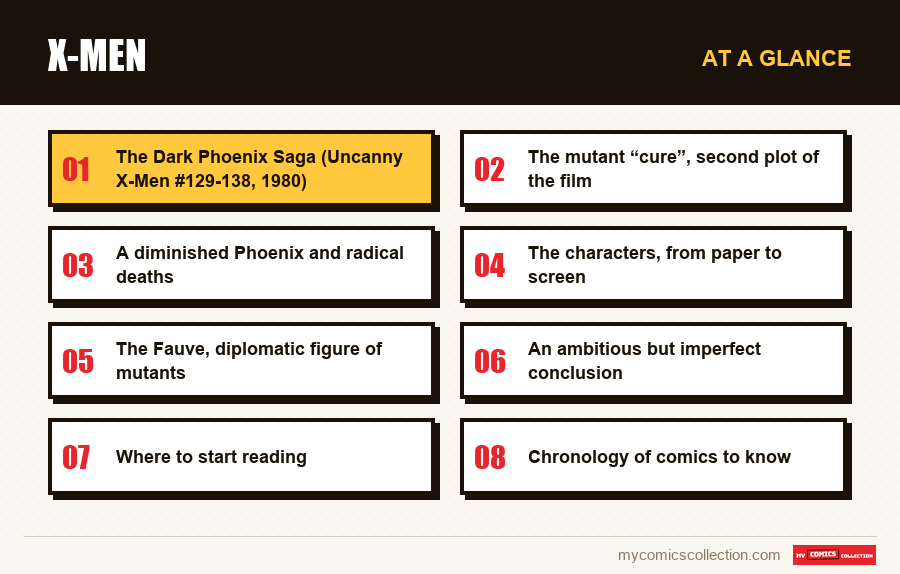
The Dark Phoenix Saga (Uncanny X-Men #129-138, 1980)
The primary source material for the film is the Dark Phoenix Saga, published in Uncanny X-Men #129-138 (1980) by Chris Claremont and John Byrne, considered one of the greatest stories in comic book history. Jean Grey, already linked to the cosmic entity of the Phoenix (appeared in Uncanny After devouring a star and causing the death of billions of beings, Jean, horrified by her own actions, sacrifices herself to prevent the Phoenix from causing harm again. This tragic and cosmic story shocked readers and redefined the X-Men.
The film takes up the heart of the drama (Jean transformed into an uncontrollable power, the heartbreak of those who love her, the final sacrifice) but radically simplifies its dimension. Where the comics unfold a cosmic fresco involving the alien Shi'ar empire and a galactic trial, the film anchors everything on Earth. The Phoenix is no longer a distinct cosmic entity, but a second repressed personality of Jean, released after his “death” in X2. This psychological rereading, more intimate, moves away from the mythological grandeur of the original saga, but retains its emotional stake: the loved one becomes a threat.
The mutant “cure”, second plot of the film
The film merges the Dark Phoenix Saga with a second plot: the discovery of a “cure” capable of suppressing the mutant gene. This idea is inspired by the “Gifted” arc of the “Astonishing X-Men” series (2004), by Joss Whedon and John Cassaday, where a laboratory develops an anti-mutant treatment. This intrigue raises a deep and heartbreaking question: is mutation a disease to be cured or an identity to be assumed? For some mutants with crippling powers, the cure is liberation; for others, it is a negation of who they are, an attempt to erase their difference. This debate, at the heart of the mutant metaphor, gives the film its thematic richness.
By combining these two stories, the film seeks to conclude its trilogy on strong issues. The cure divides the mutant community and reignites the conflict between Xavier and Magneto: the first sees it as a personal choice, the second as a weapon of genocide. This plot, faithful to the spirit of “Gifted”, enriches the discussion on identity and acceptance. Its merger with the Phoenix Saga, on the other hand, overloads the narrative: two major stories, each deserving of its own film, compete for space. This density, combined with radical scriptwriting choices, explains the more mixed reception of this third part.
A diminished Phoenix and radical deaths
The main criticism leveled at the film concerns its treatment of the Phoenix. By reducing him to a repressed personality rather than a cosmic entity, the film deprives the character of his mythological dimension. The Phoenix of the comics is a primordial force of the universe, an almost divine power; that of the film is a psychological threat, certainly spectacular, but lacking the galactic scale of the source. This simplification, dictated by the constraints of the earthly story, disappoints readers attached to the grandeur of the saga. Famke Janssen nevertheless plays a worrying Phoenix, whose power and instability remain impressive.
The film is also distinguished by its radical choices: several major characters die or lose their powers, in a desire to make an impact and conclude the trilogy. These brutal decisions divided fans, with some seeing it as audacity, others as a waste of beloved characters. They demonstrate the film's desire to offer a definitive ending, even if it means sacrificing central figures. For the reader, these deaths contrast with the comics, where the characters, notably Jean Grey, experience cyclical deaths and resurrections. The film assumes a purpose that the comic strip, by nature, never quite imposes.
Collecting this series?
Track what you own, what you are missing and what your collection is worth. 7 day trial.
Start my trial →The characters, from paper to screen
- Jean Gray / the Phoenix: Transformed into a devastating power, but reduced to a repressed personality.
- The Beast: Historical member and mutant diplomat, played by Kelsey Grammer, faithful to the spirit of the character.
- Magneto: Opposed to the remedy, which he sees as a weapon of genocide.
- Xavier: Faced with the dilemma of the Phoenix and Jean's control.
- Wolverine: Torn between his love for Jean and the need to stop him.
The Fauve, diplomatic figure of mutants
The film introduces the Beast (Hank McCoy) in his adult role as a diplomat. A founding member of the The film presents him as Secretary of Mutant Affairs, bridge between the government and the mutant community, a role faithful to his dimension as a man of dialogue. Kelsey Grammer lends him a lauded elegance and gravitas, capturing the essence of the character.
The Fauve perfectly illustrates the central theme of the film: the relationship with one's own difference. Forced to choose between assuming his bestial appearance or taking the remedy that would restore him to human form, he embodies the dilemma at the heart of the story. Its trajectory, between shame and acceptance, resonates with the mutant question. This character, long under-exploited in previous films, finds pride of place here. For the reader, it is an invitation to discover one of the most endearing members of the X-Men, whose story, from gifted young person to bestial scientist, runs through the entire mythology of comics.
An ambitious but imperfect conclusion
The Last Stand aimed to conclude the trilogy by adapting two of the greatest X-Men stories. This laudable ambition came up against the difficulty of condensing such rich material. The Dark Phoenix Saga and the cure arc each deserved their own film; their merger, combined with a change of director and radical choices, produced a more contested part than its predecessors. The film nonetheless retains strong moments, carried by its actors and the power of its themes. It illustrates the perils of adaptation: wanting to embrace everything can harm coherence.
This mixed reception does not detract from the richness of the stories that inspire it. Quite the contrary: the limits of the film recall the grandeur of the Black Phoenix Saga, a masterpiece whose cosmic scale and tragic depth remain unmatched. For the reader, The Last Stand is an invitation to discover the source, where the destiny of Jean Gray plays out on the scale of the universe, and where the dilemma of the cure questions mutant identity with an acuteness that the film only touches on. The comic strip, once again, reveals all the richness that the screen must have condensed.
Where to start reading
To extend the film, the Dark Phoenix Saga (Uncanny X-Men #129-138, 1980), by Claremont and Byrne, is the major source and a pinnacle of comics. Uncanny X-Men #101 (1976) marks the first appearance of the Phoenix. The “Gifted” arc of “Astonishing X-Men” (2004), by Whedon and Cassaday, develops the cure. This journey covers the sources of a film which merges two cult stories.
Chronology of comics to know
- 1976: Uncanny X-Men #101: the first appearance of the Phoenix.
- 1980: Uncanny X-Men #129-138: The Dark Phoenix Saga.
- 2004: “Astonishing X-Men”: Gifted: The Mutant “Cure” Arc.
Collection side: what numbers to aim for after the film
The Last Stand points to major keys to the Bronze Age. Uncanny X-Men #101 (1976, first appearance of the Phoenix) is a highly sought-after issue, important to the mythology of Jean Grey. The numbers of the Saga of the Dark Phoenix (#129-138, 1980) are prime targets, particularly those marking key moments in the story. The “Gifted” arc of “Astonishing X-Men” (2004) offers more accessible modern targets. These numbers cover various budgets. As always, condition and gradation determine value; relying on real recent sales is strongly recommended.
Its place in the saga and for the collector
The Last Stand concluded the first trilogy by adapting, not without difficulty, two cult X-Men stories. For the collector, it highlighted the Dark Phoenix Saga and Uncanny X-Men #101, major keys. It illustrates the effect of adaptations on the market. Beyond speculation, the film invites you to discover the Saga of the Black Phoenix, a cosmic and tragic masterpiece, as well as the debate on the mutant “cure”. By merging these stories, he gives a condensed version, but recalls their power. It’s a gateway to two peaks in mutant comics.
The verdict: two condensed cult sagas
- Loyalty: Jean's transformation into a Phoenix, the loved ones' dilemma, the idea of the cure and the Beast come from the comics.
- Freedoms: the Phoenix reduced to a repressed personality, the absence of the Shi'ar, the fusion of the two stories, the radical deaths.
- Collectible numbers: Uncanny X-Men #101 (Phoenix), The Dark Phoenix Saga (#129-138), “Astonishing X-Men: Gifted”.
X-Men: The Last Stand aims to adapt the Dark Phoenix Saga and the cure arc, but their fusion and radical choices make it the most contested part of the trilogy. Faithful to Jean's drama and the dilemma of mutant identity, the film simplifies its cosmic dimension. For both the reader and the collector, it is an invitation to discover the Dark Phoenix Saga and Uncanny X-Men #101.
Frequently asked questions
The Phoenix appears in Uncanny X-Men #101 (1976), and the Dark Phoenix Saga takes place in Uncanny X-Men #129-138 (1980), by Claremont and Byrne. The film takes up Jean's transformation, but reduces its cosmic dimension.
No: the film makes her a second repressed personality of Jean Grey, released after her “death” in X2. In the comics, the Phoenix is a primordial cosmic force, involving the Shi'ar Empire, absent from the film.
From the “Gifted” arc of “Astonishing X-Men” (2004), by Joss Whedon and John Cassaday, where a laboratory creates an anti-mutant treatment. The film merges it with the Phoenix Saga, asking the question: to heal or to accept one's difference?
For having merged two cult stories: each deserving its own film:, reduced the cosmic dimension of the Phoenix, and multiplied the deaths and loss of powers of beloved characters. These radical choices divided fans.
Uncanny X-Men #101 (1976, Phoenix premiere) is a major key. The issues of the Black Phoenix Saga (#129-138, 1980) are other prime targets for Jean Gray fans.
Does the film make you want to collect? Estimate the value for free of your issues (Uncanny X-Men #101, #129-138…) with our tool based on current eBay listings.