
Dark Phoenix (2019) Simon Kinberg adapt it a second time Saga of the Dark Phoenix (Uncanny X-Men #129-138, 1980) by Chris Claremont and John Byrne, this time restoring its cosmic dimension: Jean Gray absorbs a stellar force which transforms it into a Phoenix. The film takes up the drama of Jean's corruption and the involvement of extraterrestrials, but largely condenses and reinvents the narrative. Here is the detailed comparison, film versus comics.
Final part of the prequel saga, Dark Phoenix once again attempts to adapt the most famous story of the X-Men, after a first approach in The Last Stand. It draws from Claremont and Byrne's masterpiece. Source-by-source decryption.
As in each article in this series, only verified information (creators, distribution, dates, comic numbers) is stated; the comparative analysis is ours, without reproducing dialogue or protected images.
Title : Dark Phoenix (2019)
Director: Simon Kinberg
Actors: Sophie Turner (Jean Grey/Phoenix), James McAvoy, Michael Fassbender, Jennifer Lawrence, Jessica Chastain
Exit : June 2019
Studio: 20th Century Fox
Uncanny X-Men #129-138 (1980). The Dark Phoenix Saga
Uncanny X-Men #101 (1976): 1st appearance of the Phoenix
The cosmic force of the Phoenix: a stellar entity
The D'Bari: the aliens linked to the story
- La cosmic force of the Phoenix, stellar entity.
- La corruption of Jean Gray by this power.
- Le drama of those close to him in the face of his drift.
- The involvement of aliens (the D’Bari).
- Le sacrifice as a tragic outcome.
- No Club of the Damned nor manipulation by Mastermind.
- THE D'Bari become invaders, not victims.
- The story is condensed and anchored in the 1990s.
- No Shi'ar trial nor a complete galactic dimension.
- Le role of Xavier in Jean's psyche is reinvented.
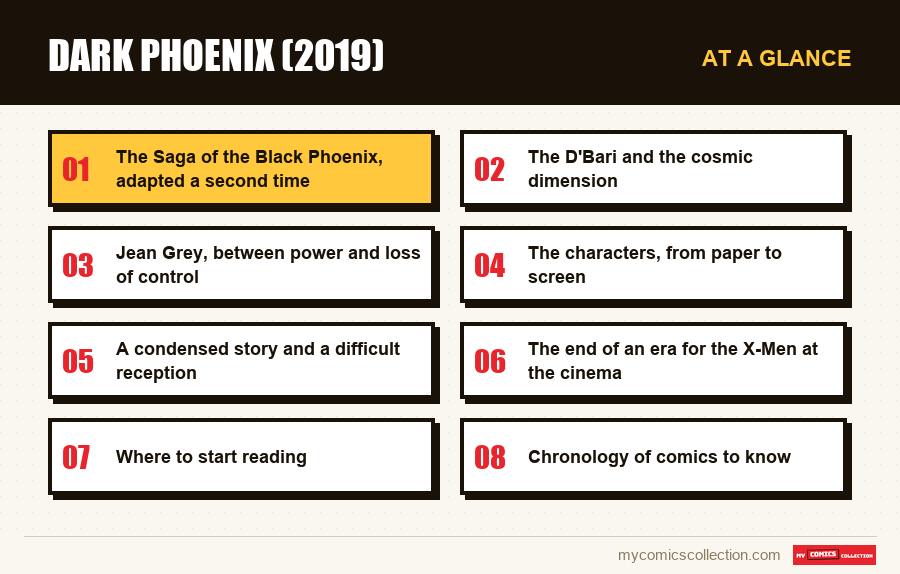
The Saga of the Black Phoenix, adapted a second time
Dark Phoenix tackles, like The Last Stand thirteen years earlier, the Saga of the Dark Phoenix (Uncanny X-Men #129-138, 1980), one of the greatest stories in comics, signed Chris Claremont and John Byrne. The story tells how Jean Grey, linked to the cosmic entity of the Phoenix (appeared in Uncanny X-Men #101, 1976), sees her power corrupted until she becomes the Dark Phoenix, a force of destruction capable of annihilating worlds. After devouring a star and causing the death of billions of beings, Jean, horrified, sacrifices herself. This story, of unparalleled cosmic scope and tragic depth, redefined the X-Men and marked the history of the medium.
Where The Last Stand had reduced the Phoenix to a repressed personality, Dark Phoenix attempts to restore its cosmic dimension: Jean absorbs a stellar force during a space mission, which triggers her transformation. This choice brings the film closer to the source, by making the Phoenix a real entity from space. The film retains the central drama (Jean transformed into a threat, the heartbreak of those close to her, the sacrifice) and involves aliens, a distant echo of the galactic dimension of the saga. However, he radically condenses the story, sacrificing many elements to fit into a single film.
The D'Bari and the cosmic dimension
The film introduces the D'Bari, an alien race from the comics, but profoundly modifies their role. In the Dark Phoenix Saga, the D'Bari are the victims of the Phoenix: Jean, under the influence of the entity, destroys their star, causing the death of billions of them: an act which triggers the galactic trial led by the Shi'ar empire. The film transforms the D'Bari into invaders who seek to seize the force of the Phoenix to dominate the Earth, led by a figure played by Jessica Chastain. This inversion-from victims to aggressors-moves considerably from the source, while maintaining an extraterrestrial connection to the story.
This modification illustrates the difficulty of adapting the cosmic dimension of the saga. The comics unfold a galactic fresco involving the Shi'ar empire, a celestial trial and issues on a universe scale. The film, constrained by its format and its terrestrial anchoring, cannot reproduce this magnitude. It therefore reduces the extraterrestrial component to a more classic threat of invasion. For the reader, it is a reminder of the richness of the source: the Saga of the Black Phoenix is not only the drama of Jean, but a cosmic epic whose scope far exceeds what two successive adaptations were able to bring to the screen.
Jean Grey, between power and loss of control
At the heart of the film, like the comics, is the tragedy of Jean Grey. The Phoenix increases her telepathic and telekinetic powers to uncontrollable levels, making her both the most powerful being on Earth and a threat to everyone she loves. This shift (the heroine becoming danger, the friend transformed into an enemy in spite of herself) is the central dramatic spring. Sophie Turner plays a torn Jean, terrified of her own power. The film explores the loss of control, guilt and the quest for identity of a character overwhelmed by a force beyond him.
The film adds a personal dimension by revisiting Jean's past and the role of Xavier in his psyche: the professor would have sealed certain traumatic memories from his childhood, a manipulation which fuels Jean's anger once the Phoenix awakens. This rereading, specific to the film, seeks to give psychological depth to the drama, by questioning the limits of paternalistic protection. It moves away from the comics, where Jean's corruption is the work of the Damned Club and Mastermind. But it retains the essential: Jean as the victim of a power and manipulations that exceed her, until the final sacrifice.
Collecting this series?
Track what you own, what you are missing and what your collection is worth. 7 day trial.
Start my trial →The characters, from paper to screen
- Jean Gray / the Phoenix: Corrupted by a cosmic force, faithful to the drama of the saga despite a reinvented story.
- Xavier: Whose role in Jean's psyche is reinvented, a source of tension.
- Magneto: Involved in tracking down Jean, true to his ambivalent nature.
- The head of the D'Bari: Extraterrestrial coveting the strength of the Phoenix, role reversed compared to the comics.
- Cyclops and the X-Men: Torn between their love for Jean and the need to stop him.
A condensed story and a difficult reception
Dark Phoenix had a difficult reception, both from critics and the public. By seeking to adapt, in a single film, a saga of considerable richness and scope, the film encountered the same pitfalls as The Last Stand: the condensation of a story which, in the comics, unfolds over numerous issues and on the scale of the universe. Despite the desire to restore the cosmic dimension of the Phoenix, the film struggles to convey the tragic depth and galactic scale of the source. Its troubled production and late release, as the franchise neared its end, took a toll on its reception.
This relative failure illustrates the difficulty of adapting the Saga of the Black Phoenix, a masterpiece whose power lies as much in its cosmic scale as in its intimate drama. Two cinematographic attempts have failed to capture its full grandeur, proof of the exceptional richness of the original story. For the reader, Dark Phoenix is an invitation to discover the source, where the destiny of Jean Gray plays out on the scale of the universe, in one of the absolute peaks of comics. The comic strip, once again, reveals a depth that the screen, despite its efforts, could only suggest.
The end of an era for the X-Men at the cinema
Dark Phoenix occupies a special place in the history of superhero cinema: it is the last film in the X-Men saga produced by Fox, before the studio was bought out and the mutants were integrated into a larger whole. This involuntary concluding position weighs on the film and its reception. After nearly twenty years and a dozen films, the mutant franchise ends with this installment, closing a major chapter in superhero cinema. This end-of-cycle context, marked by difficult production and low expectations, harmed the reception of the film, perceived as a half-hearted endpoint rather than an apotheosis.
This conclusion recalls the path traveled since the first X-Men in 2000, which launched the modern wave of comic book adaptations. The mutant saga will, in two decades, have explored varied tones (from political drama to horror, from historical prequel to irreverent comedy) and brought to the screen dozens of characters and stories from the comics. Dark Phoenix, despite its limitations, is part of this legacy. For the reader, the end of this era is an opportunity to measure the lasting influence of the X-Men on popular culture, and to immerse themselves in the comics which, from the Dark Phoenix Saga to the most recent stories, continue to fuel the mutant imagination well beyond the cinema.
Where to start reading
To extend the film, the Dark Phoenix Saga (Uncanny X-Men #129-138, 1980), by Claremont and Byrne, is the major source and a pinnacle of comics. Uncanny X-Men #101 (1976) marks the first appearance of the Phoenix. The stories preceding the saga develop the relationship between Jean and the cosmic entity. This journey covers the sources of a film which attempts to restore the cosmic dimension of the story.
Chronology of comics to know
- 1976: Uncanny X-Men #101: the first appearance of the Phoenix.
- 1980: Uncanny X-Men #129-138: The Dark Phoenix Saga.
- 1980s: The stories developing the legacy of the Phoenix and Jean Grey.
Collection side: what numbers to aim for after the film
Dark Phoenix points to major keys to the Bronze Age. Uncanny X-Men #101 (1976, first appearance of the Phoenix) is a highly sought-after issue, essential to the mythology of Jean Grey. The numbers of the Saga of the Dark Phoenix (#129-138, 1980) are prime targets, particularly those marking key moments in the story. These issues cover varied budgets within the Bronze Age. As always, condition and gradation determine value; relying on real recent sales is strongly recommended.
Its place in the saga and for the collector
Dark Phoenix closed the franchise by attempting a second adaptation of the Dark Phoenix Saga, failing to capture its magnitude. For the collector, it once again highlighted Uncanny X-Men #101 and the original saga. It illustrates the effect of adaptations on the market, even in the event of failure. Beyond speculation, the film invites you to discover the Saga of the Black Phoenix, a cosmic and tragic masterpiece whose grandeur remains unrivaled. By confronting it a second time, he recalls the intact power of a story that comics took to a height that cinema was unable to reach.
The verdict: a cosmic saga difficult to bear
- Loyalty: the cosmic force of the Phoenix, the corruption of Jean, the drama of those close to him and the sacrifice come from the comics.
- Freedoms: the absence of the Club of the Damned, the D'Bari as invaders, the condensed story, the reinvented role of Xavier, no Shi'ar trial.
- Collectible numbers: Uncanny X-Men #101 (Phoenix), The Dark Phoenix Saga (#129-138).
Dark Phoenix adapts the Dark Phoenix Saga for a second time, restoring its cosmic dimension, but struggles to convey its galactic scale and tragic depth. Faithful to the drama of Jean and the stellar force of the Phoenix, the film condenses and reinvents the story. For both the reader and the collector, it is an invitation to discover the Dark Phoenix Saga and Uncanny X-Men #101.
Frequently asked questions
From the Saga of the Dark Phoenix (Uncanny X-Men #129-138, 1980), by Claremont and Byrne, where Jean Grey, linked to the Phoenix (appeared in Uncanny The film restores its cosmic dimension.
The Last Stand reduced the Phoenix to a repressed personality; Dark Phoenix restores her nature as a cosmic entity, with Jean absorbing a stellar force in space. A closer approach to the source, but still condensed.
An alien race from the comics. In the Black Phoenix Saga, they are the victims of the Phoenix (whose star is destroyed). The film transforms them into invaders coveting its strength, an inversion from the source.
Xavier's manipulation of Jean's memories is an invention of the film, which seeks to deepen the drama. In the comics, Jean's corruption is the work of the Club of the Damned and Mastermind, absent from the film.
Uncanny X-Men #101 (1976, Phoenix premiere) is a major key. The issues of the Black Phoenix Saga (#129-138, 1980) are other prime targets for Jean Gray fans.
Does the film make you want to collect? Estimate the value for free of your issues (Uncanny X-Men #101, #129-138…) with our tool based on current eBay listings.