
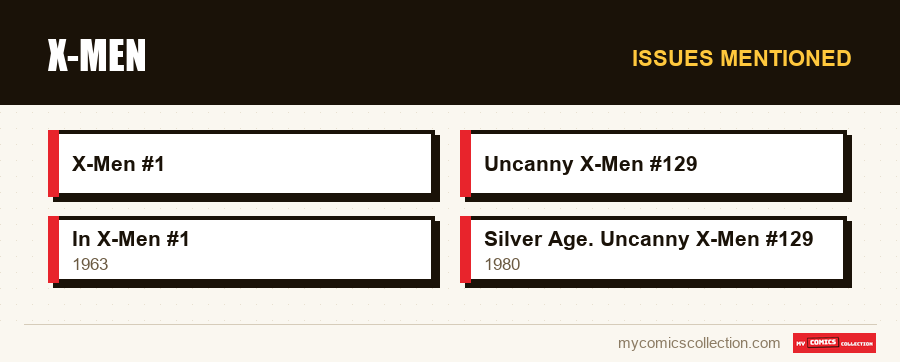
X-Men: First Class (2011) Matthew Vaughn tells the genesis of mutants in the 1960s, around the birth of friendship then the break between Charles Xavier and Magneto (X-Men #1, 1963). The film depicts the Club of the Damned (Uncanny X-Men #129-130, 1980) against the backdrop of the Cuban Missile Crisis. Faithful to the spirit of the characters, he freely reinvents the story of origins. Here is the detailed comparison, film versus comics.
A prequel that relaunches the saga, First Class explores the origins of the X-Men and the founding bond between Xavier and Magneto. It draws on mutant mythology and real history from the 20th century. Source-by-source decryption.
As in each article in this series, only verified information (creators, distribution, dates, comic numbers) is stated; the comparative analysis is ours, without reproducing dialogue or protected images.
Title : X-Men: First Class (2011)
Director: Matthew Vaughn
Actors: James McAvoy (Xavier), Michael Fassbender (Magneto), Jennifer Lawrence (Mystique), Kevin Bacon (Sebastian Shaw), January Jones (Emma Frost)
Exit : June 2011
Studio: 20th Century Fox
X-Men #1 (1963): the origins of Xavier and Magneto
Uncanny X-Men #129-130 (1980): Club of the Damned (Emma Frost, Shaw)
The Xavier/Magneto friendship: two visions of mutant combat
Mystique and the Beast: key figures of the mutants
- L'friendship then breakup between Xavier and Magneto.
- The past of Magneto, marked by the Shoah.
- Le Club of the Damned (Sebastian Shaw, Emma Frost).
- Mystical and the Fawn, key mutant figures.
- THE two philosophies of mutant combat.
- La first team differs from that of the comics (not Cyclops/Jean).
- The plot is linked to the Cuban missile crisis (1962).
- Mystical becomes a childhood friend of Xavier, an addition from the film.
- Le Club of the Damned is retooled as the main threat.
- Many original details are reinvented.
Xavier and Magneto: the genesis of a tragic friendship
The heart of the film is the birth of the relationship between Charles Xavier and Erik Lehnsherr (Magneto), before they became enemies. In the comics, from X-Men #1 (1963), the two men embody two opposing visions of mutant combat, but their common past and their friendship were only gradually developed. The film makes it the central subject: two young super-powered mutants, one an idealistic telepath, the other a Holocaust survivor consumed by vengeance, meet, bond, then separate over an irreconcilable difference. This broken friendship, the foundation of the entire saga, gives the film its tragic depth.
Michael Fassbender and James McAvoy powerfully embody this relationship, made of mutual admiration and deep disagreement. The film remains faithful to the essence of the characters: Xavier believes in coexistence, Magneto in the need to strike first, marked by the experience of the camps. Their breakup, on a beach in Cuba, crystallizes the tragedy: two men who love and understand each other, but who are forever separated by their convictions. This human dimension, faithful to the spirit of the comics while developing a largely invented past, is the great success of the film. It updates the founding dilemma of mutants.
The Club of the Damned, main threat
The antagonist of the film is the Hellfire Club, a secret organization that appeared in the comics, notably during the Dark Phoenix Saga (Uncanny X-Men #129-130, 1980). In the film, led by Sebastian Shaw, a mutant capable of absorbing energy, and his telepathic accomplice Emma Frost, the Club seeks to start a nuclear war to let the mutants dominate a world in ruins. This elegant and ruthless organization, combining power and manipulation, offers the film a threat worthy of its stakes. Kevin Bacon plays a chilling Shaw, and January Jones an Emma Frost faithful to her diamond coldness.
The film, however, reorganizes the Club of the Damned in relation to the comics. In the comics, it is an elite secret society, with complex ramifications, of which Emma Frost is a central and ambivalent figure. The film makes them above all a group of mutant supervillains serving a plan of domination. This simplification serves the effectiveness of the story, while relying on authentic characters from the comics. The Club's link with the Cuban Missile Crisis is an invention of the film, which skilfully anchors the fiction in a pivotal moment in history, reinforcing the tension and realism of the story.
A reinvented first team
The title of the film evokes the “first class” of the X-Men, but the team it features differs from that of the comics. In X-Men #1 (1963), the first team consists of Cyclops, Jean Grey, Beast, Iceberg and Angel. The film, for reasons of continuity with the previous trilogy and creative freedom, composes a different team: Mystique, the Beast, Havok, Banshee, and other young mutants. Only the Fauve and, to a lesser extent, a few figures join the original composition. This reinvention, which takes liberties with the source, allows the film to tell a new origins story without being constrained by the chronology of the comics.
This choice illustrates the general approach of the film: drawing inspiration from the spirit of the X-Men rather than copying its details. By bringing together young mutants trained by Xavier in the 1960s, the film captures the essence of "First Class" (teenagers discovering their powers, learning to master them, and choosing sides) without replicating the exact team from the comics. This freedom, assumed, made it possible to relaunch the franchise with freshness. For the reader, it is a reminder that adaptation can honor a concept while reinventing its form, as long as it respects its soul.
Collecting this series?
Track what you own, what you are missing and what your collection is worth. 7 day trial.
Start my trial →The characters, from paper to screen
- Charles Xavier: Young idealistic telepath, whose genesis is recounted in the film, faithful to the spirit of the character.
- Magneto (Erik Lehnsherr): Holocaust survivor seeking revenge, future enemy of Xavier.
- Mystical: Shapeshifter, here Xavier's childhood friend, a link invented for the film.
- Sebastian Shaw: Leader of the Club of the Damned, energy-absorbing mutant.
- Emma Frost: Telepath with diamond skin, figure of the Club of the Damned.
The Cuban Missile Crisis, a historical anchor
One of the film's great assets is its anchoring in real history. Setting its plot during the Cuban Missile Crisis (1962), the film combines mutant fiction with a major historical event, suggesting that mutants secretly played a role in this moment when the world came close to nuclear war. This process, which recalls certain uchronic stories, gives the film a particular flavor and strong dramatic tension. It places the X-Men in the context of the Cold War, a time of fear and paranoia which resonates with the theme of distrust of mutants.
This historical anchoring enriches the mutant metaphor. The Cold War, its fears and its divisions, echoes humanity's fear of mutants. By placing Xavier and Magneto at the heart of an event where humanity risks self-destruction, the film underlines their opposing visions: one wants to save a world that hates its own, the other believes that this world does not deserve to be saved. This dialogue between fiction and History, absent from the original comics but faithful to their political spirit, is one of the great ideas of the film. He reminds us that the X-Men have always been a mirror of their times.
A prequel that relaunches the saga
X-Men: First Class breathed new life into a franchise that had run out of steam after The Last Stand. By choosing the origin story and the prequel format, the film offered a fresh look at well-known characters, while exploring their youth and their founding choices. This approach, supported by a brilliant casting and careful production, was praised by critics and the public. It made it possible to relaunch the saga on new bases, focusing on the depth of the characters rather than just one-upmanship. The film thus opened a new cycle for the X-Men in cinema.
This success illustrates the inexhaustible richness of mutant mythology. By going back to the origins of Xavier and Magneto, the film touches the heart of what makes the X-Men strong: the drama of two friends separated by their convictions, the tragedy of a fight for tolerance led by rejected beings. For the reader, First Class is an invitation to discover the stories that shaped these characters, from their first appearances to the great sagas of Claremont. The film proves that, even by reinventing the details, an adaptation can honor the soul of its source and revive interest in a teeming universe.
Where to start reading
To extend the film, X-Men #1 (1963) introduces Xavier, Magneto, and the mutant concept. The stories developing Magneto's past and his connection to Xavier shed light on their relationship. Uncanny X-Men #129-130 (1980) introduces the Damned Club, Emma Frost and Sebastian Shaw. This journey covers the sources of a film which freely reinvents the origins of mutants.
Chronology of comics to know
- 1963: X-Men #1: the origins of Xavier and Magneto.
- 1980: Uncanny X-Men #129-130: Club of the Damned, Emma Frost and Sebastian Shaw.
- 1980s-1990s: The stories developing Magneto's past and his connection to Xavier.
Collection side: what numbers to aim for after the film
X-Men: First Class points to varied keys. X-Men #1 (1963, Origins of Xavier and Magneto) is a highly sought-after Silver Age mainstay. Uncanny X-Men #129 (1980, first appearance of Emma Frost and the Club of the Damned) is an important key, driven by the popularity of the characters. Stories about Magneto's past offer other targets. These numbers cover various budgets. As always, condition and gradation determine value; relying on real recent sales is strongly recommended.
Its place in the saga and for the collector
X-Men: First Class relaunched the franchise by exploring the origins of Xavier and Magneto against the backdrop of the Cold War. For the collector, it highlighted X-Men #1 and Uncanny X-Men #129 (Emma Frost, Club of the Damned). It illustrates the effect of adaptations on the market. Beyond speculation, the film invites us to discover the genesis of mutants and the founding link between Xavier and Magneto, the tragic heart of the entire saga. By freely reinventing the origins, it honors the spirit of the comics and revives interest in their founding stories.
The verdict: a genesis true to the soul of mutants
- Loyalty: the friendship then the breakup Xavier / Magneto, Magneto's past, the Club of the Damned and Mystique come from the comics.
- Freedoms: the first team reinvented, the anchor in the Cuban crisis, Mystique childhood friend of Xavier, the Club of the Damned reorganized.
- Collectible numbers: X-Men #1 (Xavier + Magneto), Uncanny X-Men #129 (Emma Frost, Club of the Damned).
X-Men: First Class tells the story of the mutants and the tragic bond between Xavier and Magneto, set against the backdrop of the Cuban Missile Crisis. Faithful to the soul of the characters despite a reinvented team and origins, the film relaunched the saga brilliantly. For both the reader and the collector, it is an invitation to discover X-Men #1 and the Club of the Damned.
Frequently asked questions
No: in X-Men #1 (1963), the first team consists of Cyclops, Jean Grey, the Beast, Iceberg and the Angel. The film brings together a different team (Mystique, the Beast, Havok, Banshee, etc.), to tell a new origin story.
A secret comic book organization, notably linked to the Dark Phoenix Saga (Uncanny X-Men #129-130, 1980), with Sebastian Shaw and Emma Frost. The film makes him the main threat, seeking to start a nuclear war.
Their opposition was founding as early as X-Men #1 (1963), and their common past was gradually developed in the comics. The film makes it the central subject, developing an origin story that is largely invented but faithful to their spirit.
No: the anchoring in the Cuban Missile Crisis (1962) is an invention of the film, which mixes mutant fiction and real history. This uchronistic process reinforces the tension and echoes the theme of fear of the other.
X-Men #1 (1963, origins of Xavier and Magneto) is a pillar of the Silver Age. Uncanny X-Men #129 (1980, first of Emma Frost and the Damned Club) is another prime target.
Does the film make you want to collect? Estimate the value for free of your issues (X-Men #1, Uncanny X-Men #129…) with our tool based on current eBay listings.