Deadpool & Wolverine (2024), directed by Shawn Levy with Ryan Reynolds and Hugh Jackman, brings together two comic book icons: Dead Pool , born in New Mutants #98 (1991) by Rob Liefeld and Fabian Nicieza, and Wolverine , appeared in Incredible Hulk #180-181 (1974) by Len Wein. The film retains the essence of the two characters (the meta humor of one, the savagery of the other) and exploits the multiverse to bring them together. Detailed comparison, film versus comics.
The first Deadpool film integrated into the great Marvel saga, this third installment brings together the talkative mercenary and the clawed mutant in a multiversal adventure that celebrates both the characters and the history of their adaptations. Under the direction of Shawn Levy, the film draws on the origins of two figures created decades apart. Source-by-source decryption.
As in each article in the series, only verified information (distribution, dates, numbers, creators) is stated; the comparative analysis is ours, without reproducing dialogue or protected images.
Title : Deadpool & Wolverine (2024)
Director: Shawn Levy
Actors: Ryan Reynolds (Wade Wilson / Deadpool), Hugh Jackman (Logan / Wolverine), Emma Corrin (Cassandra Nova), Matthew Macfadyen (Paradox)
Exit : July 26, 2024 (United States)
Studio: Marvel Studios
New Mutants #98 (1991): Deadpool's first appearance (Liefeld & Nicieza)
Incredible Hulk #180-181 (1974): 1st appearance of Wolverine (Len Wein)
Cassandra Nova: enemy of the X-Men (run Morrison)
The multiverse and the meta concept of Deadpool
- Dead Pool, talkative mercenary who breaks the fourth wall.
- Her healing factor and his immortality, inherited from Wolverine.
- Wolverine, his adamantium claws and his wild temperament.
- Le classic yellow and blue suit of Wolverine, never brought to the screen before.
- Le explosive duo and their friendly rivalry, cult in the comics.
- The multiversal plot and the journey between cinematographic universes are specific to the film.
- Cassandra Nova, enemy of the X-Men in the comics, is reoriented as the duo's antagonist.
- humor meta targets the cinema industry as much as comics.
- Ce Accurate Wolverine has a story specific to the film, distinct from the comics.
- Many cameos celebrate past adaptations, a cinematic spring.
New Mutants #98 (1991): the birth of Deadpool
Deadpool appears in New Mutants #98 (February 1991), created by artist Rob Liefeld and screenwriter Fabian Nicieza: originally a mercenary hired to attack young mutants, he quickly established himself as one of Marvel's most popular characters thanks to his humor, his madness and his unique ability to break the fourth wall: to speak directly to the reader, aware of being a fictional character. The film faithfully reproduces this essence: Wade Wilson is the same eloquent and immortal mercenary, whose meta comments are aimed as much at the public as at his adversaries. Ryan Reynolds plays a Deadpool with rare fidelity to the comics version, right down to his taste for transgression and self-deprecation.
Deadpool's healing factor, which makes him almost immortal, is directly linked to Wolverine in the comics: it is from experiments inspired by the mutant that Wade acquires his power. This connection makes the meeting of the two characters, at the heart of the film, particularly consistent with the comics.
Incredible Hulk #180-181 (1974): Wolverine's first claw
Wolverine, the other star of the film, is a historical figure in the comics. He first appears in a cameo at the end of Incredible Hulk #180 (October 1974), then fully in #181 (November 1974), created by Len Wein and drawn by Herb Trimpe. First conceived as a Canadian adversary of the Hulk, he became an icon after joining the X-Men. The film faithfully takes his attributes (the adamantium claws, the healing factor, the wild temperament) and finally gives him his classic yellow and blue costume, never worn in previous adaptations. Hugh Jackman, returning to the role, embodies a version marked by regrets, whose precise story is specific to the film. This Wolverine, one of an infinite number of variations, illustrates the multiversal concept at the heart of the story.
Cassandra Nova and the Repurposed Antagonist
The film's antagonist, Cassandra Nova, is a major enemy of the X-Men, born in Grant Morrison's run ("New X-Men", 2000s): a super-powered telepath, she is the evil twin of Professor Xavier. The film retains its formidable psychic power but reorients it as the duo's antagonist, in a multiversal context. This rereading illustrates the film's method: drawing a rich character from the comics and adapting him to the needs of a story centered on Deadpool and Wolverine. Emma Corrin gives him a chilling menace, faithful to the disturbing dimension of the character. Its integration shows how the film mixes elements from different eras of X-Men comics to compose its plot.
The characters, from paper to screen
- Dead Pool: Of rare fidelity: the meta, immortal and transgressive mercenary from New Mutants #98.
- Wolverine: Loyal attributes (claws, healing, classic costume); this specific Logan has a story specific to the film.
- Cassandra Nova: Enemy of the X-Men (run Morrison), reoriented as an antagonist of the duo.
- Paradox: Agent of a temporal organization, specific spring of the multiversal story.
- The cameos: Homages to past adaptations, a purely cinematographic spring.
Collecting this series?
Track what you own, what you are missing and what your collection is worth. 7 day trial.
Start my trial →The meta, Deadpool's trademark
The great strength of the film, as an extension of the comics, is its meta humor. Since its creation, Deadpool has had the unique distinction of knowing that he is a fictional character: he comments on his own comic strip, addresses the reader, breaks conventions. The film takes this concept to its climax by applying it to cinema: Wade comments on the industry, the studios, other films, the history of adaptations. This self-reflexive dimension, perfectly faithful to the spirit of the character, transforms the film into a celebration of two decades of comic book adaptations. Where other films erase the seams of their production, Deadpool happily displays them, in an exercise in self-deprecation that is uniquely his own.
This transgressive humor, inherited from the comics, is also what distinguishes Deadpool from the other heroes of the saga. By integrating it without distorting it, the film proves that an adaptation can respect the most radical singularity of a character (here, its awareness of being a fiction) and make it its main asset. The meta, born on paper, finds a new playground on the screen.
A tribute to an entire era of adaptations
Beyond the comics, Deadpool & Wolverine is a unique object: a celebration of more than twenty years of adaptations of mutants to the cinema. For decades, the X-Men and their allies lived in a series of films distinct from the great saga, with their own actors, their own universes. The film exploits the concept of the multiverse to pay homage to this entire history, through countless nods and reunions. This nostalgic dimension, specific to the film, has no equivalent in the comics, but it extends the meta spirit of Deadpool, which has always played with the border between fiction and reality. The film thus becomes a reflection on the very history of adaptations, on what the characters owe to the actors who played them, and on the way in which cinema perpetuates the myths of comics.
This celebration gives the film a particular scope: it does not just tell an adventure, it closes an era and opens another, integrating characters long kept aside into the grand narrative of the saga. For the viewer, it is a moment of nostalgic communion; for the reader, a reminder that these characters, born on paper, now have a rich cinematic history. By mixing homage and renewal, Deadpool & Wolverine illustrates the way in which cinema, like comics, draws on its own memory to reinvent itself.
Where to start reading
To discover Deadpool, we can go back to New Mutants #98 (1991), then explore the runs that defined his humor, notably that of Joe Kelly (late 1990s). For Wolverine, Incredible Hulk #181 (1974) was the first appearance, followed by Chris Claremont and Frank Miller's miniseries (1982), the peak of the character. Cassandra Nova is discovered in “New X-Men” by Grant Morrison. Finally, stories bringing together Deadpool and Wolverine abound, as the duo is so popular. From 1974 to today, this journey covers the sources of a film which celebrates two icons, born seventeen years apart but who have become inseparable in the hearts of readers.
Chronology of comics to know
- 1974: Incredible Hulk #180-181: First appearance of Wolverine.
- 1982: Wolverine mini-series by Claremont and Miller (highlight of the character).
- 1991: New Mutants #98: First appearance of Deadpool.
- 2000s: “New X-Men” by Morrison: Cassandra Nova.
Collection side: what numbers to aim for after the film
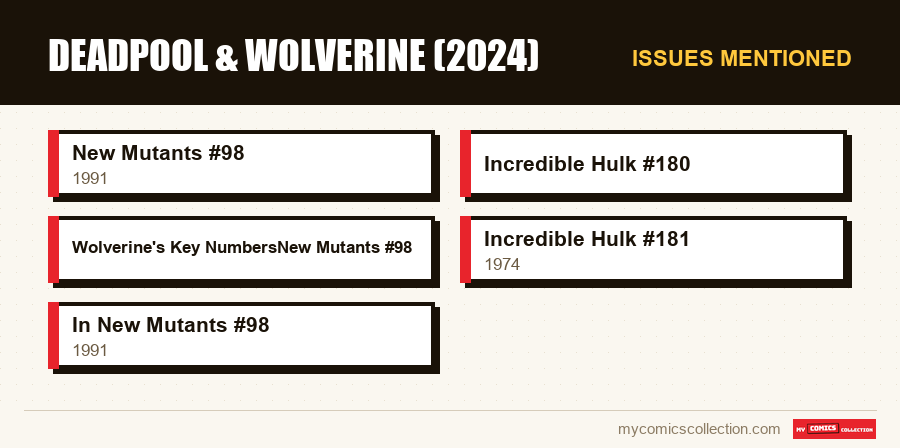
Deadpool & Wolverine highlights two major collection keys. Incredible Hulk #181 (first full appearance of Wolverine) is one of the most sought after and highly rated Bronze Age keys on the market, a true modern grail. New Mutants #98 (Deadpool's first appearance) is another highly prized key, whose value has exploded with the popularity of the character. These two issues are among the most coveted of their time, driven by the continued success of the adaptations. As always, condition and gradation determine value; relying on real recent sales is strongly recommended. These first two appearances are among the safest investments in the modern comics market, as the popularity of Deadpool and Wolverine seems inexhaustible, adaptation after adaptation.
Its place in the saga and for the collector
Deadpool & Wolverine marks the official integration of two X-Men icons into the great saga, while celebrating the history of adaptations. For the collector, the film kept Incredible Hulk #181 and New Mutants #98 at the top of the sought-after keys, confirming their status as benchmark investments. This film illustrates the enduring power of cinema on the market: two first appearances, seventeen years apart, remain among the most coveted thanks to the continued success of their characters. Beyond speculation, it recalls the richness of the X-Men gallery and the singularity of Deadpool, whose meta humor is unique in comics. By bringing these two figures together, the film pays homage to decades of comics and adaptations, in a celebratory exercise that is as enjoyable as it is faithful.
The verdict: two icons faithfully united
- Loyalty: the essence of Deadpool (meta, immortal), the attributes of Wolverine and their cult duo come from the comics.
- Freedoms: the multiversal plot, Cassandra Nova reoriented, meta humor applied to cinema.
- Collectible numbers: Incredible Hulk #181 (Wolverine), New Mutants #98 (Deadpool).
Deadpool & Wolverine brings together two comic book icons in a multiversal celebration that is as funny as it is faithful. By respecting the meta humor of one and the savagery of the other, the film honors characters created decades apart. For reader and collector alike, this is an invitation to own two of the most prestigious debuts on the market-Incredible Hulk #181 and New Mutants #98. Few films bring together two such popular characters while remaining so faithful to their essence: Ryan Reynolds' loyalty to the Deadpool of the comics, like the classic costume finally offered to Wolverine, demonstrate a deep respect for the original material.
Frequently asked questions
In New Mutants #98 (1991), created by Rob Liefeld and Fabian Nicieza. Originally a mercenary hired against young mutants, he became famous for his humor and his ability to break the fourth wall.
In a cameo at the end of Incredible Hulk #180 (1974), then fully in #181, created by Len Wein and drawn by Herb Trimpe. The film finally gives him his classic yellow and blue costume from the comics.
Very faithful to the essence of the characters: the meta humor of Deadpool, the attributes of Wolverine. The multiversal plot and cameos are unique to the film, which celebrates both the comics and the history of their adaptations.
A major enemy of the X-Men, super-powered telepath and evil twin of Professor Xavier, born in Grant Morrison's run. The film reorients her as the antagonist of the Deadpool-Wolverine duo.
Incredible Hulk #181 (first full appearance of Wolverine) and New Mutants #98 (first appearance of Deadpool) are two of the most sought after and highly rated keys on the market.
Does the film make you want to collect? Estimate the value for free of your issues (Incredible Hulk #181, New Mutants #98…) with our tool based on current eBay listings.