Dead Pool (2016) Tim Miller , with Ryan Reynolds, adapts the eloquent mercenary born in New Mutants #98 (1991) by Rob Liefeld and Fabian Nicieza. The film takes on meta humor, fourth wall awareness, the healing factor and the origin linked to the Weapon X program. It introduces Negasonic Teenage Warhead (New X-Men #115, 2001) and Colossus. Faithful to the spirit of the character, he freely reinvents his story. Here is the detailed comparison, film versus comics.
A phenomenon of superhero cinema, Deadpool brings Marvel's most irreverent antihero to the screen. He draws on a character who has become cult for his humor and his breaking of the fourth wall. Source-by-source decryption.
As in each article in this series, only verified information (creators, distribution, dates, comic numbers) is stated; the comparative analysis is ours, without reproducing dialogue or protected images.
Title : Deadpool (2016)
Director: Tim Miller
Actors: Ryan Reynolds (Wade Wilson), Morena Baccarin (Vanessa), Ed Skrein (Ajax), T.J. Miller
Exit : February 2016
Studio: 20th Century Fox
New Mutants #98 (1991): Deadpool's first appearance (Liefeld & Nicieza)
New X-Men #115 (2001): Negasonic Teenage Warhead's first appearance
The Weapon X program: the origin of the healing factor
Meta humor: fourth wall awareness
- Wade Wilson, a talkative and crazy mercenary.
- La breaking the fourth wall and meta humor.
- Le healing factor and disfigured face.
- The origin linked to Weapon X program.
- THE swords and violence jubilation of the character.
- L'love story with Vanessa is developed.
- Ajax (Francis) is reinvented as an antagonist.
- Negasonic sees his powers modified.
- Le connection with the X-Men is reduced to Colossus.
- The origin is tight into a personal story.
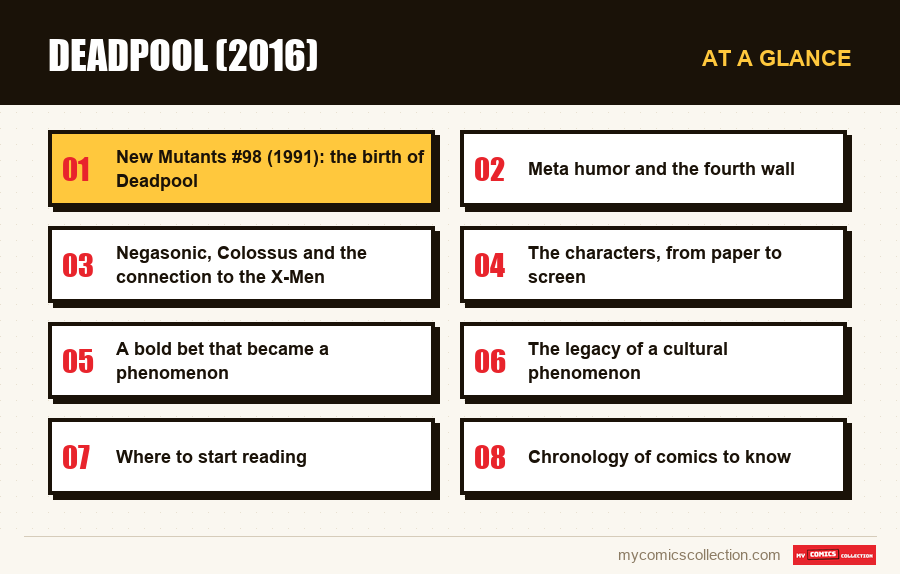
New Mutants #98 (1991): the birth of Deadpool
Deadpool appears in New Mutants #98 (1991), created by Rob Liefeld and Fabian Nicieza. Originally, Wade Wilson is a mercenary, a hitman introduced as the team's adversary. Endowed with a healing factor which makes him almost immortal, but which has also disfigured his body -, an expert in weapons and combat, he is distinguished above all by his inexhaustible eloquence and his humor. Over the years, the character has evolved from a simple villain to a cult antihero, whose most famous characteristic is that he is a comic book character: he breaks the fourth wall, addresses the reader and comments on his own fiction. This meta awareness has made him one of Marvel's most original and popular characters.
The film captures this essence perfectly. Ryan Reynolds plays a Wade Wilson faithful to the spirit of the character: talkative, irreverent, violent and endearing, constantly breaking the fourth wall to address the viewer. The film takes on the healing factor, the disfigured face, the swords, the dark humor and the meta consciousness. This fidelity to the tone and personality of Deadpool is the great success of the film, which was able to transpose to the screen what makes the character unique. On the other hand, he freely reinvents Wade's origin and entourage, condensing his mythology into a personal story.
Meta humor and the fourth wall
Deadpool's most iconic characteristic, faithfully echoed by the film, is his breaking of the fourth wall. In comics, the character knows that he is fictional: he comments on the panels, addresses the reader, references other comics and plays with the conventions of the medium. This meta consciousness, unique among superheroes, makes him a comic and subversive character, capable of making fun of the codes of the genre. The film brilliantly transposes this process to cinema: Deadpool speaks to the camera, makes fun of his own studio, other superhero films, and even the actor who plays him. This self-referential humor is at the heart of the film's identity.
This fidelity to Deadpool's meta humor made the film successful and unique. By assuming an irreverent tone, uninhibited violence and crude language, the film dared a rare adult classification for a superhero blockbuster. This bet, long considered risky, paid off: the film was a huge success, proving the public's appetite for an offbeat antihero. It thus opened the way to more daring and mature adaptations. For the reader, it is confirmation that the subversive spirit of Deadpool, born in the comics, could triumph on the screen without being watered down.
Negasonic, Colossus and the connection to the X-Men
The film connects Deadpool to the X-Men universe through two characters. Colossus, the Russian steel colossus historic member of the X-Men, plays the role of the virtuous hero who tries in vain to bring Deadpool back to the right path, providing a comic contrast with the antihero. Negasonic Teenage Warhead, a young mutant who appeared in New X-Men #115 (2001), created by Grant Morrison and Frank Quitely, completes this duo. The film, however, modifies her powers: in the comics, she has telepathic abilities, while the film gives her the power to generate explosions of energy, more suited to action. This improbable trio (Deadpool, Colossus and Negasonic) is one of the comic springs of the film.
This reduced link to the X-Men reflects a constraint of the film: having a modest budget and limited access to the major characters of the franchise. The film makes it a comedic twist, with Deadpool himself ironic about the fact of only crossing paths with two X-Men. This self-deprecation, faithful to the meta spirit of the character, transforms a production limit into a gag. Colossus and Negasonic, faithful to their nature as mutants despite adjustments, nevertheless anchor Deadpool in the X-Men universe. For the reader, they remind us that the mercenary, despite his offbeat tone, belongs to mutant mythology, where he regularly encounters the X-Men and their allies.
Collecting this series?
Track what you own, what you are missing and what your collection is worth. 7 day trial.
Start my trial →The characters, from paper to screen
- Wade Wilson / Deadpool: Eloquent and meta mercenary, faithful to the spirit of New Mutants #98.
- Vanessa: Companion of Wade, whose love story is developed for the film.
- Ajax (Francis): Reinvented antagonist, responsible for Wade's disfigurement.
- Colossus: Virtuous X-Man, comic counterpoint to Deadpool.
- Negasonic Teenage Warhead: Young mutant with modified powers for the film.
A bold bet that became a phenomenon
Deadpool represents one of the most daring bets in superhero cinema. For years, the project seemed impossible: a violent, crude and meta antihero, the antithesis of the family blockbuster, in a genre then dominated by films for general audiences. It was partly a demo sequence released online, sparking enthusiasm among fans, that convinced the studio to produce the film. This success, against all expectations, made Deadpool a phenomenon, proving that an adaptation faithful to the subversive spirit of a character could reach a huge audience, even with an adult classification.
This triumph had lasting consequences on the genre. By demonstrating the commercial viability of an irreverent and violent superhero film, Deadpool paved the way for more daring and diverse adaptations. He also cast Ryan Reynolds in a role that he dreamed of playing and which stuck to his skin. For the reader, this success is recognition of the originality of Deadpool, a long-atypical character who has become one of Marvel's biggest stars. The film has reignited interest in his comics, particularly his wilder stories, where meta humor and subversion reign supreme.
The legacy of a cultural phenomenon
The success of Deadpool has gone beyond a simple box office triumph to become a true cultural phenomenon. By imposing an irreverent antihero and an adult classification in a then very codified genre, the film shook up conventions and proved that there was a large audience for more daring adaptations. Its marketing itself, offbeat and meta like the character, left its mark and became a school. Deadpool has become an icon of popular culture, his mask and his humor instantly recognizable, to the point of transcending just the circle of comic book fans.
This legacy is measured by the film's lasting influence on the genre. By demonstrating that a subversive tone and unabashed violence could achieve massive success, Deadpool encouraged a diversification of superhero adaptations, long confined to a family register. He also made fidelity to the spirit of a character the key to success: it was by scrupulously respecting the meta humor and irreverence of Deadpool that the film won over the public. For the reader, this triumph is the ultimate recognition of a character long considered atypical, whose comics are full of narrative discoveries and daring that the film has only touched on. Deadpool, from paper to screen, embodies freedom and subversion.
Where to start reading
To extend the film, New Mutants #98 (1991) features the first appearance of Deadpool. The “Cable & Deadpool” and the character’s solo runs develop his meta humor and personality. New X-Men #115 (2001) introduces Negasonic Teenage Warhead. This journey covers the sources of a film of great fidelity to the irreverent spirit of the mercenary.
Chronology of comics to know
- 1991: New Mutants #98: Deadpool's first appearance.
- 2001: New X-Men #115: the first appearance of Negasonic Teenage Warhead.
- 2000s: “Cable & Deadpool” and the solo runs develop the meta humor.
Collection side: what numbers to aim for after the film
Deadpool points to some highly sought-after modern keys. New Mutants #98 (1991, Deadpool's first appearance) is one of the most coveted modern keys, whose popularity has exploded with the popularity of the character. New X-Men #115 (2001, premiere of Negasonic Teenage Warhead) is another target, carried by the film. The first issues of Deadpool's solo series offer other avenues. These targets cover varied budgets within modern comics. As always, condition and gradation determine value; relying on real recent sales is strongly recommended.
Its place in the saga and for the collector
Deadpool brought Marvel's most irreverent antihero to the screen with resounding fidelity and success. For the collector, it exploded interest in New Mutants #98, major modern key. It illustrates the considerable effect of adaptations on the market. Beyond speculation, the film invites us to discover Deadpool in the comics, this talkative and meta mercenary whose subversive humor has renewed the genre. By daring a faithful and adult adaptation, he proved the richness of a character who had long been atypical and who had become a world star.
The verdict: a faithfully crazy antihero
- Loyalty: Wade Wilson, breaking the fourth wall, the healing factor, the Weapon X origin and meta humor come from the comics.
- Freedoms: the love story expanded, Ajax reinvented, Negasonic's powers altered, the connection narrowed down to the X-Men.
- Collectible numbers: New Mutants #98 (Deadpool), New X-Men #115 (Negasonic Teenage Warhead).
Deadpool brings Marvel's most irreverent mercenary to the screen with total fidelity to his spirit: meta humor, breaking the fourth wall, exhilarating violence. Faithful to the character's personality, the film freely reinvents his origin and his entourage. For the reader as well as the collector, it is an invitation to discover New Mutants #98 and the crazy universe of Deadpool.
Frequently asked questions
From New Mutants #98 (1991), created by Rob Liefeld and Fabian Nicieza. Initially a mercenary opponent of the team, Wade Wilson became a cult antihero, known for his meta humor and his breaking of the fourth wall, faithfully reproduced by the film.
Yes: this is its most famous characteristic. He knows that he is a comic book character, addresses the reader and comments on his own fiction. The film brilliantly transposes this process, Deadpool speaking to the camera and ironizing on the genre.
Partly: appeared in New X-Men #115 (2001), she possesses telepathic powers in the comics. The film gives him the power to generate bursts of energy, more suited to action, while still retaining the character.
Due to a modest budget, the film only has Colossus and Negasonic. He makes it a comedic twist, with Deadpool himself ironic about the fact of only crossing paths with two X-Men: a self-mockery faithful to his meta spirit.
New Mutants #98 (1991, Deadpool premiere) is one of the most coveted modern keys. New X-Men #115 (2001, Negasonic premiere) is another target for the film.
Does the film make you want to collect? Estimate the value for free of your issues (New Mutants #98…) with our tool based on current eBay listings.