
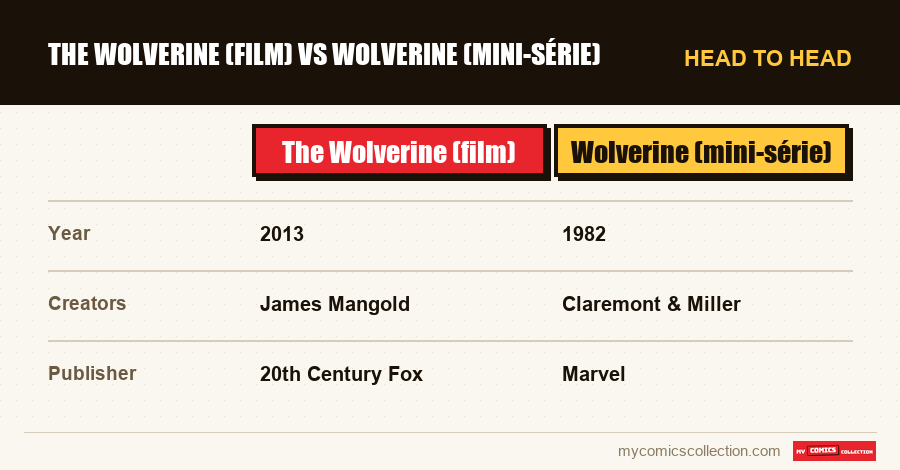
The Wolverine (2013) James Mangold , with Hugh Jackman, adapts the cult mini-series Wolverine (1982) by Chris Claremont and Frank Miller, which sends Logan to Japan. The film resumes Mariko , Yukio , THE Silver Samurai and the Yashida clan, as well as the theme of the hero's mortality. Faithful to the spirit of the Japanese story, he reinvents the plot. Here is the detailed comparison, film versus comics.
After a disappointing first attempt, Wolverine's solo saga comes back together by adapting one of his most esteemed stories. It draws on the Japanese mini-series by Claremont and Miller. Source-by-source decryption.
As in each article in this series, only verified information (creators, distribution, dates, comic numbers) is stated; the comparative analysis is ours, without reproducing dialogue or protected images.
Title : The Wolverine (2013)
Director: James Mangold
Actors: Hugh Jackman (Wolverine), Tao Okamoto (Mariko), Rila Fukushima (Yukio), Hiroyuki Sanada, Svetlana Khodchenkova (Viper)
Exit : July 2013
Studio: 20th Century Fox
Wolverine (miniseries, 1982): Claremont & Miller, in Japan
Mariko Yashida: Logan's Japanese love
The Silver Samurai: the antagonist of the Yashida clan
Yukio: Wolverine's warrior ally
- The frame Japanese and immersion in its culture.
- Mariko, Logan's love interest, and the Yashida clan.
- Yukio, the warrior allied to the disastrous destiny.
- Le Silver Samurai, iconic antagonist.
- Le code of honor and Logan's inner quest.
- Le Silver Samurai becomes robotic armor.
- La loss of healing factor, central theme of the film.
- Viper is reinvented as a poisonous mutant.
- The plot is rearranged around mortality.
- Le mourning of Jean Gray haunts Logan, link to the films.
The Wolverine miniseries (1982), film source
The Wolverine adapts one of the character's most esteemed stories: the 1982 four-issue Wolverine miniseries, written by Chris Claremont and drawn by Frank Miller. This story sends Logan to Japan, where he finds Mariko Yashida, the woman he loves, promised to a marriage arranged by her father, a criminal clan leader. Faced with a culture that values honor and self-control, Wolverine leads a battle that is as much internal as it is external: taming his savagery to prove himself worthy of Mariko. This mini-series redefined the character, revealing his depth and his code of honor, and remains an absolute reference in his mythology.
The film faithfully reproduces the setting and spirit of this story: Japan, Mariko, the Yashida clan, Yukio, the Silver Samurai, and above all the theme of Logan in search of meaning, confronted with his own nature. James Mangold captures the Japanese atmosphere and introspective dimension of the source material, offering a film more intimate and personal than the usual mutant blockbusters. The film, however, reorganizes the plot and adds its own elements, notably the loss of Wolverine's healing factor, absent from the miniseries. This freedom, in the service of a story about mortality, enriches the character while distancing itself from the letter of the source.
Mariko, Yukio and Japanese immersion
The film takes up the emblematic characters of the mini-series. Mariko Yashida, Logan's love interest, embodies the grace and honor of Japanese culture, and her arranged marriage is at the heart of the drama. Yukio, a red-haired warrior and ally of Wolverine, brings her energy and loyalty, while being haunted, in the film, by visions of death. These strong and nuanced female characters structure the story and anchor it in its Japanese setting. The film takes care of this cultural immersion: the rituals, the landscapes, the codes of honor -, faithful to the aesthetic and the spirit of the mini-series by Claremont and Miller.
This Japanese dimension is one of the film's great successes. By taking Wolverine out of his usual American context, he confronts him with a culture that questions his deep nature: can he, the animal, find peace and honor? This change of scenery, faithful to the source, offers the character a framework conducive to introspection. The contrast between Logan's savagery and Japanese restraint nourishes the story and reveals the complexity of the hero. For the reader, it is an invitation to discover the 1982 miniseries, where this confrontation between Wolverine and Japan reaches an intensity and depth that the film seeks to honor.
Wolverine's mortality, central theme
The film's main invention is to temporarily deprive Wolverine of his healing factor. An element of the Yashida clan manages to neutralize his ability to regenerate, making him vulnerable, mortal, capable of bleeding and suffering like an ordinary man. This spring, absent from the mini-series, places mortality at the heart of the story: what becomes of an immortal being confronted with the possibility of dying? This theme resonates with Logan's weariness, haunted by the losses of his long life, particularly the death of Jean Grey. The film thus explores the existential fatigue of a hero who has lived too much and lost too much.
This reflection on mortality, specific to the film, enriches the character and announces the themes that Logan will bring to their peak four years later. By making Wolverine vulnerable, the film humanizes the hero and intensifies the suspense of his fights, which are now truly dangerous. This choice, if it deviates from the mini-series, is part of a coherent exploration of the character: that of an immortal tired of his condition. For the reader, it illustrates the thematic richness of Wolverine, whose immortality is as much a burden as a power. The film thus transforms a Japanese adventure into a meditation on life, death and the weight of centuries.
Collecting this series?
Track what you own, what you are missing and what your collection is worth. 7 day trial.
Start my trial →The characters, from paper to screen
- Wolverine (Logan): In search of meaning and confronted with mortality, faithful to the spirit of the mini-series.
- Mariko Yashida: Logan's love, at the heart of the drama of the Yashida clan.
- Yukio: Allied warrior, haunted by visions of death in the film.
- The Silver Samurai: Iconic antagonist, transformed into robotic armor.
- Viper: Reinvented as a poisonous mutant, enemy of the story.
The Silver Samurai, from man to machine
The Silver Samurai is, in the comics, a warrior linked to the Yashida clan, master of the sword whose blade can cut almost anything. Iconic antagonist of the mini-series, he embodies Japanese martial tradition and warrior honor. The film takes up the character but makes a major transformation: the Silver Samurai becomes a giant robotic adamantium armor, capable of rivaling Wolverine's claws. This rereading, which favors spectacle over the human dimension of the character, moves away from the source, where the Samurai is above all a man and a cultural symbol.
This choice illustrates the film's tension between intimate fidelity and the imperatives of the blockbuster. By transforming the Silver Samurai into a machine, the film achieves a spectacular climax, but loses the symbolic significance of the original character. This freedom, discussed by fans, contrasts with the care given to the rest of Japanese immersion. For the reader, the Silver Samurai of the comics remains a very rich figure, the incarnation of martial honor and tradition. The film gives a robotic version, consistent with its issue around adamantium, but far removed from the human dimension that Claremont and Miller gave it.
A turning point towards a more adult Wolverine
The Wolverine marks an important step in the cinematographic treatment of the character. After the first solo film, considered disappointing and overloaded, this one opts for a more sober, more mature approach and more faithful to the depth of Logan. Based on the mini-series by Claremont and Miller, an absolute reference for the character, the film reconnects with what makes Wolverine rich: his quest for honor, his fight against his own savagery, his relationship with death. James Mangold imposes a more intimate vision, foreshadowing the masterpiece that he will then deliver with Logan.
This turn towards a more adult Wolverine demonstrates a maturation of the genre. Rather than multiplying fights and characters, the film takes the time to explore the psychology of its hero, his existential fatigue and his need for redemption. This approach, faithful to the spirit of the best stories of the character, was hailed as a clear improvement. For the reader, it confirms that Wolverine is not just a killing machine, but a tormented being, haunted by his immortality and his losses. The Wolverine, by drawing on the Japanese mini-series, captures this dimension and reminds us that the most beautiful adaptations are those which dare for depth rather than overkill.
Where to start reading
To extend the film, the mini-series Wolverine (1982), by Claremont and Miller, is the direct source and a pinnacle of the character, a must-read. The ongoing Wolverine series, launched in 1988, extends his adventures. Narratives exploring his mortality and weariness illuminate the film's themes. This journey covers the sources of a film faithful to the spirit of the Japanese Wolverine.
Chronology of comics to know
- 1982: Wolverine (mini-series): Logan in Japan, by Claremont and Miller.
- 1988: Wolverine (ongoing series): the character's solo adventures.
- 1980s-2000s: Stories exploring Logan's honor and mortality.
Collection side: what numbers to aim for after the film
The Wolverine points to keys to the character's mythology. There Wolverine miniseries (1982), by Claremont and Miller, is a major target, one of the character's most valued and sought after. The first issue of the ongoing series (1988) is another popular key. Incredible Hulk #181 (1974), Wolverine's first appearance, remains the absolute holy grail. These numbers cover various budgets. As always, condition and gradation determine value; relying on real recent sales is strongly recommended.
Its place in the saga and for the collector
The Wolverine straightened out the character's solo saga by adapting one of his most esteemed stories, the 1982 Japanese mini-series. For the collector, it reignited interest in this cult mini-series and in the Japanese stories of Logan. It illustrates the effect of adaptations on the market. Beyond speculation, the film invites you to discover the mini-series by Claremont and Miller, where Wolverine reveals his depth and his code of honor. By exploring his mortality and Japanese immersion, the film honors the spirit of the source material, while setting up the climax that will be Logan.
The verdict: a Japanese adventure true to the spirit
- Loyalty: the Japanese setting, Mariko, the Yashida clan, Yukio and Logan's code of honor come from the 1982 miniseries.
- Freedoms: the Silver Samurai in robotic armor, the loss of the healing factor, Viper reinvented, the plot reorganized.
- Collectible numbers: the Wolverine miniseries (1982), Wolverine #1 (1988), Incredible Hulk #181.
The Wolverine adapts Claremont and Miller's Japanese miniseries with careful cultural immersion and an introspective dimension, while adding the theme of mortality. Faithful to the spirit of the story (Mariko, Yukio, honor) the film transforms the Silver Samurai into a machine. For both the reader and the collector, it is an invitation to discover the Wolverine mini-series from 1982.
Frequently asked questions
From the miniseries Wolverine (1982), in four issues, by Chris Claremont and Frank Miller, which sends Logan to Japan to find Mariko. The film faithfully takes up this framework and its introspective spirit, while rearranging the plot.
The loss of the healing factor is an invention of the film, absent from the 1982 miniseries. It places mortality at the heart of the story, exploring what becomes of an immortal faced with the possibility of death.
A warrior linked to the Yashida clan, master of the sword, in the comics. The film transforms him into giant adamantium robotic armor, a spectacular choice that moves away from the human and symbolic dimension of the original character.
Because it adapts the 1982 miniseries, which sends Wolverine to Japan. This change of scenery confronts the hero with a culture of honor and self-control, conducive to introspection, faithfully taken up by the film.
Claremont and Miller's Wolverine (1982) miniseries is a major target. Other sought-after keys include Wolverine #1 (1988, ongoing series) and Incredible Hulk #181 (first appearance).
Does the film make you want to collect? Estimate the value for free of your issues (Wolverine 1982 mini-series, etc.) with our tool based on current eBay listings.