In short
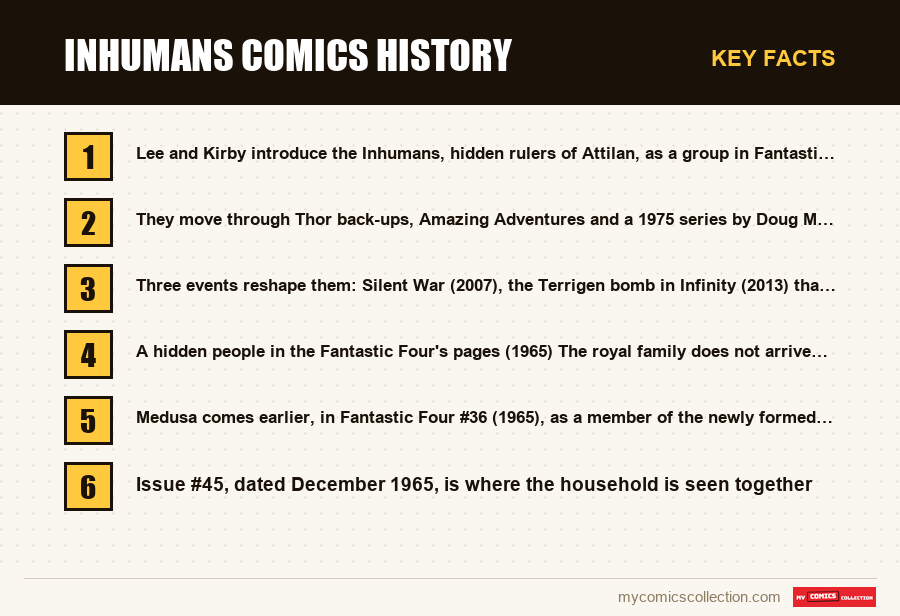
Lee and Kirby introduce the Inhumans, hidden rulers of Attilan, as a group in Fantastic Four #45 (1965). They move through Thor back-ups, Amazing Adventures and a 1975 series by Doug Moench before Paul Jenkins and Jae Lee reset them in 1998. Three events reshape them: Silent War (2007), the Terrigen bomb in Infinity (2013) that spreads new Inhumans across Earth, and the 2018 closing series.
Most Marvel teams are assembled from heroes who meet. The Inhumans are the reverse: a closed society with a king, a council, a rival prince and a genetic secret, and every era of their history is a question about what happens when that society opens its doors. The publishing record tracks the answer closely, from a hidden city in the margins of another title to an event that turned the Terrigen Mist into a worldwide plot device.
Each creator named here, from Moench to Cates, and each volume number and run length was verified against published records; the claims about why Marvel keeps restarting the family are interpretation, not record, and no pages or prices are quoted.
A hidden people in the Fantastic Four's pages (1965)
The royal family does not arrive in one issue. Medusa comes earlier, in Fantastic Four #36 (1965), as a member of the newly formed Frightful Four. At that stage nothing connects her to a hidden civilization. Issue #45, dated December 1965, is where the household is seen together; the debut guide sorts out which member turns up in which issue.
The premise that Lee and Kirby fix is a people shaped by design. The Kree experimented on early humans to create the race, and the Inhumans then developed in seclusion in Attilan, where Terrigen Mist triggers their powers. The city name Attilan itself is older than the team: it is first mentioned in a Tuk the Caveboy story in Captain America Comics #1 (March 1941). What changes in 1965 is that Attilan is attached to a royal family led by a silent king, and the set of relationships among Medusa, Black Bolt, Maximus, Gorgon, Karnak, Triton, Crystal and the giant dog Lockjaw becomes the raw material for every later writer.
Because the king gets his own treatment in the Black Bolt history, this page follows the family and the society around him: how they are used, who writes them, and why each reboot arrives when it does.
Back pages, guest spots and a shared bill (1967 to 1972)
Backstory arrives in installments tucked into Thor, from #146 (November 1967) through #152 (May 1968), the long-form origin tale for the hidden people. The Inhumans are a good example of how a back-up slot could carry a whole mythology. A collector who wants the lore, rather than the debut, is looking for this run.
The family also crosses paths with other heroes. Silver Surfer #18 (September 1970) pits them against the Surfer. From August 1970 to January 1972 the family holds a spot in Amazing Adventures #1 to #10, a split book it shares with another feature, and that spot is its first ongoing home. Jack Kirby wrote and penciled the first six issues. The shared bill tells you the commercial position: they are a feature rather than the headline, and the run stops after ten issues.
Doug Moench and the 1975 series
The next stage is the first title named for them. Inhumans volume 1 runs 12 issues, from October 1975 to August 1977, and Doug Moench writes every issue except #9. This is the era in which the family tries to stand on its own as a series rather than as a back-up. The run does not end in a single burst of resolution; instead Captain Marvel #53 (November 1977) follows up on the series' ending, which shows how the family's stories were still being finished in other people's books after their own title was gone.
For anyone following the Inhumans through time, this is a useful pattern. Marvel gives the family a series, cancels it, and then folds the loose ends into a different title. The same rhythm of a push followed by a cancellation shows up again in the 2000s and 2010s, in the volume restarts and in the 2018 closing series.
Ann Nocenti's graphic novel and Daredevil (1988 to 1990)
In 1988 the family returns in a graphic novel written by Ann Nocenti and illustrated by Bret Blevins. It is the creative team's own take on the family, set apart from the earlier Lee and Kirby and Moench versions. The follow-through arrives in Daredevil #272 to #283 (November 1989 to August 1990), where Nocenti makes Karnak and Gorgon supporting cast members.
That is a quieter kind of history, but a revealing one. Two members of a family defined by its distance from humanity move into another hero's book as supporting cast. For a collector, those twelve issues of Daredevil are a useful marker of how individual royal family members could be used without the whole court around them.
The 1998 reset: Paul Jenkins and Jae Lee
The modern era begins with Inhumans volume 2, a twelve-issue limited series by Paul Jenkins and Jae Lee, running from November 1998 to October 1999. The series won an Eisner Award. It is the series that sets the modern starting point for the family, with Jae Lee's art giving the royal court a look of its own.
The follow-ups show how hard that reset was to sustain. In 2000 a four-issue volume 3 arrives from Carlos Pacheco and Rafael Marín with art by José Ladrönn, and in 2003 and 2004 a twelve-issue volume 4 concentrates on new characters within Inhuman society. Taken together, these three volumes show the family being rethought in quick succession, and they are the reason the numbering of Inhumans needs care.
Silent War and the politics of kings (2007 to 2009)
The next structural change comes with Silent War, a 2007 limited series by David Hine with art by Frazer Irving. It runs six issues starting in January 2007: Gorgon strikes New York, and by the end Maximus controls Attilan and Black Bolt is imprisoned. The theme is one the family had always carried, a people in conflict with the surface world, and the series makes it explicit and violent.
The same decade ends with the Inhumans on a larger stage. In War of Kings (2009) the family is bound up with the Kree, whose throne on Hala is held by Ronan. The Kree link goes back to the origin of the race, so the storyline ties the family's fate to its makers' empire. As history, the period shows the Inhumans acting as a power in the Marvel universe's cosmic politics rather than as a hidden society.
Do you collect this series?
Track what you own, what you are missing and what your collection is worth. 7-day trial.
Start my trial →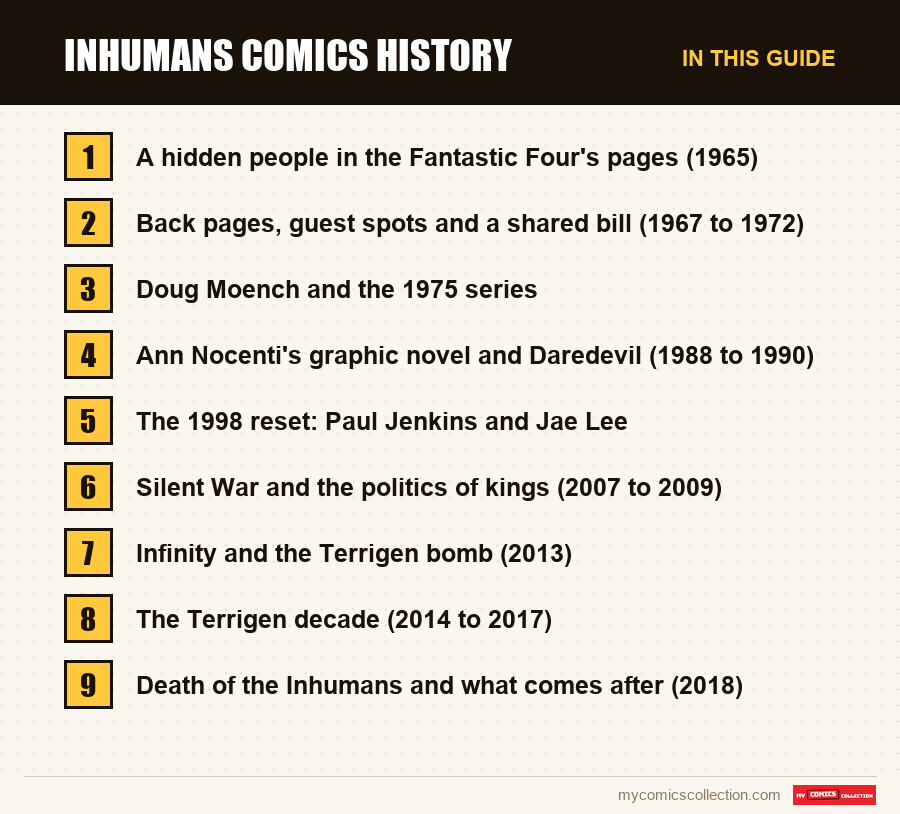
Infinity and the Terrigen bomb (2013)
The biggest reversal arrives in Infinity, Jonathan Hickman's 2013 crossover. Thanos demands the deaths of Inhumans aged 16 to 22, a demand tied to his half-Inhuman son, Thane. Attilan is destroyed, and a Terrigen bomb spreads the mist across Earth, activating dormant Inhuman abilities.
This is the hinge of the whole history. A people defined by secrecy and a closed city loses the city and gains a mass of new members. The event leads directly into the Inhumanity storyline, and our Infinity reading order covers the tie-ins in detail. For a collector, Infinity is where a family book becomes a premise that any writer can use: anyone anywhere can now become an Inhuman.
The Terrigen decade (2014 to 2017)
Inhuman launches in April 2014 and runs 14 issues to June 2015, with Charles Soule as lead writer. Alongside it comes Ms. Marvel volume 3, in which Kamala Khan, whose story is told in our Kamala Khan history, is part of the same wave of new characters. After Secret Wars the line widens: Uncanny Inhumans runs 20 issues from 2015 to 2017, and All-New Inhumans runs 11 issues. A six-issue Karnak (2015) puts the royal strategist alone under Warren Ellis, with Gerardo Zaffino and Roland Boschi on art.
The Terrigen cloud then collides with the mutants. Inhumans vs. X-Men, written by Charles Soule and Jeff Lemire, runs across 2016 and 2017 as a sequel to Death of X. The war is over the Terrigen Mist, which gives Inhumans their powers and is deadly to mutants. It ends when Medusa destroys the cloud herself, abdicates and hands leadership to Iso.
The same period carries the most distinctive solo work. The king's own twelve-issue series, Black Bolt, pairs Saladin Ahmed with artist Christian Ward across 2017 and 2018. Al Ewing writes Royals with Kevin Libranda, canceled after 10 issues, and Inhumans: Once & Future Kings, five issues by Christopher Priest and Phil Noto, was announced in 2017. On television, an earlier live-action debut on a Marvel network series led to a 2017 ABC series that was poorly received and canceled after one season; our series versus comics page covers how it differs from the books.
Death of the Inhumans and what comes after (2018)
The Terrigen era closes with Death of the Inhumans, a five-issue series from July 2018 by Donny Cates and Ariel Olivetti. The series pits the family against the Kree and the Super-Inhuman Vox. The title is blunt about what it is doing: after a decade in which the family was made central to the Marvel universe, Marvel closes the chapter.
As analysis, the history reads as a cycle of closing and opening. The 1965 city is hidden, the 2013 city is destroyed, and the 2018 series ends a line of books. The family keeps coming back because the premise, a royal house whose power is also a danger to everyone around it, is simple enough to be rebuilt by each new generation of writers.
The key issues across their history
- Fantastic Four #36 (1965): Medusa debuts, by Stan Lee and Jack Kirby, as part of the Frightful Four.
- Fantastic Four #45 (1965): the royal family appears as a group, by Lee and Kirby.
- Thor #146 to #152 (1967 to 1968): the back-up run that tells the family's origin at length.
- Amazing Adventures #1 (1970): the first ongoing feature for the family, opened by Kirby.
- Inhumans volume 1 #1 (1975): the first series named for them, written by Doug Moench.
- Inhumans volume 2 #1 (1998): Paul Jenkins and Jae Lee begin the Eisner-winning series.
- Infinity (2013): Jonathan Hickman's event in which Attilan falls and a Terrigen bomb spreads the mist across Earth.
- Death of the Inhumans #1 (2018): Donny Cates and Ariel Olivetti close the Terrigen era.
How to follow the Inhumans in a collection
Treat the family as a set of blocks. Begin with Fantastic Four #36 and #45 and the issues around them, add the Thor back-up run and Amazing Adventures, then take the 1975 series as its own run. After that, shelve each Inhumans volume by volume: volume 1 (1975), volume 2 (1998), volume 3 (2000) and volume 4 (2003) all restart at #1, so confirm volume and year before you accept a number.
The modern material is easiest to collect by event and series: Silent War, Infinity and Inhumanity, then Inhuman, Uncanny Inhumans, All-New Inhumans and Inhumans vs. X-Men. Our guide to the best Inhumans runs ranks the readings, while this page is the order in which they were published.
Frequently asked questions
The Inhumans' debut, Lee and Kirby's work, sits in Fantastic Four #45 dated December 1965. Medusa turns up earlier, in Fantastic Four #36 (1965), as a member of the Frightful Four. The city name Attilan comes from a 1941 Tuk the Caveboy story.
In Marvel's lore the Kree experimented on early humans to create the race, which then developed in seclusion in the city of Attilan, where Terrigen Mist triggers their powers. The Inhuman Royal Family, led by the silent king Black Bolt, includes Medusa, Karnak, Gorgon, Triton, Crystal, Maximus and Lockjaw.
For the modern take, begin with the 1998 limited series by Paul Jenkins and Jae Lee, which won an Eisner Award. For the debut and the Silver Age lore, start with Fantastic Four #45 and the Thor back-ups from 1967 and 1968. For the event that reshaped the line, read Infinity (2013).
In Infinity (2013), Attilan is destroyed and a Terrigen bomb spreads the mist across Earth, activating dormant Inhuman abilities in people who did not know they carried them. That opens the way for Inhumanity and the Inhuman series of 2014.
In Inhumans vs. X-Men (2016 and 2017), the fight is over Terrigen Mist, which gives Inhumans powers and is deadly to mutants. Medusa destroys the cloud herself, abdicates and hands leadership to Iso, who becomes the new Inhuman leader of a people facing a changed world.
If you own an early Inhumans appearance from Fantastic Four or Amazing Adventures, an estimate shows what your copy is worth today.
Estimate my comic