In short
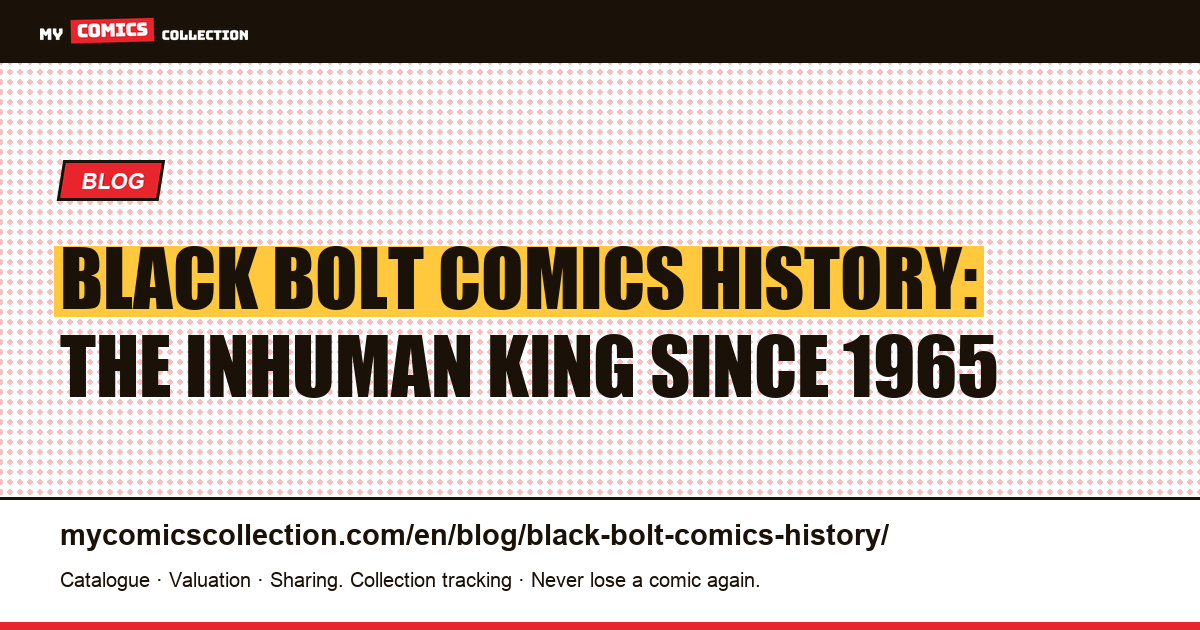
The silent king of the Inhumans, Black Bolt arrives in Fantastic Four #45 (December 1965) from Stan Lee and Jack Kirby. He gets an origin in the Thor back-ups of 1967 and 1968, the Inhumans feature in Amazing Adventures from 1970, and a new life in the 1998 Inhumans by Paul Jenkins and Jae Lee. The turning points are Silent War (2007), the Terrigen bomb of Infinity (2013) and Saladin Ahmed's Black Bolt (2017).
A king who cannot speak is a hard character to keep in print for sixty years, and yet Black Bolt has returned in every decade since 1965. This guide follows his publication history in order, from a Silver Age cliffhanger to a twelve-issue solo series that won an Eisner, and it stops at each place where the character changed shape.
Every cover date, volume number and creator named for the king below was checked, and unconfirmed names, inkers and letterers above all, are omitted. The notes on shelving and on what each period changes are our reading, and the page quotes no price.
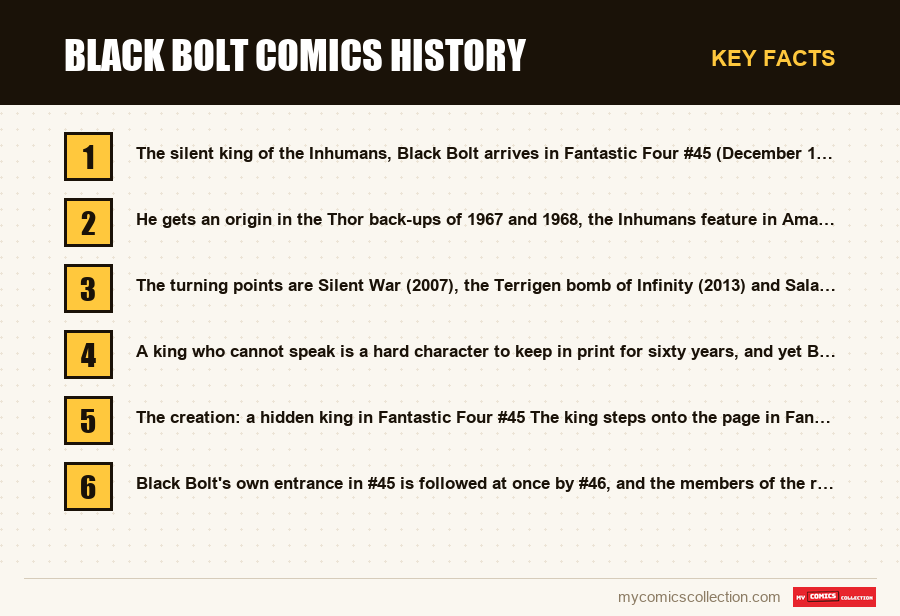
The creation: a hidden king in Fantastic Four #45
The king steps onto the page in Fantastic Four #45 with a December 1965 cover date, and the tale runs on into #46 (January 1966). Lee scripted and Kirby drew, and the two men are his creators. The setting is the middle of the stretch in which Lee and Kirby were turning the series from a team book into a mythology, and the Inhumans are one of the pieces they added to it. The royal family arrives as a family, with titles, rivalries and a hidden home, rather than as a single villain of the month.
For a collector, the useful fact is that the debut is a block rather than a single number. Black Bolt's own entrance in #45 is followed at once by #46, and the members of the royal family who surround him play their parts across the same sequence. A shelf that holds only #45 shows the introduction without the conflict that follows. The debut itself has its own guide, and this page follows the king from there.
What Lee and Kirby fixed in 1965 is the shape that every later writer has had to work with: a monarch whose power is so dangerous that he cannot speak, a family that speaks for him, and a brother, Maximus, who wants the throne. The later history of the character is largely a series of new ways to put pressure on those three facts.
An origin on the back pages: Thor, 1967 to 1968
The Inhumans did not immediately get their own book. The family's origin story appeared in back-up pages of Thor, #146 (November 1967) through #152 (May 1968), headed "Tales of the Inhumans". The back-ups tell how the hidden people came to be and how the royal family fits into that story, and they matter to a collector because they are where the character stops being a plot device in someone else's comic and becomes the lead of his own sequence.
Other appearances in the same period show how Marvel was testing the king in different settings. In Fantastic Four #59 (February 1967) he leaves Attilan to explore the world beyond it. Marvel Super-Heroes #15 (July 1968) shifts the focus to his cousin Medusa. The Incredible Hulk Annual #1 (October 1968) has the Hulk defeat the Royal Family, with Black Bolt driving him off. And in Fantastic Four #82 and #83 (January and February 1969) he fights alongside the Fantastic Four against Maximus and a group of rogue Inhumans.
Amazing Adventures and the first solo run, 1970 to 1972
The Inhumans were the lead feature of Amazing Adventures #1 to #10, August 1970 to January 1972, and Kirby wrote and penciled the opening six. In that run Black Bolt battles the Mandarin and Magneto, which tells you how the character was being positioned: as a power that could stand against established villains and not only as the ruler of a hidden city.
The same era supplies a piece of backstory that later writers lean on. A flashback in The Avengers #95 (January 1972) reveals how Maximus came to ally with the Kree and how the crash that killed Black Bolt's parents drove Maximus mad. It is where the rivalry between the brothers acquires a cause.
A series of their own: the Inhumans of 1975
The Inhumans received a series under their own name in October 1975, with Doug Moench writing every issue but #9, and Gil Kane drawing the cover of #1. It gives the whole family room to carry plots, and for a collector it belongs on the Bronze Age shelf, as a book about the family more than about the king.
The decade's other appearances place him in cosmic and team settings. In Captain Marvel #53 (November 1977) he helps stop a Kree and Skrull war on Earth, and in Marvel Two-in-One Annual #4 (January 1979) he and the Thing defeat Graviton. In The Avengers #188 (October 1979) he appears when Crystal's pregnancy is announced.
Moves, marriages and a graphic novel, 1980 to 1988
The early 1980s are about place. In Marvel Two-in-One #71 and #72 (January and February 1981) Black Bolt faces Maelstrom with the Thing, and What If? #29 and #30 (October and December 1981) carry stories on the relocation of Attilan and the role of the Eternals. Fantastic Four #240 (March 1982) moves Attilan to the Moon, which will be the city's home for much of what follows. Fantastic Four Annual #18 (January 1984) is the issue of the marriage of Black Bolt and Medusa.
The decade's most important single book is Marvel Graphic Novel, The Inhumans (1988), in which Medusa flees to Earth to bear a son, Ahura, after the Genetic Council forbids the birth. The book turns the royal couple into parents. A graphic novel is a separate object from the periodicals around it, so log it on its own.
Struggle for the throne and the 1998 relaunch, 1990 to 2000
In Inhumans Special #1 (April 1990), Maximus uses the Trikon to force the king out, and Black Bolt regains the throne. In X-Factor #65 to #68 (April to July 1991) the Royal Family joins X-Factor against Apocalypse. Inhumans: The Great Refuge (May 1995) is a one-shot about the Inhumans' ongoing battle with the Kree, and the king takes part in the Fantastic Four stories of 1995 and 1996, including the Morgan le Fay and Onslaught periods. In the Heroes Reborn universe, in Fantastic Four vol. 2 #9 and #10 (July and August 1997) and Iron Man vol. 2 #12 (October 1997), the Inhumans worship Galactus.
The decade closes with the book that many readers treat as the modern starting point. Inhumans volume 2 ran for twelve issues from November 1998 to October 1999, written by Paul Jenkins and illustrated by Jae Lee. It uses the Inhumans as a social allegory, while Maximus again tries to subvert his brother's rule. Jae Lee's art gave the family a look distinct from the Kirby tradition, which is why many readers begin here.
Two further volumes follow quickly. Inhumans volume 3 (June to October 2000) is a four-issue limited series in which Ronan attacks Attilan and the Inhuman people choose to leave with the Kree. Inhumans volume 4 (twelve issues, June 2003 to June 2004) returns the family to Earth and concentrates largely on new characters within Inhuman society. The volumes share a title, so number them by volume.
Do you collect this series?
Track what you own, what you are missing and what your collection is worth. 7-day trial.
Start my trial →
The Illuminati, Silent War and the Skrull double, 2005 to 2009
New Avengers #7 (July 2005) reveals him to be a member of the Illuminati, and Son of M (February to July 2006) follows Quicksilver's theft of Terrigen crystals. Civil War (2006 to 2007) finds him rejecting the Registration Act. Silent War is a six-issue limited series from January to August 2007 by David Hine and Frazer Irving. In it Black Bolt personally heads a team to rescue his subjects and retrieve the stolen crystals, and Maximus takes advantage of the situation to overthrow and imprison him.
Two other 2007 and 2008 series keep him in the large stories. In New Avengers: Illuminati (February 2007 to January 2008), the group splits the Infinity Gems, and Black Bolt receives Reality. In World War Hulk (August 2007 to January 2008), the Black Bolt the Hulk defeats turns out to be a Skrull, and in Secret Invasion (June 2008 to January 2009) and Secret Invasion: Inhumans (October to December 2008) the real king is captured by the Skrulls and then rescued. Readers who want that arc in order will find both crossovers covered in the guides to Planet Hulk and World War Hulk and to Secret Invasion.
The decade ends with War of Kings (May to October 2009), in which Black Bolt overthrows Ronan and declares himself ruler of the Kree. A clash with Vulcan leads to the detonation of a Terrigen bomb, and both men appear to die.
Terrigen, Infinity and a king without a voice, 2010 to 2016
The king survives. In Fantastic Four volume 4 he returns, is revealed to be the Kree genetic anomaly, and joins the Universal Inhumans, and in FF #20 and #21 he confronts the Supreme Intelligence and forces terms of a truce. The next turning point is Infinity (2013), where Thanos demands Inhuman youths and Black Bolt's scream tears down Attilan and a Terrigen bomb goes off. In New Avengers volume 3 Maximus helps him recover from the loss of his power.
The Inhuman series of 2014 and 2015 ran fourteen issues with Charles Soule as lead writer, and it is the book that rebuilt the franchise around new characters. In its pages Black Bolt is forced by Maximus to kill Auran, is separated from Medusa, and runs the Quiet Room, and in Uncanny Inhumans a figure called Sterilon restores his voice. Death of X has him framed for the death of Cyclops, and Inhumans vs. X-Men sees him ambushed by Emma Frost and Dazzler, held in Limbo and rescued by Medusa and the Inhumans.
A solo series at last: Black Bolt, 2017 to 2018
Black Bolt received his own ongoing series in 2017, twelve issues written by Saladin Ahmed with art by Christian Ward. Two trade volumes gather it, Hard Time (#1 to #6, December 2017) and Home Free (#7 to #12, June 2018), and the series took the 2018 Eisner for Best New Series. It is the book to recommend to a reader who wants the character without the long history. The author is covered on his page alongside his other Marvel work.
The same period ends the Inhumans as a line. Inhumans: Final Judgement has Medusa take the Primagen, and Death of the Inhumans (July to November 2018), five issues by Donny Cates and Ariel Olivetti, has Vox rampage through the family, with Maximus and Triton killed.
After the family: Darkhold and the Imperial years
Darkhold: Black Bolt #1 (2021) is a one-shot written by Mark Russell, with art by David Cutler and Poggi, in which the king's dreams become nightmares. In Imperial #3 (2025) he defeats the Grandmaster and leaves with Maximus and Lockjaw.
The key issues across his history
- Fantastic Four #45 (1965): Black Bolt debuts, created by Stan Lee and Jack Kirby.
- Thor #146 (1967): the "Tales of the Inhumans" back-ups begin and run to #152.
- Amazing Adventures #1 (1970): the Inhumans feature begins, with Jack Kirby on the first six issues.
- Marvel Graphic Novel, The Inhumans (1988): Medusa flees to Earth to bear Ahura.
- Inhumans volume 2 #1 (1998): Paul Jenkins and Jae Lee relaunch the family.
- Silent War #1 (2007): David Hine and Frazer Irving open the war on the Inhumans.
- Black Bolt #1 (2017): Saladin Ahmed and Christian Ward begin the solo series.
- Death of the Inhumans #1 (2018): Donny Cates and Ariel Olivetti begin the five-issue story.
How to follow Black Bolt in a collection
Start with the debut block, Fantastic Four #45 and #46, and treat the 1967 and 1968 Thor back-ups as the origin. After that, the safest method is to shelve by series and volume: the 1975 Inhumans, then volumes 2, 3 and 4, then Inhuman (2014), then Black Bolt (2017). The four Inhumans volumes share a title, and a listing that omits the volume or the year will send you to the wrong book.
For the crossovers, buy the issue that matters to the king and note the event around it, since Silent War, Infinity and Death of the Inhumans are each a self-contained block. Collected editions are a sensible way to read the story, and each one is a separate entry in a collection log from the original issues. If you want one book to test your interest, the 2017 series is complete in twelve issues. Once a Kirby-era original is on your shelf, a free valuation tells you what you hold.
Frequently asked questions
The debut is Fantastic Four #45 (December 1965), scripted by Lee, drawn by Kirby and continued in #46. Other members of the royal family have their own debut issues, so listings that say "first appearance of the Inhumans" need a second look at which character they mean.
Look to Thor #146 through #152 (November 1967 to May 1968), where "Tales of the Inhumans" tells the people's origin at length. It is a good companion to the debut, and it shows how the hidden people came to be before they had a series of their own.
For a self-contained story, start with the 2017 Black Bolt series by Saladin Ahmed and Christian Ward, twelve issues collected in Hard Time and Home Free. For the family and its politics, the 1998 Inhumans by Paul Jenkins and Jae Lee is the usual starting point.
In Silent War (2007), by David Hine and Frazer Irving, Black Bolt heads a team to rescue his subjects and retrieve stolen Terrigen crystals. Maximus takes advantage of the situation to overthrow and imprison him.
No. The 1975 series, the 1998 series, the 2000 limited series and the 2003 series each start again at #1, and the 2014 Inhuman and 2017 Black Bolt do the same. Always log the volume and year with the issue number, or two different books will look like duplicates.
If you own a Silver Age Fantastic Four from the Inhumans sequence, a quick valuation shows what your copy is worth.
Estimate my comic