
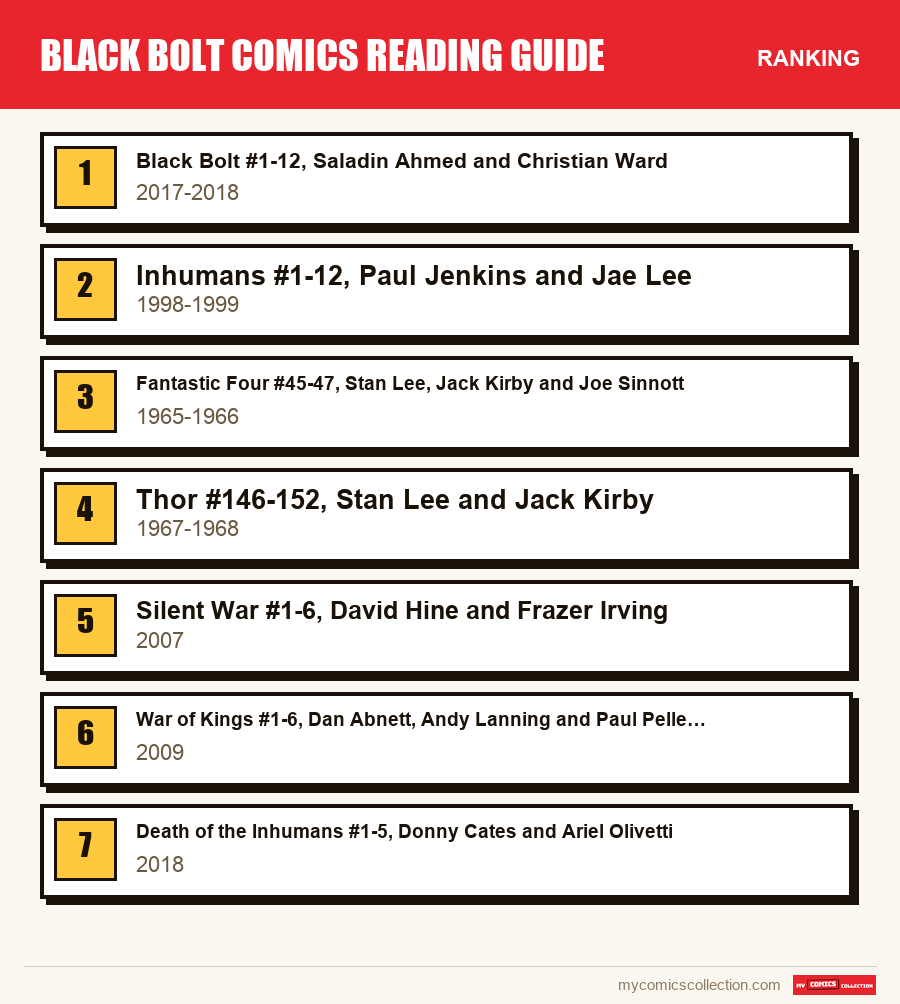
To get into the best Black Bolt comics, open the Black Bolt series (twelve issues, 2017-2018) by Saladin Ahmed on writing and Christian Ward on art, before the Inhumans series by Paul Jenkins and Jae Lee (1998-1999). The mute king of the Inhumans bursts in with Fantastic Four #45, cover-dated December 1965, his first appearance and key issue, created by Stan Lee and Jack Kirby. The cosmic wars of 2007 and 2009 extend the journey.
Black Bolt is a king who cannot speak: his voice, even reduced to a whisper, unleashes a destructive shockwave. This constraint, conceived in Jack Kirby's day, has made him a character that successive writers handle through gesture, gaze and entourage. There is therefore no single obvious entry, but several doors depending on whether you are after a modern adventure, a political tale or the sources.
As always in this guide, only verified information (creators, issue numbers, dates) is stated as fact; the analysis is our own, with no reproduction of protected art or dialogue.
His first appearance
The royal family of the Inhumans is revealed in Fantastic Four #45, cover-dated December 1965. Stan Lee writes, Jack Kirby draws, Joe Sinnott inks. This issue introduces Crystal, Karnak, Triton and the giant dog Lockjaw; Black Bolt appears in it and takes his full place in the next one. Medusa had already appeared in Fantastic Four #36 and Gorgon in issue #44, which explains why the saga gives the impression of unveiling a world that had been glimpsed in pieces.
The king of Attilan is cut from a single block: antennaed mask, absolute silence, measured gestures. Kirby invents a character whose power lies in restraint, and that restraint remains the key to every modern reading. The following issues set up the conflict with Maximus, Black Bolt's brother, and the hidden city of Attilan.
To place these issues within the whole series, our page on Fantastic Four Silver Age key issues offers a path through the Lee and Kirby period.
1: Black Bolt #1-12, Saladin Ahmed and Christian Ward (2017-2018)
This is the best way in for today's reader. The series begins in 2017 and runs twelve issues, collected in two volumes: Hard Time for issues #1-6, Home Free for issues #7-12. Saladin Ahmed writes, Christian Ward draws, Frazer Irving steps in on issue #5, and Clayton Cowles provides the lettering. The 2018 Eisner for Best New Series went to it, and its first collection was among the finalists for that year's Hugo Award for Best Graphic Story.
The title of the first volume announces the theme: Black Bolt is held in a prison there, and the story explores what becomes of a mute king when no one reads his gestures anymore. Lockjaw also has a place there that critics noticed. Ward's highly colorful style gives the whole thing the look of an art album more than a classic superhero comic.
The series is for any reader, with no prerequisites. It reads in two collected volumes, in order, and does not require knowing the Inhumans. To measure what the TV adaptation kept or left aside, our page on the series versus the comics compares the two universes.
2: Inhumans #1-12, Paul Jenkins and Jae Lee (1998-1999)
Published from November 1998 to October 1999 in the Marvel Knights line, this twelve-issue series is a political tale. Paul Jenkins writes, Jae Lee draws, and Lee also provides the cover of the first issue. Attilan is seen from the inside: castes, succession, the weight of the crown. Black Bolt is at the center of the story.
Jae Lee's dark, heavily inked art makes the volume's reputation and gives it an immediate visual identity. The story is for those who prefer power plays to battles, and who enjoy a slow pace. The first issues set the frame clearly enough to be read with no other preparation, and the series lends itself well to reading in a collected edition, in order.
If you like the slowness of this tale, pair it with the 2017 series: both deal with the king's silence, one from the angle of the court, the other from that of isolation. Reading them back to back brings out two very different conceptions of the same character.
3: Fantastic Four #45-47, Stan Lee, Jack Kirby and Joe Sinnott (1965-1966)
The founding saga fits into a few issues, from December 1965 to February 1966. Stan Lee, Jack Kirby and Joe Sinnott introduce the Inhumans, their refuge and their king. Issue #47 also marks the debut of the Alpha Primitives. To understand Black Bolt, this is the reference: everything that comes after goes back to these pages, and modern writers pick up its elements.
Who is it for? The reader who wants to know the sources, the Kirby fan and the collector looking for foundational issues. Reading it requires adjusting to the pace of 1965: Lee and Kirby present a whole world in three issues, assuming nothing is known. In exchange, it shows the character as he was first conceived.
It reads easily in a collected edition of the Lee and Kirby period. Our page devoted to Jack Kirby places these issues within the artist's body of work.
4: Thor #146-152, Stan Lee and Jack Kirby (1967-1968)
In the Thor series, a backup story replaces the usual feature starting with issue #146, cover-dated November 1967, and continues through issue #152, in spring 1968. Stan Lee writes, Jack Kirby draws. This sequence tells the origin of the Inhumans and that of Black Bolt: it is an extended story that explains where the hidden city comes from and why its inhabitants have powers.
It is for the reader who has already read the 1965 saga and wants to know more. The pages are short, since it is a complement to the main story of the God of Thunder, and they follow one another like so many chapters. Each chapter is brief, which makes reading them in a row quicker than you would think.
A practical tip for those hunting the original single issues: these stories hide behind a cover devoted to Thor, which explains why many readers miss them. Check that the backup is present in the issue before buying.
Do you collect this series?
Track what you own, what you are missing and what your collection is worth. 7-day trial.
Start my trial →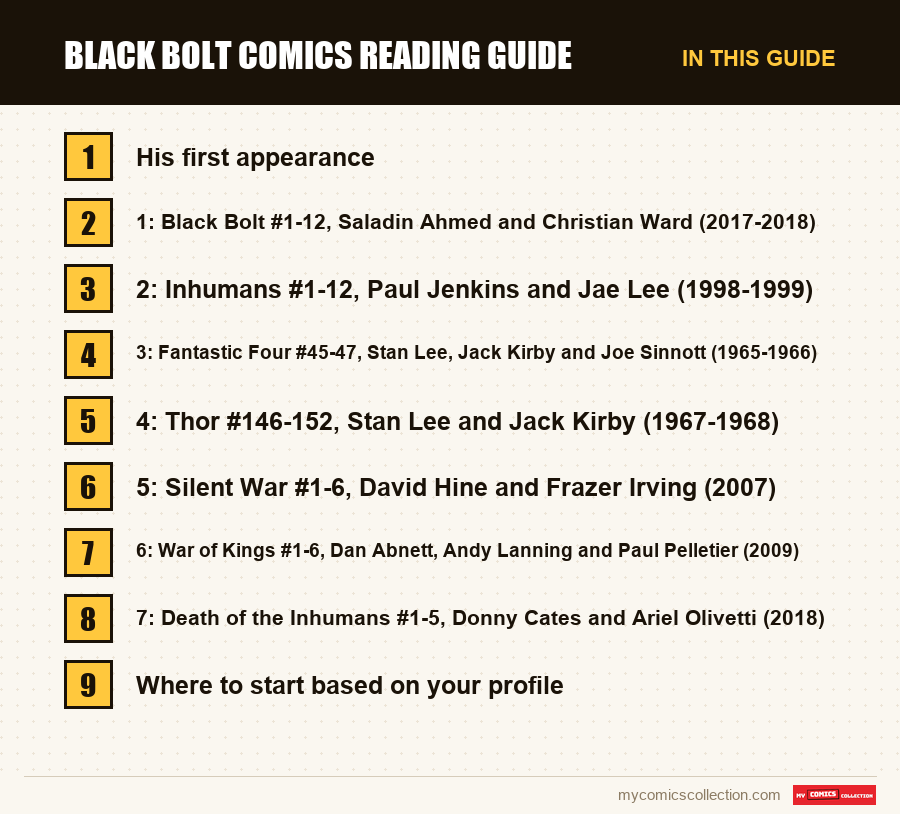
5: Silent War #1-6, David Hine and Frazer Irving (2007)
Six-issue miniseries published in 2007: the Inhumans, led by Black Bolt, go to war against the United States after Quicksilver steals the Terrigen crystals. David Hine writes, Frazer Irving draws and digitally colors his pages, which gives them a very recognizable painterly look. The sixth issue carries the subtitle "Destruction of Attilan".
This story shows the mute king engaged in a large-scale conflict, far from the intimacy of the previous series. It is for the reader already familiar with the royal family and ready to follow a political and military confrontation. The collected edition published in October 2007 gathers the whole thing. It reads as a self-contained story, with no preparation other than knowing the Inhumans.
6: War of Kings #1-6, Dan Abnett, Andy Lanning and Paul Pelletier (2009)
The war between the Kree and Shi'ar empires pits Black Bolt against Vulcan, the leader of the Shi'ar. Dan Abnett and Andy Lanning write, Paul Pelletier draws, for six issues published in 2009. The conflict drags in its wake the Guardians of the Galaxy, the Nova Corps, Darkhawk and the Starjammers.
Black Bolt is a sovereign engaged in a cosmic conflict here, and no longer a king shut away in his mountain. It is the read to favor for a fan of big space sagas, especially since the story builds on earlier events of the cosmic line. It is therefore for a reader comfortable with Marvel's empires. If you are coming from the Guardians, our Guardians of the Galaxy reading guide places the event relative to the team's series.
7: Death of the Inhumans #1-5, Donny Cates and Ariel Olivetti (2018)
Five issues published from July to November 2018. Donny Cates writes, Ariel Olivetti draws, Jordie Bellaire handles the colors and Kaare Andrews provides the covers. The Kree launch an assassination campaign to force Black Bolt to join their empire, and the king summons the four queens of the Inhuman tribes, in a meeting that turns into a trap. A Super-Inhuman created by the Kree, Vox, leads the attack.
Black Bolt is a cornered leader here: he sends Lockjaw to New Attilan, then joins the Kree laboratory with Medusa and Karnak to free Crystal and Lockjaw. The tone is dark and direct. The 120-page collected edition, released in January 2019, makes reading easy. It is for the reader who already knows the Inhumans and wants to see how a modern writer puts them to the test.
Where to start based on your profile
You want a complete, modern story with no prerequisites: pick up Black Bolt (2017-2018) in two collected volumes. You prefer politics and atmosphere: Jenkins and Lee's Inhumans awaits you, and our ranking of the best Inhumans runs places this series among the others. You are looking for the sources: read Fantastic Four #45-47, then the backups in Thor #146-152.
You like large-scale science fiction: aim for War of Kings, with the Guardians and the empires of space, or Silent War if you prefer a war fought on Earth. One last case: you are coming from the TV series and want to see what comes from the comics; our page Inhumans: the TV series versus the comics gives you your bearings before choosing.
The key issues to know
Fantastic Four #45 (December 1965) remains the benchmark key: it is the issue of the debut of Crystal, Karnak, Triton and Lockjaw, and the one where Black Bolt makes his entrance. Fantastic Four #36 contains Medusa and issue #44 Gorgon, two members of the royal family who precede the saga. Thor #146 (November 1967) launches the backup origin story.
For the moderns, keep in mind Inhumans #1 (November 1998), Silent War #1 (2007), War of Kings #1 (2009), Black Bolt #1 (2017) and Death of the Inhumans #1 (July 2018). The method is the same for all of them: read the cover date on the issue, identify the original print run and the variants, and compare several completed sales rather than a single listing. A 1965 issue is judged first on its physical condition, a 2017 issue first on its identification.
Finally, if you collect by character, keep in mind that Black Bolt appears in team series as much as in his own titles: his keys therefore often hide in issues of Fantastic Four, Thor or events. To widen out toward the teams that cross paths with the Inhumans, the Avengers hub offers other paths.
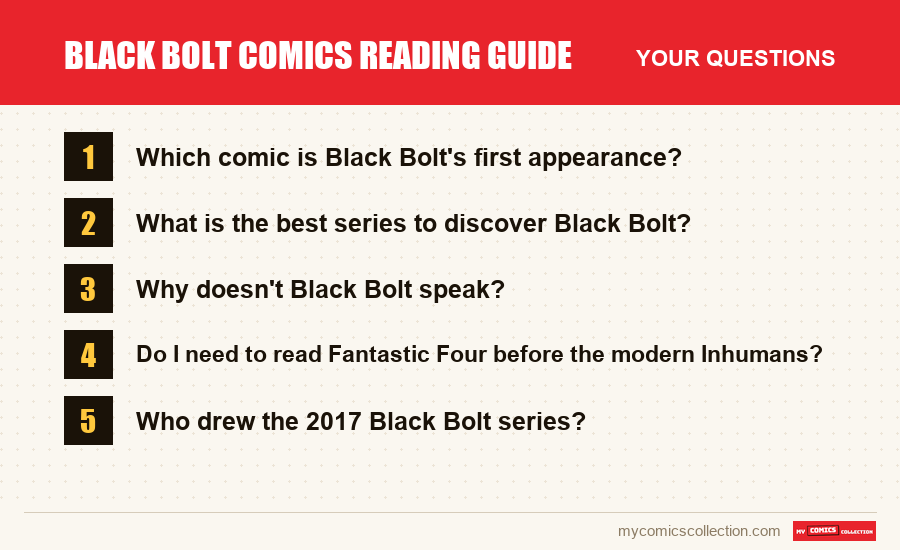
Frequently asked questions
In Fantastic Four #45, whose cover reads December 1965: Stan Lee on script, Jack Kirby on art, Joe Sinnott on inks. It introduces the royal family of the Inhumans, and the king fully asserts himself in the following issue. Medusa had appeared earlier, in issue #36.
Choose Black Bolt, written by Saladin Ahmed and drawn by Christian Ward (2017-2018): twelve issues, no prerequisites. It won the 2018 Eisner for Best New Series. Paul Jenkins and Jae Lee's story (1998-1999) is the alternative for those who prefer political intrigue.
Because his voice, even barely whispered, unleashes a shockwave capable of destroying everything. As king of Attilan, he communicates through gestures and through those close to him. This constraint, established in the days of Lee and Kirby, is the dramatic engine that modern writers pick up, from Jenkins to Ahmed.
No. The 1998 and 2017 series recap the essentials and read on their own. Fantastic Four #45-47 are useful for knowing the sources, but they are not a prerequisite. Start with what draws you, then work back toward the Lee and Kirby period.
Christian Ward draws the series, written by Saladin Ahmed. Frazer Irving steps in on issue #5, and Clayton Cowles provides the lettering. The twelve issues are collected in two volumes, Hard Time and Home Free, which allows continuous reading.
Do you own an issue of Fantastic Four from the Inhumans saga? Get it appraised before you put it away.
Appraise my comic