Inhumans (series, 2017) adapts the royal family of Inhumans , appeared in Fantastic Four #45 (1965) by Stan Lee and Jack Kirby. She stages Black Bolt , Medusa (revealed from Fantastic Four #36, 1965) and their hidden people, whose powers are born from Terrigen Mists. The series transposes Maximus' coup against his brother king, but simplifies a rich cosmic mythology and was freshly received. Here is the detailed comparison, series versus comics.
Adaptation of a little-known and flamboyant part of the Marvel universe, Inhumans brings to the screen a royal family born in the pages of the Fantastic Four. It draws on a teeming mythology of hidden super-humans. Source-by-source decryption.
As in each article in this series, only verified information (creators, distribution, dates, comic numbers) is stated; the comparative analysis is ours, without reproducing dialogue or protected images.
Title : Inhumans (2017)
Showrunner: Scott Buck
Actors: Anson Mount (Black Bolt), Serinda Swan (Medusa), Iwan Rheon (Maximus), Ken Leung (Karnak)
Broadcast: 2017, ABC (1 season, 8 episodes)
Studio: Marvel Television
Fantastic Four #45 (1965): 1st appearance of the Inhumans (Lee & Kirby)
Fantastic Four #36 (1965): Medusa's first appearance
Attilan and the Terrigen Mists: the city and the origin of powers
The royal family: Black Bolt, Medusa, Karnak, Gorgon, Crystal, Lockjaw
- La royal family and its emblematic members.
- Black Bolt, mute king whose voice is a devastating weapon.
- Medusa and her hair with supernatural powers.
- Le Maximus' coup d'état, Black Bolt's jealous brother.
- Lockjaw, the giant dog capable of teleportation.
- The action moves in Hawaii, on Earth, rather than in a fabulous city.
- La cosmic mythology is greatly reduced and simplified.
- Attilan is located on the Moon, but little shown in its grandeur.
- Le caste system inhumane becomes a central social issue.
- The story focuses on a family conflict tightened.
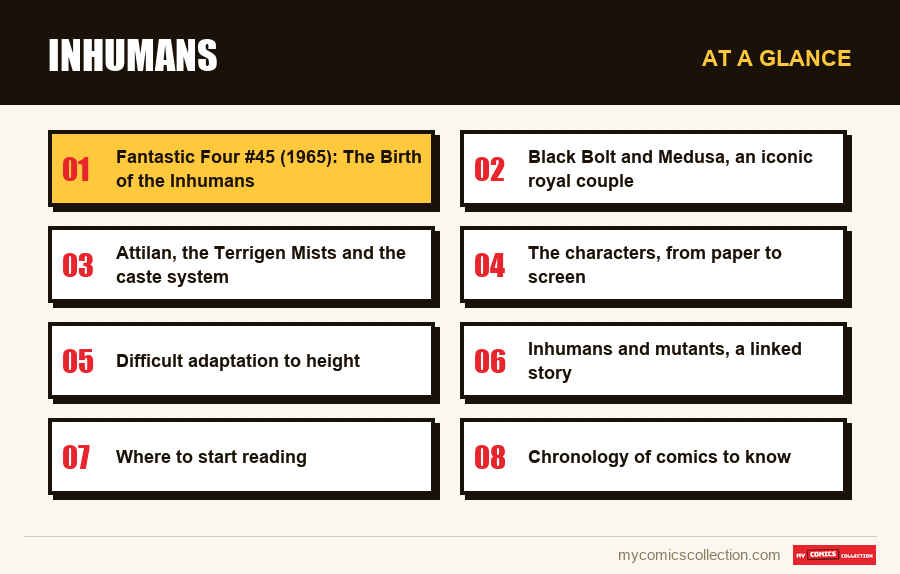
Fantastic Four #45 (1965): The Birth of the Inhumans
The Inhumans appear in Fantastic Four #45 (1965), imagined by Stan Lee and Jack Kirby at the height of their creativity. Medusa had been introduced a few months earlier in Fantastic Four #36 (1965), first as a member of the Frightful Four, before her true nature was revealed. The Inhumans are a race of humans modified in the distant past by extraterrestrial experimentation, endowed with unique powers and living hidden in the city of Attilan. Their royal family (Black Bolt the mute king, Medusa the queen, Karnak, Gorgon, Crystal and the teleporting dog Lockjaw) form a gallery of spectacular characters, with unforgettable designs by Kirby.
This mythology, one of the richest of the Silver Age, combines royalty, science fiction and family tragedy. It offers a fascinating counterpoint to classic superheroes: the Inhumans do not seek glory but the preservation of their people, torn between isolation and openness to the world. The series takes up this base (the royal family, the dynastic conflict) but must deal with means and a format which limit the cosmic scale of the source.
Black Bolt and Medusa, an iconic royal couple
At the heart of the mythology is Black Bolt, arguably the most unique character of the Inhumans. King of Attilan, he is condemned to absolute silence: his voice, even a whisper, releases a shock wave capable of razing a mountain. This curse makes him a tragic sovereign, communicating through gestures and looks, of whom every word retained is a burden. Anson Mount embodies this imposing muteness on screen, faithful to the spirit of the character. At his side, Medusa, queen with living hair that she wields like a multitude of arms, is his voice and his advisor, played by Serinda Swan.
This royal couple, one of Marvel's most emblematic, structures the series as it structures the comics. Their relationship (a king who cannot speak, a queen who speaks for him) is of obvious dramatic power. The series makes them the emotional heart of its story, even if it cannot deploy all the visual grandeur that Kirby had given to these figures. Black Bolt and Medusa remain, from paper to screen, the soul of the Inhumans.
Attilan, the Terrigen Mists and the caste system
The Inhuman mythology rests on two pillars that the series adapts in its own way. The first, the Terrigen Mists: a substance which, during a ritual called Terrigenesis, reveals the latent powers of each Inhuman. This transformation, as beautiful as it is formidable, can confer prodigious gifts as well as monstrous mutations. The second, the city of Attilan, refuge of the inhuman people, located on the Moon in the series. Around these elements, the series develops a social theme: the caste system which governs inhuman society, where the result of Terrigenesis determines the rank of each person, condemning some to forced labor.
This social prism is one of the contributions of the series: it makes Maximus' coup d'état no longer a simple whim of power, but a revolt against an unjust order. Maximus, deprived of powers by his own Terrigenesis, sees it as a machine to oppress. The series thus anchors its dynastic conflict in a critique of the inhuman hierarchy, where the comics favored mythological scope. This choice, ambitious on paper, however suffers from an execution considered too timid in view of the visual richness of the source.
Collecting this series?
Track what you own, what you are missing and what your collection is worth. 7 day trial.
Start my trial →The characters, from paper to screen
- Black Bolt: Mute king whose voice is a weapon, faithful to his version in the comics.
- Medusa: Queen with living hair, voice and advisor to the king.
- Maximus: Jealous and usurping brother, driving force of the conflict, played by Iwan Rheon.
- Karnak: Strategist capable of seeing the fault in everything.
- Crystal and Lockjaw: The young princess with elemental powers and the teleporting dog, much loved by readers.
Difficult adaptation to height
The Inhumans series has been remembered as one of the most contested Marvel adaptations. The gap between the cosmic and baroque scale of Kirby's comics and the modesty of the television production was keenly felt. The grandeur of Attilan, the excess of powers, the visual richness of the inhuman people, so many elements that are difficult to transpose on a limited budget. By moving some of the action to Hawaii and tightening the narrative on a family conflict, the series sought to circumvent these limitations, at the cost of the magic specific to the source.
This observation does not detract from the interest of the original material. Quite the contrary: the disappointment aroused by the series reminded us how much the Inhumans deserve an adaptation to their measure. Their mythology, between tragic royalty and flamboyant science fiction, remains one of Marvel's untapped treasures. The series at least had the merit of introducing these characters to a wider audience, and of drawing attention to comics that had long remained in the shadow of the most famous superheroes.
Inhumans and mutants, a linked story
A fascinating aspect of Inhuman mythology is its relationship with mutants. In recent comics, the Terrigen Mists, scattered across Earth, awakened the powers of humans carrying inhuman genes: a mechanism which served, for a time, to highlight the Inhumans. This dynamic echoes the theme of difference and marginality, dear to the Marvel universe. Inhumans, like mutants, are beings apart, feared and misunderstood, who question the place of others in society.
The series, focused on a single season, did not have time to explore this thematic richness. But it is part of a larger whole, where other productions have addressed the inhuman question: notably through the character of Daisy Johnson and the stories of Agents of S.H.I.E.L.D. For the reader, Inhumans is an invitation to explore this part of the Marvel universe where science fiction meets royal tragedy, and where the question of difference finds a singular resonance.
Where to start reading
To discover the Inhumans, the Fantastic Four stories by Stan Lee and Jack Kirby, starting with Fantastic Four #36 and #45 (1965), lay the foundations of the mythology. Paul Jenkins and Jae Lee's limited series "Inhumans" (1998) offers a more intimate and acclaimed portrait of the royal family. Recent stories where the Inhumans take center stage extend this universe. This journey covers the sources of a series which draws from a little-known but flamboyant part of Marvel.
Chronology of comics to know
- 1965: Fantastic Four #36: First appearance of Medusa.
- 1965: Fantastic Four #45: First appearance of the Inhumans and the royal family.
- 1998: “Inhumans” (Jenkins & Lee): an acclaimed miniseries about the royal family.
Collection side: what numbers to aim for after the series
Inhumans points to major keys to the Silver Age. Fantastic Four #45 (1965, first appearance of the Inhumans) is a sought-after issue, important to the entire mythology. Fantastic Four #36 (1965, first appearance of Medusa) is another valuable target. The mini-series “Inhumans” by Jenkins and Lee (1998) will interest fans of a more intimate story and its acclaimed aesthetic. These targets cover various budgets, from the sought-after Silver Age to accessible modern. As always, condition and gradation determine value; relying on real recent sales is strongly recommended.
Its place in the saga and for the collector
Inhumans brought to the screen a flamboyant but little-known part of the Marvel universe, despite a difficult reception. For the collector, it brought attention to Fantastic Four #45 and #36, keys to the Silver Age. It illustrates the effect of adaptations on the market, even contested ones. Beyond speculation, the series invites you to discover the mythology of the Inhumans, this tragic and spectacular royal family born under Kirby's pencil. She reminds us that comics contain visual and narrative treasures that even an imperfect adaptation can help to make known.
The verdict: a royal family to rediscover
- Loyalty: the royal family, Black Bolt, Medusa, Maximus' coup and Lockjaw come from the comics.
- Freedoms: the action in Hawaii, the reduced cosmic mythology, the central caste system, a tighter narrative about family conflict.
- Collectible numbers: Fantastic Four #45 (Inhumans), Fantastic Four #36 (Medusa), “Inhumans” (1998).
Inhumans transposes a spectacular royal family from the comics into a format that struggles to convey its cosmic scale. Faithful to its iconic characters (Black Bolt, Medusa, Maximus) but simplifying its mythology, the series has divided. For the reader as for the collector, it is an invitation to discover, in the comics, the tragic grandeur of the Inhumans as Kirby had imagined it. Because it is on the page, in the excess of the designs and the magnitude of the dynastic stakes, that these characters deploy their full potential: a potential that 2017 television has only touched on, but which still awaits the adaptation to its measure that this extraordinary royal family deserves.
Frequently asked questions
They appear in Fantastic Four #45 (1965), created by Stan Lee and Jack Kirby. Medusa was introduced in Fantastic Four #36 (1965). The royal family and their city, Attilan, are at the heart of this Silver Age mythology.
His voice, even a whisper, releases a devastating shockwave. King of Attilan, he is condemned to silence and communicates by gestures. It's faithful to the comics, where this muteness makes him a tragic sovereign.
It retains the royal family and the conflict with Maximus, but greatly simplifies the cosmic mythology, moves the action to Hawaii and was judged to fall short of the visual richness of the source by Kirby.
A ritual where the Terrigen Mists reveal the latent powers of an Inhuman. The result, prodigious or monstrous, determines one's rank in society: a social theme that the series develops around the caste system.
Fantastic Four #45 (1965, first appearance of the Inhumans) is the most sought after key. Fantastic Four #36 (Medusa) and Jenkins and Lee's "Inhumans" miniseries (1998) are other prime targets.
Does the series make you want to collect? Estimate the value for free of your issues (Fantastic Four #45, #36…) with our tool based on current eBay listings.