
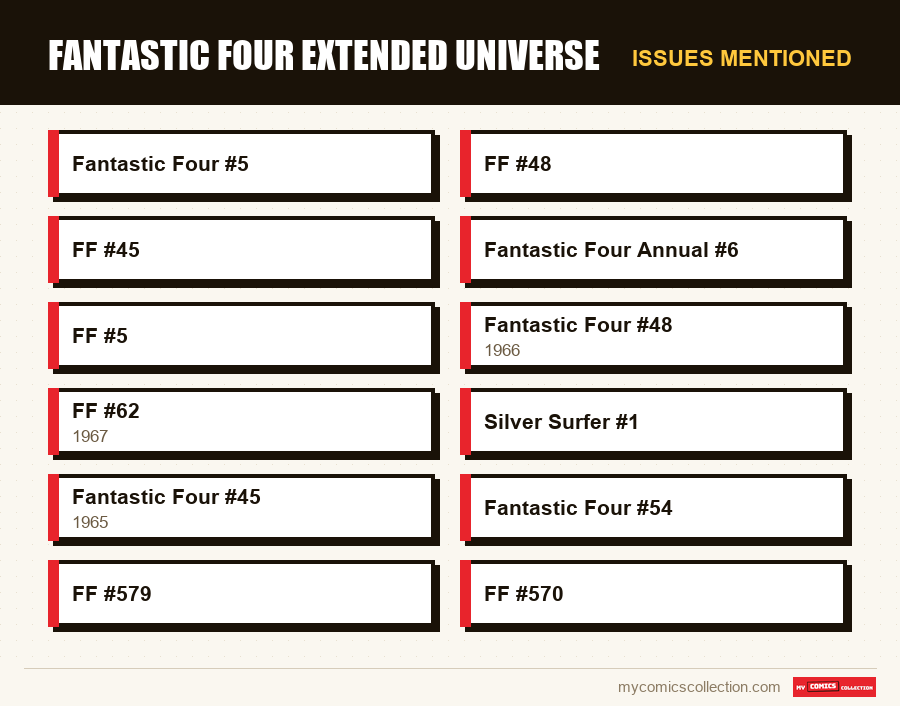
The Fantastic Four universe is the birthplace of the modern Marvel Universe. Essential early appearances include Doctor Doom (Fantastic Four #5, 1962), Silver Surfer (FF #48, 1966), Galactus (FF #48-50, 1966), the Inhumans (FF #45, 1965), and Franklin Richards (Fantastic Four Annual #6, 1968). The series Silver Surfer , Inhumans and Future Foundation form an extended universe of unequaled richness.
The Fantastic Four are the cornerstone of Marvel Comics, and their Expanded Universe proves it. Since 1961, Lee and Kirby have created in these pages a countless number of characters who have become pillars of the Marvel Universe: Doom, Galactus, Silver Surfer, the Inhumans, the Skrulls, the Black Surfer. Collecting the FF ecosystem is collecting the very foundations of Marvel.
This guide lists strategic first appearances, spin-off series, and approaches to building a complete collection of the extended Fantastic Four family. For key numbers of the main title, see our Fantastic Four key numbers guide.
Major Villains: First Appearances
Doctor Doom (Victor Von Doom)
First appearance in Fantastic Four #5 (July 1962). Greatest Marvel Villain, period. FF #5 is a premier Silver Age key that has continued to increase in value. Doom also has numerous solo appearances and has been a member of the FF themselves (Hickman run).
Galactus
First appearance in Fantastic Four #48 (March 1966). The Devourer of Worlds is introduced in the Galactus Trilogy (#48-50), one of the most important arcs in comics history. These three numbers are major investments.
Annihilus and Blastaar
Annihilus begins in Fantastic Four Annual #6 (November 1968) and Blastaar in FF #62 (May 1967). The Negative Zone sovereign is an undervalued key that gained visibility thanks to the event Annihilation (2006).
Supporting Cast: Key Characters
Silver Surfer (Norrin Radd)
First appearance in Fantastic Four #48 (March 1966). The Herald of Galactus got his own series in 1968 (Silver Surfer #1-18), then the legendary series of 1987 (vol. 3, 146 issues). A character whose solo universe is as vast as that of the FF themselves.
The Inhumans (Black Bolt, Medusa, Crystal)
First appearance in Fantastic Four #45 (December 1965). The royal family of Attilan (Black Bolt, Medusa, Crystal, Karnak, Gorgon, Triton) are introduced in the pages of the FF before becoming a franchise in their own right. FF #45 is a major key.
Franklin Richards
First appearance in Fantastic Four Annual #6 (November 1968). Reed and Sue's son is one of Marvel's most powerful mutants. His role in the Byrne and Hickman runs makes him a central character in FF continuity.
Valeria Richards
First appearance in Fantastic Four #54 vol. 3 (June 2002, Chris Claremont). Reed and Sue's daughter, named Doctor Doom, is a key character in the Hickman run and the Future Foundation.
Derivative series and spin-offs
Essential satellite titles: Silver Surfer (vol. 1 1968, vol. 3 1987-1998-146 issues), Inhumans (Jenkins/Lee 1998, 12 issues: masterpiece), FF (Future Foundation, 2011-2012, Hickman then 2013 Fraction), Fantastic Four: Life Story (2021, 6 issues) and Silver Surfer: Black (2019, Cates/Moore: visually extraordinary).
Future Foundation and Legacy
The Future Foundation (FF #579, Hickman, 2010) redefines the group's identity as a scientific think tank. The series FF (2011) with Spider-Man replacing the deceased Torch is a pivotal moment. The complete Hickman run (FF #570-588 + FF #1-23) is considered one of the best Marvel runs of all time and remains remarkably accessible as singles.
Crossovers and cosmic events
Major events in the FF universe include Annihilation (2006: Annihilus, Silver Surfer, Galactus), War of Kings (2009: Inhumans vs. Shi'ar), Secret Wars (2015, Hickman: Doom God) and Galactus the Devourer (1999). The event Infinity (2013) also ties the Inhumans to the entire cosmic Marvel.
Collecting Strategy for the Expanded Universe
FF #5 (Doom), #45 (Inhumans) and #48 (Galactus/Surfer) are the three grails: prioritize according to your budget. Complete with FF Annual #6 (Franklin/Annihilus) and the full Hickman run. Inhumans by Jenkins/Lee and Silver Surfer: Black offer excellent value for money. The Silver Surfer series vol. 3 (#1-50) is rich in cosmic keys that are still affordable (Thanos in #34-38).
Structure your collection of the Fantastic Four universe with our management application: from Doom to Inhumans, follow each branch of the First Marvel Family.
Frequently asked questions
Doctor Doom (Fantastic Four #5, 1962), the Inhumans (FF #45, 1965), Silver Surfer and Galactus (FF #48-50, 1966) and Franklin Richards (Fantastic Four Annual #6, 1968). FF #5, #45 and #48 are considered the three grails.
Annihilus debuts in Fantastic Four Annual #6 (November 1968) and Blastaar in FF #62 (May 1967). Annihilus is an undervalued key that gained visibility through the Annihilation event (2006).
Silver Surfer (the 1968 series, then the 1987 one), Jenkins and Lee's Inhumans (1998, 12 issues), FF and the Future Foundation (2011-2012), Fantastic Four: Life Story (2021) and Silver Surfer: Black (2019). Inhumans and Silver Surfer: Black offer excellent value.
It redefines the group as a scientific think tank with the Future Foundation, and it is considered one of the best Marvel runs of all time. It remains remarkably accessible in single issues.
Annihilation (2006), War of Kings (2009), Secret Wars (2015, Hickman) and Infinity (2013), which also ties the Inhumans to the cosmic Marvel. Galactus the Devourer (1999) completes the picture.