
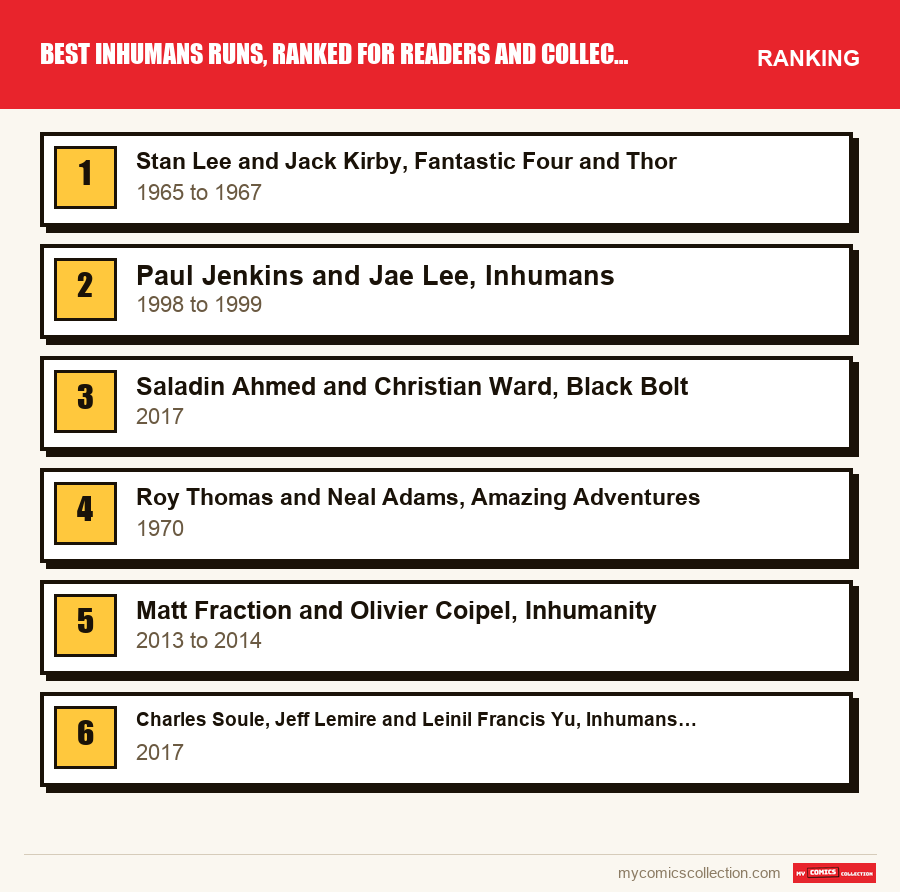
To read the Inhumans, everything starts with Fantastic Four #45 (1965), by Stan Lee and Jack Kirby, then the stories that extend its mythology. In second place comes the Inhumans series by Paul Jenkins and Jae Lee (1998), then Black Bolt by Saladin Ahmed and Christian Ward (2017). Our ranking keeps six readings, from the Silver Age to the Terrigen Mists crisis, each with the best format for reading or collecting it.
The Inhumans have rarely held their own series for more than a year or two. Their story therefore reads in scattered episodes: a hidden kingdom, a king who cannot speak, a queen with living hair, a jealous brother, and a substance that reveals or distorts the powers of those who come near it. Ranking their best runs means choosing moments when a creator took this material seriously. The six chosen follow, with what each expects of its reader.
As always on this guide, only verified information (creators, issue numbers, dates) is stated as fact; the analysis is our own, with no reproduction of protected art or dialogue.
How we chose our six readings
The Inhumans pose a ranking problem the other teams do not: their best stories are not always the easiest to find, and the easiest to find are not always the best. We kept the periods when a creator gave the kingdom of Attilan its own visual or political identity, rather than those where the characters serve to advance another hero's plot. Crossovers are included only when their effect on the mythology is lasting.
The rank shown is that of reading quality. Collecting is handled at the very bottom, separately: what makes the founding issues sought after has almost no connection with what you will read first.
Top 1: Stan Lee and Jack Kirby, Fantastic Four and Thor (1965 to 1967)
It all comes from here. Medusa appears in Fantastic Four #36 (1965), within the opposing team of the Frightful Four, without anyone yet knowing where she comes from. A few months later, Fantastic Four #45, dated December 1965, introduces readers to the hidden people of Attilan, with Black Bolt, Karnak, Gorgon, Triton, Crystal and a giant dog able to teleport. Stan Lee writes a story of encounter where the threat blends wonder and unease; Jack Kirby draws silhouettes that defined forever the look of the kingdom: dizzying cities, finned costumes, expressions of restrained grandeur.
The story does not stop at one issue. The following issues of Fantastic Four bring the Inhumans back, and from about 1967 the Thor series gives them complementary stories, still by Stan Lee and Jack Kirby. This body of work fixes the essentials: a king whose voice is a weapon, a people living apart from the world, a hierarchy whose foundations are murky. Every author who follows will draw from this bank of images, and nothing on this list replaces the original.
This reading is for every reader, and no doubt first of all for the one who has read no Inhumans: the whole is short, the staging is legible, and the tone, half epic and half fabulous, has aged less than its reputation suggests. For collecting, the original issues of the Fantastic Four series are high-ranking objects whose price reflects scarcity and condition; collected editions in color or in black and white are enough for reading. We cover the question of printings and conditions in our file on the key Fantastic Four issues of the Silver Age.
Top 2: Paul Jenkins and Jae Lee, Inhumans (1998 to 1999)
When Marvel relaunches its second-tier heroes under the Marvel Knights imprint, one of the first series is devoted to the Inhumans. Paul Jenkins writes its twelve issues, Jae Lee draws them. The result has almost nothing to do with Kirby's somewhat fabulous image: it is a court tale, silent, stretched out, where every panel seems weighed. Black Bolt rules a kingdom that no longer has a clear role, Medusa holds the balance, and Maximus, Black Bolt's brother, watches for the opportunity his twisted mind has always been waiting for.
Jae Lee is the first reason to read this run. The narrow silhouettes, the large black flats, the barely drawn faces make the characters true figures of tragedy. The muted palette of the series accentuates the distance: you are not watching heroes, you are watching a dynasty come apart. Paul Jenkins writes less dialogue than you would expect and lets the image say the essentials, which suits a mute king. It would be a mistake to expect a spectacular adventure: the story is a family drama.
The series is for those who appreciate comics with a literary tone, and who do not need Marvel continuity to enter a story. To read it, a collected edition is more than enough, and it is easy to find; to collect it in single issues, the twelve original numbers are a realistic goal, far from the prices of the founding issues. It is probably the best ratio between reading quality and ease of access in this whole ranking.
Top 3: Saladin Ahmed and Christian Ward, Black Bolt (2017)
The Black Bolt series, launched in 2017, tries something no one had dared: locking the king of the Inhumans in a cosmic prison and stripping him of his role. Saladin Ahmed imagines a sovereign deprived of his people, surrounded by fellow inmates including the Absorbing Man, and forced to relearn how to live without the defense his silence gave him. Christian Ward draws the series in a painted style with strange colors that turns the cell into an inner landscape. The title runs twelve issues.
This run holds third rank because it achieves the rarest thing: changing the point of view without betraying the character. Black Bolt's silence, which elsewhere serves as a subject of pathos, becomes here a practical handicap, a trait that must be turned to his advantage. Saladin Ahmed writes a tale of escape and unlikely friendship, in which royalty weighs less than dignity. Science-fiction fans will find a tone close to fable.
It is for readers who have already tasted the mythology and want to see it transformed. It reads in a single volume, which is its best form. On the collecting side, no market value is established: the series is too recent for a hierarchy to emerge, and only Black Bolt's future role on screen and the follow-up to his series will matter. Beware of alternate covers whose exact distribution you cannot pin down.
Top 4: Roy Thomas and Neal Adams, Amazing Adventures (1970)
The Inhumans receive their first title in Amazing Adventures #1, in 1970. Roy Thomas writes the stories, Neal Adams draws the first episodes, and the artist, then at the peak of a reputation built on other titles, brings the kingdom a more realistic anatomy and a sense of movement that stand out after Kirby. The public then discovers a royal family made more human, with gestures of ordinary life, restrained expressions, glances. The layout is dynamic and open.
This reading deserves fourth rank for a specific reason: it shows how an artist from another school can take over a world designed by someone else. It is therefore for fans of Adams and for those who want to measure, over time, how the Inhumans are taken up. Our page devoted to Neal Adams places this foray within the whole of the artist's career. The story itself is more dated than the rest of the list, but the pages are worth the detour.
For collecting, these are 1970s single issues: their state of preservation varies a lot with the paper, and the criterion to keep in mind is consistency between the indicia, the color and the binding. Collected editions are the most comfortable way to read, often paired with other stories of the period.
Do you collect this series?
Track what you own, what you are missing and what your collection is worth. 7-day trial.
Start my trial →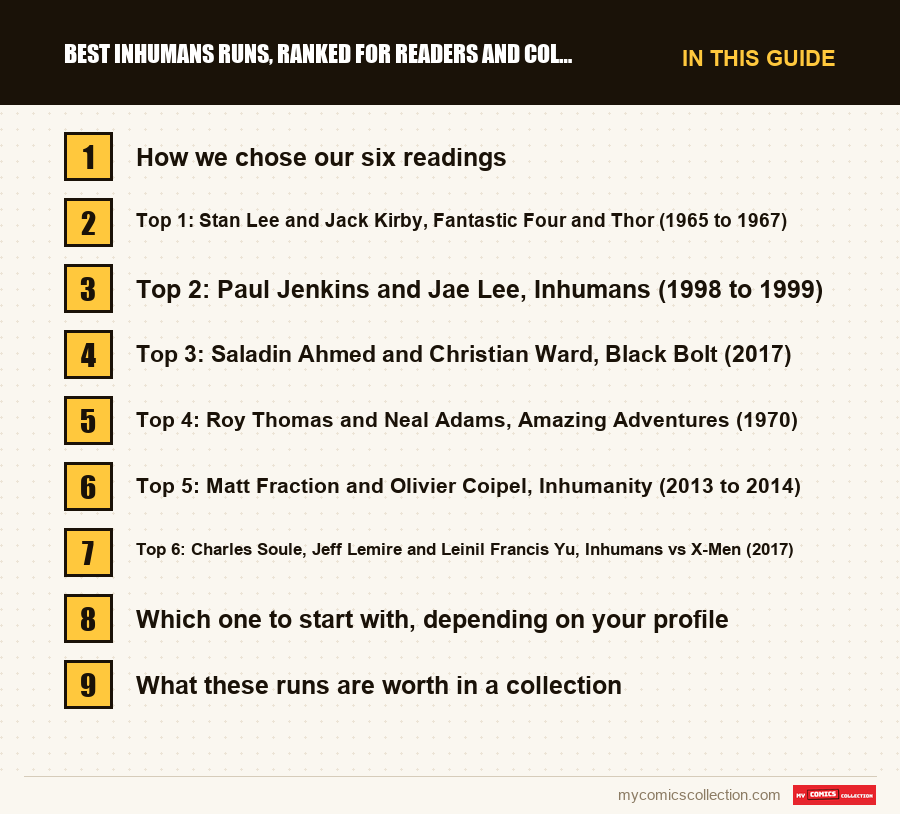
Top 5: Matt Fraction and Olivier Coipel, Inhumanity (2013 to 2014)
After the great battle of Infinity, where Black Bolt makes a choice with enormous consequences, the Terrigen Mists spread across the Earth. Inhumanity, written by Matt Fraction and drawn by Olivier Coipel, tells what happens: ordinary people discover they carry a hidden genetic heritage, and their powers awaken. This is the birth of what the reader of the time calls the new wave of Inhumans, among them Kamala Khan, the heroine of Ms. Marvel. The story sets up a deep change of status: the Inhumans are no longer an isolated people, but a presence mixed into society.
This run ranks fifth because its reach exceeds its own quality. Olivier Coipel delivers big scenes, Matt Fraction brings irony, and yet the result is sometimes diluted by the obligation to launch several other series. It is for readers curious about the origin of Kamala Khan, whose debut is detailed in our article on Ms. Marvel #1, or for those who want to understand why the Inhumans end up mixed into the following conflicts. The Matt Fraction hub places this period within the writer's body of work.
For collecting, the market value remains little established: the issues depend on successive printings and on the lasting place of the new characters. Collected editions are the better choice for reading, especially since the event spans several series.
Top 6: Charles Soule, Jeff Lemire and Leinil Francis Yu, Inhumans vs X-Men (2017)
The last reading is the most debated. In this 2017 event, the Terrigen Mists turn out to be toxic to mutants, which places the Inhumans and the X-Men in a confrontation with no simple way out. Charles Soule and Jeff Lemire share the writing, Leinil Francis Yu draws sweeping clashes, with a marked taste for big crowd scenes. The miniseries reads as the end point of a period, and several readers saw in it the limit of what the mythology could bear.
It closes the ranking because it serves as context more than as a standalone story: you read it to understand where the Inhumans ended up in the mid-2010s. It is for those who already follow the X-Men and want to see the meeting of the two universes. A single collected edition gathers the essentials, and the market value of the single issues, too recent, is not established.
Which one to start with, depending on your profile
If you are discovering the Inhumans through the 2017 television series, begin with Fantastic Four #45 in a collected edition: you will see what the production kept and what it left aside. If you prefer stories with literary ambition, the Paul Jenkins and Jae Lee miniseries is the richest entry. If you like science fiction and escape tales, Saladin Ahmed's Black Bolt is the best starting point. Ms. Marvel readers will gladly head to Inhumanity, which explains the origin of Kamala Khan's powers.
A collector can build a reading in layers: first a volume from the Kirby period, then the 1998 series, finally a selection of recent stories. This progression stays coherent, because each step shifts the center of gravity of the kingdom of Attilan slightly.
What these runs are worth in a collection
The values on this shelf split into two very distant blocks. On one side, the founding issues of the Silver Age, whose demand rests on their first-appearance status; on the other, everything else, which trades in an unrelated zone. The ratio between a founding issue and an ordinary issue of the 1998 series is one of the highest in the whole Marvel catalog, which means you can build a serious shelf without touching the first ones.
Three measures help decide: single issue against collected edition, average copy against graded copy, isolated issue against complete sequence. On recent series, like Black Bolt or Inhumanity, no market value is established; demand will depend on what the studios do with the character and on the success of its heirs. Rely on completed sales and precisely described conditions, never on a listing without a photo of the indicia.
For a mythology with scattered high points, the comparison bound albums vs single issues helps you choose.
Frequently asked questions
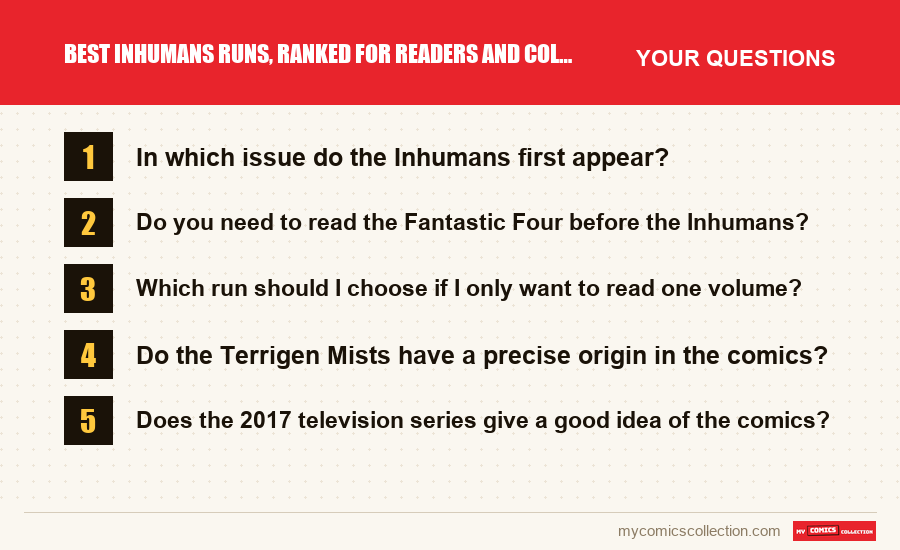
In Fantastic Four #45, dated December 1965, by Stan Lee and Jack Kirby. Medusa had appeared earlier the same year in Fantastic Four #36, within the opposing team of the Frightful Four, before her membership in the people of Attilan was revealed.
No. Issue 45 of Fantastic Four reads on its own and introduces the kingdom of Attilan with no prior knowledge. For the 1998 miniseries by Paul Jenkins and Jae Lee or for Saladin Ahmed's Black Bolt, no preparatory reading is needed.
Saladin Ahmed's Black Bolt reads in a single volume of twelve issues and needs no preparation. For a more classic entry, prefer a Fantastic Four collected edition covering issue 45 and its follow-ups, which gives you the source of everything that came after.
They are part of the mythology from the earliest days of the Inhuman people: a substance that reveals powers during Terrigenesis. Their spread across the Earth, which gives birth to new Inhumans like Kamala Khan, is told in the Inhumanity event of 2013 and 2014.
Partly. It keeps the royal family and the rivalry with Maximus, but tightens the universe and changes the setting. To measure the gap, our comparison article details what was kept and changed, and reading Fantastic Four #45 remains the best reference.
Do you have a Fantastic Four #45 or a Fantastic Four #36 in your boxes? Have it estimated by stating the exact condition of the copy.
Estimate my comic