
In short
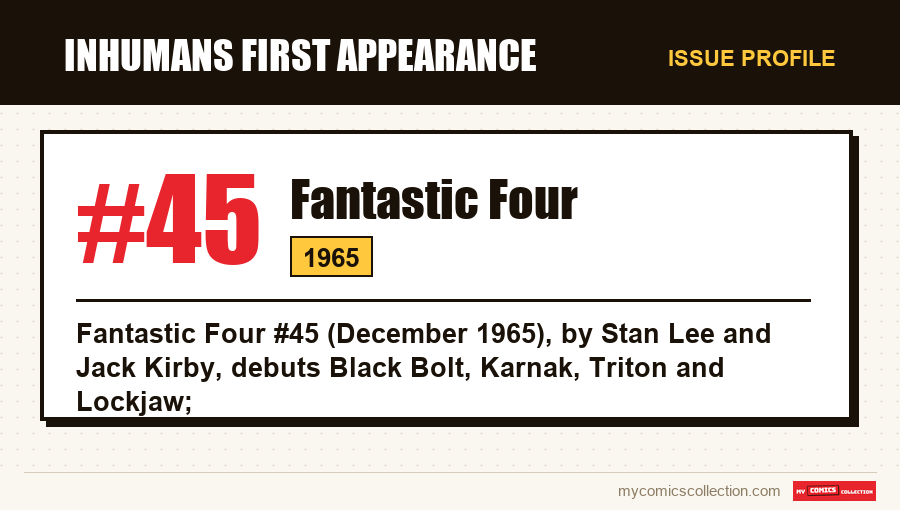
Fantastic Four #45, cover dated December 1965, is the debut of Black Bolt, Karnak, Triton and Lockjaw, created by Stan Lee and Jack Kirby. It is not the debut of every Inhuman: Medusa appears earlier in #36 (March 1965) and Gorgon in #44, while the Alpha Primitives follow in #47 (February 1966). The issue is the point where the hidden royal family is shown as a family, and that is what collectors mean by the Inhumans first appearance.
Few Silver Age issues carry a headline as easy to get wrong as this one. "First appearance of the Inhumans" sounds like a single event, but the family was assembled across several issues, and the precise answer depends on which member you are chasing.
Each debut date and credit below was verified character by character; the case for why #45 matters and the advice on choosing a copy are interpretation, and there is no price on this page.
Date, creators and place of #45 in the run
Fantastic Four #45 carries a December 1965 cover date. Lee wrote and Kirby drew; together they are named as creators of the newcomers who appear in its pages. The book belongs to the stretch of the series in which Lee and Kirby were pushing the title from a team of adventurers toward a full mythology, and the issue feeds directly into the next two chapters, #46 and #47.
The sequence that matters is short. #44 sets up a pursuit, #45 reveals the people being pursued, and the following issues develop the setting and the political conflict inside the hidden city. For a collector this means that the Inhumans story is a multi-issue block, much as the Galactus story that comes right after it is a three-issue block. Reading or collecting only one number gives you a slice, not the whole.
When you look at a listing, check the cover date and the series title before anything else. The series is the first volume of Fantastic Four, the issue number is 45, and the date is December 1965. Anything else, including later reprints and facsimiles with similar covers, is a different object.
Who debuts where: sorting the family by issue
The royal family of the Inhumans did not arrive all at once, and the safest way to avoid confusion is to list each member against the issue where the character first appears.
Medusa comes first. She debuts in Fantastic Four #36, dated March 1965, where she is seen in a flashback and then in costume as part of the Frightful Four, the villain team that fights the Fantastic Four in #36, #38 and #41 to #43 while she suffers from amnesia. At that stage she is a villain with no stated connection to a hidden civilization, which is why nobody called her an Inhuman at the time of the issue.
Gorgon comes next, in #44, as a pursuer sent after Medusa on behalf of Maximus. Then #45 brings in Black Bolt, Karnak, Triton and Lockjaw, and #47, dated February 1966, adds the Alpha Primitives to the hidden society. Taken together, the cast is built over several issues, and the cover date of #45 is the one that matters most because it is the issue that gives the group its leader and most of its members.
This list explains why serious collectors rarely talk about a single "Inhumans first appearance". They talk about #45 for the king and the royal family, #36 for Medusa and #44 for Gorgon. Each of those has its own small market, and the prices follow the weight of the character and the visibility of the issue.
How the family is introduced in the story
The plot of the Inhumans sequence unfolds through the pursuit of Medusa. In #44 Gorgon is on her trail for Maximus, and in #45 the Fantastic Four find themselves in the middle of a conflict between a hidden royal family and the world outside. The story brings the team face to face with Black Bolt, the silent king, with Karnak and Triton, two members of the royal circle, and with the giant dog Lockjaw.
What makes the debut effective is the way it presents the family. Instead of a single villain or a single new hero, the issue shows a group with titles, loyalties and a place of their own, and that place is Attilan, the hidden city where a barrier raised by Maximus traps Medusa from #45 to #48 until Black Bolt frees her. The group is a world as much as a cast, which is why the characters returned so often afterwards.
The dialogue is not reproduced here, and it does not need to be: what the issue establishes is the situation. A hidden people with a ruling family, a rivalry inside that family and a link to the Fantastic Four through Medusa, who was already known to readers from the Frightful Four stories. That link is the editorial bridge that Lee and Kirby built to bring a new corner of the Marvel universe into an existing series.
Why it is a key issue
The case for #45 rests on four points. First, it is the debut of the king, Black Bolt, and of the royal family members Karnak and Triton, and it is the debut of Lockjaw, a character with a loyal following of his own. Four debuts in a single issue is a rare density for a collector.
Second, the Inhumans proved durable. After the Fantastic Four stories, the characters moved on to a back-up feature in Thor, which ran from #146 (November 1967) to #152 (May 1968) and contained their first extensive origin story. They then received their first ongoing feature in Amazing Adventures, which ran from #1 (August 1970) to #10 (January 1972), with Kirby writing and penciling the first six issues. They also had their own series, launched in October 1975 and running into 1977, with Doug Moench writing all but #9.
Third, the characters have been present in later adaptations and event stories, which keeps readers returning to the source. Whenever a new storyline or screen project puts Black Bolt or Medusa in the spotlight, the debut issues attract fresh attention, and the market behind them moves with that attention.
Fourth, the issue sits within a run of Fantastic Four numbers that collectors already treat as foundational. It sits just before the Galactus Trilogy, whose first chapter, #48, picks up from the Inhumans story, and a collector filling in this part of the series will want it for the run as much as for the characters.
Do you collect this series?
Track what you own, what you are missing and what your collection is worth. 7-day trial.
Start my trial →
Reprints, collections and issues often confused with the debut
As with most Silver Age keys, the Inhumans debut is easy to read without owning the original. The collected edition titled Inhumans: The Origin of the Inhumans, published in October 2013, gathers Fantastic Four #36, #38 and #41 to #47 together with the Thor back-ups #146 to #152, which makes it a convenient way to follow the whole arc. For #45 itself in color, the fifth Marvel Masterworks: Fantastic Four hardcover reaches it, and the third black-and-white Essential volume of the series begins at #41, just before the royal family enters.
Several things are routinely mistaken for the debut. The later Inhumans series of 1975 is a different book with its own first issue, and the same goes for any more recent series with the same title. A Thor back-up of 1967 and 1968 is an origin retelling, not a debut. And a listing that mentions the "Inhumans" on a cover may refer to a series that uses the name but has no connection with the 1965 issue.
The simplest filter is the combination of series, number and date: Fantastic Four volume 1, #45, December 1965. If a listing does not show all three, ask the seller before you ask the price. If you are comparing the story with the later books, the guide to the best Inhumans runs lays out where those series fit.
What to check before buying a copy
A 1965 Marvel is a fragile object, and the checks that apply to the issue are the same ones that apply to the rest of the run. Examine the spine for stress lines and for splits at the staples. Look at the corners for blunting and at the edges for chipping, which is common on books that were handled and stored in the period.
Look at the cover for color break, rubbing and creases, and for any sign of cleaning or touch-up. Check the interior pages for tears and for writing, and the back cover for staining. For a slabbed copy, study both sides of the holder and the label notes, since a bare grade cannot reveal whether restoration took place.
The right question is not "what is the issue worth" but "what is this copy worth, given its grade, restoration status and edition". Because no two copies are the same, a useful habit is to compare several similar copies and to note how they were sold. A ratio between #45 and neighboring issues in the same condition is more stable than any isolated figure, and it protects you from paying debut prices for a different issue by mistake.
If you are comparing it with other books of the same era, the Fantastic Four key issues page gives a map of the numbers that matter, and the guide to #48 covers the issue that follows the Inhumans story.
The appearances that matter after #45
If you are building a small set around the Inhumans, the following issues give you a sensible structure. Fantastic Four #36 (March 1965) is Medusa's debut. #44 (1965) is Gorgon's. #47 (February 1966) introduces the Alpha Primitives. These three, together with #45, make up a compact cluster of numbers that tell the story of how the family was assembled.
Beyond the Fantastic Four, the Thor back-up of 1967 and 1968, the Amazing Adventures feature of 1970 to 1972 and the Inhumans series of 1975 to 1977 show how the characters were given their own space. If you want a set that follows the characters, these are the logical next steps, and the guide to the best Black Bolt comics suggests a reading order for later years.
A cluster built this way has a clear logic and a modest number of items, and it lets you decide where to spend. Put the largest share of your budget on #45, because it carries the most debuts, and treat the other numbers as complements that you can upgrade over time.
Frequently asked questions
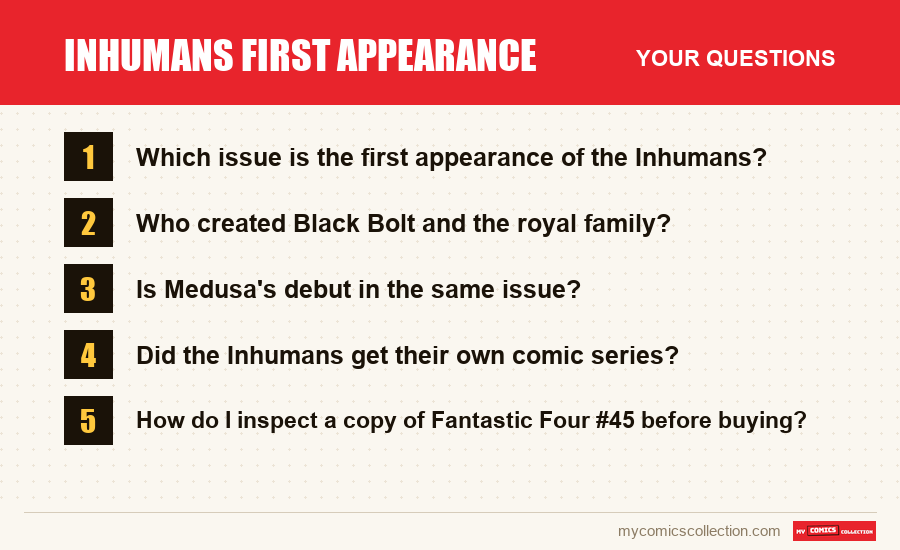
It depends on the character. Fantastic Four #45 (December 1965) introduces Black Bolt, Karnak, Triton and Lockjaw. Medusa appears earlier in #36 (March 1965) and Gorgon in #44, and the Alpha Primitives follow in #47 (February 1966). Collectors usually mean #45 when they say the Inhumans first appearance.
Stan Lee and Jack Kirby created Black Bolt, Karnak, Triton and Lockjaw in Fantastic Four #45, with Lee credited as writer and Kirby as artist. The same pair created Medusa in #36 and Gorgon in #44, so the whole royal family comes from the Lee and Kirby run.
No. Medusa debuts in Fantastic Four #36, cover dated March 1965, in a flashback and then in costume as part of the Frightful Four. She is not presented as an Inhuman at that point. Her connection to the hidden royal family is developed later, in the stories that lead to #45.
Yes, after appearing in the Fantastic Four, they had a back-up in Thor from #146 to #152, a feature in Amazing Adventures from #1 to #10, and their own series launched in October 1975 that ran into 1977. Doug Moench wrote all but #9 of that series.
Confirm the series, the number and the December 1965 date, then inspect the spine, corners, color, staples and interior pages. For a graded copy, read the label notes for restoration and set it beside comparable examples. Do not rely on the grade number alone when judging eye appeal.
If you own Fantastic Four #45 or the issues around it, a free valuation can place your copy against comparable examples.
Estimate my comic