The Infinity (2013) reading order starts with Jonathan Hickman's six-issue main series, published August to November 2013 with art by Jim Cheung, Jerome Opeña and Dustin Weaver. Read Avengers vol. 5 #14-17 and New Avengers vol. 3 #8 first, then Infinity #1-6, interleaving Avengers #18-23 and New Avengers #9-12 by release date. The other series are extras, and Inhumanity follows the event.
Infinity is an unusual event: two fronts, outer space and Earth, advance at the same time, and the writer running them, Jonathan Hickman, also writes both Avengers series that surround the miniseries. This guide does not retell the story. It tells you in what order to open the single issues so that both fronts stay readable.
As always in this guide, we only state verified information (creators, issue numbers, dates); the analysis is our own, with no reproduction of protected artwork or dialogue.

What to read before Infinity
You do not need to know the Avengers from their earliest days to get into Infinity: it is enough to pick up Hickman's run partway through. The immediate prelude comes down to five single issues: Avengers vol. 5 #14-17 and New Avengers vol. 3 #8. In those issues Captain Universe pushes the Avengers to recruit Ex Nihilo, Abyss, Starbrand and Nightmask while the threat closes in on Earth: without them, the launch of Infinity #1 feels abrupt.
There is also a newsstand prologue: Free Comic Book Day 2013 (Infinity). This giveaway issue is easy to lose in a longbox; it is not mandatory, but it sets the tone of the event before Infinity #1.
If you are coming to Hickman's Avengers run from this side, go back further in Avengers vol. 5 from #1: the teams, the internal tensions and the adversaries make more sense that way. Our Avengers reading guide places this run among the team's other eras.
Phase 1: the launch with Infinity #1
The main series begins in August 2013 with Infinity #1. Three artists share the series (Jim Cheung, Jerome Opeña and Dustin Weaver): do not expect a uniform style from one issue to the next, since that is a trait of the event. The first issue sets up the two fronts; read it on its own, in one sitting, before any tie-in.
The right instinct afterward is not to chain all six issues together without the Avengers series. Hickman designed Avengers #18-23 and New Avengers #9-12 as the two other pillars of the same narrative: skipping those single issues means reading a story with pieces missing.
Phase 2: Avengers and New Avengers, in alternation
Hickman's two series carry the heart of the event outside the miniseries. You will find issues #18-23 in Avengers vol. 5, and issues #9-12 in New Avengers vol. 3. The most reliable method is to follow the cover dates: after each issue of Infinity, open the issue or issues of Avengers and New Avengers released the same week or the following week.
A collector's tip: set up three stacks side by side, Infinity, Avengers, New Avengers, and always take the oldest issue from the tops of the three stacks. That reproduces the release order, which is the one the publisher intended, without having to memorize a chart.
To place Hickman within his career, the page for author Jonathan Hickman gathers our articles on his other work.
One word of caution on numbering: Avengers and New Avengers have each had several volumes with the same title. The issues of this event belong to the fifth volume of Avengers and the third volume of New Avengers. In a shop or on a marketplace, an Avengers #18 from another era carries the same number but has nothing to do with this story: always check the volume, the year and the cover before completing your stack.
Another useful habit is to keep a written list of the issues you have already read, because alternating between three titles quickly blurs your memory. Cross off each issue as you go; if you read digitally, use the same method, with a separate list for each series.
Phase 3: the series that widen the picture
Around this core, the event crosses over with a large number of regular series. The most natural ones to read next, because they extend the space front or the characters involved, are:
- Guardians of the Galaxy vol. 3 #8-9;
- Nova vol. 5 #8-9;
- Captain Marvel vol. 7 #15-16;
- Mighty Avengers vol. 2 #1-3;
- Secret Avengers vol. 2 #10-11;
- Thunderbolts vol. 2 #14-18.
These series have their own writers and their own tone. Read each block after the issue of Infinity that matches it chronologically, using the cover dates as a guide. If you collect one of these regular series, you already have these issues in your run anyway: that is why this block is optional for anyone following the story of the event alone.
This phase lends itself to selective reading. A reader who already knows Guardians of the Galaxy vol. 3 will find it natural to read issues #8-9 back to back; a reader who has never opened Thunderbolts vol. 2 can simply read issues #14-18 as one compact block, without going back through the series. Either way, the key is not to confuse a supplement with an obligation: the event stands on its own without these series.
For a collector, the appeal lies elsewhere: these issues often carry an event banner or logo on the cover, which helps you spot them loose in a bargain bin. Look for the logo, check the title and volume, then file them with their home series rather than with the main series, so you do not fragment your runs.
Phase 4: the attached miniseries
Three limited series carry the Infinity name in their titles:
- Infinity: The Hunt, four issues written by Matt Kindt, drawn by Steven Sanders;
- Infinity: Heist, four issues written by Frank Tieri, drawn by Al Barrionuevo;
- Infinity: Against the Tide, two issues.
These are side stories: they broaden the cast rather than move the main plot forward. You read them for the pleasure of seeing the event from other points of view, once you have the main series in your head. They work best when read right after the end of Infinity #6 rather than on the heels of the first issue.
Each of the three miniseries has its own creative team, which makes them easy to file by creator: Matt Kindt with Steven Sanders for The Hunt, Frank Tieri with Al Barrionuevo for Heist. If you collect those creators, these are issues to add to their bibliography, regardless of the event.
Do you collect this series?
Track what you own, what you are missing and what your collection is worth. 7-day trial.
Start my trial →
Phase 5: the finale and the follow-up with Inhumanity
The main series ends in November 2013 with Infinity #6. Finish Avengers #23 and New Avengers #12 first if you have fallen behind: they are the closing chapters of Hickman's two series for this event.
The direct consequence of the event is called Inhumanity, published starting in December 2013. If you want to see what the event changes for the Inhumans in the Marvel universe, that is the sequel to read.
To place the event among Thanos's major cosmic sagas, our page on Thanos crossovers gives you the map.
The tie-ins you can skip
The following are optional, which takes nothing away from their own merits:
- Superior Spider-Man Team-Up #3-4: a team-up that is useful if you follow the series, incidental to the event;
- Fearless Defenders #10: a single issue, attached to a series with its own storyline;
- Wolverine and the X-Men Annual #1: worth reading for the series it is the annual of;
- Infinity: Against the Tide #1-2, for anyone who wants to finish the whole set.
The golden rule: a tie-in is skippable when the main series and Hickman's two Avengers titles are enough on their own. That is the case here, and it is one of the strengths of this event's architecture.
Single issues or collected editions: how to read it
With single issues, you set the pace yourself, but you have to manage several stacks. With collected editions, the sorting between titles is already done, but the contents change from one volume to the next: note the issues listed on the back cover or on the copyright page of Infinity, then check them against the summary below. If a volume collects Infinity #1-6 without the Avengers titles, you are only reading a third of Hickman's narrative: plan to add the matching Avengers and New Avengers volumes.
For a reader building a library, the best method is to start from the core (the main series and Hickman's two series), then add the tie-ins in blocks of complete series. Note in your collection list the issues you already own: a single missing Avengers #18 breaks the reading chain.
The key issues to know
The value of an event issue is judged by its place in the narrative, not by its cover alone. For Infinity, keep three rules of thumb in mind:
- Infinity #1 and #6, the opening and closing issues, are the bookends of the main series; check printings and cover variants before buying;
- Avengers #18-23 and New Avengers #9-12 are best hunted as blocks: a complete run is easier to resell than a single issue;
- the Free Comic Book Day 2013 (Infinity) issue, distributed as a giveaway, should always be compared against several completed sales before you buy.
Before settling on a value for an Infinity or an Avengers from this period, compare several completed sales of the same issue, in the same condition. Our history of Thanos in comics helps you pin down the character's appearances that matter to collectors.
Summary: the complete reading order
- Avengers vol. 5 #14-17 (prelude)
- New Avengers vol. 3 #8 (prelude)
- Free Comic Book Day 2013 (Infinity) (prologue)
- Infinity #1 (August 2013)
- Avengers vol. 5 #18-23 and New Avengers vol. 3 #9-12, alternating with Infinity #2-6 by release date
- Guardians of the Galaxy vol. 3 #8-9, Nova vol. 5 #8-9, Captain Marvel vol. 7 #15-16
- Mighty Avengers vol. 2 #1-3, Secret Avengers vol. 2 #10-11, Thunderbolts vol. 2 #14-18
- Infinity: The Hunt #1-4, Infinity: Heist #1-4, Infinity: Against the Tide #1-2
- Infinity #6 (November 2013)
- Inhumanity (starting December 2013)
Frequently asked questions
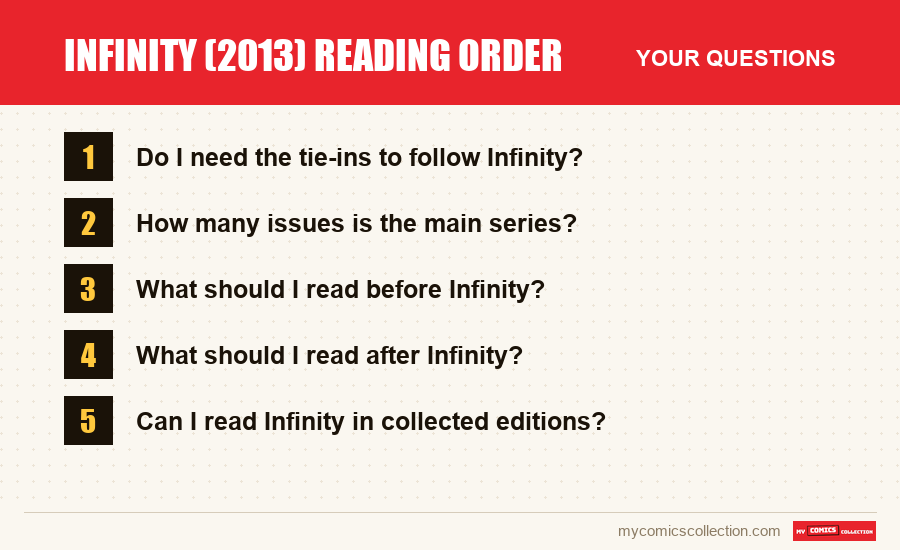
No. The main series, Avengers #18-23 and New Avengers #9-12 are enough to follow the event. The other series add context for the characters they follow, but the central plot does not depend on them.
Six issues, published from August to November 2013, written by Jonathan Hickman and drawn by Jim Cheung, Jerome Opeña and Dustin Weaver. Count more for the whole story, since the author's two Avengers series are part of the reading.
Avengers vol. 5 #14-17 and New Avengers vol. 3 #8, the immediate prelude. If you want the full context of Hickman's run, go back to Avengers vol. 5 #1, which introduces the teams and the starting stakes.
The direct sequel is Inhumanity, published starting in December 2013. It shows the consequences of the event for the Marvel universe. Read it once you have finished Infinity #6, Avengers #23 and New Avengers #12.
Yes, but check the contents of each volume: some only collect the main series. Compare the list of printed issues with the summary in this article, then add the volumes of Hickman's two Avengers series to get the whole narrative back.
Your issues of Infinity, Avengers or New Avengers deserve a careful appraisal before you shelve them or sell them.
Estimate my comic