A comic without a barcode is not necessarily a mystery: before 1974, no American comic book carried one, and even after this date, certain editions (Whitman, multipack variants) were without one until 1979. To identify and date these issues, we cross several markers printed on the copy itself: the indicia (legal notices), the cover price, the seal of the Comics Code Authority, the declaration of postal property and, where applicable, the form of the price box. Together, these elements allow you to locate a comic within a few months, without ever needing a scanner.
A collector who comes across a pile of comics inherited from an attic or purchased in batches almost always encounters the same reflex: look for the small white and black rectangle at the bottom left of the cover to identify the number. Except that on a good part of American comics (everything that was printed before the mid-1970s, but also certain much later special editions) this rectangle simply does not exist. The UPC (Universal Product Code) barcode is a recent invention in the history of the comic book, and its absence on a copy says nothing about its rarity, its authenticity or its value in itself: it says above all that the comic was printed before, during, or on the sidelines of a technical transition in the American publishing sector.
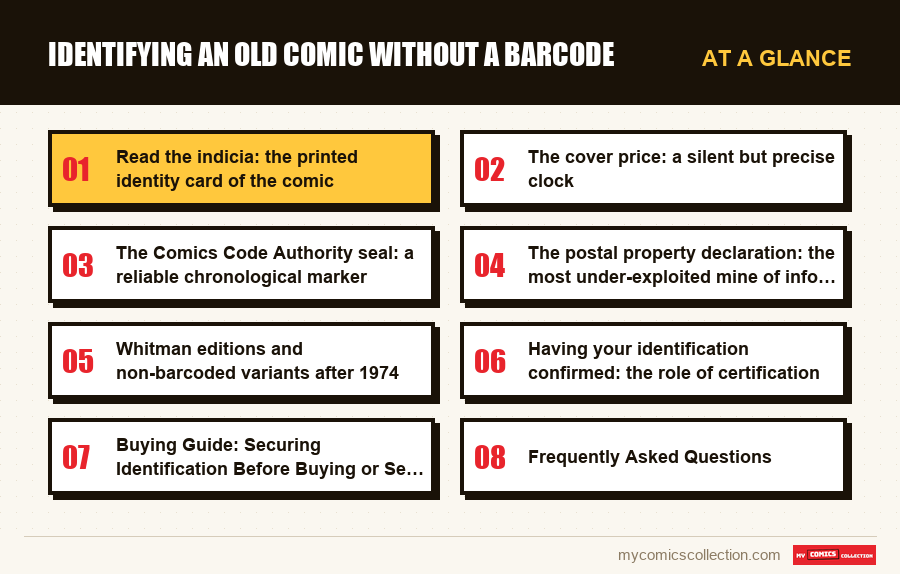
This guide details the really usable benchmarks for identifying and dating a comic without a barcode: reading the indicia (the block of legal notices), the evolution of the cover price over the decades, the seal of the Comics Code Authority, the declaration of postal ownership printed periodically in the interior pages, and the particular cases of Whitman editions or price variants from the 1970s. None of these methods replaces a reference catalog, but all of them make it possible to restrict a range of dating before even taking out a magnifying glass or database.
Why have so many comics never had barcodes?
The UPC code is an American standard officially adopted in 1974 by the retail industry to allow optical reading of products at checkout. However, its adoption by comic book publishing was not instantaneous. The first publishers to experiment with barcodes on their covers did so in the mid-1970s, but generalization to the entire market (Marvel, DC and independent publishers combined) only really took hold from 1976-1977, as kiosks and newsagents were equipped with optical readers to track their sales. Before this change, an American comic book only displayed three areas of information on its cover: the illustration, the title with its number, and the price box. No space was reserved for a future barcode.
In practical terms, this means that the entire Golden Age (late 1930s to 1950s), the Silver Age (mid-1950s to early 1970s), and much of the Bronze Age (to mid-1970s) are structurally barcode-free. A copy of Action Comics, Detective Comics or Amazing Spider-Man from the 1960s has never carried this type of marking, quite simply because the tool did not yet exist when it was printed. The absence of a barcode on these numbers is therefore not an anomaly to be interpreted, but the norm of their time.
The transition 1974-1979: the most delicate period to read
The real complexity lies not in comics from the 1950s or 1960s, whose absence of barcodes is obvious and unambiguous, but in the transition window which extends from 1974 to 1979. During these few years, certain titles already carry a barcode while others, published the same month by the same publisher, still do not have one. This heterogeneity can be explained by the fact that publishers added the barcode gradually, title by title, and not all at once across their entire catalog. A collector who compares two consecutive issues of the same series dating from this period can therefore legitimately end up with one carrying a barcode and the other not, without it being a printing error or a rare variant.
Read the indicia: the printed identity card of the comic
The most reliable marker for identifying a comic without a barcode remains the indicia, this block of text in small characters generally printed on the first inside page or at the bottom of the cover, depending on the era and the publishers. Each American publisher was legally required to include a base of information: the exact title of the publication, the volume number and the edition number, the date of publication (month and year), the name of the publisher, the copyright notice, and often the name of the editor-in-chief or responsible publisher. It is this same area which, on older comics, serves as the true civil status of the issue: it alone allows us to confirm with certainty that it is indeed the number and printing sought, regardless of the presence or absence of a barcode on the cover.
One point of vigilance is worth noting: the date printed in the indicia is not the actual date of sale. By American editorial convention inherited from the newsstand distribution system, the date appearing in the index is systematically earlier than the actual release date, generally by two to three months. A comic dated “October” in its indicia was therefore most likely distributed on newsstands during July or August of the same year. This convention, which aimed to give unsold items a window of presence on the shelves before their displayed expiry date, remains valid over the entire period without barcodes and explains why the indicia date must never be confused with the actual publication date when searching for precise dating.
The cover price: a silent but precise clock
The price printed in the cover box constitutes, with the indicia, the second major marker for dating a comic without a barcode. The American market has experienced a succession of price levels tight enough over time for it to serve as an approximate dating method, even without reading a single line of text. Comics remained sold at 10 cents from the 1930s until 1961, when almost all American publishers moved to 12 cents (Dell briefly tried 15 cents in 1961 before returning to 10 cents the following year). This 12 cent level held until 1969, when the market rose to 15 cents. The early 1970s then saw a period of price instability: in 1971, DC went from 15 to 25 cents by adding sixteen pages of additional content, imitated for a time by Marvel before a rapid decline to 20 cents; DC itself went down to 20 cents in 1972 by abandoning the bonus pages. The price then stabilized at 25 cents around 1974, then 30 cents in 1976, before variants at 35 cents appeared in 1977 on certain titles tested in restricted markets.
This price chronology alone allows us to place a comic without a barcode within a range of a few years, even before checking the index. A copy displaying 12 cents on the cover cannot mathematically date from before 1961 or after 1969. A 25-cent copy is almost necessarily from the mid-1970s, a pivotal period which coincides precisely with the gradual arrival of the barcode: which makes it one of the most useful benchmarks for confirming that an issue without a barcode belongs to this transitional window rather than to an earlier era.
The particular case of the 35 cent variants from 1977
The year 1977 constitutes a textbook case for collectors who work on comics without barcodes or with an atypical price box. Faced with a generalized price increase, some publishers tested an increase to 35 cents on a limited number of copies, distributed in limited market areas, before generalizing this price. These copies are recognized by a price inscribed in a diamond rather than in the usual rectangle used for standard 30 cent prints. On these variants, the presence or absence of a barcode itself becomes a criterion of distinction: the original 1977 print copies carry a barcode, while certain later reprints of the same content display a price diamond at 35 cents but a barcode box remains empty, which allows them to be differentiated at a simple glance once the mark is known.
The Comics Code Authority seal: a reliable chronological marker
On the vast majority of mainstream American comics published between the mid-1950s and early 2000s, a small round or rectangular seal is printed in the upper right corner of the cover, reading "Approved by the Comics Code Authority". This seal results from the self-regulation put in place by the American industry in 1954, in reaction to campaigns against violence in comics of the time, notably those carried out by the psychiatrist Fredric Wertham. Its constant presence on the covers for almost fifty years makes it a complementary dating marker to the indicia: its design was slightly revised at the beginning of the 1970s, which allows, for a trained eye, to roughly distinguish a copy before or after this graphic redesign. Its total absence, on the other hand, points either towards a publisher who never adhered to the Comics Code (the case of many independent and underground publishers), or towards a period before 1954, or towards the gradual abandonment of the seal by certain publishers from the 2000s.
Collecting this series?
Track what you own, what you are missing and what your collection is worth. 7 day trial.
Start my trial →The postal property declaration: the most under-exploited mine of information
Few collectors think of exploiting this source, although it is particularly rich: American postal legislation (currently codified in section 3685 of title 39 of the United States Code) has required since the 19th century that publications benefiting from a second-class postal rate to periodically publish, in their own pages, a “Statement of Ownership, Management, and Circulation”. Since 1960, this statement also includes the average circulation and the actual circulation for the past year. Concretely, a certain number of issues of American comics (not all, but a recurring selection chosen by each publisher to comply with the legal obligation) contain on the interior pages an insert detailing the identity of the publisher, the editor-in-chief, the owner of the publication, as well as the paid and free circulation figures for the financial year concerned.
For a collector seeking to identify or authenticate a comic without a barcode, this declaration constitutes documentary proof directly printed in the copy itself: it unambiguously confirms the legal identity of the publisher and the period of publication, and in passing gives a numerical indication of the actual print run of the title concerned on that date: data that few other sources provide with such a level of original precision. These circulation figures, compiled and cross-referenced by independent research on the history of the sector, now make it possible to objectively compare the circulation of a given title from one year to the next rather than relying on rough estimates.
Whitman editions and non-barcoded variants after 1974
A particular case deserves specific attention, because it concerns comics published well after the generalization of the barcode: the so-called “Whitman” editions. Between February 1977 and May 1979, Western Publishing, via its Whitman brand, distributed, in parallel with the traditional newsstand network, copies sold in batches of several issues (multipacks) in supermarkets and toy stores, outside the traditional newsagent circuit. These non-returnable editions had graphic variations on the price box: some retained a normal barcode, others displayed a price written in a diamond with a barcode box left entirely blank. There was no strict, uniform rule applied to all titles: the variation depended on the title, the month and sometimes the lot concerned, making each copy of this period to be examined on a case-by-case basis rather than by general deduction.
This detail has an important consequence for identification: a comic without a barcode dated 1977, 1978 or 1979 is therefore not necessarily an anomaly or a printing error. It may as well be an authentic Whitman edition, generally considered by catalogers as a print in its own right and not as a simple reprint, even if it has historically remained significantly more confidential in volume than the classic newsstand edition of the same issue.
Having your identification confirmed: the role of certification
Once the internal benchmarks of the comic are crossed (indicia, cover price, CCA seal, possible postal declaration) the most solid confirmation remains certification by a specialized third-party grading service, the best known of which is CGC (Certified Guaranty Company). This type of service does not simply assign a conservation rating: it also authenticates the precise identity of the issue, the printing and, where applicable, the variant, based on exactly the same physical markers detailed above, examined by experts trained to recognize the subtleties specific to each publisher and each decade. The census published by these organizations keeps a public record of the number of copies of a given issue subject to certification, all grades combined, which gives a relative idea of the observed rarity of one print run compared to another, including for non-barcode periods where no other centralized counting source exists.
For an old copy without a barcode whose potential value justifies the approach, having its identification verified by this type of service eliminates the residual doubt which may remain after an independent analysis, in particular on price variants or Whitman editions where the visual criteria are tenuous. This is also the step which secures a subsequent resale, a serious buyer rarely trusting an unconfirmed identification on an old issue number.
Buying Guide: Securing Identification Before Buying or Selling
Whether you are looking to acquire an old comic without a barcode or to verify the authenticity of a copy already in a collection, a few concrete reflexes allow you to avoid the most frequent dating errors.
- Always check the indicia before hedging. The cover can be misleading (advertising insert, reported price sticker), while the indicia, printed in the factory, remains the most reliable source for the title, number and date.
- Never confuse indicia date and actual on-sale date. The usual gap of two to three months between the two can distort a cross-search with other historical events or other issues of the same series.
- Cross-reference the cover price with the chronology of the price levels. A price inconsistent with the supposed period (for example 12 cents on an issue dated after 1970) should immediately alert you to a possible issue or printing confusion.
- Identify the shape of the price box, not just the number. A diamond rather than a rectangle, an empty barcode box rather than an absent one: these graphic details often distinguish a variant from a standard print from the period 1974-1979.
- Look for a postal ownership declaration on the interior pages. When it exists on the copy concerned, it provides confirmation of publisher and period that is difficult to falsify.
- Be wary of a copy that is “too clean” for its apparent age without a barcode. A new state of conservation on a comic supposedly dating from the 1960s or 1970s justifies additional verification before any purchase, in particular to rule out a facsimile or a reprint not marked as such.
- Don't rely solely on a visual search online. Two prints of the same number can look the same on the screen while only the physically printed index and price allow us to decide with certainty.
- Have copies certified with real financial implications. Beyond a certain level of potential value, the cost of third-party certification remains largely justified by the security provided for identification and resale.
These reflexes do not replace a complete reference database, but they make it possible to quickly rule out the most common dating errors and to know, even before consulting an external catalog, in which time window an item without a barcode is likely located. For collectors who manage a large collection of old copies, keeping a structured inventory greatly facilitates this cross-checking work over the course of acquisitions: this is precisely one of the uses for which the collection management application has been designed, by centralizing the identification information specific to each number as it is verified.