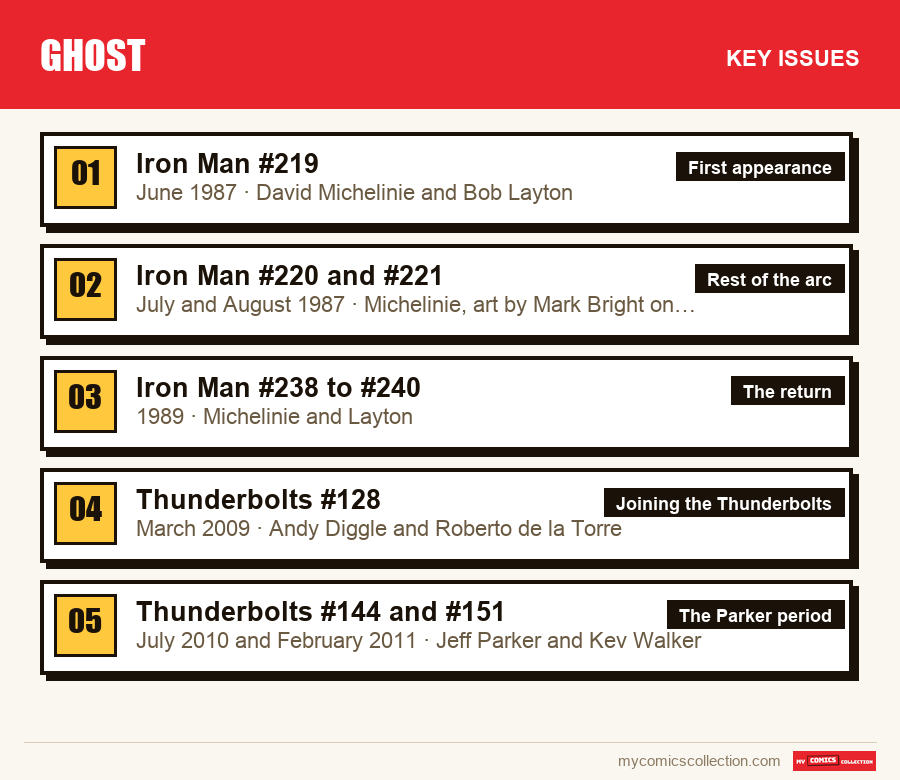
Ghost first appears in Iron Man #219, dated June 1987 and put on sale March 17, 1987, in a story titled "Ghost Story" written by David Michelinie and drawn by Bob Layton. In the comics, Ghost is a man with no name, a former engineer turned industrial saboteur, able to make his body intangible thanks to a technology he developed himself. In cinema, the role became Ava Starr, a young woman played by Hannah John-Kamen in Ant-Man and the Wasp (2018) then in Thunderbolts* (2025), and expected in Avengers: Doomsday on December 18, 2026. The two versions share a power and a costume, almost nothing else. For a collector, the issue to aim at remains Iron Man #219; the Thunderbolts appearances from 2009 form the second tier.
Ghost is one of those characters you think you know because you saw them on screen, and discover on opening the comics. The 2018 viewer met a victim: a child irradiated by a lab accident, who suffers every second and seeks a cure. The 1987 reader met a sabotage professional, paid by multinationals to sink others, who hates corporate technology to the point of making it his revenge. The name and silhouette are the same, the dramatic logic is the reverse.
This gap has a direct consequence for anyone wanting to buy: demand on the first issue comes almost entirely from cinema, while the issue's content does not resemble the film. It is a frequent situation, and it deserves knowing exactly what you are buying. This page covers the first appearance, the issues that build the character afterward, and how to shelve them in a collection without confusing them with those of another ghost in the Marvel catalog.
A note to avoid any search confusion: this Ghost has no link with Ghost Rider, nor with the different versions of "Ghost" published by other publishers. It is the saboteur who appeared in the Iron Man series, and him alone.
Iron Man #219: what the issue contains
Iron Man #219 carries the cover date of June 1987, with an on-sale date of March 17, 1987, following the custom of the time that showed on the cover a date several months after the actual release. The script is by David Michelinie, the pencils and inks by Bob Layton. The duo is then in the middle of its second stint on the title, the one immediately preceding the Armor Wars saga, and has already given the Tony Stark character part of his lasting traits.
The plot is a matter of industrial warfare. A Roxxon executive hires Ghost to push a small research company, Accutech, into bankruptcy, because it refuses to hand over a particle generator technology. Stark Enterprises buys Accutech for that same technology, and Iron Man crosses the saboteur while investigating an incident. The villain is therefore not introduced as a cosmic threat, but as the tool of a conflict between companies, which fits the series' concerns in this period perfectly: Stark is as much a boss as a hero there.
The character reveals himself over the next two issues. Iron Man #220, dated July 1987, sees Ghost turn against his sponsors and kill Spymaster by partially passing him through a wall. Iron Man #221 concludes the confrontation: Stark sets a trap near the generator, Ghost's suit overheats, and only the charred costume is found. The disappearance, of course, is not definitive.
Iron Man #219
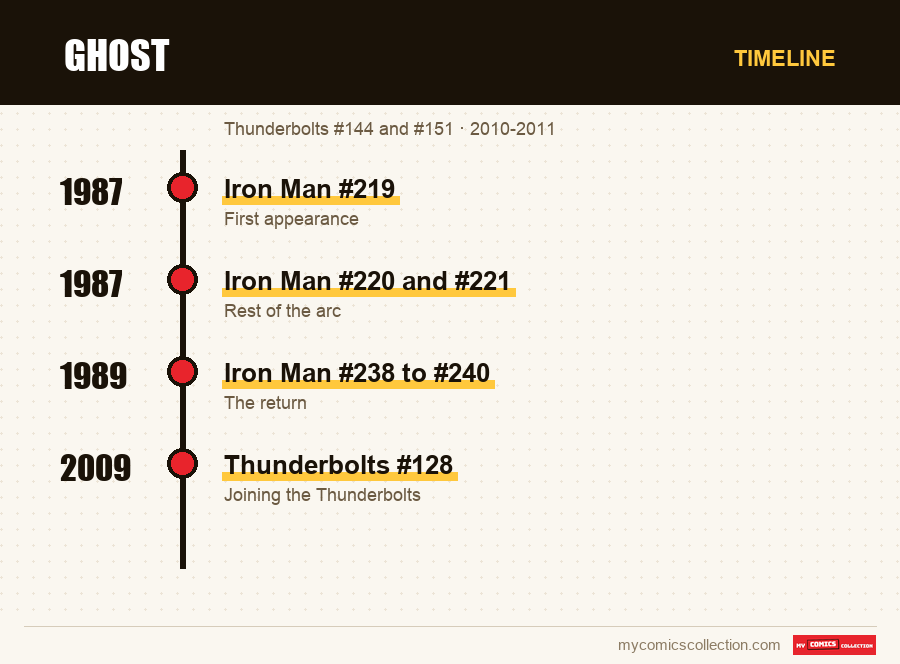
"Ghost Story." First appearance of Ghost, hired by Roxxon against Accutech. The issue is a regular episode of the series, with no variant cover, printed at the normal scale of a monthly title of the late 1980s.
Iron Man #220 and #221
#220, "Ghost of a Chance," contains Spymaster's death, killed by Ghost. #221 closes the first confrontation with the saboteur's fake death. The three issues form a complete story that it makes sense to keep together.
Who Ghost is in the comics
The comics' Ghost has no known civilian name. It is a writing choice that has lasted almost forty years and is part of the character: he erased every trace of his previous life, and successive writers have respected that erasure. He is human, with no innate power. Everything he can do, he owes to his suit and to the technology he integrated into his own body.
His origin was only told in 2011, in Thunderbolts #151 (dated February 2011, written by Jeff Parker and drawn by Kev Walker). Ghost explains to Moonstone there that he was a brilliant engineer at a big computer company, behind chips able to function in an intangible state. His employers got rich thanks to him, then had the woman he loved killed when she threatened to reveal their practices. He then fused this technology with his body, survived an assassination attempt, and eliminated his former bosses one by one before becoming a full-time saboteur.
The story is deliberately fragile: it is delivered to Moonstone, a manipulative interlocutor, by a man whose mental health suffered from his long periods in an intangible state. The reader does not know whether they are hearing the truth. This uncertainty is what makes Ghost interesting: a radical anti-capitalist, paranoid antagonist, whose very personal history might be a fabrication.
His abilities come down to three words: intangibility, invisibility, intrusion. He passes through walls, turns invisible, hacks electronic systems. He is an enemy tailored for Iron Man, whose whole power rests on an armor and computer networks: Ghost is the adversary who turns Stark's strength into a vulnerability.
The issues that build the character after 1987
A first appearance is not enough to make a character. What gave Ghost his place in the Marvel universe is a series of returns, first against Iron Man, then in a team that changed his nature.
Iron Man #238 to #240
Ghost reappears in Italy, this time in the service of Justin Hammer, another of Stark's industrial enemies. The arc establishes that the saboteur survived and refuses to obey anyone for very long: he ends up turning against Hammer himself.
Thunderbolts #128
During the period when Norman Osborn controls national security, the Thunderbolts become a covert operations team. Ghost is part of it. The character changes function: he is no longer an isolated adversary, but a member of a group of criminals employed by the government.
Thunderbolts #144 and #151
#144 opens Jeff Parker's cycle, where the team is supervised by Luke Cage and becomes an inmate rehabilitation program. Ghost stays there, and #151 finally delivers his origin. It is the richest read on the character, the one that gives him a voice.
Ava Starr: what cinema changed
When Marvel Studios integrated Ghost into Ant-Man and the Wasp, released in 2018, the character was entirely rewritten. The screen's Ghost is named Ava Starr. She is the daughter of a former collaborator of Hank Pym, Elihu Starr, and it is a lab accident in her childhood that made her unstable: her body constantly desynchronizes, which lets her pass through matter but makes her suffer and condemns her in the short term. Hannah John-Kamen plays the role.
The reversal is complete. The comics' saboteur chose his condition, puts it at the service of a revenge, and works as a mercenary. Ava Starr endures hers, seeks to heal, and is an antagonist only by necessity. All that remains in common is the code name, the intangibility power and a hooded costume that recalls the silhouette drawn by Layton. The family name Starr itself refers to another comics character, Elihu Starr, known at Marvel under the identity Egghead, which shows the writers rebuilt the character from pieces taken elsewhere.
In Thunderbolts*, released in 2025, Ava Starr reappears within a team of misfits. The transposition here joins the comics' trajectory, where Ghost also ended up in a formation of criminals employed by a murky authority. We analyzed what separates the film's team from the comics' in our comparison Thunderbolts, the film versus the comics, and the first adaptation in Ant-Man and the Wasp, the film versus the comics.
For Avengers: Doomsday, expected in theaters on December 18, 2026, Hannah John-Kamen is part of the cast announced by Marvel Studios in March 2025. Nothing has been said officially about the importance of the role. Our article on the key Thunderbolts and New Avengers issues before Doomsday places the character within the whole team.
First appearance, notable appearance: where the value lies
The comics market has long distinguished a character's first appearance from later appearances, for a simple reason: there is only one first issue, whereas there are dozens of appearances. In Ghost's case, the hierarchy is clear and suffers no ambiguity. No earlier cameo, no shadow appearance in a previous issue, no prototype version published elsewhere. Iron Man #219 is the first appearance, in the full sense, and that is all. Our guide first appearance, cameo or full appearance explains why this clarity is valuable: it avoids the debates that pull demand in several directions.
What to keep in mind, on the other hand, is the nature of the issue. Iron Man #219 is an ordinary monthly episode of 1987, printed in the period's volumes, sold at newsstands and in the specialty shop network then in full growth. Copies are not lacking. The preservation of late-1980s comics was already careful among many readers, which means very-good-condition copies are relatively numerous. Scarcity, in this case, is not the engine: it is the attention paid to the character that makes demand vary.
This attention is cyclical. It rises at a film's announcement, peaks around its release, then falls back. The character has had two film releases in seven years and expects a third, which puts him in a rare situation for a secondary Iron Man villain. But a prudent collector does not reason on a film: he reasons on what he wants to keep once the release has passed. We give no price here: no public source publishes a verifiable recent movement on this issue, and any figure would be an invention.
How to collect Ghost, in practice
Set the scope
First decide whether you collect Ghost, or Michelinie and Layton's Iron Man, or the Thunderbolts. These three scopes overlap, but do not lead to the same purchases. A collector of the character does not need the whole 1987 Iron Man series.
Buy the complete arc
Iron Man #219, #220 and #221 form one story. Buying them together generally costs less than hunting the first alone, and gives a readable set, with Spymaster's death as a bonus.
Check the edition
Issues of this period exist in a newsstand version and a specialty-shop version, distinguished by the barcode on the cover. Note which you own: it is collecting information, not a detail.
Read before certifying
A 1987 issue in fine condition does not always need certification. It is justified when the copy is very clean and you plan to resell; for a reading collection, a good bag is enough.
Reading, for its part, can be done without touching the period single issues. Michelinie and Layton's episodes have been gathered in collections at Marvel, and the Diggle then Parker Thunderbolts period has been too. It is the best solution to discover the character without exposing fragile copies, and to form an idea before deciding whether he deserves a place in the collection. Our guide the key Iron Man issues places Iron Man #219 among the series' other important issues, and the history of Iron Man in comics gives the context of the Michelinie and Layton period.
Three frequent mistakes
Confusing Ghost and Ghost Rider. It is the most widespread search mistake, and it sometimes leads to poorly targeted purchases. The two characters have nothing in common, neither editorially nor narratively.
Believing the first issue tells the film's story. Iron Man #219 speaks neither of Ava Starr, nor of Hank Pym, nor of a quantum accident. A reader giving it to a fan of the film should present it as what it is: the editorial origin of the name and the power, not that of the screen's heroine.
Buying at the peak of a release. The weeks around a film concentrate attention, therefore rushed buyers. For an issue available in numbers like this one, patience is almost always rewarded. The quiet months between two films are when you choose your copy instead of taking the one that remains.