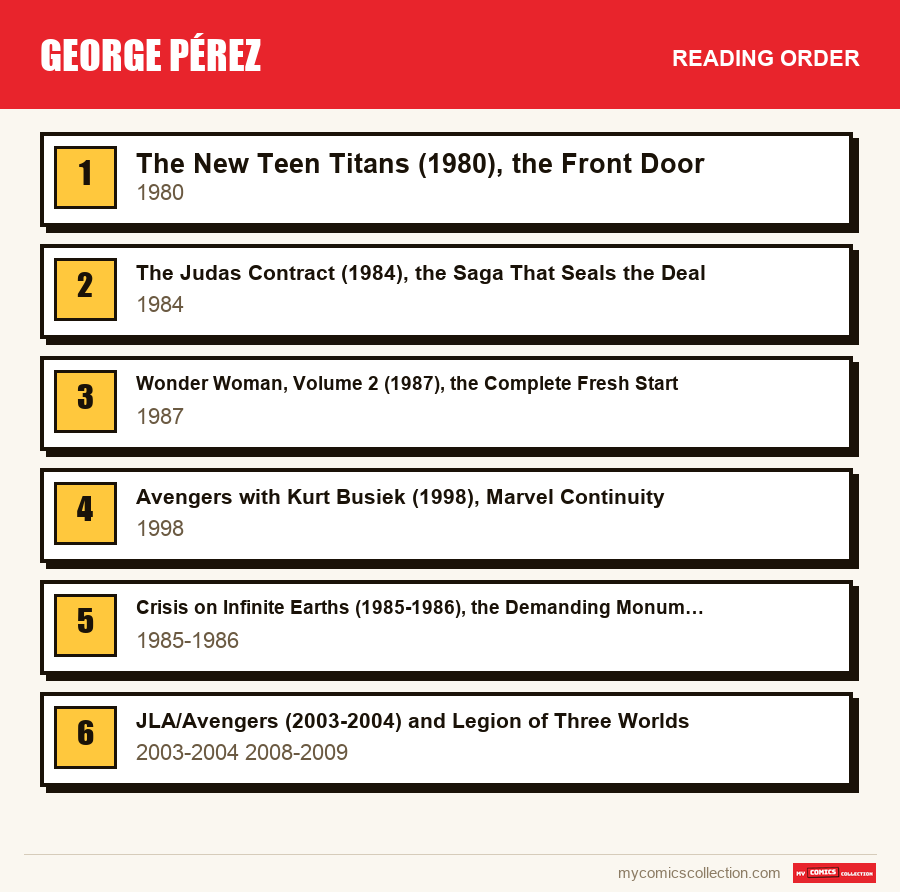
To read George Pérez, start with The New Teen Titans (1980), where Marv Wolfman and Pérez set up a brand-new team you can follow with no prior reading. Then move on to The Judas Contract (1984), the 1987 Wonder Woman, Kurt Busiek's Avengers (1998), Crisis on Infinite Earths (1985-1986), and finally JLA/Avengers (2003-2004) and Legion of Three Worlds. The order runs from the most accessible to the most demanding in terms of background knowledge.
George Pérez's name comes up whenever people talk about pages crowded with dozens of characters, each one recognizable. But his body of work spans two publishers and more than three decades, and a reader who opens the first collected edition they find may land on a saga that assumes twenty years of earlier reading. This reading path is meant to avoid that pitfall: it sorts the work by difficulty of entry, not by date.
As always in this guide, only verified information (creators, issue numbers, dates) is stated as fact; the analysis is our own, with no reproduction of protected artwork or dialogue.
Step 1: The New Teen Titans (1980), the Front Door
It all begins in October 1980 with a preview insert tucked into DC Comics Presents #26, followed by the series The New Teen Titans, whose first issue came out in November of that year. Marv Wolfman writes, Pérez draws. Why start here? Because the team is new: Raven, Cyborg, Starfire and others arrive with no baggage, and you meet each character at the pace of the story.
It is also the step that best shows what Pérez brings to a monthly title: steady clarity on the page, even when several characters share the same panel. Issue #2 introduces Deathstroke; our article on his first appearance explains why it matters.
If you just want to judge the art without investing much, a collected edition of the early issues is enough. If you collect, the series guide and our ranking of Teen Titans runs explain which single issues to target. That ranking puts this run at the top, and we point you there rather than redo the analysis.
Who is this first rung for? Anyone who has already read a superhero comic and wants to understand why Pérez is so closely tied to the idea of readability. The panels are packed, yet the eye always knows where to go: the reading order of characters within a single image is carefully planned, and that discipline is the foundation of his reputation.
Step 2: The Judas Contract (1984), the Saga That Seals the Deal
In 1984 it unfolds in Tales of the Teen Titans, from #42 to #44, extended by an Annual #3. It assumes you have read the previous step, but nothing more: the relationships between team members, built up over several years of publication, reach their resolution here. We will not reveal which one, because the effect depends on the buildup.
Why read it second? Because it continues exactly in the register of the first group of issues, with greater intensity. You get to see what a team looks like when its creators have had four years to bring it to life.
A reading tip: if the series hooks you, do not rush straight into what follows. Take a break and move on to step 3, which changes heroine and ambition, before coming back to the Titans if you still want more.
On the collecting side, the landmarks are New Teen Titans #1 and #2, the latter for the introduction of Deathstroke. The issues that follow, printed in large runs, can be found in good condition without much trouble, which lets you build a complete set at your own pace rather than on impulse.
Step 3: Wonder Woman, Volume 2 (1987), the Complete Fresh Start
After Crisis on Infinite Earths, DC started over on new foundations and entrusted Pérez with the overhaul of Wonder Woman. Volume 2 opens in 1987 and runs for 62 issues until 1992. Pérez handles both plot and art for the first 24 issues, then keeps the plotting; he roots Diana in Greek mythology with a rigor of research that shows from the very first pages.
Why this spot? Because the whole thing reads without any background: the heroine is taken back to her origin, and you learn her world as she does. The writing is denser than that of the Titans, but it demands sustained attention more than prior knowledge.
It is also the most useful step for a collector, since the early issues are in demand. Our ranking of Wonder Woman runs places it among the other great periods, and the character hub gathers the articles on her key issues.
A reading note: if Avengers is unfamiliar to you, do not try to understand everything from the first issue. The easiest approach is to keep going, jot down the names that keep returning, and go back once you have finished the series. That second read is the one that reveals Busiek's work on the team's memory and Pérez's work on its staging, panel by panel. A collected edition lets you navigate this way without handling fragile single issues.
Step 4: Avengers with Kurt Busiek (1998), Marvel Continuity
In the 1970s, Pérez had already drawn the Avengers, starting with issue #141 in 1975. Step 4 is his return: in 1998, the relaunched series, volume 3, rests on a script by Kurt Busiek, with Pérez on art at the start. The project is a tour de force, since each panel brings together a number of heroes that other artists would reserve for a double-page spread.
Why so late in the path? Because the reading rewards anyone who knows the history of the Avengers; Busiek draws heavily on forty years of the past. A reader who does not know who Wonder Man is or where Kang comes from will miss some nods, but will not lose the thread.
If you are after reading pleasure, this choice is ideal. If you are after a collection, see the ranking of Avengers runs, where this period comes in first, and the Avengers hub to place each issue.
This step also illustrates what Pérez does best in collaboration: Busiek brings the memory, Pérez the staging. If you enjoy that pairing, our guide to the major Wonder Woman artists shows how other artists carried the torch on Diana after him.
Do you collect this series?
Track what you own, what you're missing and what your collection is worth. 7-day trial.
Start my trial →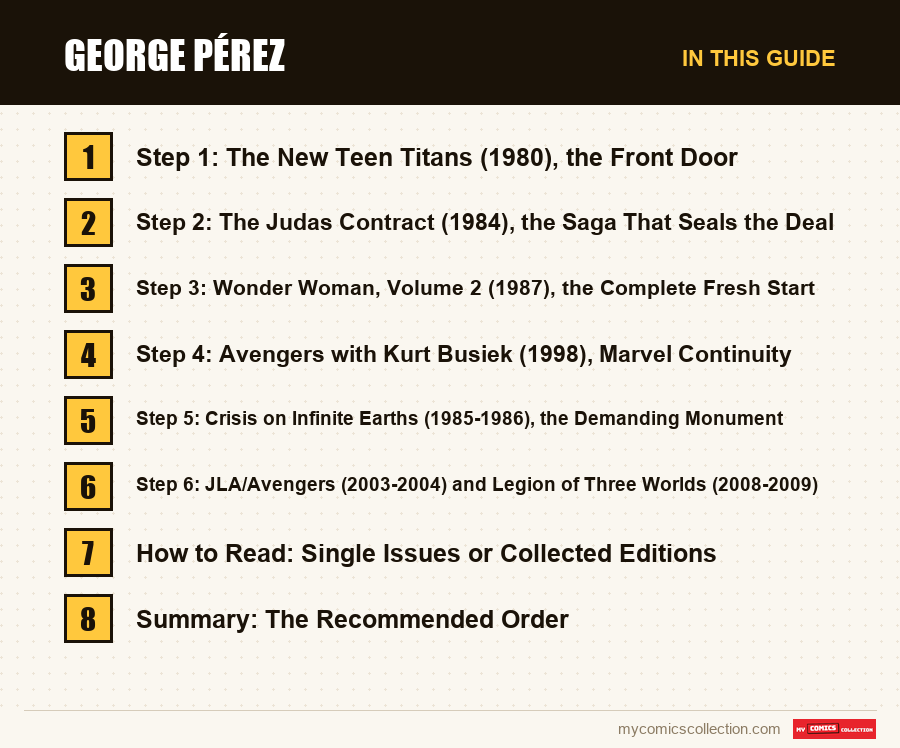
Step 5: Crisis on Infinite Earths (1985-1986), the Demanding Monument
This twelve-issue maxi-series, written by Marv Wolfman and drawn by Pérez, reshapes the entire DC universe. It is the best known of his works and the hardest to approach: without any landmarks on the parallel Earths, a reader drowns in the cast list before reaching the actual story. Issues #7 (Supergirl) and #8 (Barry Allen) are the ones readers cite first.
Why fifth? Because the saga is tailored to people who have already tasted Pérez's style and know a few DC figures. Our comparison with the animated adaptation helps you spot the stakes before reading, and the key issues help you choose if you collect.
Read after the previous steps, it comes into its own: in the small panels you spot heroes you met elsewhere, and you can then gauge the scale of the compositional work.
One practical tip before diving in: read it in several short sittings. The density of the pages is tiring if you go too fast; the work reveals itself when you stop to identify the background silhouettes. It is a pleasure for collectors as much as for readers, and it alone justifies choosing a large-format edition.
Step 6: JLA/Avengers (2003-2004) and Legion of Three Worlds (2008-2009)
The last rung, and the most demanding. JLA/Avengers, four issues published in 2003 and 2004, brings the two universes together; Kurt Busiek writes and Pérez draws a project the artist had carried since the 1980s. Legion of Three Worlds, five issues written by Geoff Johns and published from August 2008 to September 2009, has three versions of the Legion of Super-Heroes meet.
Both series call for a dual background: DC and Marvel for the first, several Legion continuities for the second. Without it they remain readable, but lose most of their pleasure. That is why we place them at the end.
The second one has a particular feature: it exists in French in a softcover collection released in September 2025. Our article on the Legion details that volume and the other useful issues.
Two Marvel landmarks complete the picture for anyone who wants to go back to the beginnings. Pérez has drawn Avengers since 1975, starting with issue #141, and in those years he alternated with Fantastic Four: you can watch the line work grow denser issue after issue, well before the Titans. Later, in 1991, Pérez drew the first four issues of Infinity Gauntlet before handing the book over to Ron Lim; it is a useful detour for measuring Pérez's ability to fill a panel with dozens of characters without losing readability.
How to Read: Single Issues or Collected Editions
The choice of format depends on what you are looking for in this body of work: reading pleasure, linework to admire up close, or a collectible piece.
For reading, a collected edition is enough in almost every case: Pérez's sagas are dense, and modern paper does justice to the fineness of his line, something the yellowed original single issues serve less well. For steps 1 to 3, favor collected editions; step 5 lends itself to a large-format edition, because the double-page spreads matter.
For collecting, target a few landmarks: New Teen Titans #1 and #2, Wonder Woman vol. 2 #1, Crisis on Infinite Earths #7 and #8. The mid-run issues of these series, printed in large runs in the 1980s, remain reader purchases rather than speculator ones. Before buying, check the volume and the condition with equal care, and log each acquisition to avoid duplicates.
A word on the market: we give no figures, because prices vary with the condition of the copy and the date of the sale. It is better to compare several completed sales of the same issue in the same condition, then take the median rather than the most spectacular example.
Summary: The Recommended Order
Here is the complete order, from the most accessible to the most demanding: The New Teen Titans (1980), The Judas Contract (1984), Wonder Woman volume 2 (1987), Avengers with Kurt Busiek (1998), Crisis on Infinite Earths (1985-1986), then JLA/Avengers (2003-2004) and Legion of Three Worlds (2008-2009).
If you only read one, take the first. If you read two, add the third, which changes universe and tone. To place everything in context, the artist hub gathers all the articles linked to Pérez, including buying guides and rankings.
Frequently Asked Questions
Start with The New Teen Titans, launched in November 1980 with Marv Wolfman. The team is new, the story assumes no earlier reading, and Pérez's art is a model of clarity here. Collected editions of the early issues are enough to get a feel for it.
No, it is the other way around. Crisis on Infinite Earths involves so many characters and parallel Earths that it is better to approach it after the Titans and Wonder Woman. You will recognize heroes you have already met, and the reading becomes more comfortable.
Yes. Volume 2 restarts from Diana's origin after Crisis on Infinite Earths, and Pérez handles both plot and art for the first 24 issues. No knowledge of DC is required: you discover the world at the same time as the heroine.
You can, but the enjoyment is greatest for those who know both universes. This four-issue series (2003-2004), written by Kurt Busiek and drawn by Pérez, is packed with nods to forty years of continuity from both publishers.
The catalog changes; check the French-language publisher's list before buying. All we can say is that Legion of Three Worlds, drawn by Pérez, appears in a softcover collection released in September 2025, alongside a run of Action Comics.
Is a New Teen Titans or a 1987 Wonder Woman sitting at your place? Get an estimate before deciding whether to keep it or sell it.
Estimate my comic