Wonder Woman was born in December 1941 from the pen of William Moulton Marston and the pencil of Harry G. Peter: two names inseparable from American comics history. Since then, a handful of creators have each reinvented the Amazon for their own era: Robert Kanigher in the Silver Age, George Perez with the landmark 1987 relaunch, then Greg Rucka, Gail Simone, and the Brian Azzarello & Cliff Chiang partnership in the twenty-first century. The key issues of those runs, when they come up for sale, reflect the lasting importance of each creative voice.
Created in All Star Comics #8 (December 1941, first appearance), then given her own title with Sensation Comics #1 (January 1942, first cover feature), Wonder Woman is one of only three DC characters to have published continuously since the Golden Age. That longevity is the product of collective work: every decade, a writer, or a writer-artist team, took ownership of the character and rewrote its rules without betraying its original feminist core.
This guide traces the landmark runs, the key issues that define them, and their documented values. eBay medians come from our estimator (eBay.fr + eBay.com, June 2026); auction records are sourced from Heritage Auctions, CGC News, and GoCollect. Where a precise figure cannot be confirmed, it is stated qualitatively.
William Moulton Marston & Harry G. Peter: the founders (1941-1947)
William Moulton Marston was a psychologist, co-inventor of the polygraph, and an advocate for women's rights: all before writing comics. When he created Wonder Woman, he openly declared his intention to give the genre a hero embodying positive feminine values in a medium dominated by male aggression. Harry G. Peter, a press illustrator whose style drew on Art Deco and classical figures, gave her an immediately iconic look. Together they produced issues that are now among the most valuable in Golden Age collecting:
- All Star Comics #8 (Dec. 1941): first appearance of Wonder Woman: documented record $1,620,000 for a CGC 9.4 (Heritage Auctions, June 2022), previous record $936,223 (2017).
- Sensation Comics #1 (Jan. 1942): first cover feature: documented record $399,100 for a CGC 9.6 (Heritage Auctions, 2017).
- Wonder Woman vol. 1 #1 (Summer 1942): first solo title: documented record ~$291,000 (Heritage Auctions).
These three issues:All Star Comics #8, Sensation Comics #1, and Wonder Woman vol. 1 #1: form the foundational trinity. On eBay the signal is too thin for the first two (different series, rare sales); auction records are the only reliable benchmark. Marston died in 1947; Peter continued into the 1950s.
Robert Kanigher & Ross Andru: the Silver Age (1958-1968)
After a transition period, Robert Kanigher, who had been the series' regular writer since the 1940s, relaunched Wonder Woman in the Silver Age alongside artist Ross Andru. Wonder Woman #98 (May 1958) is recognised as the first Silver Age issue of the title: Kanigher entirely rewrote Diana's origin to match the DC sensibility of the era. Our eBay estimator returns a median of €9 across 63 active listings: a liquid market for low-grade copies. The issue is very scarce in high grade (no copy graded above 8.0 in the CGC census), making it a sought-after target for Silver Age specialists.
Dennis O'Neil & Mike Sekowsky: the 1968 break
In 1968, writer Dennis O'Neil and artist Mike Sekowsky made a radical departure: in Wonder Woman #179 (Dec. 1968), Diana renounces her Amazon powers, sets aside her costume, and becomes an ordinary mortal: a boutique owner in New York going by the name Diana Prince. This "mod" era, ironically contemporary with second-wave feminism, drew sharp criticism from Gloria Steinem, who campaigned for the restoration of Wonder Woman's powers. Kanigher returned in 1973 to write Wonder Woman #204: Diana regains her powers and costume, and the issue simultaneously introduces Nubia, the first Black character in the Wonder Woman universe. Our eBay estimator returns a median of €9, high €24 , across 28 active listings.
George Perez: the 1987 relaunch (vol. 2)
After Crisis on Infinite Earths ended the original series at vol. 1 #329 (1986), DC handed the relaunch to George Perez. Wonder Woman vol. 2 #1 (February 1987) started from scratch: Perez rooted Diana in Greek mythology, reimagined Amazon history, and raised the title's narrative ambition to a new level. His run lasted until 1992 (issue #62 as writer) and remains the gold standard for the character in the Modern Age. Important note: vol. 2 #1 returns only 5 active eBay listings: too thin for a reliable median; most of those copies are inexpensive common issues. The prestige of this run is better reflected in its omnibus collections, which continue to sell steadily in bookshops.
Greg Rucka: editorial authority (2003-2006)
Greg Rucka came to Wonder Woman via the graphic novel Wonder Woman: The Hiketeia (2002), a gripping moral thriller pitting Diana against Batman. His run on the ongoing series (approximately 2003-2006, vol. 2 #195-226) cast Wonder Woman as a United Nations ambassador navigating geopolitical stakes and Olympian gods simultaneously. The arc Eyes of the Gorgon (issues #205-213) climaxes in a live televised battle against Medusa at Yankee Stadium, where Diana blinds herself to defeat the Gorgon without looking away. Rucka returned to the character in 2016 (Rebirth), delivering a dual-timeline narrative structure that earned fresh critical praise.
Gail Simone: the longest female run (2007-2010)
Gail Simone, the first woman to write a sustained long run on Wonder Woman, took over from issue #14 (vol. 3, 2007) and stayed through #44 and the anniversary special #600. Her most memorable arc, Rise of the Olympian, introduced Genocide, a monster capable of holding its own against Diana, and revisited the hierarchy of the Olympian gods. Wonder Woman #200 (vol. 1, 1972) shows an eBay median of €22 across 22 active listings; issue #600, the 2010 anniversary number, returns a median of €10 across 18 active listings: solid collector numbers for two landmark issues.
Brian Azzarello & Cliff Chiang: New 52 mythological reinvention (2011-2014)
When DC launched the New 52 in September 2011, Azzarello and Chiang took Wonder Woman and delivered what many consider the most internally consistent run of the entire relaunch: 35 issues of unbroken narrative, in which Diana discovers she is the daughter of Zeus rather than a clay statue brought to life. Chiang's art (spare, classical, and violent in equal measure) is immediately distinctive. Wonder Woman #219 (vol. 2) shows an eBay median of €9 across 35 active listings. New 52 vol. 4 #1 trades below €10 on eBay for a common copy: accessible entry into one of the most acclaimed modern runs.
Key issue reference table by era
| Issue | Creators | Significance | eBay data (all grades) |
|---|---|---|---|
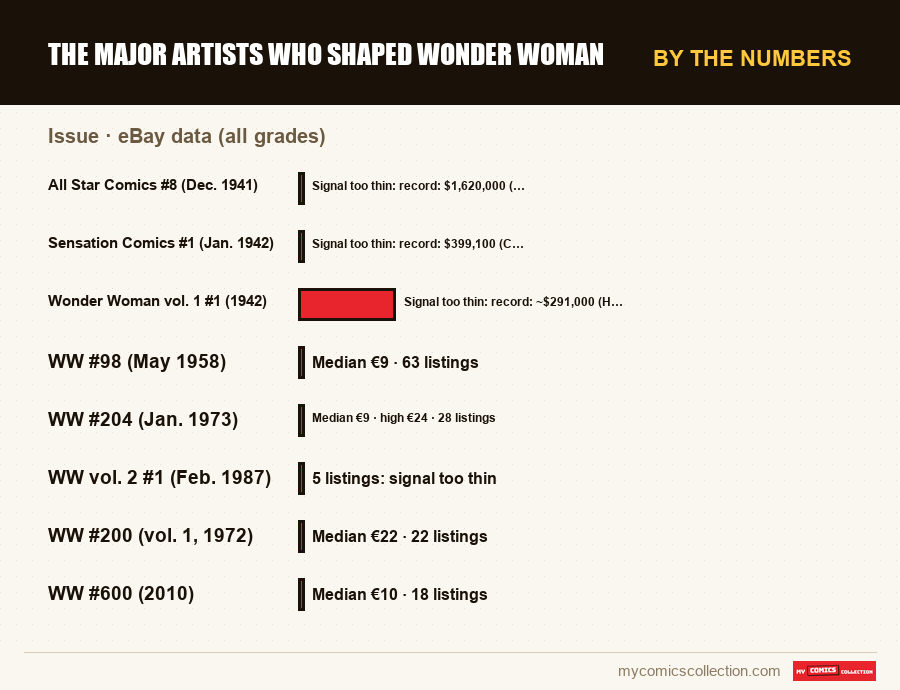
| All Star Comics #8 (Dec. 1941) | Marston / Peter | 1st appearance of Wonder Woman | Signal too thin: record: $1,620,000 (CGC 9.4, Heritage 2022) |
| Sensation Comics #1 (Jan. 1942) | Marston / Peter | 1st solo cover feature | Signal too thin: record: $399,100 (CGC 9.6, Heritage 2017) |
| Wonder Woman vol. 1 #1 (1942) | Marston / Peter | 1st solo title | Signal too thin: record: ~$291,000 (Heritage) |
| WW #98 (May 1958) | Kanigher / Andru | Silver Age debut, new origin | Median €9 · 63 listings |
| WW #204 (Jan. 1973) | Kanigher / Heck | Powers restored + 1st Nubia | Median €9 · high €24 · 28 listings |
| WW vol. 2 #1 (Feb. 1987) | Perez / Potter | Post-Crisis relaunch | 5 listings: signal too thin |
| WW #200 (vol. 1, 1972) | Sekowsky | Anniversary issue, Rucka run | Median €22 · 22 listings |
| WW #600 (2010) | Simone / multiple | Anniversary, end of Simone run | Median €10 · 18 listings |
Record sources: Heritage Auctions, CGC News, sellmycomicbooks.com. eBay medians: mycomicscollection.com estimator, June 2026.
The pop-culture legacy: from Lynda Carter to Gal Gadot
The impact of the creators listed above extends well beyond comics: the television series starring Lynda Carter (ABC/CBS, 1975-1979, three seasons) fixed the Amazon's image in popular culture for a generation. The 2017 film directed by Patty Jenkins with Gal Gadot grossed $824 million worldwide: the first female-led solo superhero film to cross that threshold. That success rests in part on the narrative depth accumulated by Marston, Perez, Rucka, and their successors: Diana is a character who sustains complexity.
Do you own a Wonder Woman issue? Get a free valuation with our tool based on real eBay sales: low, median, and high estimates.
Frequently asked questions
Wonder Woman was born in December 1941 from the pen of psychologist William Moulton Marston and the pencil of Harry G. Peter, in All Star Comics #8. Her first cover followed in Sensation Comics #1 (January 1942) and her first solo title, Wonder Woman vol. 1 #1, came out in summer 1942.
They form the Golden Age trinity: All Star Comics #8 (first appearance), Sensation Comics #1 (first cover) and Wonder Woman vol. 1 #1 (first solo title). Documented auction sales are the only reference for these issues, since the everyday market is too thin to give a reliable signal.
George Perez took charge of Wonder Woman vol. 2 #1 (February 1987), after the end of Crisis on Infinite Earths closed vol. 1 at #329. He anchors Diana in Greek mythology and reinvents the history of the Amazons. His run, which lasted until 1992, remains the character's benchmark in the modern era.
In 1968, writer Dennis O'Neil and artist Mike Sekowsky turned Diana into an ordinary mortal, owner of a fashion boutique in New York under the name Diana Prince. This "mod" era was criticized by Gloria Steinem. In Wonder Woman #204 (1973), Diana regains her powers, and the issue introduces Nubia.
Greg Rucka (2003-2006) makes Diana an ambassador to the United Nations, with the Eyes of the Gorgon arc. Gail Simone (2007-2010) wrote a long run with Rise of the Olympian and issue #600. Brian Azzarello and Cliff Chiang (2011-2014) delivered 35 uninterrupted issues on the New 52, in which Diana discovers she is Zeus's daughter.