Fantastic Four (2005) Tim Story adapts Marvel's first family of superheroes, born in Fantastic Four #1 (1961) by Stan Lee and Jack Kirby. The film features Red Richards, the Invisible Woman, the Human Torch and the Thing, as well as their enemy Doom (Fantastic Four #5, 1962). Faithful to the characters and the cosmic origin, it modifies the antagonist and lightens the tone. Here is the detailed comparison, film versus comics.
Adaptation of the founding team of the Marvel universe, Fantastic Four brings to the screen a family of heroes as united as they are dysfunctional. It draws on the founding stories of Lee and Kirby. Source-by-source decryption.
As in each article in this series, only verified information (creators, distribution, dates, comic numbers) is stated; the comparative analysis is ours, without reproducing dialogue or protected images.
Title : Fantastic Four (2005)
Director: Tim Story
Actors: Ioan Gruffudd (Red Richards), Jessica Alba (Sue Storm), Chris Evans (Johnny Storm), Michael Chiklis (Ben Grimm), Julian McMahon (Fatalis)
Exit : June-July 2005
Studio: 20th Century Fox
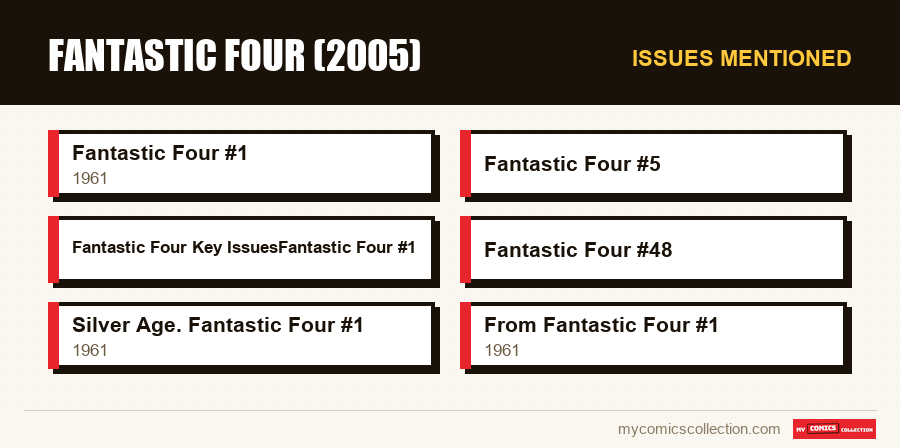
Fantastic Four #1 (1961): First appearance of the Fantastic Four
Fantastic Four #5 (1962): Doom's first appearance
Cosmic rays: the origin of powers
The dysfunctional family: the heart of the concept
- THE four heroes and their iconic powers.
- The origin by cosmic rays in space.
- La Thing, Ben Grimm, and his monster drama.
- La family dynamics, warm and confrontational.
- Doom (Victor Von Doom), the sworn enemy.
- Doom gains powers, even though he doesn't have any in the comics.
- Victor is present during the space accident, an addition from the film.
- The tone is light and family, less epic.
- La cosmic dimension comics is reduced.
- Fatalis is a business rival of Red, an invention.
Fantastic Four #1 (1961): Marvel's First Family
The Fantastic Four appear in Fantastic Four #1 (1961), created by Stan Lee and Jack Kirby. This issue marks the beginning of the modern Marvel era: scientist Red Richards, his companion Sue Storm, her brother Johnny Storm and pilot friend Ben Grimm leave aboard an experimental rocket, where they are exposed to cosmic rays which give them powers. Red becomes Mister Fantastic, able to stretch his body; Sue, the Invisible Woman; Johnny, the Human Torch; and Ben, transformed into a stone colossus, the Thing. Unlike classic superheroes, they do not hide their identity and behave like a family: united, but crossed by conflicts, in particular the tragedy of Ben, prisoner of his monstrous appearance.
The film faithfully reproduces this origin and these characters: cosmic rays in space, the four powers, family dynamics and the drama of the Thing. Michael Chiklis plays a touching Ben Grimm, whose transformation into a stone monster is the emotional heart of the film. The main freedom concerns the tone and the antagonist: the film adopts a light and family register, reducing the cosmic and scientific dimension which makes comics great. It also profoundly modifies Fatalis. On the heroes themselves, however, the film stays true to the spirit of Marvel's First Family, celebrating its warmth and feuds.
Fatalis, the sworn enemy reinvented
Victor Von Doom, aka Doctor Doom, is the most iconic enemy of the Fantastic Four, appearing in Fantastic Four #5 (1962). In the comics, he is a scientific genius and monarch, ruler of the fictional country of Latveria, whose disfigured face is hidden by a metal mask. Doom has no superpowers per se: his power comes from his superior intelligence, his mastery of technology and magic, and his armor. Rival of Red Richards, whom he jealous, he is one of the greatest villains in the entire Marvel universe, a tragic and grandiose tyrant figure.
The film profoundly changes the character. Victor is present there during the space accident and also gains powers, his skin transforming into metal and allowing him to manipulate electricity: an invention of the film, absent from the comics where his power is purely technological. He is also presented as a business tycoon, Red's business rival. This rereading, which reduces Fatalis to the rank of supervillain with powers, moves considerably away from the grandiose figure of the comics. For the reader, the real Doom is much more than an electric man: he is a despotic monarch, an unrivaled genius, whose complexity and scope far exceed the film version.
A family of heroes, between heat and conflicts
What sets the Fantastic Four apart from other superheroes is their family nature. The film captures this dimension: the bickering between Johnny and Ben, the relationship between Red and Sue, the solidarity despite the tensions. This family dynamic, warm and conflicting, is at the heart of the concept created by Lee and Kirby, which broke with solitary and secretive heroes. The Fantastic Four live in the open, famous and human, with their faults and their arguments. The film honors this aspect, focusing on comedy and family emotion rather than pure action.
Ben Grimm's drama, The Thing, is the most poignant. Transformed into a being of stone, incapable of regaining human form, he embodies the tragedy of the big-hearted monster, rejected by the world and by himself. The film develops this dimension, notably through his relationship with his partner, who flees him after his transformation. This suffering, faithful to the comics, brings a welcome depth to the film. For the reader, it reminds us that the Fantastic Four, beneath their family adventure trappings, carry universal themes: self-acceptance, difference, the bonds that unite a family in the face of ordeal. The film captures the essence of it.
Collecting this series?
Track what you own, what you are missing and what your collection is worth. 7 day trial.
Start my trial →The characters, from paper to screen
- Red Richards / Mister Fantastic: Stretchy scholar, faithful to Fantastic Four #1.
- Sue Storm / The Invisible Woman: Capable of invisibility and force fields.
- Johnny Storm / the Human Torch: Young hothead who bursts into flames and flies.
- Ben Grimm / the Thing: Stone colossus with poignant drama, emotional heart of the film.
- Victor Von Doom / Doom: Sworn enemy, with reinvented powers and motivations.
A light tone, far from the scale of comics
The main characteristic of the film is its light and family tone. Where Lee and Kirby's comics have built a cosmic mythology of incredible richness (exploring space, parallel dimensions, threats on a universe scale like Galactus) the film focuses on a more modest adventure, centered on the heroes' adaptation to their powers and their confrontation with Doom. This approach, which favors comedy and emotion, makes the film accessible but reduces the epic and visionary dimension of the source. The Fantastic Four of the comics are explorers of the unknown; those in the film are above all an endearing family.
This choice was divisive. While it captures the warmth and humor of the team, the film neglects what makes the Fantastic Four great in the comics: their dimension as cosmic adventurers, pushing the boundaries of the possible. This reduction in ambition partly explains the recurring difficulty in adapting the team to the cinema, the richness of which comes from Kirby's unbridled imagination. For the reader, the film is an invitation to discover the founding stories of Lee and Kirby, where the Fantastic Four confront Galactus, explore the Negative Zone and push the boundaries of the universe. The comic strip reveals a breadth that the film, in its family register, only touches on.
The Fantastic Four, founders of the Marvel universe
Adapting Fantastic Four means bringing to the screen the team that started it all. In 1961, Fantastic Four #1 marked the birth of the modern Marvel era: it was with this family of heroes that Stan Lee and Jack Kirby invented a new way of telling superheroes, more human, more complex, with fallible and endearing characters. From this foundation will flow the entire Marvel Universe: Spider-Man, the X-Men, the Avengers. The Fantastic Four are therefore not just one team among others: they are the cornerstone of an entire mythology, the pioneers of an editorial revolution.
This historical importance makes their adaptation all the more delicate. The 2005 film captures the family warmth, but struggles to capture the cosmic scale and visionary imagination that made Kirby's series great. Because the Fantastic Four are above all explorers of the unknown, constantly pushing the boundaries of the possible, from the Negative Zone to the confines of the universe. For the reader, the film is an invitation to discover the founding stories of Lee and Kirby, where this pioneering team displays inexhaustible creativity. Understanding the Fantastic Four means understanding the very origin of the Marvel universe, this family of heroes who started it all.
Where to start reading
To extend the film, Fantastic Four #1 (1961) presents the birth of the team, and #5 (1962) the arrival of Doom. The “Galactus Trilogy” (Fantastic Four #48-50, 1966) is a pinnacle of the series. Lee and Kirby's grand tales of the 1960s display the team's cosmic scale. This journey covers the sources of a film faithful to the characters but more modest than its source.
Chronology of comics to know
- 1961: Fantastic Four #1: The first appearance of the Fantastic Four.
- 1962: Fantastic Four #5: Doom's first appearance.
- 1966: Fantastic Four #48-50: the “Galactus Trilogy”.
Collection side: what numbers to aim for after the film
The Fantastic Four points to major keys to the Silver Age. Fantastic Four #1 (1961, first appearance of the team) is one of the most sought after and valuable keys in history, an absolute pillar. Fantastic Four #5 (1962, premiere of Fatalis) is another essential key. The “Galactus Trilogy” (#48-50, 1966) is highly coveted. These numbers cover high budgets but remain pillars of the market. As always, condition and gradation determine value; relying on real recent sales is strongly recommended.
Its place in the saga and for the collector
Fantastic Four brought Marvel's first family of superheroes to the screen, favoring familial warmth over cosmic scope. For the collector, it revived interest in Fantastic Four #1 and #5, major keys to the Silver Age. It illustrates the effect of adaptations on the market. Beyond speculation, the film invites you to discover the founding stories of Lee and Kirby, where the team explores the universe and faces cosmic threats. By capturing the familial spirit of the source material while reducing its ambition, it recalls the unsuspected wealth of a founding team of the entire Marvel Universe.
The verdict: a loyal family, a reinvented Doom
- Loyalty: the four heroes, the cosmic origin, the Thing and the family dynamic come from the comics.
- Freedoms: Fatalis endowed with powers, present during the accident, light tone, reduced cosmic dimension.
- Collectible numbers: Fantastic Four #1 (the team), Fantastic Four #5 (Fatalis), the “Galactus Trilogy”.
Fantastic Four adapts Marvel's first family by focusing on family warmth and humor, to the detriment of the cosmic scope of the comics. Faithful to the heroes and their origins, the film profoundly reinvents Fatalis as a supervillain with powers. For both the reader and the collector, it is an invitation to discover Fantastic Four #1 and #5.
Frequently asked questions
From Fantastic Four #1 (1961), created by Stan Lee and Jack Kirby, which marks the beginning of the modern Marvel era. The four heroes acquire their powers through cosmic rays. The film faithfully reproduces this origin and the family dynamic.
No: in the comics, his power comes from his intelligence, his technology, his magic and his armor, not superpowers. The film gives him metal skin and control of electricity, an invention that demeans the character.
It retains the heroes, the cosmic origin and the family dynamic, but adopts a light and family tone, reduces the cosmic dimension of the source and reinvents Fatalis, far from the grandiose figure of the comics.
Ben Grimm, transformed by cosmic rays into a stone colossus incapable of regaining human form. His drama of a monster with a big heart, rejected in spite of himself, is the emotional heart of the film, faithful to the comics.
Fantastic Four #1 (1961, team premiere) is a very valuable Silver Age mainstay. Fantastic Four #5 (1962, Doom premiere) and the "Galactus Trilogy" (#48-50) are other major targets.
Does the film make you want to collect? Estimate the value for free of your numbers (Fantastic Four #1, #5…) with our tool based on current eBay listings.