Fantastic Four and the Silver Surfer (2007) Tim Story adapts the “ Galactus Trilogy» (Fantastic Four #48-50, 1966) by Stan Lee and Jack Kirby, introducing the Silver Surfer and his master Galactus, devourer of worlds. The film takes up the tragic herald and the cosmic threat, but transforms Galactus into a simple cloud and lightens the story. Here is the detailed comparison, film versus comics.
A sequel that raises the scale of threats, this second part brings to the screen one of Marvel's most famous stories: the arrival of Galactus. It draws from the “Galactus Trilogy” by Lee and Kirby. Source-by-source decryption.
As in each article in this series, only verified information (creators, distribution, dates, comic numbers) is stated; the comparative analysis is ours, without reproducing dialogue or protected images.
Title : Fantastic Four and the Silver Surfer (2007)
Director: Tim Story
Actors: Ioan Gruffudd, Jessica Alba, Chris Evans, Michael Chiklis, Doug Jones (Silver Surfer)
Exit : June 2007
Studio: 20th Century Fox
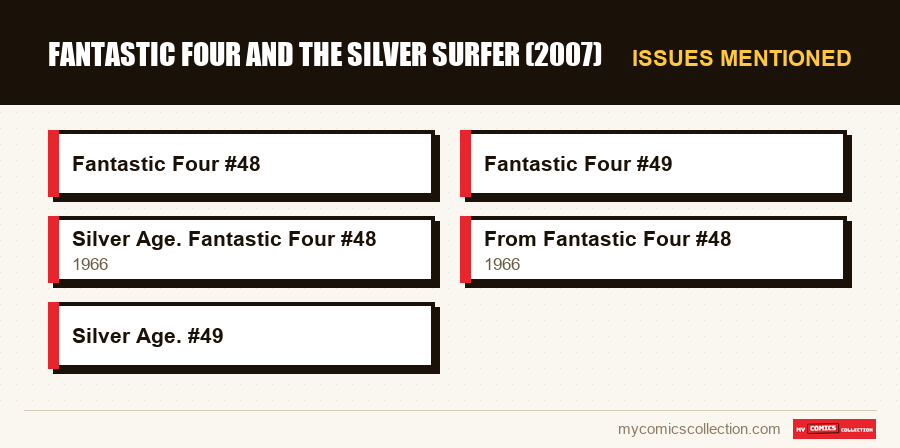
Fantastic Four #48 (1966): 1st appearance of the Silver Surfer and Galactus
“Galactus Trilogy”(#48-50, 1966): Lee & Kirby
Galactus: the devourer of worlds
The Silver Surfer: the tragic herald and his redemption
- Le Silver Surfer, herald of Galactus on his board.
- Galactus, cosmic entity devouring worlds.
- Le Cosmic power and the power of the Surfer.
- La redemption of the Surfer, who turns against his master.
- La threat of annihilation of the Earth.
- Galactus becomes a simple cosmic cloud, without humanoid form.
- The role of Surfing and its history are condensed.
- Doom is added to the plot, absent from the trilogy.
- The tone remains light and family, far from the epic breath.
- La cosmic philosophy comics is reduced.
The “Galactus Trilogy” (Fantastic Four #48-50, 1966)
The film adapts one of the absolute pinnacles of comics: the "Galactus Trilogy", published in Fantastic Four #48-50 (1966) by Stan Lee and Jack Kirby. This story introduces two major figures from the Marvel universe. First Galactus, a primordial cosmic entity who feeds on the energy of entire planets, indifferent to the fate of their inhabitants: not a villain, but a force of nature, as old as the universe. Then the Silver Surfer, his herald, who travels the cosmos on his board to find worlds for him to devour. When the Surfer discovers humanity and its capacity to love and create, he rebels against his master to save the Earth, in a moving gesture of redemption. This visionary tale expanded the Marvel Universe on a cosmic scale.
The film takes up the heart of this trilogy: the arrival of the Silver Surfer, the threat of Galactus, the redemption of the herald who turns against his master to protect the Earth. Doug Jones plays an elegant and tragic Surfer, faithful to the spirit of the character. The main and famous freedom concerns Galactus: where the comics give him a grandiose humanoid form, a colossus wearing an emblematic helmet, the film reduces him to a simple shapeless cosmic cloud. This highly criticized decision deprives the story of its most iconic figure. The film also condenses the Surfer's story and adds Doom, absent from the original trilogy.
The Silver Surfer, tragic herald
The Silver Surfer is one of Lee and Kirby's finest creations. A cosmic being with a silver body, riding a plank through space, he embodies a figure of tragic nobility: condemned to serve Galactus by finding worlds for him to devour, he sacrificed his freedom to spare his own planet. His discovery of humanity, its beauty and its fragility, pushes him to rebellion. This philosophical and melancholic character, meditating on the human and cosmic condition, has become one of Marvel's most beloved, carrying a rare depth. His redemption, in the trilogy, is one of the most moving moments in comics.
The film captures the essence of the character: his melancholy, his power, his gesture of redemption. The relationship between the Surfer and the Fantastic Four, particularly Sue Storm, whose humanity touches him, is true to the spirit of the source material. The film succeeds in its visual representation of the Surfer, fluid and ethereal, one of its strong points. However, it condenses his history and his philosophy, reducing the meditative dimension which is the richness of the character in the comics. For the reader, the Silver Surfer is an invitation to discover not only the trilogy, but also his own series, where his reflections on the universe and humanity reach a depth that the film only sketches.
Galactus reduced to a cloud: the controversy
The film's most talked-about decision is its portrayal of Galactus. In the comics, Galactus is a visually grandiose figure: a colossal humanoid being, clad in armor and wearing an iconic horned helmet, whose appearance is overwhelming in its majesty. This image, signed Kirby, is one of Marvel's most iconic. The film instead chooses to represent Galactus as an immense shapeless cosmic cloud, a galactic storm without face or body. This bias, justified by the fear that a humanoid giant would appear ridiculous on screen, deeply disappointed fans, deprived of the most emblematic figure of the story.
This controversy illustrates the difficulties of adapting the most disproportionate concepts of comics. Galactus, with its cosmic nature and bold design, represented a visual challenge that the film preferred to avoid rather than address. This choice, symptomatic of the cautious tone of the duology, deprived the story of its strongest impact. For the reader, the real Galactus remains an unforgettable figure, an embodiment of Kirby's visionary imagination, whose majesty surpasses anything a cloud could suggest. The film, by reducing it, missed the opportunity to bring to the screen one of the most grandiose creations in comic book history.
Collecting this series?
Track what you own, what you are missing and what your collection is worth. 7 day trial.
Start my trial →The characters, from paper to screen
- The Silver Surfer: Tragic herald of Galactus, faithful to Fantastic Four #48, with the condensed story.
- Galactus: Devourer of worlds, reduced to a cosmic cloud, very far from the comics.
- Fantastic Four: The family of heroes, faithful to the first film.
- Sue Storm: Whose humanity touches the Surfer, faithful to the spirit of the trilogy.
- Doom: Added to the plot, absent from the original "Galactus Trilogy".
A cosmic threat in a family tone
The film increases the scale of threats compared to the first part, by introducing an entity capable of destroying the entire Earth. This rise in power, faithful to the trilogy which brought Marvel into the cosmic era, offers the film a challenge worthy of its source. However, the tone remains light and family, in continuity with the first film. This gap between the excessiveness of the threat (Galactus, devourer of worlds) and the lightness of the treatment weakens the impact of the story. The epic grandeur and philosophical scope of the “Galactus Trilogy” come up against a register that is too familiar to carry them fully.
This contrast illustrates the recurring difficulty in adapting the Fantastic Four, whose richness lies in their dual nature: endearing family and cosmic explorers. The film favors the first dimension to the detriment of the second, reducing a visionary epic to a family adventure. For the reader, it is an invitation to discover the “Galactus Trilogy” in the comics, where the arrival of the devourer of worlds and the redemption of the Surfer reach an unparalleled breadth and depth. The comic strip reveals the epic breath and philosophical scope that the film, in its cautious register, was unable to capture.
The challenge of adapting Kirby's cosmic
The Fantastic Four duology illustrates the continuing difficulty in bringing Jack Kirby's cosmic universe to the screen. The designer's creations (Galactus, the Silver Surfer, the Celestials) are of a visual and conceptual excess that defies the conventions of cinema. Their grandeur, their philosophical scope, their daring design constitute a challenge that adaptations have long preferred to avoid, as evidenced by the Galactus-cloud in the film. This caution, while it reassures the studios, deprives the public of the wonder specific to the imagination of Kirby, one of the greatest visionaries in the history of comics.
This pitfall reminds us that certain works draw their strength from what makes them difficult to adapt. The “Galactus Trilogy” is not just an action story: it is a meditation on the insignificance of humanity in the face of cosmic immensity, and on the capacity of a being to redeem itself through love of life. This depth, carried by Kirby's grandiose images, resists too wise an adaptation. For the reader, the film is an invitation to return to the source, where the epic breath and philosophical scope of the story reach their heights. Kirby's cosmic, in all its glory, has yet to be fully brought to the screen.
Where to start reading
To extend the film, the “Galactus Trilogy” (Fantastic Four #48-50, 1966), by Lee and Kirby, is the direct source and an absolute pinnacle of comics. The solo series “Silver Surfer” develops the character’s philosophy. The great cosmic stories of the Fantastic Four extend this universe. This journey covers the sources of a film faithful to the heart of the trilogy but reduced in its ambition.
Chronology of comics to know
- 1966: Fantastic Four #48: the first appearance of the Silver Surfer and Galactus.
- 1966: Fantastic Four #49-50: the continuation and end of the “Galactus Trilogy”.
- 1968: “Silver Surfer” (solo series): the philosophy of the herald.
Collection side: what numbers to aim for after the film
The Silver Surfer points to major keys to the Silver Age. Fantastic Four #48 (1966, first appearance of the Silver Surfer and Galactus) is one of the most sought-after keys of the era, an iconic number. Fantastic Four #49 and #50 (1966) complete the trilogy and are highly coveted. The first issue of the solo series “Silver Surfer”(1968) is another target. These numbers cover high budgets but remain pillars of the market. As always, condition and gradation determine value; relying on real recent sales is strongly recommended.
Its place in the saga and for the collector
The Silver Surfer brought one of Marvel's greatest stories, the "Galactus Trilogy", to the screen, despite Galactus being reduced to a cloud. For the collector, it revived interest in Fantastic Four #48, a major key to the Silver Age. It illustrates the effect of adaptations on the market. Beyond speculation, the film invites you to discover the “Galactus Trilogy” and the Silver Surfer series, where the cosmic threat and the redemption of the herald reach an unprecedented scale. By reducing Galactus, he reminds us how Kirby's visionary creations remain a challenge, and a source of wonder, for cinema.
The verdict: a watered-down cosmic trilogy
- Loyalty: The Silver Surfer, Galactus devourer of worlds, the Cosmic Power and the redemption of the herald come from the comics.
- Freedoms: Galactus reduced to a cloud, the story of the Surfer condensed, the addition of Doom, the family tone.
- Collectible numbers: Fantastic Four #48 (Surfer + Galactus), #49-50 (trilogy), “Silver Surfer” #1 (1968).
The Silver Surfer adapts the grandiose "Galactus Trilogy" by capturing the tragic herald and his redemption, but reduces Galactus to a mere cloud and maintains an overly familial tone. Faithful to the heart of the source but watering down its cosmic excess, the film disappoints on the essentials. For both the reader and the collector, it is an invitation to discover Fantastic Four #48 and the “Galactus Trilogy”.
Frequently asked questions
From Fantastic Four #48 (1966), created by Stan Lee and Jack Kirby, in the "Galactus Trilogy" (#48-50). Herald of Galactus, he rebels to save the Earth. The film faithfully portrays the character and his redemption.
The film chooses to depict Galactus as a shapeless cosmic cloud, for fear that a humanoid giant would appear ridiculous. This choice, much criticized, deprives the story of the grandiose and emblematic figure drawn by Kirby in the comics.
A cult retelling of Fantastic Four #48-50 (1966), by Lee and Kirby, which introduces Galactus and the Silver Surfer and brings Marvel into the cosmic era. The film adapts its heart, while reducing its scale.
No: Fatalis is added to the plot of the film, absent from the “Galactus Trilogy” of the comics. This addition, which mixes two stories, weighs down an already dense story and moves away from the source.
Fantastic Four #48 (1966, premiere of The Surfer and Galactus) is a major key to the Silver Age. #49-50 complete the trilogy, and “Silver Surfer” #1 (1968) is another hot target.
Does the film make you want to collect? Estimate the value for free of your numbers (Fantastic Four #48-50…) with our tool based on current eBay listings.