Fantastic Four (2015) Josh Trank offers a reboot of Marvel's first family, inspired by the modern rereading "Ultimate Fantastic Four» (2004) by Bendis and Millar. The film features the heroes of Fantastic Four #1 (1961), rejuvenated, and their origin via the Negative zone, but suffered from troubled production and a disastrous reception. Here is the detailed comparison, film versus comics.
New reboot from the founding team of Marvel, this film with a thwarted destiny attempts a darker and modern approach. It draws from the Ultimate version of the Fantastic Four. Source-by-source decryption.
As in each article in this series, only verified information (creators, distribution, dates, comic numbers) is stated; the comparative analysis is ours, without reproducing dialogue or protected images.
Title : Fantastic Four (2015)
Director: Josh Trank
Actors: Miles Teller (Red Richards), Kate Mara (Sue Storm), Michael B. Jordan (Johnny Storm), Jamie Bell (Ben Grimm), Toby Kebbell (Victor)
Exit : August 2015
Studio: 20th Century Fox
Fantastic Four #1 (1961): Team's 1st appearance
“Ultimate Fantastic Four”(2004): Bendis & Millar
The Negative Zone: the dimension from which powers come
Doom (Victor): the team's sworn enemy
- THE four heroes and their iconic powers.
- The version young and modern, inspired by Ultimate.
- La Negative zone as the source of power.
- La Thing and its stone monster drama.
- Victor Von Doom, the sworn enemy.
- The tone is dark and body horror, far from the family spirit.
- Doom is reinvented as an entity of the Negative Zone.
- La family dynamics is largely absent.
- The story is amputee by chaotic production.
- L'cosmic adventure comics is reduced.
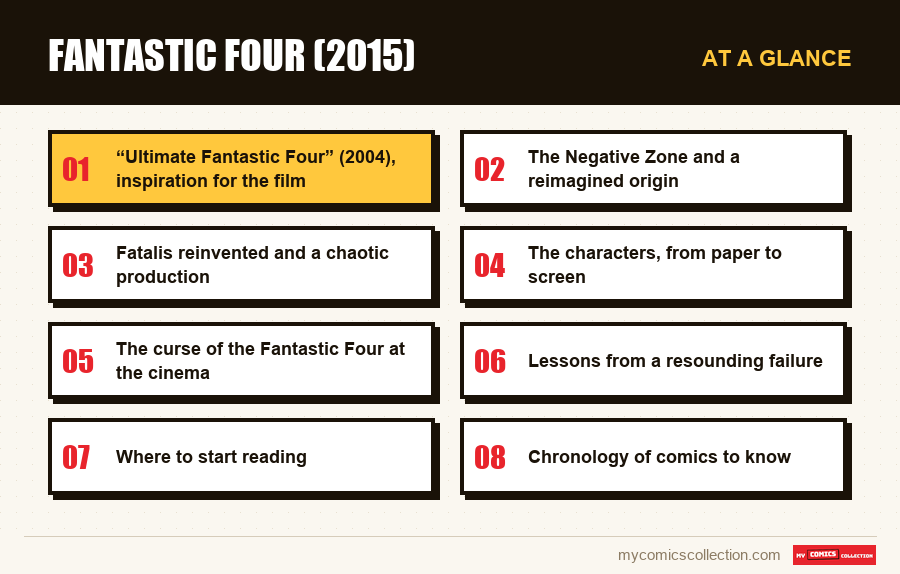
“Ultimate Fantastic Four” (2004), inspiration for the film
The 2015 film is inspired by "Ultimate Fantastic Four" (2004), a modern reimagining of the team launched by Brian Michael Bendis and Mark Millar in Marvel's Ultimate universe. This version reimagines the Fantastic Four as young scientific prodigies, whose powers come not from space flight, but from an accident linked to a parallel dimension, the Negative Zone. This rejuvenated and more contemporary approach, which modernized the origins of the heroes for a 21st century readership, served as a model for the film. This takes up the idea of young scientists and the dimensional origin, moving away from space flight and cosmic rays from the classic 1961 story.
The film therefore retains the four heroes and their powers, as well as the Negative Zone as the source of their transformation, faithful to the Ultimate version. It also adopts a more serious and realistic tone, in the spirit of this modern rereading. The main break lies in the register: where “Ultimate Fantastic Four” retained a dimension of adventure and team spirit, the film turns to body horror, emphasizing the horror of the transformation of bodies. This dark bias, very far from the family and bright spirit of the classic Fantastic Four, disoriented the public and contributed to the failure of the film.
The Negative Zone and a reimagined origin
The origin of the powers, in the film, is based on the Negative Zone, a parallel dimension from the comics: for Lee and Kirby, it is an antimatter universe explored by Red Richards. The film makes it the source of the heroes' transformation: during an expedition to this dimension (named "Planet Zero" in the film), the four protagonists, as well as Victor, are exposed to an energy which alters their bodies. Red gains elasticity, Sue gains invisibility, Johnny gains combustion, and Ben becomes a stone monster. This retelling, inspired by Ultimate, replaces the space flight and cosmic rays of the original story with dimensional exploration.
The film emphasizes the horror of these transformations, filmed as traumatic mutations: bodies that deform, burn or petrify. This body-horror approach, while it reflects a desire for seriousness and realism, radically moves away from the spirit of the Fantastic Four, whose powers, in the comics, relate to wonder and adventure rather than terror. This shift in tone illustrates the film's difficulty in finding its way. For the reader, the Negative Zone is an invitation to discover the cosmic stories of Lee and Kirby, where this antimatter dimension is the scene of extraordinary adventures, a thousand miles from the horrific register of the film.
Fatalis reinvented and a chaotic production
The film once again reinvents Doom (Victor Von Doom). In the comics, he is a genius and a monarch, with unrivaled intelligence and technology, one of Marvel's greatest villains. The 2015 film makes him a young antisocial programmer, transformed by the Negative Zone into an entity with telekinetic and destructive powers, whose appearance evokes a creature from the parallel dimension. This rereading, very far from the grandiose character of the comics, reduces Fatalis to a generic antagonist, deprived of the complexity and scope that make him great. This is one of the many weaknesses of a film that struggles to do justice to the Fantastic Four universe.
The failure of the film can be explained above all by a notoriously chaotic production. Disagreements between the director and the studio, extensive reshoots and a disfigured final edit resulted in a disjointed work, a rushed third act and sacrificed coherence. The film thus became a textbook case of production excesses, its final version not reflecting the initial vision of its director. For the reader, this failure illustrates the persistent difficulty in adapting the Fantastic Four, whose cosmic richness and family spirit resist dark rereadings. He reminds us that fidelity to the soul of a work (here, the wonder and warmth of Marvel's first family) is essential to a successful adaptation.
Collecting this series?
Track what you own, what you are missing and what your collection is worth. 7 day trial.
Start my trial →The characters, from paper to screen
- Red Richards: Young scientific prodigy, faithful to the Ultimate version, in a dark tone.
- Sue Storm: The Invisible Woman, with force fields and invisibility.
- Johnny Storm: The Human Torch, young hothead.
- Ben Grimm / the Thing: Stone monster with a poignant drama, filmed like a horror.
- Victor Von Doom: Reinvented as an entity from the Negative Zone, very far from the Doom of the comics.
The curse of the Fantastic Four at the cinema
The failure of the 2015 film fueled the idea of a Fantastic Four “curse” in cinema. After the two films from 2005-2007, considered too light, and this dark and failed reboot, the founding team of Marvel had still not found its adaptation up to par. This recurring difficulty is due to the particular nature of the Fantastic Four: their richness lies in a delicate balance between cosmic adventure, scientific wonder and familial warmth, which is difficult to capture. Successive attempts failed by leaning sometimes towards lightness, sometimes towards darkness, without finding the right tone.
This thwarted story underlines, by contrast, the greatness of Lee and Kirby's original series. The Fantastic Four of the comics are explorers of the infinite, a family of adventurers pushing the boundaries of possibility, whose unbridled imagination founded the entire Marvel universe. No adaptation has yet done full justice to this joyful excess. For the reader, these failures are an invitation to return to the source, where the pioneering team displays inexhaustible creativity, from the Negative Zone to Galactus. The Fantastic Four are still waiting for the adaptation that will combine their cosmic scale and their family heart, the one that will finally honor Marvel's first family.
Lessons from a resounding failure
The failure of 2015's Fantastic Four serves as a lesson for superhero cinema as a whole. It illustrates the dangers of out-of-tune production, where a director's vision and a studio's imperatives come into conflict without resolution. The result (a disjointed film, with an uncertain tone and disfigured editing) has become a frequently cited example of the excesses that an adaptation can experience. This failure also precipitated a turning point: the team's rights will eventually return to a fold capable, we hope, of doing it justice, proving that a failure can open the way to a revival.
Beyond the circumstances of its production, the film underlines an essential truth about adaptation: we cannot betray the spirit of a work without compromising its success. The Fantastic Four are, in essence, a family of adventurers driven by wonder and warmth; transforming them into body horror heroes amounted to denying their very identity. For the reader, this failure is an invitation to return to the comics of Lee and Kirby, where the team displays a joy of exploration and an inventiveness that no film has yet been able to capture. He reminds us that fidelity to the soul of a work, more than to its letter, is the key to a successful adaptation.
Where to start reading
To extend the film, Fantastic Four #1 (1961) features the birth of the team. “Ultimate Fantastic Four” (2004), by Bendis and Millar, is the modern reinterpretation that inspires the film. Lee and Kirby's grand cosmic stories, including the “Galactus Trilogy,” showcase the scope of the team. This journey covers the sources of a failed film but inspired by an interesting rereading.
Chronology of comics to know
- 1961: Fantastic Four #1: The first appearance of the Fantastic Four.
- 1962: Fantastic Four #5: Doom's first appearance.
- 2004: “Ultimate Fantastic Four”: the modern reinterpretation that inspires the film.
Collection side: what numbers to aim for after the film
Fantastic Four (2015) points to various keys. Fantastic Four #1 (1961, team's first appearance) is a very valuable Silver Age mainstay. Fantastic Four #5 (1962, premiere of Fatalis) is another essential key. The first issue of “Ultimate Fantastic Four” (2004), which inspires the film, is a more accessible modern target. These issues cover a variety of budgets, from Silver Age to modern. As always, condition and gradation determine value; relying on real recent sales is strongly recommended.
Its place in the saga and for the collector
Fantastic Four (2015) will remain as a failed reboot, victim of chaotic production and a poorly chosen tone. For the collector, however, it has maintained interest in Fantastic Four #1 and "Ultimate Fantastic Four." It illustrates the effect of adaptations on the market, even in the event of failure. Beyond speculation, the film invites us to discover the Ultimate version of the team and the founding stories of Lee and Kirby. By failing to capture the spirit of the Fantastic Four, it recalls, by contrast, the richness of a team whose cosmic scale and familial warmth still await their proper adaptation.
The verdict: a dark and failed reboot
- Loyalty: the four heroes, their powers, the young version (Ultimate) and the Negative Zone come from the comics.
- Freedoms: the body-horror tone, Fatalis as an entity from the Negative Zone, the absence of family dynamics, an amputated story.
- Collectible numbers: Fantastic Four #1 (The Team), Fantastic Four #5 (Fatalis), “Ultimate Fantastic Four” #1.
Fantastic Four (2015) attempts a dark reboot inspired by the Ultimate version, but fails by adopting a body-horror tone and suffering from chaotic production. Faithful to the heroes and the Negative Zone but betraying the family spirit of the source, the film disappointed. For the reader and the collector, it is an invitation to discover Fantastic Four #1 and “Ultimate Fantastic Four”.
Frequently asked questions
From Bendis and Millar's "Ultimate Fantastic Four" (2004), which reimagines the team as young prodigies whose powers come from a parallel dimension. The film takes up this rejuvenated version and the dimensional origin.
Because of chaotic production (disagreements between director and studio, reshoots, disfigured editing) and a poorly chosen body-horror tone, very far from the family and luminous spirit of Fantastic Four. The result is disjointed and unsuccessful.
A parallel antimatter dimension from the comics of Lee and Kirby, explored by Red Richards. The film makes it the source of the heroes' powers (named "Planet Zero"), replacing space flight and cosmic rays from the original story.
No: the film reinvents him as a young programmer transformed into an entity from the Negative Zone, with telekinetic powers. This generic version is very far from the Fatalis of the comics, genius and monarch, one of Marvel's greatest villains.
Fantastic Four #1 (1961, Team) is a Silver Age mainstay. Other targets include Fantastic Four #5 (1962, Doom) and “Ultimate Fantastic Four” #1 (2004), which inspired the film.
Does the film make you want to collect? Estimate the value for free of your numbers (Fantastic Four #1, #5…) with our tool based on current eBay listings.