A lot of comics on eBay is neither a systematic trap nor a martingale: it is a calculated bet. The real opportunity exists when a seller describes his lot poorly (no issue number, unflattering photo, missing keywords) and therefore attracts fewer bidders than a well-referenced lot. The real trap exists when the lot hides a degraded condition, an undeclared restoration, or when the transaction falls outside the protected framework of eBay. The difference between the two is almost never down to luck: it comes down to carefully reading the photos, description, seller profile and return policies before clicking “bid”.
Searching for “comic lot” on eBay brings up tens of thousands of ads at any given time: entire boxes of comics from the 1990s sold by the kilo, unsorted “box lots” inherited from an attic, lots curated by a professional reseller around a specific theme, or mystery lots where even the seller doesn't really know what he's offering. This heterogeneity is precisely what makes the category fascinating for a collector: it mixes, in the same flow of announcements, the best deal of the year and the worst scam of the month.
The most common reasoning among occasional buyers, “there must be a treasure hidden in this box of 200 comics”, is not absolutely wrong, but it ignores a simple statistical fact: most lots are put up for sale by people who, contrary to the legend of the forgotten attic, generally know what they own. Real nuggets almost never come from a treasure unknown to everyone; they come from a referencing error by the seller, that is to say a problem with the visibility of the ad rather than a problem with knowledge of the content.
This article dissects the real mechanism of comic lots on eBay: why some are undervalued, what are the documented pitfalls of the market (counterfeits, CGC reholder scam, off-platform scams), what eBay buyer protection really covers, and how to build a reliable evaluation method before betting a single euro.
From end-of-garage sale boxes to the “comic lots” category: how this market was structured
Before the rise of online commerce, the sale of a collection of bulk comics went almost exclusively through three channels: resale to a local comic shop (which generally buys back at a fraction of the price to generate its own resale margin), the regional convention, or word of mouth between collectors. In all three cases, the potential buyer had physical access to the lot before purchasing, which mechanically limited unpleasant surprises but also reduced the number of potential buyers to those able to travel.
eBay has changed the game by dissociating sales from physical presence. A seller can now reach a global pool of buyers for a box of comics that, locally, would only interest a handful of people. This large-scale competition had two contradictory effects on the price of the lots. On the one hand, it has raised the stakes on well-identified and well-photographed lots, where several buyers are competing for the same sought-after piece. On the other hand, it has created a considerable mass of poorly referenced lots, because the seller has neither the time nor the skills to catalog 300 comics one by one, which largely escape eBay's internal search engines and therefore the majority of buyers.
It is this second category which fuels the site's reputation as a hunting ground for nuggets. The J-MONTY COMICS site, which has documented this phenomenon for several years, summarizes the mechanism as follows: each nugget found in a lot comes from an error on the part of the seller, because if he had known what he had and how to promote it, he would not have sold it drowned in a generic lot. In other words, the “luck” of the collector who comes across a sought-after comic in a subtitled lot is not mystical: it is the direct consequence of a lack of commercial referencing, reproducible and identifiable if you know where to look.
The lot category has also become more complex with the arrival of professional sellers who know perfectly how to put together an attractive offer: thematic lots around a character, a narrative arc or an artist, “starter” lots for beginners, so-called “key issue bulk” lots which voluntarily announce several key numbers to justify a high starting price. These professional lots are rarely bargains, the seller has already integrated the value of each piece into his price, but in return they offer security of content that amateur lots do not always have.
Why a poorly described lot can really hide a good deal
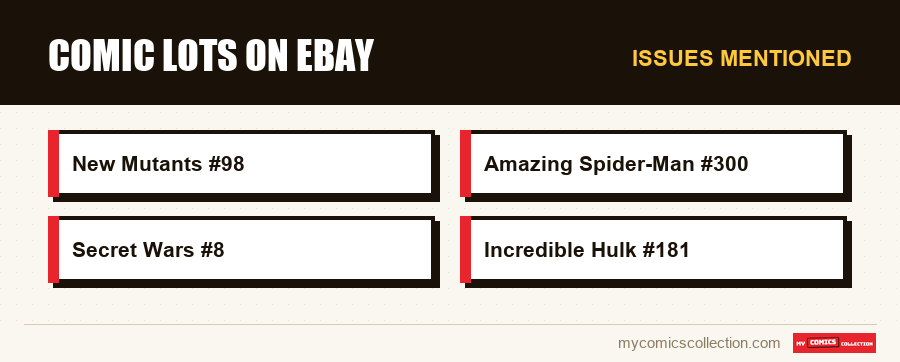
The starting point for any serious hunt for undervalued lots is to understand how the eBay search engine works and how sellers, often despite themselves, evade it. A concrete example documented by J-MONTY COMICS illustrates the phenomenon well: a batch containing New Mutants #98 (the first appearance of Deadpool, one of the most sought-after covers of the late 1980s) had been photographed in seventh position in the ad's image gallery, sandwiched between several issues of little commercial interest. The same site reports that this issue, in high grade, was then trading in a range of 450 to 900 dollars depending on the sales observed: a considerable difference in value that remained invisible to the majority of buyers who only consult the cover photo of the ad.
The same type of mechanism was observed on relistings: a first put on sale of a lot containing Amazing Spider-Man #300 or Secret Wars #8, without the issue number being mentioned in the title, resulted in a sale price significantly lower than that obtained during a second put online where the seller, having identified his error, explicitly mentioned the key numbers. This duplicate listing (the same merchandise, two radically different sales results) demonstrates that the perceived value of a lot depends as much on its textual description as on its actual content.
Concretely, a seller who lists a lot generally lets a nugget slip for one of these reasons: he ignores the hierarchy of value within his own collection and treats all numbers equally; he writes a generic title like “lot of vintage comics” without citing any number or any mention of “first appearance”, “1st app” or “key issue”; he chooses as the main photo the most aesthetic cover rather than the most valuable; or he sets a low starting price to attract bidders without realizing that he is selling off a highly valued piece in the process. Spotting these flaws requires method rather than luck: browse the results of broad rather than targeted searches, systematically open all the photos in an ad (including those at the end of the gallery, often overlooked by other buyers), and read the entire description rather than relying on the title alone.
This approach has a structural limit: the more a tracking method is documented and shared publicly, the more it attracts nugget hunters, which gradually closes the window of opportunity. Lots that are visibly poorly photographed or poorly titled are now scrutinized by a community of experienced pinball players who apply exactly the same techniques. The real contemporary opportunity therefore shifts towards lots recently put online, seller accounts that are not very active (individuals selling occasionally rather than professionals), and searches formulated in a non-standard way which escape the automatic alerts of other hunters.
The different batch families and what they really imply
Not all lots are equal and do not follow the same purchasing logic. The lot curated by a professional dealer presents precisely announced contents, often accompanied by individual photos of each number and a condition statement per piece; its price already incorporates the market value of each comic, so the buyer is paying for convenience and reliability more than for a bargain. The thematic lot, built around a character, an artist or a specific run, targets a buyer who is already a collector of the theme and is generally traded close to the sum of the individual odds, with a slight discount for service rendered (no need to search for each number separately).
The “estate” lot or inheritance lot, often put up for sale by a relative of the deceased collector or by a professional mandated to liquidate a collection, can contain real surprises because the seller discovers the contents at the same time as he sells it, without emotional connection or prior knowledge of the value. It is historically one of the most reliable sources of real bargains, but also one of the favorite targets of fake inheritance scams, a point detailed below.
The “box lot” or “bulk lot”, sold by weight or volume rather than by piece, corresponds to a pure statistical bet: the seller rarely displays the detailed content, contenting himself with an overall photo and a mention of years or publishers covered. This is the riskiest and most speculative category, where the relationship between the price paid and the probability of finding a number that covers the investment remains difficult to assess without a physical inspection impossible before purchase. Finally, the "mystery" or "grab bag" lot, which openly assumes not to reveal anything about the content beyond a number of comics and sometimes a range of years, is more of a game than a reasoned purchase: a practice to be reserved for a clearly delimited leisure budget, never for an investment budget.
The Real and Documented Pitfalls of the eBay Lot Market
The first trap, and the most insidious, does not concern amateur lots but already certified pieces resold apparently with complete confidence: the reholder scam. This fraud system, publicly revealed in 2024, exploits a flaw in CGC's reholdering process (the replacement of a damaged protective shell without complete re-rating of the comic). The documented mechanism is as follows: a fraudster buys a copy actually graded at a very high level: the case cited in several reports is an Incredible Hulk #181 rated 9.8 - opens the sealed shell without leaving any visible trace of manipulation, removes the original comic, replaces it with a copy of significantly lower quality of the same number, then reseals the shell via the CGC reholdering service. The lower quality comic is then found in a case still displaying the original rating 9.8, and can be resold at the price of a high-end copy even though the actual content no longer justifies it.
CGC publicly acknowledged that this incident affected “a few hundred” comics, which suggests that the actual number of pieces affected, accumulated over several years of practice before detection, could be higher. The case was brought to light not by CGC itself but by the collecting community, notably via the specialist YouTube channels Automatic Comics and Swagglehaus, after the alleged fraudster put a suspicious number of rare variants called "Mark Jewelers" up for sale on eBay, attracting the attention of experienced buyers capable of spotting the statistical anomaly. For a lot buyer, the practical lesson is twofold: a sealed CGC shell is not an absolute guarantee if it has been resealed after reholdering, and it is better to check the certification history of an example via the CGC certificate number before bidding on a high-value piece rather than relying solely on the label visible in the photos.
The second documented trap concerns pure fake comics, particularly on copies targeting an intermediate price zone: neither six-figure auctions which attract advanced expertise, nor cheap comics which do not interest counterfeiters, but the range where a copy in unusually good condition for an unusually low price can slip under the radar of a buyer in a hurry. This signal, too good condition for too low a price, remains the best red flag, whether it's a comic sold alone or slipped into a bundle to dilute the attention paid to that particular piece.
The third trap directly affects the functioning of the platform: solicitation outside eBay. The documented pattern consists of a dishonest seller privately contacting a buyer interested in an ad, claiming eBay fees are too high, and then offering a direct transfer transaction for a supposedly reduced price. One case reported by GoCollect describes a buyer who wired funds without ever receiving the promised comics, with the seller using a fictitious account and email address. By leaving the eBay framework, the buyer loses any protection built into the fees that the platform charges precisely to secure the exchange on both sides. No discount, no matter how attractive, justifies leaving a protected transaction for a lot whose value exceeds a few dozen euros.
The fourth trap concerns false inheritances: a seller presenting himself as heir or agent of a collection, pressuring the buyer to conclude without inspection, refusing any offer deemed “too low” while claiming to be unaware of the value of the pieces, or demanding payment in cash only. The documented solution consists of requiring proof of mandate or heirship before any significant financial commitment: a precaution rarely applied by buyers in a hurry to conclude a deal that seems too good.
Collecting this series?
Track what you own, what you are missing and what your collection is worth. 7 day trial.
Start my trial →What the eBay Money Back Guarantee actually covers on a lot of comics
Unlike other product categories (electronics, recognized fashion items), comics are not among the categories covered by the eBay Authenticity Guarantee, the third-party verification service that eBay offers for certain collectibles and luxury products. A buyer should therefore not expect a batch of comics to be inspected by an independent third party before shipment, regardless of its selling price.
On the other hand, the general protection, the eBay Money Back Guarantee, applies to comics as well as to any other item. The central principle: a seller is required to deliver an item conforming to its description. If the item received is different from what was advertised, arrives damaged, or is in intentionally or unintentionally misdescribed condition, the buyer has a right of return within 30 calendar days of the estimated delivery date, even if the seller's announcement displayed a "no returns" policy. This rule has a direct practical consequence for the purchase of lots: a non-return policy displayed by the seller has no legal value in the face of a well-founded report of non-compliance, which leaves a real margin of safety even on a lot presented as sold "as is".
The refund covers the price of the item and the original shipping costs; in the event of a return for non-conformity, the return costs are the responsibility of the seller, not the buyer. The procedure starts from the eBay purchase history, by first contacting the seller directly; if no resolution is reached within three business days, eBay may be asked to arbitrate. This mechanism changes the nature of the risk taken on a poorly photographed or approximately described lot: the worst scenario is almost never the outright loss of the money invested, but the loss of time linked to a return procedure, provided that the condition of the lot received is systematically documented (immediate photos upon opening the package) before any handling.
Cinema speculation and Marvel/DC releases: when media hype artificially inflates a lot
A recurring phenomenon on the lot market deserves particular attention: the effect of a film, series or casting announcement on the displayed price of lots containing, or claiming to contain, a first appearance linked to the character concerned. As soon as a studio announces the adaptation of a previously secondary character, a wave of sellers artificially raises the starting price of their lots by highlighting the number concerned in the title, regardless of the real condition of the piece or its objective rarity. This type of speculative over-titling temporarily transforms once-neglected lots into hotly contested listings, with bids sometimes far exceeding the market value observed before the listing.
For a buyer, this phenomenon creates a double trap: the first is to pay a price inflated by hype which can fall as quickly as it is built if the film is postponed, poorly received or changes creative direction; the second, more insidious, concerns lots where the key number announced in the title is in reality a heavily degraded copy, a reprint or a facsimile slipped among other comics of little value: the mention of the correct number in the title attracts the click, but there is no guarantee that the item visible in the photo corresponds to the expected condition or edition. The simplest rule of caution remains to systematically compare the price asked for a lot “boosted” by cinema news with the history of sales concluded on the same piece before the announcement, rather than relying on the starting price set after the media hype. An estimation tool based on current eBay listings, checked against the sold history, lets you do this verification in minutes rather than guessing on instinct.
Buying guide: the method for evaluating a lot before bidding
Buying a lot of comics on eBay without a method is like buying blind; here are the concrete checks to systematically carry out before placing a bid or clicking on “Buy now”.
- Open all photos in the ad, without exception: including those at the end of the gallery, often overlooked by busy sellers and other buyers; This is where poorly presented pieces are most often hidden.
- Read the full text description, not just the title: a seller who carefully lists each number contained in the lot generally indicates good knowledge of his stock, therefore an already adjusted price; a seller who remains vague signals the opposite.
- Check seller profile and history: number of reviews, age of the account, percentage of positive reviews, and especially the nature of the negative reviews (a negative review linked to a delivery time does not have the same impact as a review denouncing a non-compliant item).
- Be wary of too good a condition for too low a price on an individually identifiable part in the lot: this is the most reliable warning signal to detect a counterfeit copy or a potentially compromised case.
- Check the certificate number on any piece already graded visible in the lot by cross-checking it with the grader's certification basis, rather than relying solely on the photographed label.
- Never accept a payment request outside of eBay, regardless of the discount offered by the seller to “avoid platform fees”.
- Require proof of mandate for any lot presented as an estate before committing a significant amount, in particular if the seller rushes the conclusion of the sale or refuses any questions about the origin of the lot.
- Photograph the lot as soon as the package is opened, before any handling, to document a possible discrepancy with the description in the event of recourse to the Money Back Guarantee.
- Compare the starting price with the history of completed sales on identifiable pieces in the lot rather than with active listings, which reflect asking prices and not prices actually paid.
- Set a maximum budget before viewing the ad and stick to it, to avoid the bidding rush which mechanically transforms a potential good deal into an overpaid purchase.
For collectors who follow several lots in parallel or who want to keep track of what they already own before bidding on a potential duplicate, keep an up-to-date inventory of their collection: via a dedicated application like the comic collection management application: avoids the classic pitfall of repurchasing an issue already on the shelves in a batch.