Flea markets, flea markets and garage sales remain one of the rare places where an old comic can still sleep in a box without its seller knowing its real value. The vast majority of the piles offered are current copies without much commercial interest, but the historic American distribution system (returns to newsstands, comics without covers, successions never sorted) explains why key issues still resurface today outside the specialized circuit. Knowing how to inspect the condition, recognize a reissue and verify the completeness of a copy before purchasing makes all the difference between a find and a disappointment.
Hunting for comics at a flea market is as much about amateur archeology as it is about negotiation. Unlike specialized stores where each piece has already been sorted, graded in the eye of the seller and displayed at a considered price, the stall of a general second-hand dealer or the cardboard placed on the floor of a garage sale has often not been subject to any sorting. The seller has sometimes inherited a collection, emptied an attic or bought a lot in bulk without knowing what it really contained, and it is precisely this lack of expertise that creates, from time to time, an opportunity for the buyer who knows what they are looking at.
This guide is not intended to sell dreams: the probability of coming across a key issue in good condition during a given release remains low, and most of the comics sold at flea markets are worth their listed selling price, neither more nor less. It is rather a matter of providing the concrete tools (historical, technical and methodological) to quickly sort the wheat from the chaff, avoid the most common pitfalls (reissues, incomplete copies, hidden damages) and seriously evaluate what you are holding in your hands before taking out your wallet or, on the contrary, before letting slip a piece that was worth it.
Why do rare comics still end up on shelves?
To understand why old comics still circulate outside specialized channels, we must go back to the newsstand distribution system which dominated the American market until the mid-1970s. At the time, comics were sold "on a return basis": newsstands were only charged on the copies actually sold to the public, and unsold copies had to be destroyed to prove that the stock was not sold. Independent distributors, however, did not have the logistical means to return entire stacks of unsold magazines to the publisher: they were content to tear off the cover and return it alone as proof of destruction, the body of the comic being supposed to be destroyed. In fact, a significant portion of these uncovered copies, and sometimes entire piles never really destroyed, escaped crushing and ended up sold at a discount in secondary sales points, or quite simply stored in reserves, garages, back rooms. It is estimated that at the height of this system, no more than 25% of printed comics were actually sold to the public; the rest should in theory disappear.
This mechanism explains two essential things for those shopping today. First, the disproportionate presence of comics without covers or with partially torn covers in flea market lots: these are not necessarily copies mistreated by their owner, but survivors of a return circuit which never worked to the end. Then, the reason why entire successions of comics: accumulated by a reader in the 1960s and 1980s who bought his issue each month on newsstands then put the pile in the attic without ever reselling it: resurface today during an estate sale, a move or a garage sale organized by heirs who have no idea of the value of what they are liquidating. It is this second scenario, much more than the first, which produces the most interesting discoveries: a complete, unsorted box, of which the seller simply wants to “empty the space”.
The development of the collection market itself also played a role. The first Comic Book Price Guide by Robert M. Overstreet, published in November 1970 in just 1,000 copies based on historical research by researcher Jerry Bails, structured for the first time a benchmark of values recognized by collectors and dealers. Before then, there was simply no consensus on what made an issue valuable: comics were seen as disposable children's entertainment, not a heritage asset. This cultural shift, from consumer object to collectible object, took place gradually over several decades, which means that entire generations of comics circulated, were stored or thrown away without anyone thinking to verify their value. Flea markets are, still today, one of the last points of friction between this ancient culture of disposable objects and the structured collector's market that has been built since.
Inspect a comic before buying: the serious bargain hunter's method
When faced with a stall or an unsorted box, the first question is not “how much is it worth” but “what do I really have in front of me”. Before even thinking about the rating, it is necessary to establish the identity and completeness of the copy.
Check completeness first
An incomplete comic loses most of its value, regardless of its theoretical rarity. Count the pages, check that the centerfold (the central stapled notebook) is present and has not been detached, and look to see if any advertising coupons have been cut out inside: a very common practice among young readers in decades past, who cut out the promotional offers (figurines, decoders, free comics) printed on the back of the interior pages. A copy missing a coupon page loses much of its potential, even if the cover is intact.
Examine under raking light
The method used by experts involves tilting the comic under raking light (a flashlight held at an angle is sufficient) to reveal shallow creases, surface frictions and paper undulations invisible in head-on light. A 10x magnifying glass then allows you to examine the condition of the staples (rust, off-centering) and the printing quality of the cover, two clues which also help to distinguish an original printing from a more recent reissue.
Check the condition of the back and angles
The spine (the stapled edge) is often the first place to reveal wear: tension lines, wrinkles, splits or color breaks along the fold are defects which, even minor to the naked eye, weigh heavily in a professional evaluation. Corners are also telling: soft, rounded, or bent corners indicate prolonged unprotected storage, often a sign that a copy has been lying around in a pile rather than being kept flat in a sleeve.
Beware of odors and humidity
A pronounced musty or musty odor, extensive freckling (foxing) or a uniform yellowish tint to the paper indicate storage in a humid or poorly ventilated environment: attic, cellar, garage. This damage is irreversible and directly affects the grade that a professional grading service could assign to the copy, regardless of its editorial interest.
Collecting this series?
Track what you own, what you are missing and what your collection is worth. 7 day trial.
Start my trial →Reissues, subsequent printings and counterfeits: what to really fear
Good news for those shopping at flea markets: pure counterfeiting, a fake manufactured from scratch to imitate an old comic book, remains an extremely rare phenomenon in the world of comic books. When it exists, it concerns almost exclusively independent titles in black and white, printed in few copies, easier to reproduce than a color comic from a large historical publisher. The real risk to be aware of at flea markets lies elsewhere: that of confusing an original print with one of the multiple reprints, facsimiles or special editions published much later on legendary issues.
Publishers have in fact published, over the decades, numerous reissues of their most emblematic issues (anniversaries, promotions, educational facsimiles) which reproduce the original cover but have neither the paper, nor the format, nor sometimes even the exact dimensions of the original edition. Several clues allow them to be quickly distinguished: the format of a facsimile is often slightly different from the original, particularly on the oldest and most imitated issues; the title page or inside cover usually mentions the actual publication date of the reissue, the publisher and sometimes an explicit note indicating that it is a later printing; and the quality of color reproduction, on modern reissues, is often sharper and more contrasting than on a decades-old original, whose vintage offset printing has its own characteristic imperfections.
Good practice is to always open the comic, not just look at the cover, and check the copyright page or the first inside page, which contains the filing date, the edition number and sometimes mentions of previous printings. It is also one of the rare places where a flea market seller will not have thought to verify the information himself, which makes it a reliable source for making decisions quickly on site, without specialist equipment.
The impact of adaptations on the rating of finds
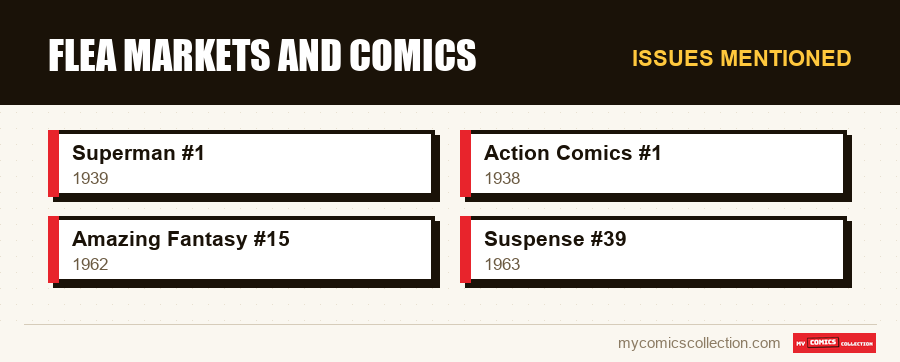
The valuation of old comics does not only follow a logic of raw rarity: it is directly correlated to the cultural visibility of the character or the universe concerned, and film and television adaptations have had a demonstrable effect on the prices achieved at auction in recent years. The most spectacular price records on the market systematically concern the first appearances of characters who have become global film franchises: Superman #1 (1939) reached $9.12 million at auction in November 2025, establishing the absolute market record; Action Comics #1 (1938), in a CGC 8.5 graded copy of the prestigious “Kansas City” provenance, sold for $6 million at Heritage Auctions in April 2024; Amazing Fantasy #15 (1962), which marks the first-ever appearance of Spider-Man, reached $3.6 million as of September 2021 in a CGC 9.6 graded copy; and Tales of Suspense #39 (1963), Iron Man's first appearance, crossed the $2 million mark.
These amounts remain extreme cases, specific to exceptionally well-preserved copies of historically founding issues: they in no way represent what a bargain hunter could hope to find on a Sunday morning at a garage sale. On the other hand, they illustrate a very real market dynamic: each new release of a film or series linked to a character mechanically revives interest, and therefore demand, for its very first appearance numbers, even in much more modest states of conservation than the record copies. A damaged, incomplete or later edition of a key issue associated with a character brought to the screen will thus often retain a higher symbolic and market value than an equivalent comic in good condition but linked to a character that has remained confidential. This is a factor to keep in mind when sorting a flea market box: the name of the character on the cover is sometimes more important, for resale, than the objective condition of the paper.
Buying guide: good reflexes in the field
- Arrive early. Professional sellers and experienced collectors go first to the flea market stalls; the best pieces often disappear before the market officially opens.
- Carry a magnifying glass and a flashlight. Inspection under grazing light and examination under a 10x magnifying glass of the staples and the printing screen are the two most useful tools for quickly sorting a box without bulky equipment.
- Always open the comic. The cover is never enough to authenticate a copy: the interior copyright page reveals the real date of printing and distinguishes in a few seconds an original from a reissue.
- Count the pages and look for missing coupons. A copy with missing pages loses most of its commercial value, even if the cover appears to be in perfect condition.
- Do not neglect unsorted batches. Entire boxes, sold by weight or package by heirs in a hurry to empty a house, are statistically more likely to contain an interesting piece than a stall already selected piece by piece.
- Beware of damp odors and yellowish stains. This storage damage is irreversible and weighs heavily on any subsequent evaluation, even if the editorial content of the issue is interesting.
- Negotiate based on what you know, not what you hope. A flea market seller rarely sets his price on a documented basis: offer a price consistent with the actual condition of the item rather than its theoretical value in very good condition.
- Check the rating before processing a part you have doubts about. A comic that seems interesting but whose value you don't know deserves a quick estimate rather than a blind purchase or, conversely, a refusal out of an abundance of caution.
Once you return home, cataloging what you have found, and monitoring the evolution of the price of the numbers you keep, quickly becomes essential as soon as the collection exceeds a few dozen pieces. An application dedicated to comics collection management allows you to keep a structured trace of each acquisition, its estimated condition and its provenance, which proves valuable the day you want to resell or simply know what your set of finds accumulated at flea markets is really worth.