Ask yourself three questions before buying: exactly which comic is it (title, issue number, year, publisher), what is its real condition, and is it a key issue? Then compare with the last 5 to 10 completed sales of a copy in comparable condition, and take their median as your reference price. Never rely on unsold listings, whose prices can be completely disconnected from the market.
⚠️ For reference only: This information is provided for educational purposes only. My Comics Collection is not an investment advisor. Prices vary with condition, scarcity, and market trends. Always check recent sales before any purchase.
You're at a flea market, a yard sale, a convention, or you're scanning an eBay listing, and you spot a comic. The seller names a price. You don't know if it's a deal or a trap. You might have 30 seconds to decide. This guide gives you the reflexes to never overpay for a comic.
Estimating a comic's value before buying is a learnable skill, and it can save you dozens or hundreds of dollars over time. Unscrupulous sellers count on your uncertainty to charge top dollar for what doesn't deserve it.
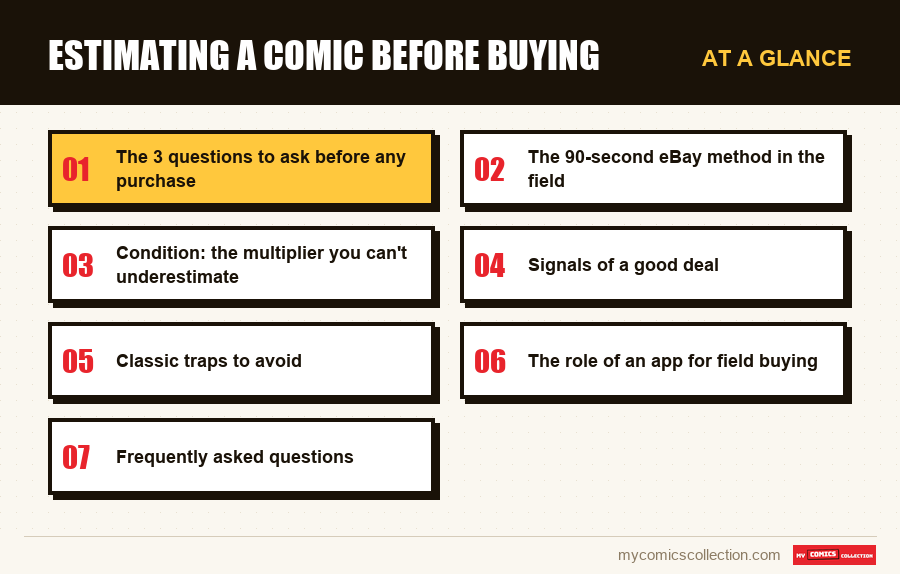
The 3 questions to ask before any purchase
Before opening your wallet, three quick questions frame the evaluation:
1. What exactly is this comic? Title, issue number, year, publisher. An "Amazing Spider-Man" can mean a 1963 issue or a 2014 issue: one might be worth hundreds of dollars, the other a few dollars. A New Mutants #98 (first Deadpool) deserves very different attention from a New Mutants #97. Precise identification is non-negotiable.
2. What's the real condition? Not the condition the seller claims: the condition you evaluate yourself. Look at the cover (creases, tears, stains, faded color), the corners (rounded or sharp), the spine, and flip through the interior pages quickly (browning, marks, torn pages). Be precise: the difference between Very Fine and Very Good can cut value in half.
3. Is this a key issue? Is there a first appearance, a major death, or an important transformation? A common issue from the same series doesn't have remotely the same value as a key. A few seconds of phone research can keep you from letting a $5 key issue slip away, or from paying $50 for an ordinary comic.
The 90-second eBay method in the field
The most reliable price check is accessible from your smartphone, free, in under two minutes. Here's how to do it standing in front of a flea-market bin:
Open the eBay app (or mobile site). Type the exact title and issue number into the search bar. Add the keyword "sold" if you're on eBay.com, or activate the "Sold Items" filter. Look at the last 5 to 10 sales for a copy in condition comparable to yours.
The median of those sales is your reference price. If the seller is asking less than this median, it's an interesting deal. If they're asking more, negotiate or walk away. This method takes 60 to 120 seconds with practice.
Warning: don't base judgment on active listings (without the "sold" filter). Sellers can post prices entirely disconnected from the real market. Only completed transactions count.
Condition: the multiplier you can't underestimate
A comic's condition impacts price in ways casual buyers don't fully grasp. For a popular key issue, the value gap between a Good (GD) copy and a Near Mint (NM) copy can reach a 1-to-5 ratio, sometimes more.
Here are concrete benchmarks: imagine a comic with a $110 NM reference value. In Very Fine (VF), it's worth about $65-$75. In Fine (FN), $40-$50. In Very Good (VG), $22-$33. In Good (GD), only $11-$17. These ranges apply to the vast majority of modern-age key issues.
What this means in practice when buying: if you pay for a comic as if it were in VF when it's actually VG, you're paying two to three times too much. Learn to evaluate condition yourself rather than relying on the seller's description, which naturally skews optimistic.
Points to inspect quickly: corners (sharp = good condition, rounded = lower grade), cover (glossy highlights = good, faded = bad), spine (should be clean without horizontal creases), and the interior by flipping quickly (white pages = excellent, yellowish = lower grade).
Collecting this series?
Track what you own, what you are missing and what your collection is worth. 7 day trial.
Start my trial →Signals of a good deal
A good deal isn't just a low price. It's a low price for a comic whose real value is higher. Signals to watch:
The seller isn't a comic specialist. A family yard sale, a general estate sale, a village flea market: these contexts favor deals because sellers haven't done their research. Conversely, at a specialty comic booth at a convention, prices are generally well-documented.
The comic is in a "bulk" lot. Many sellers don't sort issue by issue. If you find a lot of 50 comics for $22 and one of them is an $88 key issue, the lot becomes very interesting even if the other 49 are worthless.
The price hasn't caught up. If an issue has been announced in an upcoming MCU or DCU adaptation, its value may have risen since the seller set their price. They may not know their "old comic" is now worth three times what they're asking.
Classic traps to avoid
Reprints sold as originals. Popular comics have often been reprinted, sometimes with covers very close to the original. An Amazing Fantasy #15 from 1961 (first Spider-Man) is a comic worth hundreds of thousands of dollars. Its 1990s reprint is worth a few dollars. Always check the interior copyright and publication date.
Variants in poor condition sold as rare. A 1:50 variant in Poor (P) condition with a torn cover isn't worth much despite its theoretical scarcity. Scarcity and condition are evaluated together, never separately.
Inflated prices around film releases. Opportunistic sellers at markets and platforms know film releases push prices up. But post-announcement prices often retreat after a few weeks. Buying in the first days after an MCU announcement often means paying at the top.
The role of an app for field buying
The ideal situation for an active buyer is to access a pricing database directly on their phone, in 30 seconds, standing in front of a comic bin. My Comics Collection does exactly that: search a title and issue, instantly get current eBay listing data and price ranges by condition.
This fundamentally changes the power balance with sellers. Where uncertainty used to force you to "take a risk" or walk away for caution, you now have the same information as the professional seller, in seconds.
Frequently asked questions
The fastest field method is to type the title and issue number into Google followed by "key issue" or "first appearance." Specialty sites index key issues by series and number. With practice, you'll identify important numbers in your favorite series directly. A dedicated app like My Comics Collection also flags key issues when searching for an issue.
Check in order: corners (sharp = good grade, rounded or creased = lower grade), cover (no creases, no stains, glossy = Near Mint), spine (no horizontal creases), title page by quickly flipping (white = good, yellowed = worse). If all four criteria pass, the copy is at least Very Fine. Any visible defect drops it one or more grades.
Both have advantages. At conventions, specialty booths often have better conditions and targeted selection, but prices are generally well-researched. Yard sales and flea markets offer more opportunities to find underpriced comics because sellers aren't specialists. The best deals are often found in contexts where the seller doesn't know what they're selling is worth.
At yard sales and flea markets, negotiation is almost always possible: it's the cultural norm. At specialty convention booths, margins are often tight and sellers know their prices, but respectful negotiation on a lot or at end of day is always possible. Arrive with real price data (recent eBay sales) rather than subjective arguments.