Saturday morning, 8:30 AM. In front of you, a wobbly table covered with a checkered cloth, stacked with comics in a heap. The seller, a grandfather emptying his son's attic, looks at you kindly and asks if you want everything for $22.
Saturday morning, 8:30 AM. In front of you, a wobbly table covered with a checkered cloth, stacked with comics in a heap. The seller, a grandfather emptying his son's attic, looks at you kindly and asks if you want everything for $22. Among the pile, you spot a red and blue cover. Amazing Spider-Man #300. Your pulse quickens.
This kind of scene is less rare than you'd think. Yard sales, estate sales, and flea markets remain in 2026 one of the last places where comics circulate at prices disconnected from the market. But to turn these moments into real windfalls, you need preparation, method, and speed. This guide gives you all the tools.
Before you go: preparing like a pro
The difference between a collector who leaves with treasures and one who leaves empty-handed often plays out before even arriving on-site. Preparation is the key.
Build and memorize your wishlist
Your wishlist is your compass. Without it, you end up hesitating in front of every comic, searching online with spotty 4G, losing precious time while another collector sweeps the stalls. Before any yard-sale outing, your wishlist must be accessible offline on your phone.
A good yard-sale wishlist has multiple priority levels:
- Level 1: Absolute must-haves: specific key issues you're missing, with exact numbers (Amazing Fantasy #15, X-Men #1, Incredible Hulk #181, etc.). These titles you need to know by heart.
- Level 2: Series to complete: runs where you're missing issues. Note the missing issues, not the whole series: you'll avoid duplicates.
- Level 3: Opportunities: interesting comics at bargain prices, even if you're not specifically chasing them: worth buying if under $X.
With the My Comics Collection app, your wishlist syncs continuously with your collection. When you scan a comic on-site, the app immediately tells you if it's on your wishlist, if you already own it, and its current price. No more accidental duplicate buys.
Know key issues by heart
You can't check the internet in the middle of a packed yard sale. You need the most valuable titles in your head. Here are the classics to memorize:
Key issues to recognize without internet
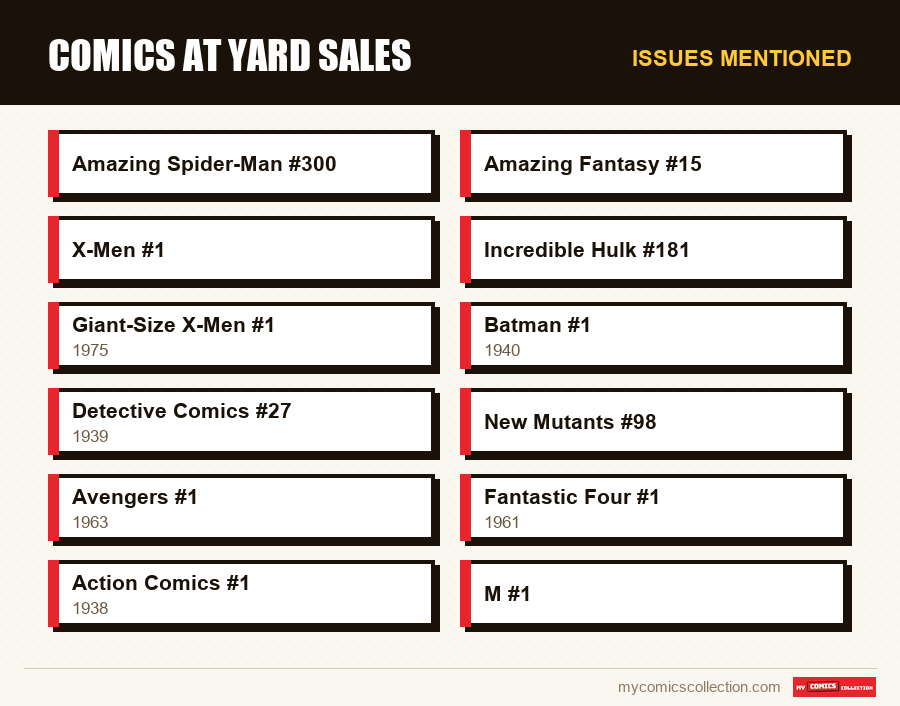
- Amazing Fantasy #15 (1st Spider-Man), red/blue cover, Ditko
- Incredible Hulk #181 (1st full Wolverine), green cover, 3 characters
- X-Men #1 (1963, yellow cover) and Giant-Size X-Men #1 (1975)
- Amazing Spider-Man #300 (1st Venom), black cover, Todd McFarlane
- Batman #1 (1940) and Detective Comics #27 (1939)
- New Mutants #98 (1st Deadpool), yellow cover, small format
- Avengers #1 (1963) and Fantastic Four #1 (1961)
- Action Comics #1 (1938, 1st Superman), extremely rare but worth knowing
- House of M #1, Civil War #1 (MCU-related first appearances)
- Walking Dead #1, #2 (highly sought, black and white covers)
Gear up to act fast
The right gear makes the difference in the first quarter-hour, when the best booths are still intact:
- A sturdy cloth bag or tote: seller plastic bags damage corners
- Protective bags and boards in your car, to store purchases immediately
- Small-bill cash: sellers appreciate it and it speeds negotiation
- A phone charged to 100% with app and wishlist loaded offline
- A flashlight or phone flashlight to examine interior pages in dim stalls
On-site: the 3-minute stall scanning method
Arriving at a yard sale, you have one goal in the first minutes: quickly spot stalls likely to have comics and prioritize them. The best finds disappear fast, often swept up by other collectors arriving at opening.
The recon loop (5-10 min)
Make a fast loop of the yard sale without stopping. Spot every stall with boxes, bins, or piles of stuff. Comics often hide under other objects or in cardboard boxes on the ground. Organized yard sales (moving, estate sales) are more likely to hide real gems than professional flea market dealers.
Quick pile inspection
At each stall, don't spend more than 3 minutes unless there's an obvious find. Flip visible covers, check dates, look for Marvel/DC/Image logos. A quality comic is often recognizable by its cover: Silver Age and Bronze Age have a distinctive aesthetic.
Scan and verify
As soon as a comic catches your eye, pull out your phone and scan the barcode (for post-1974 comics) or search manually in the app. In 15 seconds, you know if it's a key issue, what its price is, and whether you already own it. Don't rely on memory alone: even experts make mistakes.
Decision and negotiation
If the comic ticks every box (wishlist, interesting price, acceptable condition), negotiate immediately. Never put the comic down to "think about it": you risk watching it disappear into another buyer's hands during your hesitation.
Identifying a key issue without internet
The real talent of a yard-sale hunter is recognizing a valuable comic by eye, without real-time verification. Here are the visual clues to master.
Read the publication date
The date is your first filter. Any comic published before 1985 deserves closer examination. Golden Age (1938-1956), Silver Age (1956-1970), and Bronze Age (1970-1985) comics generally carry far more value than modern comics. The date is usually at the top of the cover or in the legal indicia inside.
Recognize a key issue by its cover
Certain visual signs are positive red flags:
- "1st appearance" or "origin" on the cover: publishers loved flagging this back in the day
- An unknown character on the cover: if the cover shows a new character being introduced, verify
- Issue #1: not always synonymous with value, but always worth checking
- Very low issue numbers (<20) for major series (Amazing Spider-Man, X-Men, Avengers)
- Announcements of "special issue," "giant-size," "annual": often key issues
Physical condition: the real criteria
A comic in good condition is worth 5 to 10 times more than one in poor condition, even 50 times for Near Mint vs. Good. Systematically check:
- Cover: tears, marked creases, rounded corners, gloss and shine (or loss of gloss)
- Spine: vertical creases on the back are deal-breakers for demanding collectors
- Interior pages: yellowing, stains (water, humidity), missing or torn pages
- Smell: a musty smell indicates water damage often invisible to the eye
- Back cover: cut-outs (vintage contest coupons), library stamps, pen writing
Watch for detached covers: some sellers display only the cover of a comic without interior pages: it can look like the right comic from afar, but a comic without interior pages is worth nothing. Always verify you're holding a complete copy.
Warning signs to know
Not every comic lot at a yard sale is a deal. Some traps come up regularly and cost unprepared collectors.
Stamped comics
Comics stamped "SAMPLE," "REPRINT," or "FILE COPY" have zero or drastically reduced value. A visible stamp on a cover makes a comic practically unsellable on the secondary market, even if the stamp covers a small area.
"As-is" lots with a valuable comic visible
Some experienced sellers place an attractive comic on top of a lot, with less interesting comics underneath. Always examine the entire lot before buying, or ask to see each comic if the seller refuses access to the bottom of the box.
Reproductions and facsimiles
Since the 1990s, Marvel and DC have published many facsimiles of iconic issues: large-format reproductions sold in newsstands. Amazing Fantasy #15 Facsimile, Incredible Hulk #181 Facsimile... These reproductions are worth only a few dollars but visually resemble originals. The telltale sign: the "FACSIMILE EDITION" mention at the bottom of the cover and often a current price (like $3.99) instead of the vintage price.
Hidden poor condition
A clever seller sometimes presents the comic in an opaque plastic sleeve or oriented to hide defects. Always ask to remove the comic from its protection for a full examination. A refusal to show the comic in the light is a clear warning sign.
Collecting this series?
Track what you own, what you are missing and what your collection is worth. 7 day trial.
Start my trial →Your wishlist always in your pocket
With My Comics Collection, your wishlist lives in the same account as your collection, the iPhone and iPad app keeps a copy readable offline, and the barcode scanner works as soon as you have a signal. On-site, in 15 seconds, you know if a comic is worth it, and if you already own it.
Create my wishlist for free →7-day trial
The art of negotiation at yard sales
Negotiation is a normal and expected part of yard sales. Unlike stores, displayed prices are starting points, not firm rates. Not negotiating often leaves money on the table.
The golden rules of negotiation
- Negotiate respectfully: the seller isn't a used-goods pro: it's usually a private individual. A friendly approach works much better than an aggressive one.
- Bundle your purchases: offer a price for the whole rather than negotiating comic by comic. "I'll take all this for $X" is more effective and faster.
- Start at 50-60% of asked price: that's the usual range. If the comic is listed at $11, offer $5.50-$6.50. You'll probably land at $8.
- Use small bills: offering exactly $16.50 cash for a comic listed at $19.80 can be enough to close.
- Accept a no: if the seller won't come down, you either accept the price or move on. Not pressing is a sign of respect and keeps the door open to come back later.
What you shouldn't reveal
You have no obligation to inform a seller of the true market value of what they're selling. Private-party commercial negotiation is a free market. Never lie ("it's worthless"), but you don't have to say "this comic is worth $880 on eBay" if the seller offers it for $5.50.
That said, if a seller directly asks about value, answer honestly. It's a matter of personal ethics and clear conscience for enjoying your collection.
How My Comics Collection transforms yard-sale outings
For a long time, the yard-sale comic hunter had to rely on memory, paper notes, or shaky 4G to identify finds. That time is over. A dedicated app radically changes the field experience.
The barcode scanner: 15 seconds for an informed decision
Since the 1970s, American comics carry a universal product code (UPC). My Comics Collection lets you scan it directly with your phone camera to instantly identify the comic, get its current price, and check if it's on your wishlist or already in your collection. No more duplicate buys. No more comics bought too expensive out of ignorance.
Offline collection check
4G in the open fields where yard sales are often held isn't always reliable. In the iPhone and iPad app, My Comics Collection keeps an encrypted copy of your collection on the device: open it once on a network before you go, and on-site, even without signal, you can verify at a glance whether you already own the comic you're holding.
Price history for confident negotiation
Knowing that Amazing Spider-Man #300 in Very Good is worth between $88 and $132 on the secondary market gives you a decisive negotiating edge. If the seller asks $55, you know it's a deal. If they ask $165 for a poor copy, you pass. Real-time information is the lever of rational decision-making.
What to do after the yard sale
You come home with comics, sometimes still dirty or unprotected. A few steps to not skip:
Sort and evaluate calmly
Yard-sale adrenaline may have made you buy some less interesting comics than planned. Sort cold, examine each in natural light, reassess condition.
Catalog immediately in the app
Don't let purchases pile up without logging them. Scan each new comic in My Comics Collection as soon as you get home. Your collection stays current, and you avoid buying the same titles at the next yard sale.
Protect the nice finds
Key issues deserve a bag + board immediately. For very-high-condition copies, consider sending to CGC or CBCS for professional grading: it can multiply resale value.
Update your wishlist
Remove comics you just bought from your wishlist, and add those that slipped away this morning. Your wishlist should reflect your real collection state to be useful at the next yard sale.
Estate sales and flea markets: slightly different rules
Private yard sales and professional flea markets don't work exactly the same. At a professional flea market dealer:
- Prices are often closer to market: pros do their research
- Negotiation room is real but more limited (10-20% rather than 30-50%)
- Comics are often better preserved and in better condition
- You'll find fewer unexpected gems, but more consistency in quality
Private yard sales, especially in smaller cities and rural areas, remain the most fertile hunting grounds for real deals. A move, an estate, a teen emptying their room: these situations generate comic lots sold hastily without prior research.
Pro tip: subscribe to yard sale apps (YardSale, Garage Sale by Map, Craigslist) and enable notifications for your area. Arriving at opening, even a bit early, often makes all the difference between finding and missing.
Frequently asked questions
Never leave a yard sale empty-handed
My Comics Collection: your mobile wishlist, instant barcode scanner, up-to-date estimates, and full collection management, with a 7-day trial. Prepare your next yard sale right now.
Start for free →No charge during trial · Instant access