You have a comic in your hands with no barcode. Maybe it comes from an attic find, an estate, an auction. Maybe you bought it at a flea market. The problem is always the same: how do you know exactly what it is?
You have a comic in your hands with no barcode. Maybe it comes from an attic find, an estate, an auction. Maybe you bought it at a flea market. The problem is always the same: how do you know exactly what it is? Which title, which issue, which date, which edition? And above all, is it a first edition or a reprint?
American comics only started receiving UPC barcodes from 1974-1975, and widespread adoption didn't happen until the early 1980s. Everything prior (the Golden Age (1938-1956), Silver Age (1956-1970), Bronze Age (1970-1980) as a whole) must be identified otherwise. This guide gives you the complete method.
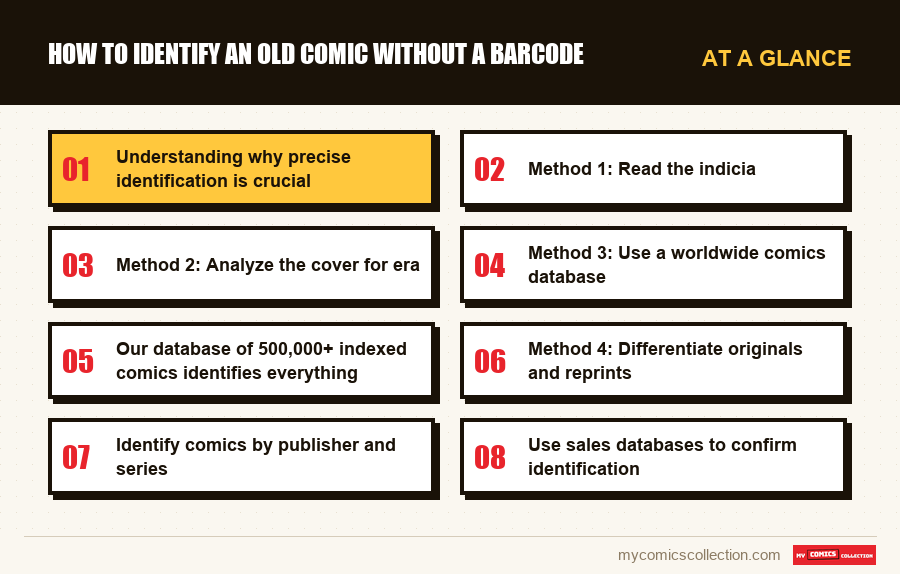
Understanding why precise identification is crucial
The difference between an original Amazing Fantasy #15 from 1962 and a 1990 reprint is tens of thousands of dollars. Between an authentic Superman #1 from 1939 and a 1974 "treasury edition" reprinting the same content, the difference is hundreds of thousands of dollars. These cases are extreme, but they illustrate a reality: for old comics, the exact edition is everything.
Approximate identification isn't enough. "It's a 1960s Spider-Man" means nothing value-wise. "It's Amazing Spider-Man #14, first edition, March 1964, Fine condition": now you have actionable information.
Beware of appearances: Many reprints faithfully reproduce the original cover. Without reading the internal info, it's impossible to distinguish original from copy by eye, even for an expert.
Method 1: Read the indicia
Indicia are your main source of information. They're the legal info printed in the comic, usually in small type. Each American publisher was legally required to include this info in every issue published. It doesn't lie.
Where to find the indicia?
Location varies by publisher and era:
- Marvel: Usually at the bottom of the first content page (page 1) or on page 2
- DC: Often on the inside front cover or at the bottom of page 1
- EC Comics: Inside front cover
- Dell/Gold Key: Back cover or inside page
If the indicia aren't immediately visible, flip through the first pages: they're always there, even if tiny and hard to read.
What do you find in the indicia?
Typical info in American comic indicia
- Complete official title (sometimes different from the cover title)
- Volume number and issue within the volume (e.g., "Vol. 1, No. 14")
- Publication date (often offset by 2 months from cover date)
- Publication frequency (monthly, bimonthly, etc.)
- Publisher name and headquarters address
- Copyright notices (e.g., "© 1964 Marvel Comics Group")
- Second class postage number (specific to American comics)
- "Reprint" mention if applicable: this is where the essential plays out
Interpreting cover date vs. actual publication date
Important peculiarity: the date printed on an American comic's cover is systematically shifted toward the future. A comic with "September 1964" on the cover was put on sale in July 1964. This is a practice inherited from the newsstand distribution system: the comic stayed displayed until the "expiration date" on the cover.
For identification, use the date in the indicia, which is the actual publication date, more precise and more reliable for databases.
Method 2: Analyze the cover for era
Even without reading the indicia, the cover alone gives valuable info on the publication period.
Cover price as an era indicator
The price shown on the cover is a reliable temporal marker for American comics:
- 10 cents: Golden Age comics and early Silver Age (until about 1961)
- 12 cents: Marvel and DC Silver Age (1961-1968)
- 15 cents: Silver Age/Bronze Age transition (1969-1971)
- 20 cents: Early Bronze Age (1971-1972)
- 25 cents: Mid Bronze Age (1973-1976)
- 30-35 cents: Late Bronze Age (1977-1979)
- 40-50 cents: Early Modern Age (1980-1983)
Warning: Prices for Canadian and British markets were different. A comic with "12¢/15¢ Can." was sold for 12 cents in the US and 15 cents in Canada: an important distinction for edition identification.
Read the publisher logos
Marvel and DC logos have evolved over time, letting you approximately date a comic by logo alone:
- Marvel used the name "Timely" until 1949, then "Atlas" until 1961, then "Marvel Comics Group"
- DC used "National Comics," then "National Periodical Publications," then "DC Comics" from 1977
- Presence of the "Comics Code Authority" logo (CCA, a small stamp on the cover) indicates a post-1954 publication
Method 3: Use an online collaborative database
An online collaborative database is the comic identification bible. This kind of database catalogs millions of comic issues worldwide, with for each: cover image, publication info, creator list, and details of all known editions.
Search by title and issue
If you have the comic's title and issue number, even approximately, the catalog will let you find the exact edition. The search gives you all known editions of the same issue: original, reprints, cover variants, foreign editions.
Search by cover
For comics with distinctive covers, a visual image search engine can help when the title is unreadable. My Comics Collection does not identify covers from photos: once you have a title, its catalog of about 2.6 million issues shows the covers of every edition so you can compare them with your copy.
A catalog of about 2.6 million issues to find each issue
My Comics Collection includes a built-in worldwide catalog of about 2.6 million issues. Search any series and number (even without barcode, even for a 1940s comic) and you get the edition with all its metadata.
Identify my comics for free →7-day free trial
Collecting this series?
Track what you own, what you are missing and what your collection is worth. 7 day trial.
Start my trial →Method 4: Differentiate originals and reprints
This is often the central question: do you have the original or a reprint? Several clues help decide.
Clues in the indicia
A reprint must legally mention it in its indicia. Look for mentions:
- "Reprint Edition" or "Special Reprint Edition"
- A copyright date different from the publication date (e.g., copyright 1962, publication 1987)
- "Originally published as..." followed by another date
- The term "Treasury Edition" or "Giant-Size" indicating a different format from the original
Paper quality and texture
Original comic paper yellows in characteristic ways. The "pulp" paper used until the 1970s yellows from inside outward: center pages yellow before outer pages, and the paper back yellows faster than the printed face. Reprints on modern paper yellow differently or not at all.
Original 1950s-1960s comics often have a slightly rough, almost granular texture to the touch. Reprints are generally on smoother, whiter paper.
Printing codes and plate numbers
At the bottom of some interior pages of 1950s-1970s comics, you'll find printing codes: letter and number sequences identifying the printing plate and date. These codes are specific to each run and constitute authenticity proof hard to falsify.
Color and print quality
Printing techniques have evolved enormously. Silver Age original comics used primitive four-color printing: colors didn't align perfectly, creating a "halo" effect visible with a magnifying glass around color flats. Modern reprints have sharp, perfectly aligned colors.
Identify comics by publisher and series
Some series and publishers have specific identification characteristics worth knowing.
Marvel Silver Age comics (1961-1970)
Early Stan Lee and Jack Kirby Marvels are the most coveted and most often copied. True originals have:
- The "Marvel Comics Group" logo above the title (absent on early Timely/Atlas)
- Indicia mentioning "Magazine Management Co." until 1968
- Prices of 10, then 12 cents
- The CCA logo top-right of the cover
- Interior page numbers with specific printing codes
Golden and Silver Age DC comics
DC (then called National Comics) has a long, complex editorial history. Key identification points:
- The "National Comics Publications" or "National Periodical Publications" mention in indicia until the 1970s
- Title-specific "second class postage" number
- Price variants between US editions and editions for other markets
EC Comics (1950-1956)
EC comics (Tales from the Crypt, Weird Science, etc.) are extremely popular and often reprinted. Originals are distinguished by:
- Absence of the CCA logo (EC stopped publishing before the code became widespread)
- "Entertaining Comics" mention in indicia
- 10-cent prices
- Period-specific print quality with some color granularity
Use sales databases to confirm identification
Once a comic is identified, auction databases (Heritage Auctions, eBay completed listings) let you verify your identification by comparing with similar copies recently sold. If your identification is correct, you should find clear visual matches with sold copies.
My Comics Collection integrates market prices from current eBay listings, letting you in a single search identify your comic AND get an idea of its current value.
Frequently asked questions
Identify and catalog effortlessly
Stop spending hours searching dozens of sites. My Comics Collection brings together cover identification, database, and market prices in a single app.
Try free for 7 days →No commitment