
You're emptying your parents' attic, clearing out a late grandparent's basement, or you've inherited a house, and there, behind boxes of clothes and an old sewing machine, you hit a stack of comics.
You're emptying your parents' attic, clearing out a late grandparent's basement, or you've inherited a house, and there, behind boxes of clothes and an old sewing machine, you hit a stack of comics. Dozens, maybe hundreds of copies. Yellowed, piled haphazardly, sometimes in plastic bags or cardboard boxes. Your first reflex is mixed: curiosity, excitement, and an immediate question: is any of this worth something?
The good news: yes, it can be worth a lot. The bad news: without method, you risk either underestimating a gem or wasting energy on comics with no particular market value. This guide walks you step by step, from initial discovery to final valuation, with every precaution to miss nothing.
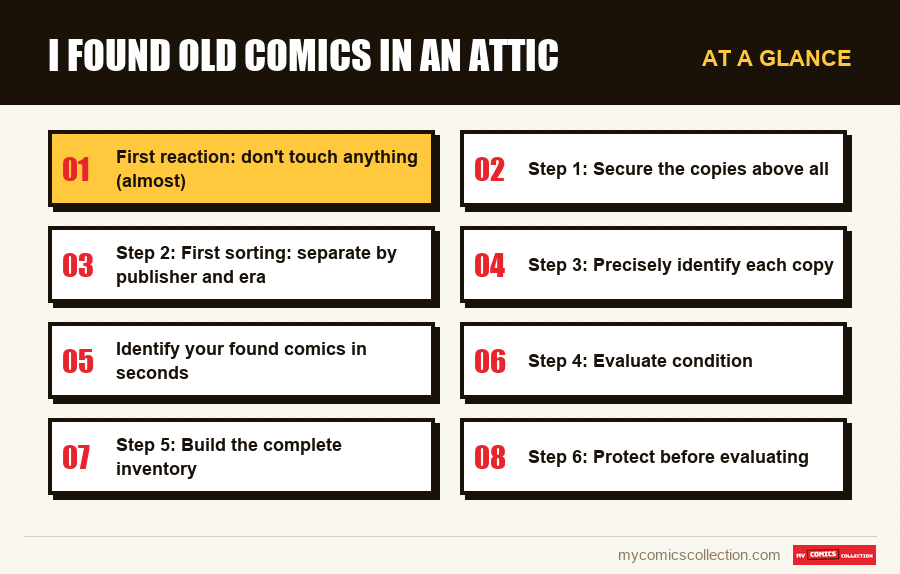
First reaction: don't touch anything (almost)
It's counterintuitive, but your first move should be restraint. When you discover a batch of old comics, the natural urge is to flip through them, stack them neatly, maybe even clean them. That's exactly what not to do in the first minutes.
Here's why: preservation condition is the number one factor in a comic's value. A simple cover crease, a greasy fingerprint, a cornered page: all of these can drop a copy's price by 30 to 60%. And once the damage is done, it's irreversible.
Golden rule: Before handling anything, photograph the stack as it is. Photograph each comic individually, front cover and back cover. These photos will be your starting point for identification and your proof of initial state.
If comics are damp, don't try to dry them quickly with a heat source. Let them air-dry naturally flat, in a dry room, separating them with non-acidic absorbent paper. Poorly managed humidity causes irreparable mold.
Step 1: Secure the copies above all
Once photos are done, your priority is to shield comics from immediate risks. An attic is the most hostile environment there is for a comic: temperature swings, humidity, dust, direct light, rodents. The longer comics stay there, the more they degrade.
Transport them in rigid cardboard boxes, flat and not stacked to the point of crushing the bottom copies. If there are many, make multiple trips rather than overloading boxes. Avoid sealed plastic bags that trap humidity.
What you need urgently
- Rigid cardboard boxes, "longbox" format if possible
- Thin cotton gloves to handle potentially valuable copies
- Non-acidic tissue paper to separate them
- A clean, dry, temperature-stable space to store them temporarily
- A smartphone to photograph each copy
Step 2: First sorting: separate by publisher and era
Once comics are safe, start with a rough visual sort. No question of evaluating each copy's price yet: you're simply trying to group coherent sets to work better next.
Identify major publishers
Publisher logos usually appear at the top or bottom of the cover. The main ones you'll find in a vintage American collection:
- Marvel Comics (also called "Marvel Group" or "Atlas Comics" before 1961): characteristic "M" logo
- DC Comics (called "National Comics" or "Detective Comics" until the 1970s)
- Dell, Gold Key, Harvey: licensed comics (Disney, Looney Tunes, etc.)
- EC Comics: 1950s horror and science fiction, very sought after
- Fawcett, Quality, Timely: Golden Age publishers (1938-1956)
Distinguish the major eras
Publication era is often as important as publisher in determining potential value:
- Golden Age (1938-1956): WWII and post-war comics. Extreme rarity, values potentially reaching tens of thousands of dollars for key issues.
- Silver Age (1956-1970): Marvel and DC's golden era. First appearances of Spider-Man, X-Men, Fantastic Four. Highly coveted.
- Bronze Age (1970-1985): rich period with many important "key issues." More accessible values but trending up sharply.
- Modern Age (1985-present): mass production, generally lower value except exceptions (Death of Superman, major first appearances).
Tip: Comics before 1980 don't have barcodes. To identify them, you need to read the info printed inside: the indicia: mentions publisher, date, and volume number. Our dedicated guide explains the process in detail.
Step 3: Precisely identify each copy
This is the most time-consuming but most important step. For each comic, you need to determine: exact title, issue number, publisher, publication date, and if possible whether it's a first edition or a reprint.
Read the indicia
Indicia are legal info printed in small type, usually at the bottom of the first content page or inside front cover. They mention the official title, volume number, publication date, and copyright info. It's your most reliable source.
Use an online collaborative database
An online collaborative database is a reference for comic identification. It catalogs millions of issues with covers, dates, creators, and features. You can search by title, issue, or cover appearance.
Identify your found comics in seconds
My Comics Collection includes a built-in worldwide catalog of about 2.6 million issues. Scan the barcode or type the series and issue number, and you get title, issue, and date: even without a barcode, even for 1940s comics.
Start identification for free →7-day free trial
Differentiate originals from reprints
This is often where most of the value plays out. An original Amazing Fantasy #15 (first Spider-Man, 1962) is worth $55,000 to $550,000 depending on condition. A 1980s reprint of the same issue might be worth $22. The difference plays out on details: paper quality, printing codes, indicia legal mentions.
Here's how to distinguish original from reprint:
- Check the indicia: a reprint often mentions "Reprint" or a date different from the original copyright
- Examine paper quality: 1960s-1970s paper yellows differently than modern reprint paper
- Compare against the catalog, which lists all known editions of any issue
- Cover price codes can also indicate date (10 cents for 1960s, 15 cents for late '60s, 25 cents for early '70s)
Step 4: Evaluate condition
A comic's condition is graded on a standardized scale: the same used by pros worldwide. Understanding this scale is essential to neither over- nor underestimate your finds.
Comic grading scale (best to worst)
- Near Mint (NM, 9.0-9.8): nearly perfect, very slight handling. Maximum value.
- Very Fine (VF, 7.5-8.5): slight creases, slightly reduced gloss. Still very sought after.
- Fine (FN, 5.5-6.5): visible handling but solid pages, acceptable colors. Good quality/price compromise.
- Very Good (VG, 3.5-4.5): significant handling, marked creases. Still interesting for rare issues.
- Good (GD, 1.8-2.5): heavily used, complete but damaged. Reduced value except for absolute rarities.
- Fair / Poor: damaged, incomplete. Value mainly documentary.
The reality of an attic discovery? Most comics will be VG to Fine at best. Attic conditions (summer heat, winter humidity, dust) are rough. That's not bad news: even in VG, a Silver Age key issue can be worth hundreds of dollars.
Collecting this series?
Track what you own, what you are missing and what your collection is worth. 7 day trial.
Start my trial →Step 5: Build the complete inventory
Resisting the urge to jump straight to "what's it worth?" is necessary discipline. Without a complete inventory, you can't have a clear view of what you really have. And a partial inventory exposes you to missing valuable pieces that slip under the radar.
For each comic, record:
- Title and issue number
- Publisher and publication date
- Edition (original, reprint, variant)
- Estimated condition (per scale above)
- Specific observations (missing pages, rusty staples, signatures, etc.)
A manual inventory of 200 comics can take two to three days. With the My Comics Collection app, the same operation takes a few hours. You scan the barcode when there is one, otherwise you search the series and issue number in the catalog, and the record is added to your inventory with all metadata.
Step 6: Protect before evaluating
Once the inventory is done, before thinking about selling or keeping, you must protect your comics. Each day spent without proper protection is another day of degradation.
Non-PVC plastic sleeves
Insert each comic in a polyethylene or polypropylene sleeve. Absolutely avoid PVC, which releases acids and accelerates degradation. Quality sleeves cost a few cents each.
Backing boards
Slip a rigid backing board into each sleeve to prevent storage creases. Like sleeves, choose acid-free cardboard.
Vertical longbox storage
Comics are stored upright in longboxes, never stacked flat. Upright, they don't crush each other. Fill boxes without letting comics tilt.
Controlled environment
Ideal temperature between 59 and 68°F (15-20°C), relative humidity between 40 and 50%. Avoid basements, attics, and garages. A tempered indoor room is ideal.
Step 7: Decide what to do: keep, sell, donate
You now have your inventory and your comics are safe. Now comes the decision: what to do with it all? There's no universal answer, but here are the questions to ask.
Keep the collection
If some comics speak to you emotionally (series you read as a kid, characters you care about, issues that belonged to a loved one) keep them. A collection is also a personal story. Market value isn't the only criterion that counts.
If you keep all or part, the management app becomes indispensable. You'll want to track price evolution, complete runs, spot missing issues. A well-kept digital inventory is also insurance in case of disaster.
Sell copies
For valuable pieces, several options: eBay for common issues (global audience, but strong competition), specialized auctions for high-value copies (Heritage Auctions, ComicLink), local comic shops for medium lots (convenient but lower purchase price than market), and comic fairs/conventions for direct collector exchanges.
For potentially very valuable comics (several hundred dollars), consider professional CGC or CBCS grading before sale. An official grade reassures buyers and can significantly boost sale price.
Donate or give away
Comics in poor condition or without particular value can find second life: local libraries, associations, schools, hospitals. Never discard comics in bulk before checking: even a damaged comic might interest a collector trying to complete a series.
Classic traps to absolutely avoid
Years of comics-world experience reveal the costliest mistakes newcomers make when facing an attic find.
- Selling too fast to a dealer: comic shops buy to resell with margin. You'll get 30 to 50% of market value at best. Take time to inventory first.
- Trusting family memory: "Grandpa said it was very rare" is worthless without verification. Conversely, "worthless" comics can turn out to be treasures.
- Cleaning comics: no chemical or physical intervention without expert advice. Amateur cleaning destroys more than it repairs.
- Tossing "ugly" comics: an Amazing Fantasy #15 in very poor condition is still worth thousands of dollars. Identify before eliminating.
- Neglecting seemingly "plain" comics: unknown-to-the-public titles can be rarities. The database and systematic inventory are your protections.
Real case: In 2021, an American family found a copy of Superman #1 (1939) in an attic inside a Bible. Estimated at over $1 million, it had nearly been tossed with old newspapers. The story is extreme, but it illustrates why each copy deserves identification before being discarded.
FAQ
Catalog your discovery for free
My Comics Collection turns hours of manual inventory into an efficient evening. Barcode scanning, a catalog of about 2.6 million issues, price tracking: everything you need to value your attic discovery.
Create my inventory for free →7-day free trial, no commitment