Every comic collector knows this frustration: having almost all the issues of a series, except two or three that have been missing for months. These "gaps" in runs are one of the most universal realities of collecting.
The missing comics in your collection: how to find them and complete your runs
Every comic collector knows this frustration: having almost all the issues of a series, except two or three that have been missing for months. These "gaps" in runs are one of the most universal realities of collecting. Good news: efficient methods exist to identify missing issues, find them and acquire them at the best price. Here's how to approach run completion methodically.
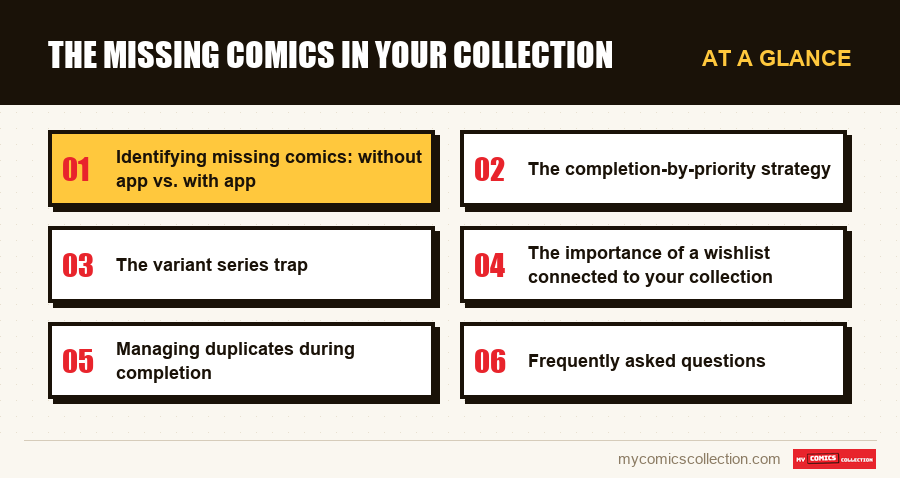
Identifying missing comics: without app vs. with app
Before searching, you need to know precisely what's missing. Seemingly simple, this exercise can become a puzzle once the collection exceeds a few hundred issues.
Without a digital tool, the classic method is to browse your longboxes, note present issues on paper, then compare with a complete series list. This approach is tedious, error-prone (you forget a box, you confuse two editions) and, above all, unusable in real situations: you don't drag your paper list to a flea market.
With a dedicated app like My Comics Collection, the logic completely flips. Your catalog is always up to date, and the app can automatically display the issues of a series you don't yet have: it's your missing list generated in one click. In shop or at a flea market, you consult this list from your phone and immediately know if the comic you're holding fills a gap.
The difference isn't trivial: many collectors have "missed" hard-to-find issues because they didn't know in real time that they were looking for them.
Where to find missing issues?
Once your missing list is established, the hunt can begin. Each channel has its advantages.
Specialty shops and their back-issue bins are the first instinct. Stock varies by shop, and some specialize in older comics. Main advantage: you can physically inspect the comic's condition before buying. Take time to check staples, spine, corners and interior condition. For common 90s-2000s issues, you'll generally find your missing at reasonable prices.
eBay and online platforms offer the widest choice of back issues, including for confidential series or older issues unfindable elsewhere. The key: filter by condition, compare sellers (returns, feedback) and don't forget shipping in the calculation: a $3 comic with $9 shipping from overseas can cost more than at a local shop.
Flea markets and yard sales are ideal hunting ground for 70s-2000s collections. Prices are often ridiculously low, but availability is random: you won't find on demand the specific issue you're missing. Strategy: go regularly with your missing list in mind (or on phone) and take what you find when you find it.
Comics conventions and festivals concentrate in one weekend what would take you months to find in stores. Many back-issue-specialized dealers attend, prices are often negotiable and stocks are vast. Ideal place to fill multiple gaps at once on difficult runs.
Collector networks (forums, Facebook groups, Discord) give access to comics nobody sells in stores. Another collector might have exactly the missing issue as a duplicate. These collector exchanges often work as trades (issues for issues) or at very advantageous prices.
The completion-by-priority strategy
If you have a long list of missing issues and a limited budget, you have to prioritize. Here's the logic to follow.
Key issues first. These are the most narratively and financially important issues in a run: first appearances of characters, pivotal issues in a major arc, significant anniversary issues. These issues tend to gain value over time and become increasingly hard to find in good condition. If your run has missing key issues, that's where your budget should go first.
Transition issues next. These are issues that link narrative arcs together: not strictly key issues but essential so the run has reading coherence. They're often easier to find and cheaper than key issues.
"Fillers" last. Filler issues (one-shots without major narrative stakes, minor transition episodes) can wait. They'll complete your run, but they're generally neither rare nor expensive. Patience here: they always end up appearing.
This hierarchy lets you progress intelligently on your run: the most important pieces are secured first, and you progressively complete the rest.
The variant series trap
Watch for a classic pitfall in run completion: cover variants. On some modern series, each issue can have 5, 10, sometimes 20 different covers (cover A, B, incentive variant, retailer exclusive, etc.).
The question to ask is simple: what are you collecting? If you collect issues for the stories and narrative completeness, cover A (main cover) is enough. If you also collect variants, the game completely changes: some incentive variants (only available when ordering 25 or 50 copies of the standard cover) are nearly impossible to find and can reach very high prices.
Don't get trapped by the temptation to "have everything." An issue you think is missing is sometimes just a variant you don't have and don't necessarily need. Clearly define your collection rules before starting the hunt: main cover only, or variants included? The answer to this question will save you frustrations and unnecessary expenses.
Collecting this series?
Track what you own, what you are missing and what your collection is worth. 7 day trial.
Start my trial →The importance of a wishlist connected to your collection
The wishlist is the most underused tool by collectors who manage their collection without a dedicated app. Yet it's a major paradigm shift in how you approach completion.
With a wishlist connected to your inventory in My Comics Collection, each issue you identify as missing can be added in one tap. From that moment, this issue is on your permanent radar. You no longer risk passing by this comic in a flea market bin without recognizing it: the app reminds you that you're looking for it.
This wishlist-inventory connection also creates natural discipline: you don't look for anything any way: you follow a precise list. It's more efficient, more economical and far less frustrating than blind hunting.
Managing duplicates during completion
Run completion sometimes comes with an undesirable side effect: duplicates. You buy a lot of 20 comics to get 5 missing ones: the other 15, you already have. Or you buy an issue you thought you didn't have, and it's already in a forgotten box.
Duplicates aren't a disaster: many collectors resell them, trade them or give them to friends who are starting out. But they represent an avoidable cost with good collection management.
Golden rule: always check your catalog before buying. Not when you get home: on site, at the moment of purchase. With your app on your phone, it's a 10-second check that can save you several dollars for a comic you already have as a duplicate.
For duplicates already in your possession, identify them in your catalog (most apps let you mark a copy as "duplicate" or "for sale") and resell them to fund other missing issues. Rotation is part of the game.
Completing a run is one of comic collecting's most satisfying challenges. With the right methods and tools, what seemed like an endless quest becomes a manageable project, issue after issue.
Frequently asked questions
The most reliable method is using a collection management app like My Comics Collection, which lets you automatically visualize the "gaps" in a given series. Alternatively, online collaborative databases or fan wikis list all issues of each series. Compare this list with your inventory to precisely identify your missing. The advantage of a dedicated app: this comparison is done permanently and in real time, without manual work.
It depends on the use you make of your collection. If you collect for value or eventual grading, aim for the best condition possible: a Very Fine comic is often worth 3 to 5 times more than a Good copy on important issues. If you collect for reading or narrative completeness, lesser condition is acceptable, especially for inexpensive issues. On key issues though, never buy poor condition thinking you'll replace it later: you end up never replacing it, and the bad copy stagnates in the collection.
Favorable periods vary by channel. On eBay, end-of-month often sees sellers liquidating stock at reduced prices. End-of-year conventions let sellers clear before holidays. Spring flea markets (April-June) are traditionally best-stocked. Finally, just after a canceled film or TV adaptation, comics linked to that project see their values temporarily drop: a good time to buy if you think the adaptation will resume.
Yes, often, provided you do the math before buying. If a lot of 30 comics costs you $45 and contains 8 issues you're looking for, your average cost per missing issue is $5.60: often cheaper than in a shop. The other 22 comics become duplicates to resell or trade, which can recoup part of your investment. Classic mistake: buying a lot "because it's a good deal" without verifying how many lot issues you actually need. A management app with an up-to-date missing list lets you do this calculation in minutes.