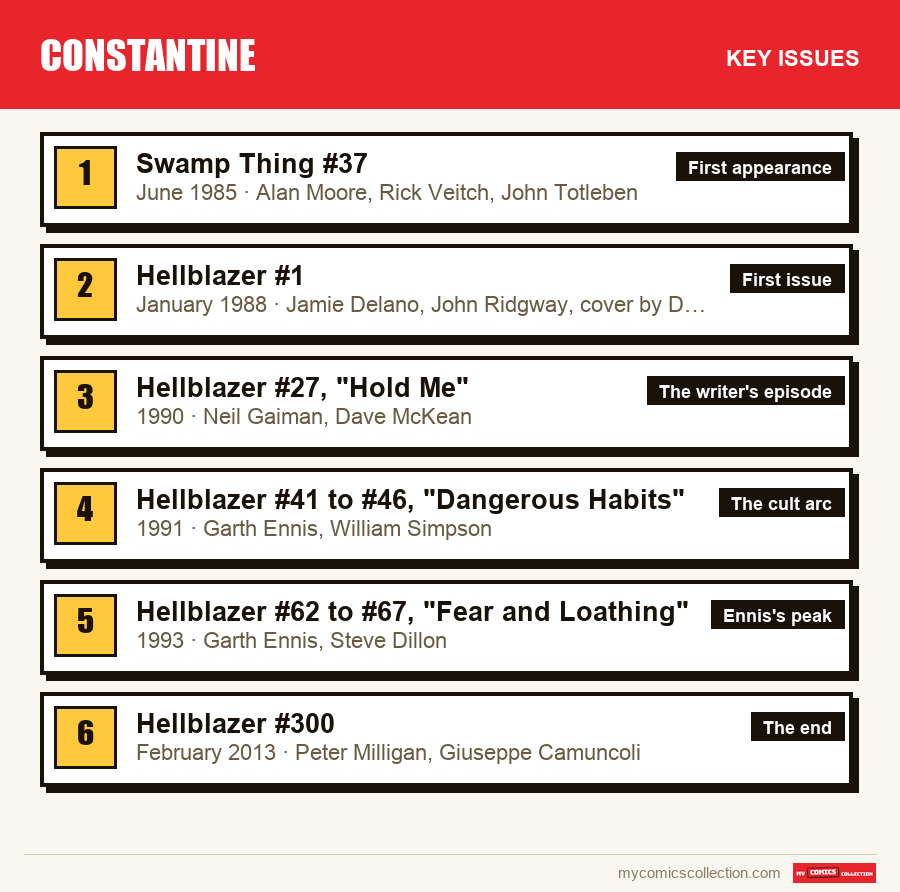
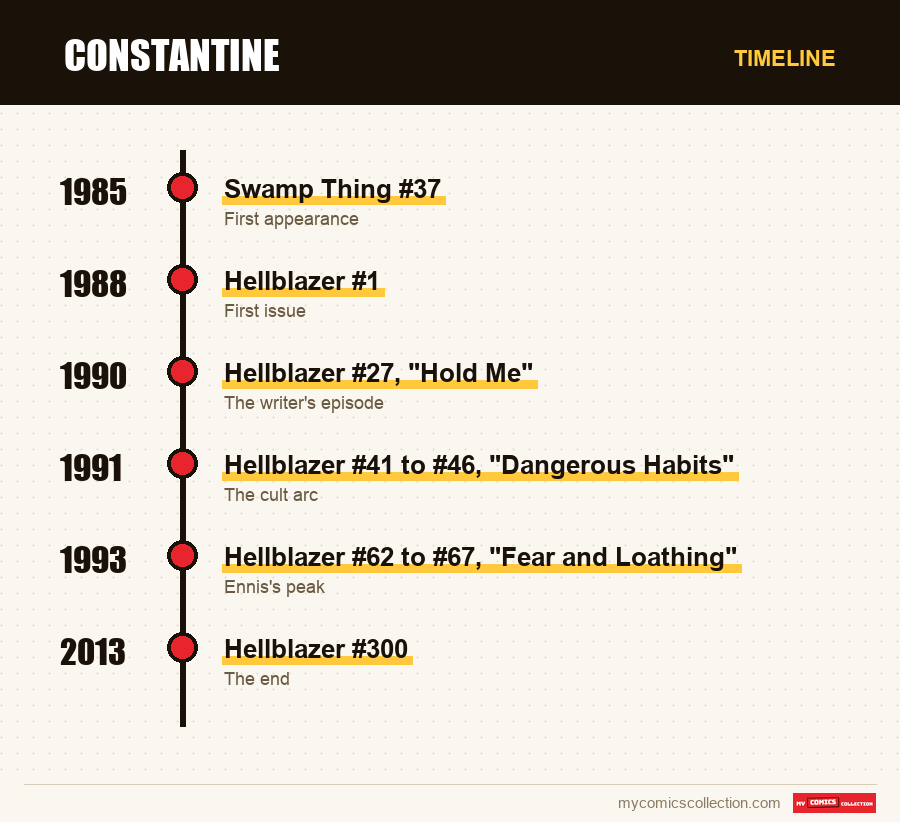
John Constantine's key issues are: Swamp Thing #37 (June 1985), his first appearance, by Alan Moore, Rick Veitch and John Totleben; Hellblazer #1 (January 1988), the first issue of his series, by Jamie Delano and John Ridgway, cover by Dave McKean; Hellblazer #27, written by Neil Gaiman and drawn by McKean; Hellblazer #41 to #46, "Dangerous Habits" by Garth Ennis, source of the 2005 film; then the runs of Paul Jenkins (#89 to #128), Warren Ellis (#134 to #143), Brian Azzarello (#146 to #174) and Mike Carey (#175 to #215); finally Hellblazer #300 (February 2013), the last issue of the original series, signed by Peter Milligan. On the market, Swamp Thing #37 dominates, followed by Hellblazer #1; the others are driven mostly by reading interest.
John Constantine has a rare particularity: he was born as a supporting character in someone else's series, and ended up carrying one of the longest series in DC's history, 300 issues without interruption from 1988 to 2013. In between, he went through the Vertigo imprint, a dozen British and Irish writers, two screen adaptations, and several relaunches.
For a collector, this longevity poses a simple problem: where to start, and what to keep? This guide answers issue by issue. It does not revisit the adaptations, already compared to the comics in our articles on the 2005 film and the 2014 series. It focuses on the issues, their writers, and their place in a collection.
The character's birth
Constantine was conceived in the mid-1980s in the Swamp Thing series, at the request of artists Stephen Bissette and John Totleben, who wanted a character with the face of the singer Sting. Alan Moore makes him a working-class London magician, cynical, funny, and always ready to sacrifice a friend to save the world. He first appears as Swamp Thing's guide, to whom he offers a kind of education in the occult, before becoming a leading character of the series.
His success with readers pushes DC to give him his own series. It was to be called Hellraiser; the title already being taken by a horror franchise, it took the name Hellblazer. The first issue came out in January 1988, five years before the creation of Vertigo, the imprint that would take over the series from March 1993.
The key issues, from Swamp Thing to Hellblazer
Swamp Thing #37
The issue where it all begins. Constantine introduces himself to Swamp Thing and draws him into the "American Gothic" cycle. Two weeks later, he makes a cameo in Crisis on Infinite Earths #4, his second appearance. A year earlier, in #25, a silhouette with Sting's face already crossed the background, but it is not Constantine. The Saga of the Swamp Thing #37 sheet details the issue.
Hellblazer #1
Delano sets Constantine in London, in a Thatcherite England he observes with an openly political anger. The first arc pits the magician against a demon of hunger and introduces Papa Midnite, one of his recurring adversaries. Dave McKean's painted and collage covers give the series an immediate visual identity.
Hellblazer #27, "Hold Me"
During a break in Delano's run, which leaves #25 and #26 to Grant Morrison, Neil Gaiman writes a one-off episode about a homeless man's ghost, drawn by McKean. Gaiman had already had Constantine appear in The Sandman #3 in 1989. This standalone episode is often recommended as the series' best entry point.
Hellblazer #41 to #46, "Dangerous Habits"
Constantine learns he has lung cancer. To escape death, he sets the powers of hell against one another. Garth Ennis, who came like Delano from the British weekly 2000 AD, makes his entry on the series here, and the story serves as the basis for the 2005 film. #41 is its first issue.
Hellblazer #62 to #67, "Fear and Loathing"
The arc that shows Constantine at the height of his personal life, with his relationship with Kit and his fortieth birthday party attended by his friends, Zatanna and Swamp Thing included. Ennis also prepares the fall that follows. #63 lands just as the series passes under the Vertigo label.
Hellblazer #300
Last issue of the original series, and conclusion of Peter Milligan's run, begun at #250, the longest in the title's history. Constantine finally ages there, as he had been aging in real time since 1988. The same month, DC puts him back in its main universe in a younger form.
The runs, in order: who wrote what
Hellblazer is read by writers. Here is the succession of main writers, to know where to start and where to stop.
Jamie Delano (#1 to #24, #28 to #40). The founder. A political, haunted Constantine, surrounded by his taxi-driver friend Chas. Delano will return for #84, which finally tells why Chas owes Constantine so much, and for #250.
Garth Ennis (#41 to #50, #52 to #83, then #129 to #133). The public's favorite run, and the second longest. Ennis makes Constantine a man who drinks, loves and loses, and pits the First of the Fallen against the magician.
Eddie Campbell (#85 to #88). A short interlude signed by the artist of From Hell.
Paul Jenkins (#89 to #128). A more intimate, very British run, whose tenth anniversary of the series, in the form of an evening at the pub with the reader, is the most singular moment.
Warren Ellis (#134 to #143). Short but noted, opened by the "Haunted" arc in a grimy London.
Brian Azzarello (#146 to #174). The author of 100 Bullets sends Constantine to an American prison then across the United States, in a long story built like a crime thriller.
Mike Carey (#175 to #215, then #229). The third longest run, ambitious and mythological, which brings in Constantine's children and the death of his sister Cheryl.
Denise Mina (#216 to #228), a Scottish crime novelist, then Andy Diggle (#230 to #249), who brings the character back to his working-class Liverpool roots.
Peter Milligan (#250 to #300). The longest run in the title's history, which marries Constantine off and leads him to the last issue.
After 2013: the relaunches
As early as 2011, DC reintroduces Constantine into its main universe, notably in Justice League Dark, then gives him a new series, Constantine, in 2013. Other relaunches follow, including The Hellblazer during the Rebirth push. In November 2019, Simon Spurrier relaunches the character under the title John Constantine: Hellblazer, a praised series that ends in October 2020. The title returns again in 2024 for a new miniseries.
These recent series are read for themselves; none has, to date, the collecting importance of the 1985 and 1988 issues. They can be a good entry for a new reader, provided they know their Constantine is sometimes younger and less worn than the original series' one.
How to build a Constantine collection
With more than 300 possible issues, the question is not to have everything, but to know what to aim for. Three strategies hold up.
The two centerpieces
Swamp Thing #37 and Hellblazer #1. These are the two issues that carry most of the demand, and that resell most easily. Buy them in the best possible condition, and demand detailed photos, especially of the spine and corners.
A writer's run
Choose a writer and complete their run: Ennis from #41 to #83, or Delano from #1 to #40. It is a coherent, readable collection, and often cheaper per issue than you think, because the in-between issues circulate in lots.
The milestones
The turning-point issues: #41 (Ennis's arrival), #63 (move to Vertigo), #100, #200, #250 and #300. A short collection that tells the series' publishing history in about ten issues.
For pure reading, collections are cheaper: DC has reissued the series in numbered volumes that follow release order. No price guide is given in this article. For a specific copy, the free estimate starts from its real condition.
Pitfalls to avoid
Swamp Thing #25 presented as a first appearance. The background silhouette with Sting's face is not Constantine. #37 remains the official first appearance.
Newsstand and direct editions. Across the 1980s, the two versions coexist; their content is identical. Note the version in your inventory, without making it a deciding criterion.
Collections mistaken for single issues. Reissues often reuse the original covers. Always check the format and pagination in a listing.
Relaunches confused with the original series. Several recent series carry a similar title, and some have a #1. Always specify the year in your records. To place Constantine in the whole of horror stories to collect, our guide to collectible horror comics and our history of the Vertigo imprint give the context.