The Black Adam comics history starts with Teth-Adam, a former champion of the kingdom of Kahndaq who holds the same powers as Shazam. His first appearance is in The Marvel Family #1 (December 1945) at Fawcett, the work of Otto Binder and C. C. Beck. Originally a simple enemy of the Marvel Family, he became, under Geoff Johns's pen, an antihero who protects his country by force, and one of the most ambiguous characters in the DC universe.
Eighty years of publication, and a single name for very different roles. Black Adam has been the villain of a family of heroes, a reprint ghost, a probationary member of a team, a sovereign at war with the United States, and then the star of a movie. This guide follows his own life, not that of the Marvel Family, of which he is only the original adversary.
As always in this guide, only verified information (creators, issue numbers, dates) is stated as fact; the analysis is our own, with no reproduction of protected artwork or dialogue.
His first appearance
In December 1945, The Marvel Family #1 brought together at Fawcett the heroes who orbit Billy Batson's Captain Marvel. Otto Binder and C. C. Beck introduce there an adversary cut from the same pattern as the hero: a man of antiquity who was given the same power but uses it differently. This is Teth-Adam, whom posterity will call Black Adam.
The character is thus born as a mirror: same powers, same magic invocation, opposite virtue. This construction explains what follows. Where other villains are defined by a weapon or a plan, Black Adam is defined by what he shares with the hero, which makes every later evolution possible without betraying the origin. Our article on the 2022 movie returns to this principle.
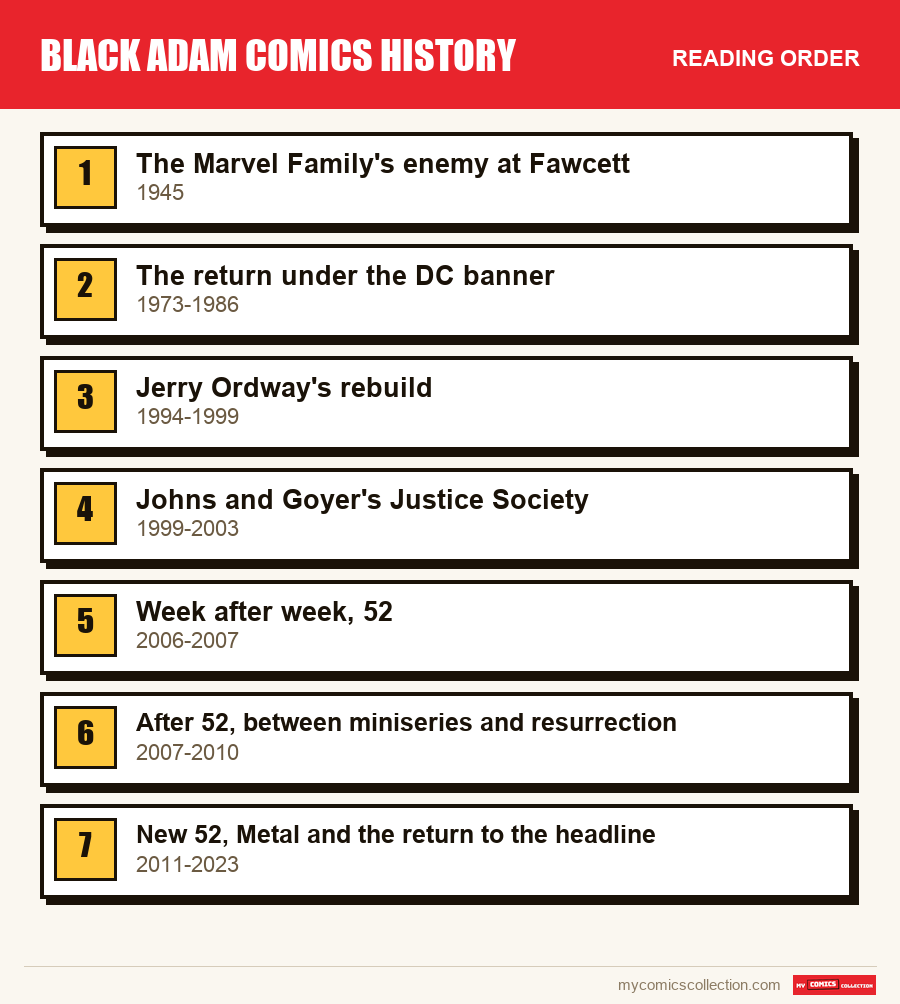
Era 1: The Marvel Family's enemy at Fawcett (1945)
The 1945 Black Adam is a serial antagonist: a one-story character, useful so that the Marvel Family has an adversary of its own stature. Binder's text, Beck's art, the Fawcett universe: everything there is geared toward adventure more than tragedy, and nothing foreshadows the antihero Geoff Johns will develop more than half a century later.
What matters for what follows is the starting setup: an ancient champion, the magic word shared with the hero, and a reversed destiny. These elements will be the keys to every reinterpretation, including the one that makes Kahndaq the country of Teth-Adam. For the collector, The Marvel Family #1 remains the issue where everything begins, but it will be more useful to compare it with later revivals than to judge it alone.
Era 2: The return under the DC banner (1973-1986)
DC acquired the license to the Fawcett characters in the early 1970s, and Black Adam first returns through reprint: Shazam! #8 (1973) republishes him. Shazam! #28 then shows him in a new story, which makes it his first appearance of the DC era in an original tale. This pre-Crisis period ends with Crisis on Infinite Earths, which reshuffles the cards of the DC universe.
The Black Adam of these years is still an occasional adversary, far from the character he will become. But he exists again on the newsstand, and that is what allows later writers to take him up: a forgotten character could not have been reinvented. To understand the effect of the Crisis on the characters of this generation, see our history of DC Comics.
Era 3: Jerry Ordway's rebuild (1994-1999)
After the Crisis, DC had to rewrite the origins of the Marvel Family. Jerry Ordway published the graphic novel The Power of Shazam! in 1994, which serves as the basis for the regular series of the same name. In the graphic novel as in the series that follows it, Teth-Adam again becomes a deadly, unnuanced enemy of Captain Marvel.
This era is the hinge between the Fawcett era and the modern era: the Shazam universe is reset in the post-Crisis world, and it is on this foundation that Geoff Johns will work five years later. Reading Ordway's work before the more recent runs helps you understand what they build on.
Era 4: Johns and Goyer's Justice Society (1999-2003)
The real turning point comes in the JSA series, relaunched in 1999 by Geoff Johns and David S. Goyer. In JSA #6, Black Adam attacks the Society while under the influence of Theo Adam. He returns as a probationary member in JSA #21, claiming to be free of that influence, then leaves with Atom Smasher in JSA #45, because the team refuses to cross certain lines. The "Black Reign" crossover between JSA and Hawkman follows: his militia seizes Kahndaq, and the Society ends up leaving him the country on condition that he not cross its borders.
Johns and Goyer redefine the character: the team adversary becomes a man who has his reasons and defends them by force. This reading makes his presence among heroes both possible and unstable, and 52 will pick it up. To place the team, see our guides to Hawkman and Doctor Fate, both members of the Society in those years.
Do you collect this series?
Track what you own, what you are missing and what your collection is worth. 7-day trial.
Start my trial →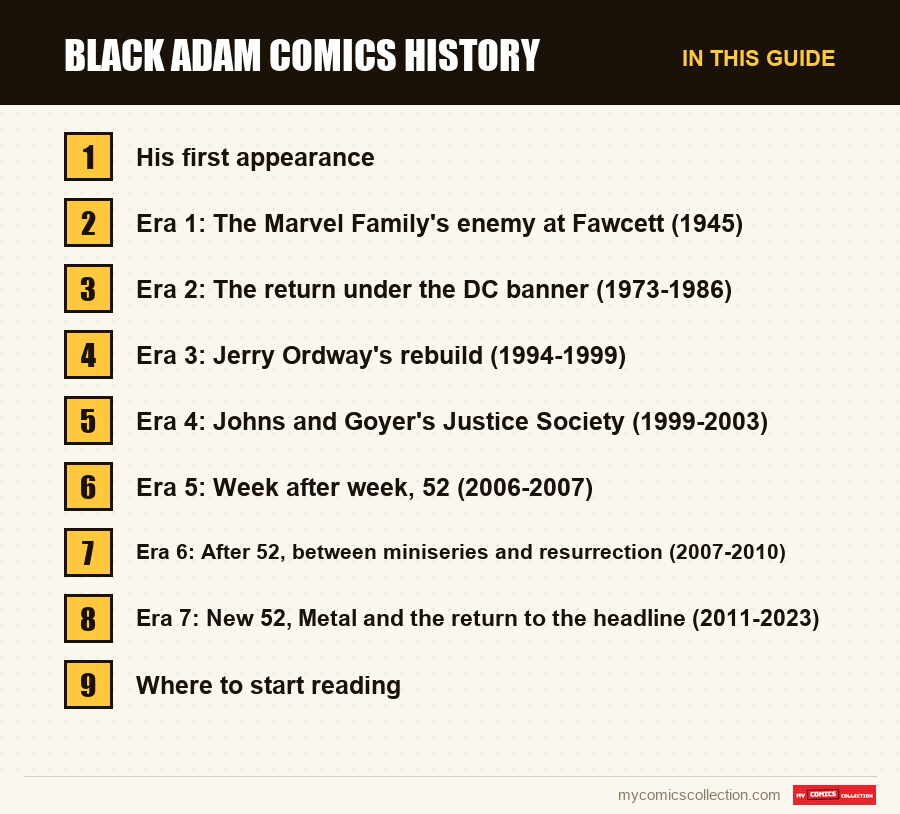
Era 5: Week after week, 52 (2006-2007)
The weekly series 52 ran from May 2006 to May 2007. The credits of this collective undertaking list four writers (Johns, Morrison, Rucka, Waid), Giffen's layouts, and many artists who alternate from one week to the next. Black Adam rules Kahndaq there. Adrianna Tomaz, who was given to him, convinces him to use his powers peacefully for his country, and he transforms her into Isis. He also shares his power with Amon, Adrianna's brother, who becomes Osiris.
Warning, spoiler: Sobek, who turns out to be Famine, one of the Four Horsemen, kills Osiris, and Isis dies of Pestilence's infection. Black Adam then exterminates the entire population of Bialya, then attacks the heroes of the whole world for a week. Captain Marvel's lightning finally strips him of his powers, and Captain Marvel changes his magic word. The final act takes place in week 50 of 52 and in the four-issue miniseries World War III. Black Adam is no longer an adversary of the Marvel Family here: the story makes him a tragic figure. To understand the event that precedes it, see our Infinite Crisis guide.
The weekly format matters for understanding the effect of this story. 52 begins in May 2006, in the wake of Infinite Crisis, and runs 52 issues; the covers are by J. G. Jones. Black Adam is not its only thread: the series braids several, and his advances in fits and starts, at the pace of one issue per week. A reader who picked up only the issues that show him would lose the progression that leads from the peace of Kahndaq to the rage of Bialya.
For storage, the series lends itself to collecting by block rather than by single issue: the 52 single issues form a set whose reading value exceeds that of each piece. The four-issue miniseries World War III is shelved separately, as an extension of week 50.
Era 6: After 52, between miniseries and resurrection (2007-2010)
Black Adam survives the end of 52. The six-issue miniseries Black Adam: The Dark Age ran from late 2007 to early 2008 and extends his mourning. In Countdown #47 (June 2007), Mary Marvel finds him hiding in Gotham, and he passes all his powers to her, including those taken from Isis. Later, Brightest Day #0 (April 2010) resurrects Osiris after Blackest Night, which opens a new cycle for the character.
These series make up the post-52 period: the character is no longer defined there by a team, but by his loss. For the collector, this is an era whose issues are little known, and therefore less contested, which is precisely what makes collecting them attractive to a long-term reader.
Era 7: New 52, Metal and the return to the headline (2011-2023)
After the 2011 relaunch, his origin is told again in Justice League vol. 2 (#7, #10, then #19 to #21), with a new character, Aman, whose life Adam seems to take in order to seize the wizard's power. Justice League of America vol. 3 #7.4 (November 2013) shows him facing the Crime Syndicate's message, then Forever Evil has him live again in Kahndaq against a corrupt ruler. Dark Nights: Metal #4 shows him among the Council of Immortals.
What follows is more visible: Infinite Frontier (2021-2023) has him join the Justice League, and a Black Adam series appeared in 2022, with Rafa Sandoval on the character's visual design. Jaume Collet-Serra's movie, with Dwayne Johnson, came out in October 2022; it rereads a publishing trajectory that already spans nearly eighty years. For the League's heroes, see our Justice League reading guide.
Where to start reading
Here are five entry points, depending on your reader profile.
- The reader who wants the source: The Marvel Family #1 (1945), to understand Binder and Beck's mirror setup.
- The Justice Society reader: JSA #6, #21 and #45, by Geoff Johns and David S. Goyer, three issues that tell the character's evolution within a team, then the "Black Reign" crossover for the seizure of Kahndaq.
- The saga reader: 52 (2006-2007). It is the weekly series that makes him a tragedy.
- The reader who wants a rebuild: The Power of Shazam! by Jerry Ordway (1994), to understand the universe he comes out of.
- The reader in a hurry: Black Adam: The Dark Age (2007-2008), a six-issue miniseries that extends the mourning of 52.
The key issues to know
The collecting method is to separate the origin, the return under DC and Johns's turning points. No price is given: values vary from one sale to the next.
- The Marvel Family #1 (December 1945): Black Adam's first appearance, by Otto Binder and C. C. Beck.
- Shazam! #8 (1973): the reprint, which puts him back on the newsstand under DC.
- Shazam! #28: his return in an original story of the DC era.
- JSA #6: his first attack on the Society, under Theo Adam's influence.
- JSA #21 and #45: his probationary entry, then his departure with Atom Smasher.
- 52 (2006-2007): the shift from villain to tragedy.
- Black Adam: The Dark Age (2007-2008): the six-issue miniseries that follows 52.
For a reader building a collection around the character, the rule is simple: buy the source first, then the three JSA issues, then 52 in a trade paperback. Our guide to the Shazam runs completes this list for the original universe.
One last point of method: the character is collected in two stages. The first is the historical foundation, that is, The Marvel Family #1 and the reprint in Shazam! #8, which call for attention to condition and printing. The second is Geoff Johns's period, from JSA to 52, which you can assemble in a short time because the series are continuous. Write down the exact title and issue number in your inventory before buying: Shazam! #8 and #28 are two unrelated objects, one being a reprint and the other a new story.
Frequently asked questions
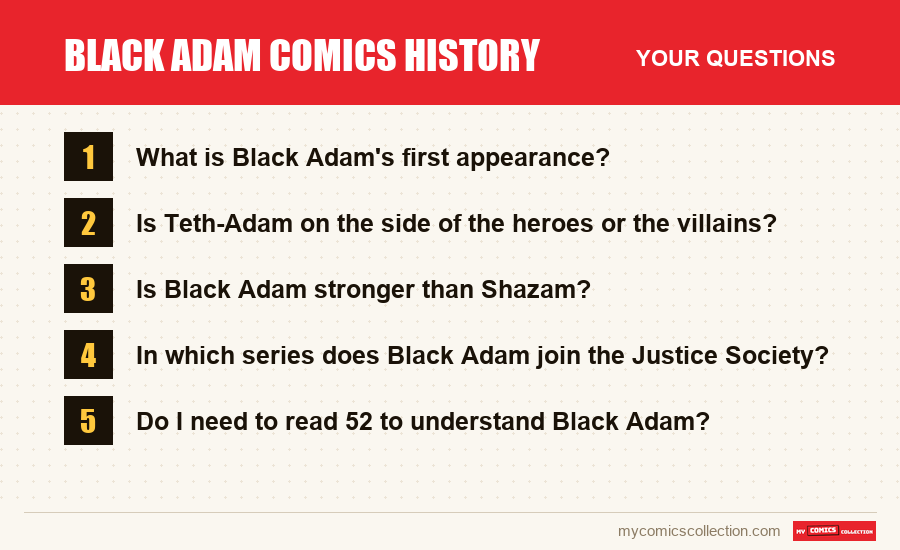
The Marvel Family #1, dated December 1945, at Fawcett Comics. The character was created by Otto Binder and C. C. Beck as an adversary of the Marvel Family. It is the origin issue, and the starting point of any collection of the character.
Both, depending on the era. He is born a villain in 1945, becomes an antihero in Geoff Johns and David S. Goyer's JSA, then slides toward tragedy in 52. His constancy comes from his conviction: force, in his view, is the only justice that protects Kahndaq.
He has the same powers as Shazam, which is the very principle of his creation in 1945. The gap is less about power than about mastery: Billy Batson remains a kid in an adult's body, while Teth-Adam has millennia of experience.
In JSA, relaunched in 1999 by Geoff Johns and David S. Goyer. He attacks the Society in issue #6, joins on probation in issue #21, then leaves in issue #45 with Atom Smasher. The evolution can therefore be read in three key issues.
Yes, if you want to understand why the character becomes a tragedy. This weekly series, published from May 2006 to May 2007, tells of Isis, Osiris and the destruction of Bialya, written by four writers. It reads without any major prerequisite.
Do you have a JSA, a 52 or an issue from the Marvel Family in your boxes? Get it appraised before you sell it.
Appraise my comic