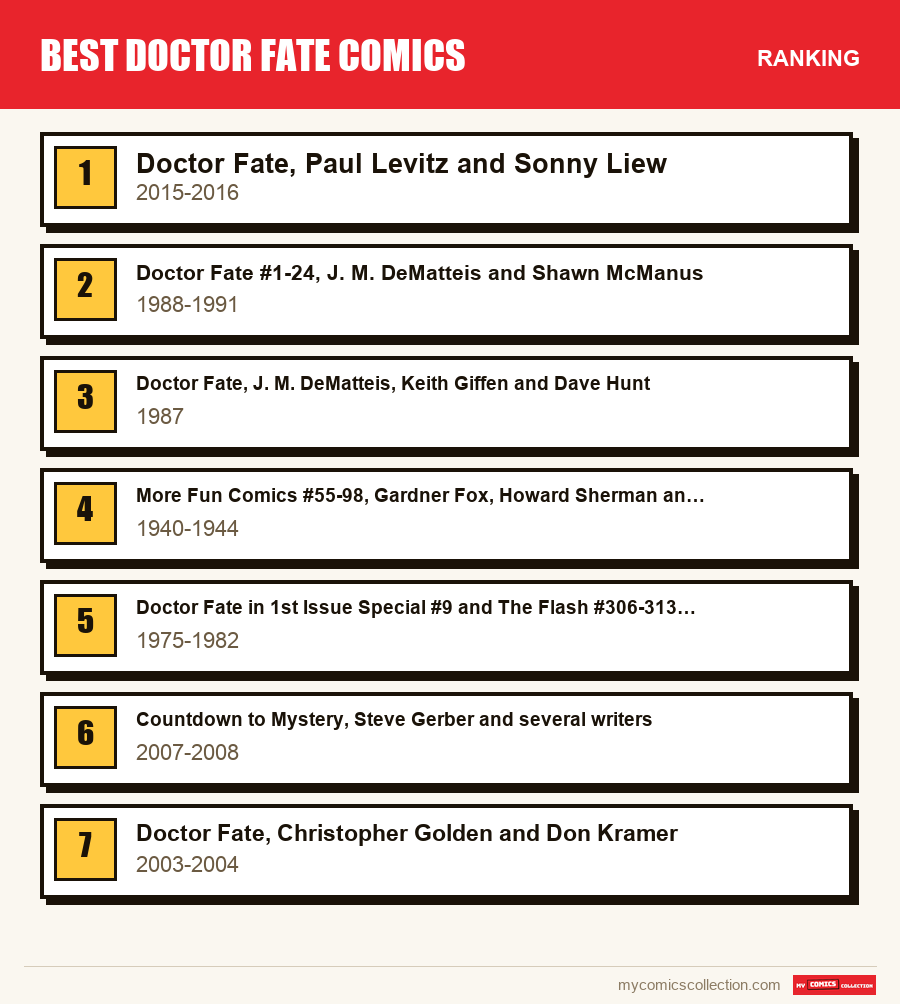
The best Doctor Fate comics to start with today begin with the Doctor Fate series (2015-2016) by Paul Levitz and Sonny Liew, which stars Khalid Nassour and keeps Kent Nelson as his mentor. For the original helmet, move on to More Fun Comics #55 (1940), by Gardner Fox and Howard Sherman, then to the J. M. DeMatteis and Shawn McManus series (1988), centered on Eric and Linda Strauss.
Doctor Fate is not a man, but a helmet, a tunic and a golden cape, worn by very different people across the eras. Kent Nelson embodies him in 1940, Eric and Linda Strauss take over in 1987, Hector Hall puts him on in 2003, and Khalid Nassour inherits him in 2015. This guide ranks seven reads and specifies, for each, who wears the helmet, so that you do not credit one wearer with another's adventures.
As always in this guide, we only state what is verified (creators, issue numbers, dates); the analysis is our own, with no reproduction of protected art or dialogue.
His first appearance
Kent Nelson, the original Doctor Fate, is born in More Fun Comics #55, dated May 1940. Writer Gardner Fox and artist Howard Sherman give him a six-page story; Sherman then draws the first three years of monthly episodes. The character's origin is only told a year later, in More Fun Comics #67 (May 1941).
In All-Star Comics #3, dated winter 1940, the sorcerer joins the Justice Society. His last appearance with the team of that era is in issue #21, summer 1944, and his solo series stops with More Fun Comics #98 (July-August 1944). This Golden Age fixes the figure: a sorcerer in a golden helmet, who becomes one of the pillars of the team.
The other wearers have their own debuts: Eric and Linda Strauss in the 1987 miniseries, Jared Stevens in Fate #1 (November 1994), Khalid Ben-Hassin in Earth 2 #9 (February 2013, by James Robinson and Brett Booth), and Khalid Nassour with Paul Levitz and Sonny Liew in 2015.
1: Doctor Fate, Paul Levitz and Sonny Liew (2015-2016)
This is the most recent and most independent entry point. The series runs eighteen issues, from June 2015 to November 2016. Sonny Liew draws most of it, with several guests depending on the episode, including Inaki Miranda, Brendan McCarthy, Ibrahim Moustafa and Breno Tamura. Paul Levitz writes the whole run.
It gives Doctor Fate a new face. Khalid Nassour is an Egyptian-American medical student chosen to wear the helmet; the series shows him facing the god Anubis, with Nabu as his guide, and presents him as Kent Nelson's grand-nephew. The 1940 character plays the role of mentor rather than lead hero.
It is for the reader who knows nothing of the character's past and wants a complete story. The trade paperbacks split the series into three volumes: issues #1 to #7, #8 to #12 and #13 to #18. The first is enough to judge whether the series suits you.
2: Doctor Fate #1-24, J. M. DeMatteis and Shawn McManus (1988-1991)
The 1988 ongoing series extends the previous year's miniseries. It runs forty-one issues and ends in 1992; J. M. DeMatteis and Shawn McManus sign the first twenty-four. The wearer is first Eric Strauss, paired with Linda Strauss, then, from issue #25, Inza Cramer becomes the sole holder of the helmet.
This series brings a sharp break from the Golden Age tone. We leave the solitary archaeologist for a couple who share a single sorcerer's body, and the story explores the psychology of that fusion more than the fights.
It is for those who enjoy the adult fantasy series of the late 1980s. Plan on a continuous read, starting with the first issue: the story's cycles echo one another, and the early episodes set up what the later ones develop.
3: Doctor Fate, J. M. DeMatteis, Keith Giffen and Dave Hunt (1987)
Before the series, the four-issue miniseries, dated July to October 1987, sets up the change. J. M. DeMatteis writes, Keith Giffen pencils and Dave Hunt inks. The first issue is titled "Cycles." Kent Nelson disappears there, and Eric and Linda Strauss take over the helmet.
It gives us the act of handing down: it is in these four issues that the role stops belonging to a single man. It is for anyone who wants to know why the successive wearers differ so much. Read it just before the 1988 series, of which it is the preamble.
For a collector, issue #1 of this miniseries carries the first appearance of Eric and Linda Strauss, which gives it the interest of a wearer's key issue.
4: More Fun Comics #55-98, Gardner Fox, Howard Sherman and other artists (1940-1944)
The Golden Age Doctor Fate is read in More Fun Comics, from #55 to #98. Gardner Fox writes the stories of this period; Howard Sherman draws the first three years of monthly episodes, before other artists take over. The series ends in the issue dated July-August 1944.
It gives us the canon: the figure of Nabu, the golden helmet and the look of the hero as we still recognize it. It is for the comics history enthusiast and for anyone building a collection around the Justice Society, of which Doctor Fate is a member from All-Star Comics #3.
These single issues date from the era of the anthology titles, when Doctor Fate shared each issue with other short series. They are rare and fragile. Reading a reprint is more realistic; the page on Golden Age collecting details the precautions to take with period single issues.
Do you collect this series?
Track what you own, what you are missing and what your collection is worth. 7-day trial.
Start my trial →
5: Doctor Fate in 1st Issue Special #9 and The Flash #306-313, Martin Pasko, Walt Simonson and Keith Giffen (1975-1982)
The character returns, after years of appearances in Justice League issues, with a story of his own. In 1st Issue Special #9 (1975), Martin Pasko writes and Walt Simonson draws. In 1982, Pasko writes a run of backup stories in The Flash #306 to #313, drawn by Keith Giffen. The three issues of The Immortal Doctor Fate (1985) then collect several of these stories.
This read supplies a missing link: it shows a modernized Kent Nelson before the 1987 shift. It is for the Bronze Age reader, and for those who follow Walt Simonson through his bibliography.
The 1985 reprint is the easiest to track down; none of the pieces requires reading the previous ones.
6: Countdown to Mystery, Steve Gerber and several writers (2007-2008)
This eight-issue miniseries, whose first issue is dated November 2007, splits each issue between Doctor Fate and Eclipso. The project was meant to relaunch the character with Steve Gerber, who starts the writing; after his death, other writers finish it, including Adam Beechen, Gail Simone, Mark Waid and Mark Evanier for the final issue. Justiniano and Walden Wong draw the first episode.
It offers a double-feature format, where each episode alternates between Doctor Fate and Eclipso, and a tone of occult investigation; the result is uneven, since several pens follow one another. It is for those who like DC's occult series, or who follow one of these writers.
To read it, one trade paperback, Dr. Fate: Countdown to Mystery, gathers the first four issues; the rest is found in single issues.
7: Doctor Fate, Christopher Golden and Don Kramer (2003-2004)
Hector Hall is the wearer in this five-issue miniseries, published from October 2003 to February 2004. Christopher Golden writes, Don Kramer draws. The plot unfolds in Salem, where Hector confronts a curse.
It adds one more wearer to the lineage: Hector, who takes the role after the relaunch of the Justice Society, is killed in Day of Vengeance (2005). It is for readers of the 2000s JSA and for those completing the lineage of wearers.
A short, self-contained read, useful for filling a gap, but not essential before the earlier entries.
Where to start depending on your profile
You are discovering the character: read the Paul Levitz and Sonny Liew series. It assumes no prior reading, and the mention of Kent Nelson gives the necessary context. You like the Golden Age: start from More Fun Comics #55, with the Golden Age collecting guide close at hand.
You prefer adult fantasy series: start with the 1987 miniseries, then move straight on to the 1988 one without a break. You follow the teams: Khalid Nassour's recent adventures are found in Justice League Dark relaunched by James Tynion IV, where Kent Nelson dies in the "A Costly Trick of Magic" arc and where Khalid becomes the sole Doctor Fate. He then appears in Justice Society of America, under Geoff Johns in 2022 and then under Jeff Lemire in 2024.
To place these teams within the DC Universe as a whole, the history of the Justice League serves as a landmark. Doctor Fate shares the Justice Society with other heroes born in 1940, including Carter Hall: the guide to the best Hawkman comics follows the same multiple-wearer logic, which helps compare the two helmets.
A methodological tip for multiple wearers: first choose the wearer who appeals to you, then read in publication order of his or her own series. Mixing eras without a landmark creates the impression of contradictions that are really just changes of hands. Also note the reprints and trade paperbacks, which sometimes carry a title close to the original series: always check the issues contained before deciding.
The key issues to know
They are sorted by wearer, because each debut is a distinct key. Kent Nelson: More Fun Comics #55 (May 1940), then More Fun Comics #67 (May 1941) for the origin and All-Star Comics #3 for the entry into the Justice Society. Eric and Linda Strauss: Doctor Fate #1 of the miniseries (July 1987). Jared Stevens: Fate #1 (November 1994). Khalid Ben-Hassin: Earth 2 #9 (February 2013). Khalid Nassour: Doctor Fate #1 (June 2015).
The turning points are the death of Kent Nelson in 1987, the death of Hector Hall in Day of Vengeance in 2005 and that of Kent in Justice League Dark. To spot them in a long box of single issues, look first at the title and the year, then at the condition of the spine and corners; successive wearers sometimes have the same name on the cover. A wearer's key issue only gains lasting value if that wearer has a readable follow-up, so check that follow-up before buying.
Frequently asked questions
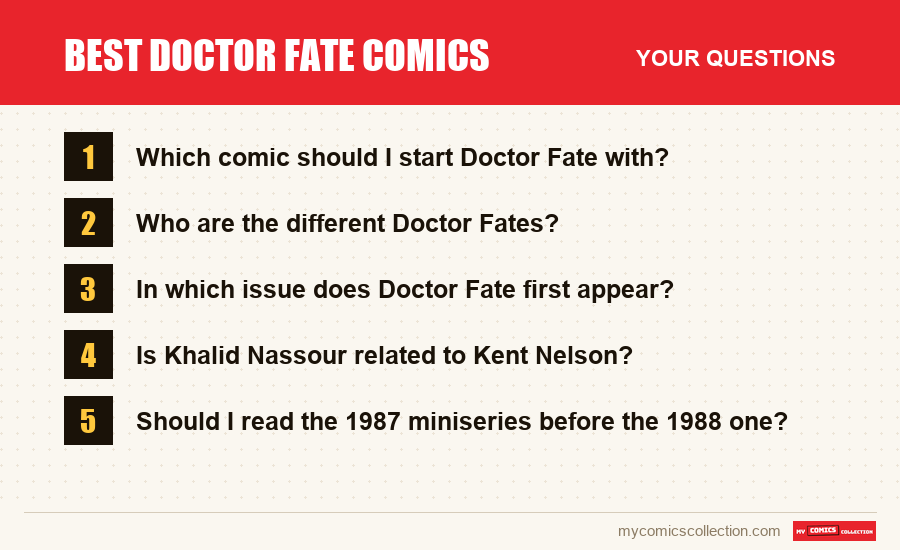
The Doctor Fate series (2015-2016) by Paul Levitz and Sonny Liew, eighteen issues, needs no prior reading and introduces Khalid Nassour. For the original helmet, go back to More Fun Comics #55, by Gardner Fox and Howard Sherman, or to the 1987 miniseries.
Kent Nelson wears the helmet from 1940. Next come Eric and Linda Strauss (1987), Inza Cramer, Jared Stevens (1994), Hector Hall (2000s), then Khalid Nassour (2015). An alternate version, Khalid Ben-Hassin, appears in Earth 2 #9. Each has his or her own key issues.
In More Fun Comics #55, dated May 1940, by Gardner Fox and Howard Sherman. The character's origin is told in issue #67 of May 1941; the entry into the Justice Society dates from winter 1940.
Yes: in the Paul Levitz and Sonny Liew series (2015), Khalid Nassour is Kent Nelson's grand-nephew, who becomes his mentor. The two characters coexist in this series, before Kent's death in Justice League Dark leaves Khalid as sole holder.
It is recommended. The four-issue miniseries (July to October 1987) tells of Kent Nelson's departure and the arrival of Eric and Linda Strauss, which the 1988 series assumes you know. The two read in one sweep.
Own a copy of More Fun Comics or an issue of the 1988 series? Get it appraised before you sell it or insure it.
Estimate my comic