
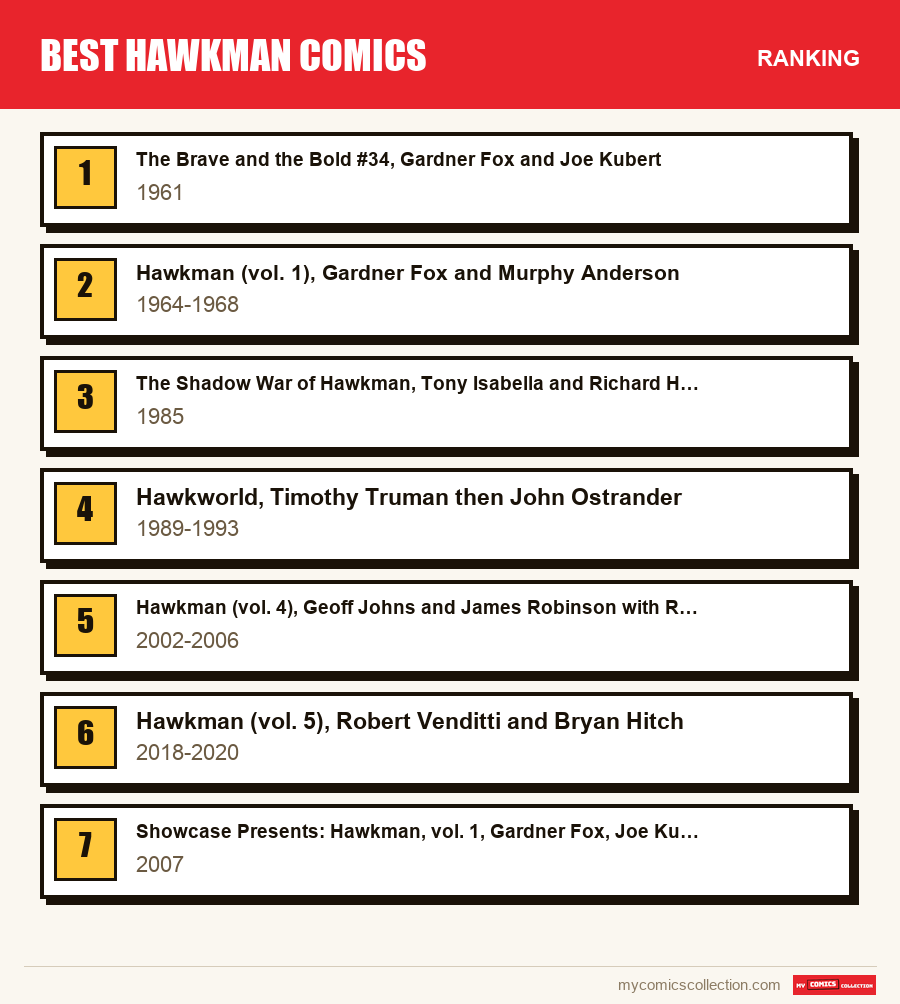
The best Hawkman comics start, for where to begin, with The Brave and the Bold #34 (February-March 1961), where Gardner Fox and Joe Kubert set up Katar Hol, a police officer from Thanagar. Continue with Hawkman (1964), then Hawkworld (1989) for his modern overhaul. Carter Hall, the version born in 1940, is read in the 2002 series by Geoff Johns and James Robinson, or in Robert Venditti's 2018 one.
Hawkman poses a problem that few characters impose on their readers: he exists under several identities that do not overlap. Carter Hall is born in 1940, Katar Hol in 1961, and the stories of the following decades switch from one to the other, sometimes confusing them. This guide ranks seven reads, and says each time which version is involved, so that you can choose your entry point without falling into confusion.
As always in this guide, we only state verified information (creators, issue numbers, dates); the analysis is ours, with no reproduction of protected artwork or dialogue.
His first appearance
For Carter Hall, everything begins with Flash Comics #1, dated January 1940. Writer Gardner Fox and artist Dennis Neville create this Golden Age Hawkman, who presents himself as the reincarnation of an Egyptian prince. Carter Hall then joins the Justice Society in All Star Comics #3 (winter 1940), and chairs the team from issue #8, until 1951.
For Katar Hol, the date is February-March 1961: The Brave and the Bold #34, written by Gardner Fox and drawn by Joe Kubert. The same author thus writes both versions, twenty-one years apart. This second Hawkman is a police officer from the planet Thanagar, who arrives on Earth with his wife Shayera Thal to track a thief named Byth.
The 1961 issue is the one most readers hunt for to understand the character. It comes a year after The Brave and the Bold #28, which launched the Justice League, as our page on that issue #28 recounts; the title served as a testing ground for DC. Finally, note that Shiera Sanders becomes Hawkgirl in the Golden Age stories, alongside Carter Hall.
1: The Brave and the Bold #34, Gardner Fox and Joe Kubert (1961)
Three consecutive issues, from #34 to #36, serve as a tryout: #34 introduces the Thanagarian couple, #35 brings together "Menace of the Matter Master" and "Valley of Vanishing Men," #36 "Strange Spells of the Sorcerer" and "The Shadow Thief of Midway City." The title of the story in issue #34, "Creature of a Thousand Shapes," sets the tone: a shape-shifting thief who has to be caught. Joe Kubert draws its first chapter, in an expressive, dark line.
What this read brings to the character is considerable. The 1961 Hawkman drops the mystical anchoring of the 1940 version and replaces it with science fiction: a police officer from another planet, and no longer a reincarnated prince.
It is for the reader who wants to see the creation and does not fear a period pace. The three issues read in one evening, and finding them together avoids hunting down each issue separately. The reprint collections described further on offer them alongside their sequels.
2: Hawkman (vol. 1), Gardner Fox and Murphy Anderson (1964-1968)
The series under his own name opens with issue #1, dated April-May 1964: Fox writes the story titled "Rivalry of the Winged Wonders!" and Murphy Anderson draws it. It runs twenty-seven issues, through the August-September 1968 issue, and then the title merges with that of the Atom to become The Atom and Hawkman.
The series gives the character what a monthly title can offer: longevity, with twenty-seven appointments over four years. Issue #4, dated October-November 1964, is the one in which Gardner Fox introduces Zatanna; she plays a guest role, and the issue remains a Hawkman issue. Our guide on the history of Zatanna recounts the rest of her trajectory.
This read suits anyone who wants to live DC's Silver Age in full. It is longer and more naive than the 1961 issue, but it shows an established character. Take the first eight issues to get an idea, then continue if the tone appeals to you. Here, it is indeed Katar Hol on the page, and not Carter Hall.
3: The Shadow War of Hawkman, Tony Isabella and Richard Howell (1985)
Four issues published from May to August 1985 make up this miniseries, inked by Alfredo Alcala. Tony Isabella writes, Richard Howell draws, and the covers are by Howell and Dick Giordano. The story pits Katar Hol and Shayera Thal against a conspiracy that threatens the planet they adopted.
The miniseries appears in 1985, the year of Crisis on Infinite Earths, which upended the character's continuity. It therefore has historical interest, beyond the story itself.
It is for a reader who already knows the Silver Age version and wants to see how they tried to wrap it up. If you are a beginner, go straight to the next entry: the context rebuilds itself there without help.
4: Hawkworld, Timothy Truman then John Ostrander (1989-1993)
Three prestige-format issues, published in 1989, which Timothy Truman writes and draws, with Enrique Alcatena on inks. The story takes Katar Hol from the origin: a young police officer from a privileged family on Thanagar, he rebels against his planet's policy of conquest, is exiled, then returns with the help of Shayera Thal, an officer from a modest background, to face Byth Rok.
The contribution is a complete change of tone: Thanagar becomes a class society, and the naive science fiction of 1961 gives way to a political tale. A monthly series extends the miniseries from 1990 to 1993, with thirty-two issues and three annuals; John Ostrander scripts it, with Truman having plotted the first six issues. A new series, Hawkman (vol. 3), then takes over, with Ostrander writing the first six issues.
This read is for fans of serious overhauls and readers who like politically minded stories. It is the most accessible entry point for Katar Hol, since it starts everything over from zero, without requiring the Silver Age.
Do you collect this series?
Track what you own, what you are missing and what your collection is worth. 7-day trial.
Start my trial →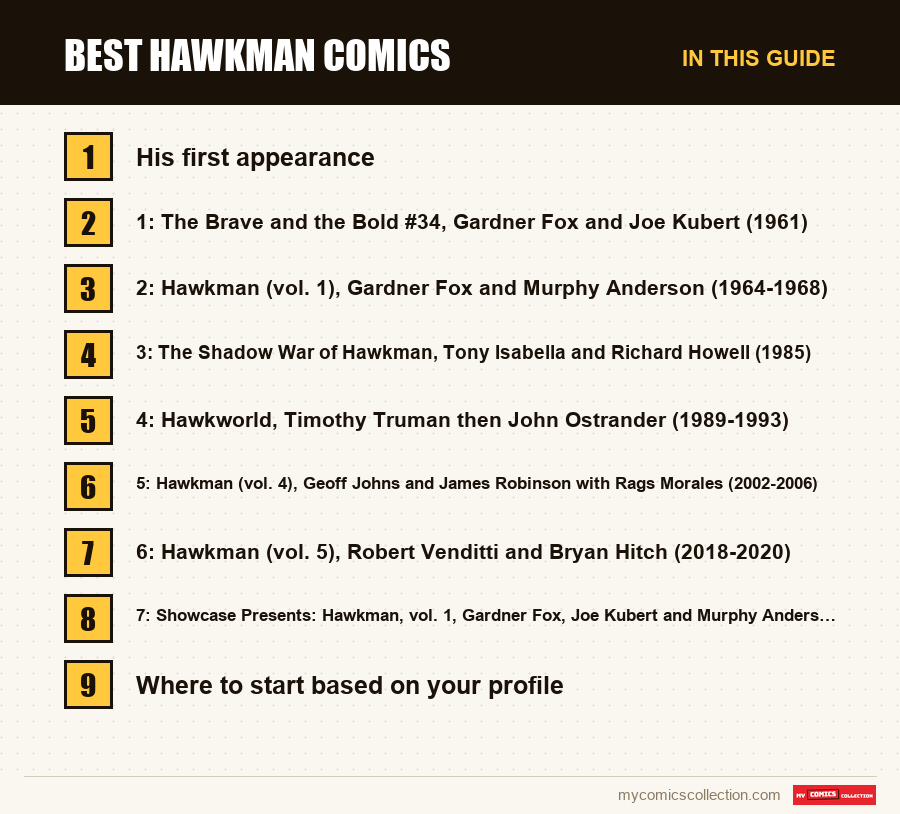
5: Hawkman (vol. 4), Geoff Johns and James Robinson with Rags Morales (2002-2006)
The series begins in 2002 and runs forty-nine issues under the title Hawkman. Geoff Johns and James Robinson write it at the start, Rags Morales draws, then Justin Gray and Jimmy Palmiotti take it over in its third year. At issue #50, in 2006, it becomes Hawkgirl: Kendra Saunders, the Hawkgirl of the moment, takes the title role, and the series stops with issue #66, in July 2007.
This time it is Carter Hall at the top of the bill, with Kendra Saunders as Hawkgirl. For a reader who knows the character from the Justice Society, it is the best way to find him again as a headliner.
It is for anyone who wants to follow Hawkman in a long modern series, and it holds up when read in blocks. To place one of the two opening writers within his body of work, our page on Geoff Johns details his bibliography.
6: Hawkman (vol. 5), Robert Venditti and Bryan Hitch (2018-2020)
Issue #1 is dated August 2018, after Hawkman Found #1, and extends the events of Dark Nights: Metal. Robert Venditti writes, Bryan Hitch draws the first twelve issues, and the covers of several issues are by Stjepan Šejić. The first collection gathers issues #1 to #6, the second issues #7 to #12.
The story follows Carter Hall, who discovers the origin of his many reincarnations: he supposedly once led the Deathbringers, who sacrificed entire populations, then rebelled. Condemned to be reincarnated until he saves as many lives as he took, he turns to his past lives when these enemies target Earth. The theme is a rereading of the very confusion of the character.
This is the read to open if you like big modern sagas and want an overall explanation of the character's multiple identities. The first twelve issues read as a single block, with no prerequisites. You can stop there, or continue to the end of the series, in 2020.
7: Showcase Presents: Hawkman, vol. 1, Gardner Fox, Joe Kubert and Murphy Anderson (2007)
This black-and-white volume, published in March 2007, gathers stories published from 1961 to 1966: The Brave and the Bold #34 to #36, #42 to #44 and #51, The Atom #7, Mystery in Space #87 to #90 and Hawkman #1 to #11. Gardner Fox writes most of the scripts, with Bob Haney among others; Joe Kubert, Murphy Anderson, Gil Kane and others draw.
For a Silver Age reader, it is the most rewarding shortcut: a single book contains everything you need to know the founding period of Katar Hol. A second volume, from 2008, continues the series. The color Hawkman Archives also exist: the first volume (May 2000) collects The Brave and the Bold #34 to #36, #42 to #44 and Mystery in Space #87 to #90, the second (April 2005) issues #1 to #8 of the 1964 series.
It suits anyone who wants to read the Silver Age without chasing the original issues. The drawback is obvious: no color. If you read first for pleasure, favor the Archives; if you want quantity, the black-and-white volume is enough.
Where to start based on your profile
You want to know the creation. Open The Brave and the Bold #34, then Hawkman #1 (1964), which is Katar Hol in his original version. If the period paper puts you off, go through the Showcase Presents volume.
You like serious overhauls. Take Hawkworld (1989): it requires no prior reading and opens on Thanagar as Truman reinvents it.
You know Carter Hall from the Justice Society. Choose Hawkman (vol. 4, 2002) by Johns and Robinson, or the 2018 series by Venditti and Hitch, depending on whether you prefer the tone of 2002 or that of 2018.
You want a closed reading block. The first twelve issues of the 2018 series form a closed whole, whose first collection is easy to find.
You collect character debuts. Look for Flash Comics #1 for Carter Hall and The Brave and the Bold #34 for Katar Hol. Our pages on the key issues of Blackest Night show another stretch of his chronology, where Hawkman and Hawkgirl are among the Black Lanterns.
The key issues to know
Chronological landmarks for Hawkman, from 1940 to 2018. Prices have no place here: only the method for hunting these issues matters.
- Flash Comics #1 (January 1940): the first appearance of Carter Hall, by Gardner Fox and Dennis Neville.
- All Star Comics #3 (winter 1940): Carter Hall joins the Justice Society, whose chairmanship he takes at issue #8.
- The Brave and the Bold #34 (February-March 1961): the first appearance of Katar Hol, by Gardner Fox and Joe Kubert.
- Hawkman #1 (April-May 1964): the start of the series under his own name, by Fox and Murphy Anderson.
- Hawkman #4 (October-November 1964): the first appearance of Zatanna, who is a guest there.
- The Shadow War of Hawkman #1 (May 1985): the start of the Isabella and Howell miniseries.
- Hawkworld (1989): Timothy Truman's miniseries, which overhauls Katar Hol.
- Hawkman (vol. 4) #1 (2002): the start of the Johns and Robinson series.
- Blackest Night #1 (July 2009): a company-wide event, in which Hawkman and Hawkgirl are among the Black Lanterns; you hunt it for the event, not for the hero.
- Hawkman (vol. 5) #1 (August 2018): the start of the Venditti and Hitch series.
Before buying a copy, check which version it relates to, because Carter Hall and Katar Hol sit side by side in catalogs. Then note the cover year and the volume, and compare three closed sales for the same condition, setting aside the outliers. The free estimate completes this cross-check.
Frequently asked questions
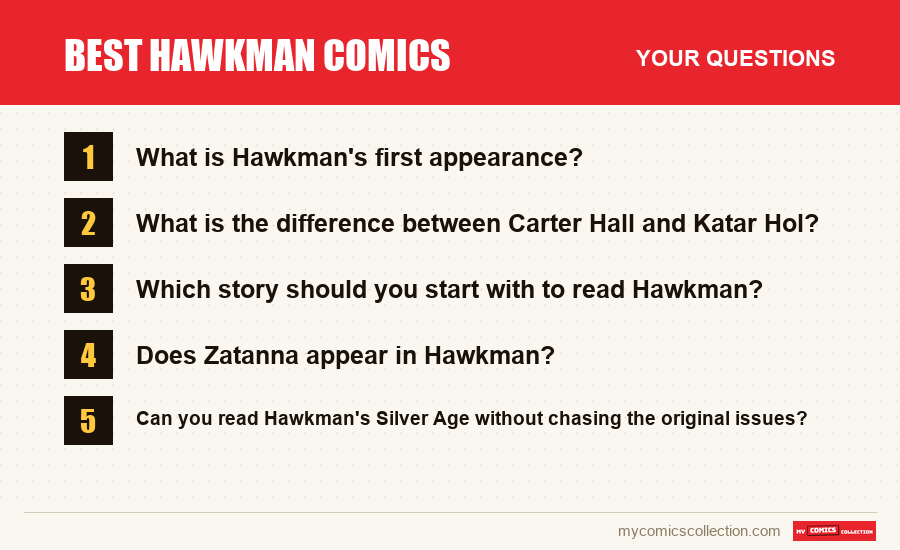
It depends on the version. Carter Hall appears in Flash Comics #1, dated January 1940, created by Gardner Fox and Dennis Neville. Katar Hol appears in The Brave and the Bold #34, dated February-March 1961, by Gardner Fox and Joe Kubert. Both are first appearances of Hawkman.
Carter Hall is the Hawkman of 1940, presented as the reincarnation of an Egyptian prince. Katar Hol is the one of 1961, a police officer from the planet Thanagar who came to Earth with his wife Shayera Thal. Later stories, like the 2018 series, try to link these identities.
For Katar Hol, start with The Brave and the Bold #34 or, if you prefer a modern overhaul, with Hawkworld (1989). For Carter Hall, open the 2018 series by Robert Venditti and Bryan Hitch, whose first twelve issues form a self-contained whole.
Yes, she makes her first appearance in Hawkman #4, dated October-November 1964, scripted by Gardner Fox. She is a guest there: the issue belongs to Hawkman, and does not become a Zatanna issue. You hunt it for that first appearance.
Yes. The black-and-white volume Showcase Presents: Hawkman (2007) collects The Brave and the Bold #34 to #36, other appearances and Hawkman #1 to #11. The color Hawkman Archives offer part of the same material, in two volumes.
Do you have a Hawkman issue from the Golden Age, the Silver Age or a recent relaunch? Have its condition and value assessed.
Estimate my comic