The Infinite Crisis reading order runs from Countdown through the event to the aftermath. The main series is 7 monthly issues, December 2005 to June 2006, written by Geoff Johns with four artists (Phil Jimenez, Jerry Ordway, George Pérez, Ivan Reis) trading off. Read the one-shot Countdown to Infinite Crisis first, then the four six-issue miniseries (The OMAC Project, Villains United, Day of Vengeance, Rann-Thanagar War), then the seven main issues, and continue with 52.
Few DC events demand as much preparation as this one: in 2005, a reader who opened issue #1 of the main series landed in the middle of a plot set up in a one-shot, four parallel miniseries and dozens of issues of regular series. This guide puts that material back into a workable order, from the most essential to the most peripheral.
As always in this guide, we only state verified information (creators, issue numbers, dates); the analysis is our own, with no reproduction of protected pages or dialogue.
What to read before
The title points back to Crisis on Infinite Earths, the 1985 series that redrew the publisher's multiverse. A reader in a hurry can skip it: the TV series compared with the comics and the key issues of the original already give you the bearings you need to read the 2005 event.
The lead-up proper comes down to five items, to be read in this order:
- Countdown to Infinite Crisis, a one-shot that kicks things off;
- The OMAC Project, 6 issues, written by Greg Rucka with art by Jesus Saiz, among others (2005);
- Villains United, 6 issues, written by Gail Simone with art by Dale Eaglesham (2005);
- Day of Vengeance, 6 issues, written by Bill Willingham with art by Justiniano (2005);
- Rann-Thanagar War, 6 issues, written by Dave Gibbons with art by Ivan Reis (2005).
Add DC Special: The Return of Donna Troy, a 4-issue miniseries also tied to the build-up to the event. The main thread can be followed without it.
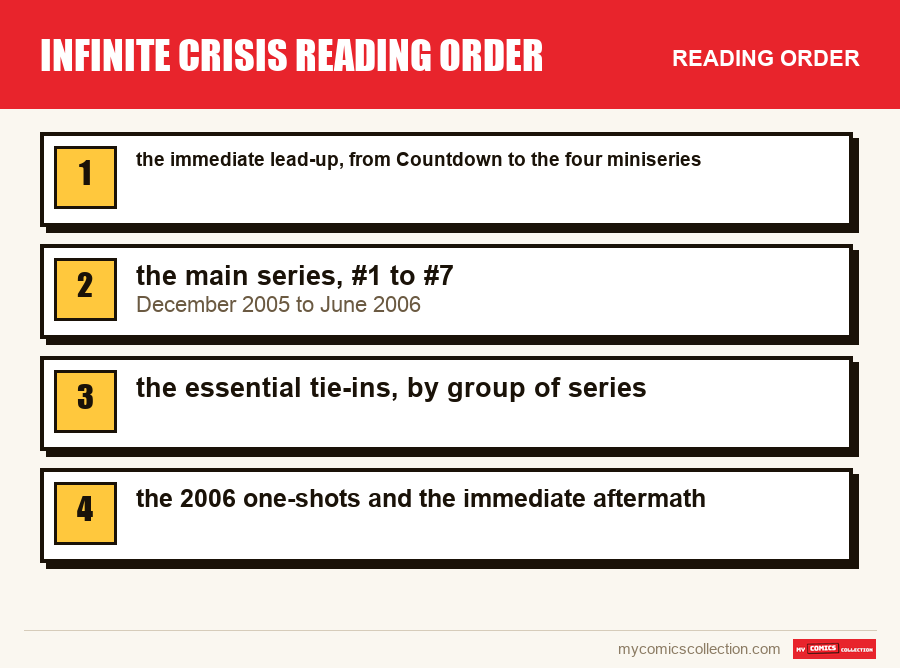
Phase 1: the immediate lead-up, from Countdown to the four miniseries
Start with Countdown to Infinite Crisis. This one-shot works as a launch pad: The OMAC Project picks up the story right where it leaves off, which makes it a must-read before the first miniseries. The page count is modest, so the effort is low: it is the quickest piece of the lead-up to read, and the one you should not skip.
The four miniseries are then read in parallel or one after the other. Whichever you choose, here is what each one brings to the whole, without giving away its content:
- The OMAC Project, written by Greg Rucka, continues the opening one-shot directly. If you only read one miniseries from the lead-up, pick this one, since it resumes the story where the one-shot stops.
- Villains United, by Gail Simone, puts the DC universe's villains front and center. Dale Eaglesham's art sets up a gallery of criminals gathered into a secret society against the heroes.
- Day of Vengeance, by Bill Willingham and drawn by Justiniano, brings together the publisher's magical characters against the Spectre; nothing stops you from saving it for the end of the lead-up.
- Rann-Thanagar War, by Dave Gibbons and Ivan Reis, is the cosmic miniseries. It follows the 2004 Adam Strange miniseries; if that title is unfamiliar, you can still read it, and readers of Green Lantern will find familiar ground.
Each of the four miniseries has a 2006 follow-up: an Infinite Crisis Special #1 specific to each title. These one-shots fit in after the main series or partway through, depending on your pace, and we come back to them below.
Phase 2: the main series, #1 to #7 (December 2005 to June 2006)
The main series runs 7 monthly issues. Johns writes all seven, but the art comes from four hands (Jimenez, Ordway, Pérez, Reis): no single name sums up the series' look. For a collector, that is worth remembering: a copy signed by just one of the artists only tells part of the production story.
The reading splits conveniently into three stretches, for the main series alone:
- #1 to #2: the setup. Issue #1 is the entry point, dated December 2005; it assumes you have read the lead-up.
- #3 to #5: the body of the story. This is where the regular series most often cross paths with the main series.
- #6 to #7: the conclusion, published through June 2006. Issue #7 closes the series and opens onto what follows.
We do not summarize the plot, out of respect for discovery. Just remember the reading rule: only open #1 after reading at least Countdown to Infinite Crisis and The OMAC Project; the other two miniseries enrich the picture without being essential on a first pass.
Phase 3: the essential tie-ins, by group of series
The tie-in list is long: it spans more than twenty regular series. Rather than copy it out in full, here are the groups of issues that matter, depending on the titles you already follow. The issues cited are those listed for the event; all of them date from 2005-2006.
- Around Superman: Superman #216-217, #219 and #221-226; Action Comics #826, #829-831 and #836; Adventures of Superman #639, #642-643, #645 and #648-649. Our Superman reading guide puts these titles in context.
- Around Batman and his family: Batman #635-641 and #645-650 (plus Annual #25), Nightwing #109-110 and #112-117, Robin #140-147, Catwoman #46-49, Birds of Prey #83 and #87-90. See also our Nightwing reading guide.
- Around the Trinity and the teams: Wonder Woman #219-221 and #224; JLA #115-125; JSA #73-80 and #82; Teen Titans #29-33 and Annual #1; Outsiders #29-33.
- Around the other titles: Green Arrow #52-59, Firestorm #17-22, Hawkman #46-49, Manhunter #13-14, The Flash #225, Aquaman #35 and #37, Green Lantern #7.
These issues run alongside the main series during its publication; the surest way to slot them in is to follow the title you already read, then circle back to the main series at each pause. The Superman single issues are the best signposted of the tie-ins, since three regular series take part; if you want a dense read, you can interleave them with main series issues #3 to #5, but it is not required.
Phase 4: the 2006 one-shots and the immediate aftermath
After the main series, two families of short reads remain. First, the four miniseries' Infinite Crisis Special #1 issues (Day of Vengeance, The OMAC Project, Rann-Thanagar War and Villains United), published in 2006. Then Infinite Crisis Secret Files and Origins (2006), which serves as a companion file, and DCU: Brave New World, a one-shot also tied to the event.
The story that follows has two faces. Editorially, the publisher jumped most of its series ahead by a year: this is "One Year Later," where the stories resume a year after the end of the event. As a reading matter, it is 52 that tells the missing year.
52 runs 52 weekly issues, from May 2006 to May 2007 (issue #1 is dated May 10, 2006), one week after the end of Johns's series. Four writers share the scripting (Johns, Morrison, Rucka and Waid), and Keith Giffen supplies the breakdowns. It is a far heavier reading commitment than the event itself, and we recommend it to anyone who wants everything that follows, but never as a required step of Infinite Crisis. For the period after that, you can also read the miniseries Crisis Aftermath: The Battle for Bludhaven (6 issues) and Crisis Aftermath: The Spectre (3 issues).
Do you collect this series?
Track what you own, what you are missing and what your collection is worth. 7-day trial.
Start my trial →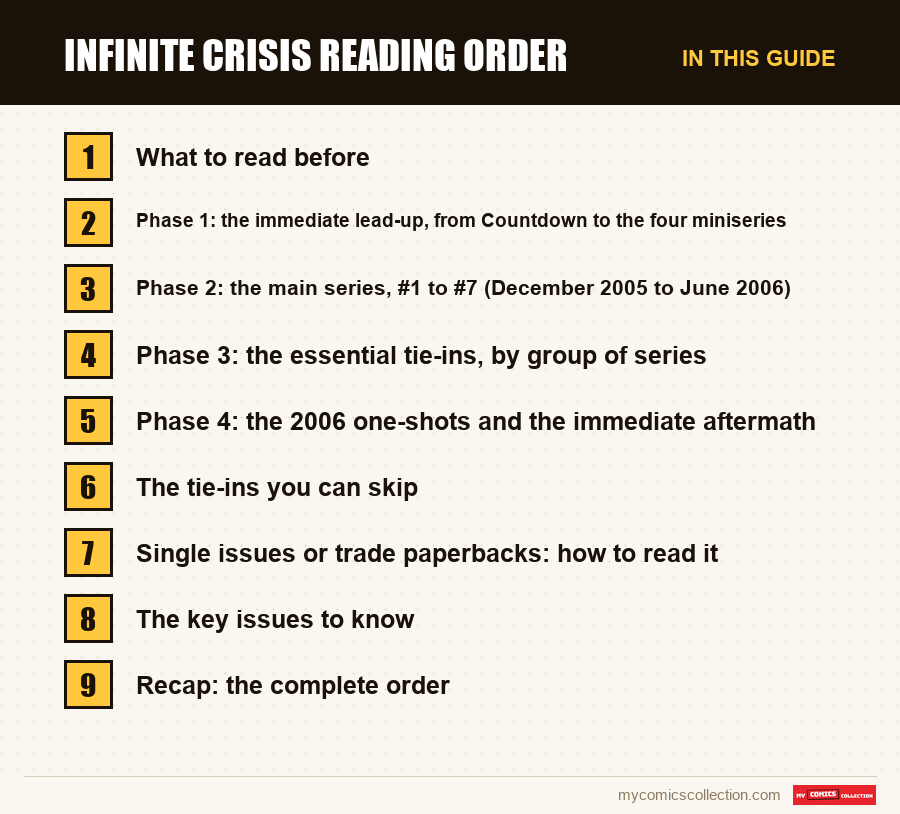
The tie-ins you can skip
Almost all the tie-ins can be skipped on a first read, and not because of quality: they are written for readers who already follow the host series, and the main series was designed to stand on its own once the lead-up has been read. The case of Batman #635-641 and #645-650 is typical: they belong to the series' own narrative thread, and those who read Batman will run into them anyway.
Three categories deserve sorting:
- high-volume titles (JLA #115-125, for example), which demand a big investment for limited added value to the event;
- supporting-character series (Manhunter, Firestorm), to read if you already like the hero;
- companion one-shots, more useful to someone completing a collection than to someone reading for the story.
Single issues or trade paperbacks: how to read it
The question first comes down to format. Single issues follow publication order and keep the original covers, but the event is spread across a year of monthly issues: the lead-up (2005) comes before the main series (2005-2006), which comes before 52 (2006-2007). If your goal is reading, a trade paperback will save you time; if your goal is building a collection of single issues, buy in publication order.
The method we recommend for a trade paperback: check the table of contents to see which issues it contains (the main series alone, or with a miniseries), and match that table to the order in this guide. A trade that only contains the seven main series issues leaves you to fill in the lead-up separately; a trade devoted to one miniseries always gives you all six issues, but not the matching Infinite Crisis Special one-shot. The table of contents is therefore your best referee, well ahead of the title printed on the spine.
For single issues, the advantage is flexibility: you can buy the lead-up miniseries one at a time, which limits the initial effort. The downside is scattering: more than a hundred tie-in issues are spread across about twenty titles, and that is where gaps in a collection show up most often.
The key issues to know
Every event has its sought-after issues, and this one is no exception. Our method is to reason by role in the story rather than by assumed scarcity:
- Infinite Crisis #1 (December 2005): the opening issue of the main series, the one that draws collectors' attention; check the cover credits on your copy. Issue #7 (June 2006), which closes the series, comes right behind it in interest.
- Countdown to Infinite Crisis: the launch one-shot, often forgotten, but essential for anyone who wants a complete lead-up.
- The opening issues of the miniseries: The OMAC Project #1, Villains United #1, Day of Vengeance #1 and Rann-Thanagar War #1. In the public's mind, a miniseries #1 sells together with the whole run: look for complete six-issue sets rather than stray issues.
- 52 #1 (May 10, 2006), which opens the weekly follow-up. The weekly schedule makes complete sets scarcer on the market, which weighs on the hunt for a flawless copy.
When you hold a copy from this period, first examine the spine and staples, then compare its condition against completed sales. On the question of variants, check the cover credit inside the issue: a regular issue whose cover has been swapped does not have the value of an original variant. Then estimate your copy with our free valuation tool, which keeps you from relying only on asking prices.
Recap: the complete order
- Countdown to Infinite Crisis (one-shot)
- The OMAC Project #1-6 (2005)
- Villains United #1-6 (2005)
- Rann-Thanagar War #1-6 (2005)
- Day of Vengeance #1-6 (2005)
- Optional: DC Special: The Return of Donna Troy #1-4
- Infinite Crisis #1-3 (from December 2005)
- Optional, to slot in: tie-ins from Superman, Action Comics, Adventures of Superman, Batman, Nightwing, Robin, Wonder Woman, JSA, JLA, Teen Titans, Outsiders
- Infinite Crisis #4-7 (through June 2006)
- Infinite Crisis Special #1 of the four miniseries (2006), Infinite Crisis Secret Files and Origins (2006)
- 52 #1-52 (May 2006 to May 2007)
- Optional: Crisis Aftermath: The Battle for Bludhaven #1-6, Crisis Aftermath: The Spectre #1-3
Frequently asked questions
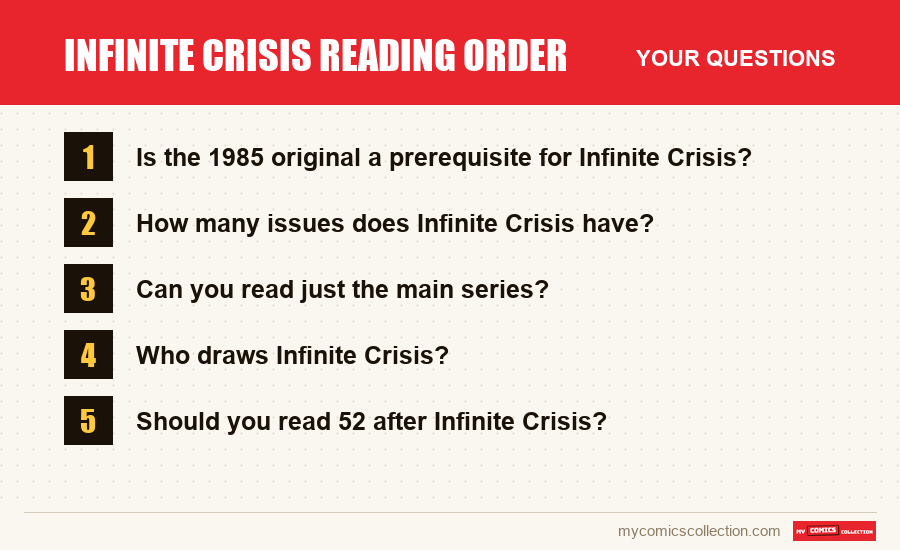
No, it is not essential. The title refers to the 1985 series, and some scenes pick up elements from it, but Geoff Johns's series is readable once you have worked through the 2005 lead-up. The key issues of the original are enough to catch the references.
The main series has 7 issues, published from December 2005 to June 2006. With the lead-up (a one-shot and four miniseries of six issues each), you reach about thirty single issues, plus the optional tie-ins and the weekly follow-up 52.
Yes, as long as you accept being lost at times early on. If you want to limit the effort, read at least Countdown to Infinite Crisis and The OMAC Project, then the main series. The regular-series tie-ins remain optional for a first pass.
Geoff Johns writes the series; on the art side, you will find Jimenez, Ordway, Pérez and Reis. The lead-up miniseries have their own teams, for example Gail Simone for Villains United and Greg Rucka for The OMAC Project.
Only if you want what follows. 52 comes out every week for a year, from May 2006 to May 2007, and tells the missing year before "One Year Later"; its writers are Johns, Morrison, Rucka and Waid. The event stands on its own without it.
Do you own single issues from the lead-up or from Geoff Johns's series? Get your copies valued before you shelve them.
Value my comic