
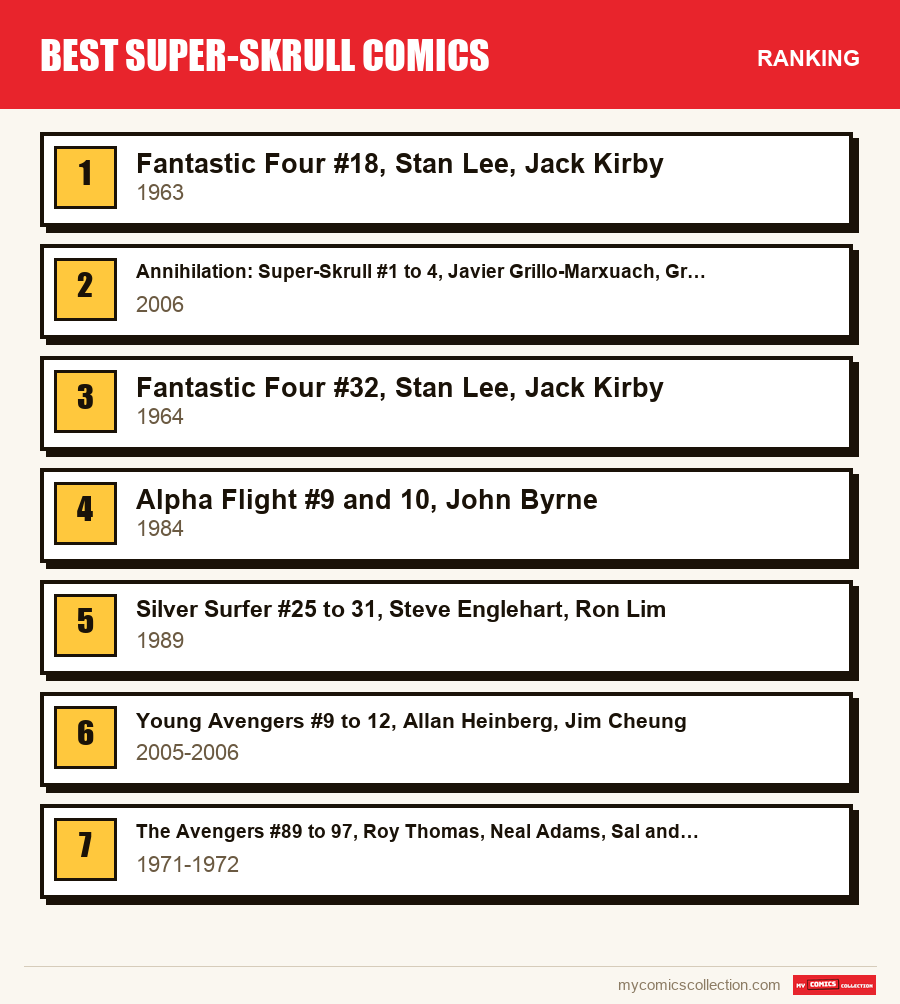
The best Super-Skrull comics start with Fantastic Four #18 (September 1963), where Stan Lee and Jack Kirby invented this warrior who combines the powers of all four heroes. Continue with the miniseries Annihilation: Super-Skrull (2006) by Javier Grillo-Marxuach and Greg Titus, which finally puts him at the center of the story, then go back to Fantastic Four #32, Alpha Flight #9 and 10 and Silver Surfer #25 to 31.
Kl'rt rarely headlines an entire series, and that is what makes his path tricky to follow: he bursts into an issue of Marvel's First Family, vanishes for years, then returns in the corner of a cosmic saga. Seven reads follow, all chosen because Kl'rt decides something in them, with what each contributes, who it is for and how to approach it.
As always in this guide, only verified facts (creators, issue numbers, dates) are stated as fact; the analysis is our own, with no reproduction of protected artwork or dialogue.
His first appearance
Kl'rt makes his entrance in Fantastic Four #18 (September 1963), a single issue credited to writer Stan Lee and artist Jack Kirby. Emperor Dorrek VII turns the soldier Kl'rt into a living weapon there: he borrows from each of the four heroes their power, Mr. Fantastic's elasticity, the Torch's flame, the Thing's strength and the Invisible Woman's invisibility. He is defeated, in the end, by Johnny Storm.
The issue matters for a simple reason: it is the birth of the character as the collecting world defines him. The Skrulls themselves are older, since they appear in Fantastic Four #2, cover-dated January 1962, but the species and its model soldier are not the same thing. If you are looking for the Super-Skrull key issue, it is #18, and no other.
To place this issue within the series of its early days, read the page on the first Fantastic Four series; the writer is presented on the Stan Lee page.
How we ranked the seven reads
The Super-Skrull is a character who passes through: he serves as a foil to the Richards family, as an agent of the Skrull Empire, as the armed fist in a war larger than he is. We kept only stories where Kl'rt plays a driving role, as main enemy or reluctant hero, and set aside the simple cameos. The ranking rests on the balance between the character's interest within the story, how easy the story is to get into, and its weight in the overall arc of his path. It runs from the essential read down to the optional one.
1: Fantastic Four #18, Stan Lee, Jack Kirby (1963)
A single issue, cover-dated September 1963, is enough to set an archetype. Lee and Kirby stage an adversary whose strength lies not in an original power but in the sum of his enemies' powers. Each hero finds himself facing his own amplified reflection, which forces the team to think like tacticians rather than brawlers. That is the principle that will bring Kl'rt back for sixty years: a threat tailor-made against the Fantastic Four.
What this story gives the character is considerable. It establishes his soldier's fanaticism, his absolute loyalty to the emperor and his rivalry with the Thing and the Torch, which will resurface in his later returns. It also fixes his starting principle: a soldier built for a single mission, to beat the Fantastic Four.
Who should read it? Every reader, without exception, and first of all anyone discovering Kirby. How should you read it? On its own, in one issue, or in a collection from the Lee and Kirby period. The context of the previous months is described in our history of Fantastic Four comics.
2: Annihilation: Super-Skrull #1 to 4, Javier Grillo-Marxuach, Greg Titus (2006)
This is the story in this ranking where Kl'rt is both the subject and the engine of the action. Javier Grillo-Marxuach writes these four issues, Greg Titus draws them and Gabriele Dell'Otto does the covers; Annihilus's wave ends up reaching the Skrull Empire. A machine, the Harvester of Sorrows, turns planets into fuel, and Kl'rt, accompanied by the engineer R'Kin, makes his way to the Negative Zone to destroy it.
The interest lies in seeing the soldier without his usual enemies. The conflict with the Fantastic Four disappears, and what remains is a warlord who threatens the prison warden, Hawal, designer of the machine, to obtain a virus able to destroy it, then raises an army among the inmates. R'Kin betrays him; Kl'rt destroys the Harvester of Sorrows but loses his son and appears to die. The soldier gains a personal dimension there that his duels against the Torch and the Thing had not explored.
Who should read it? The space opera reader, and anyone who wants to understand why Kl'rt remains a respected character. How should you read it? After issue #18, preferably in the order of the Annihilation saga, of which the miniseries is a part; the Book 2 collection gathers these issues with those of Silver Surfer and Ronan. See our Annihilation reading guide.
3: Fantastic Four #32, Stan Lee, Jack Kirby (1964)
Cover-dated November 1964, this issue brings Kl'rt back more than a year after his defeat. He escapes from the prison where he had been held since #18, reaches New York under the identity of the Invincible Man and kidnaps Franklin Storm, the father of Sue and Johnny. Stan Lee and Jack Kirby enjoy muddying the trail: for part of the story, you don't know who is hiding behind this new adversary.
What follows is more interesting than the mystery. The single issue shows that the Super-Skrull is not a 1963 footnote but a recurring enemy the series will know how to reuse. It also sets up a trait that will serve afterward: the adversary goes after the heroes' family more than the heroes themselves.
Who should read it? The Silver Age reader, and anyone who likes characters who go in disguise. How should you read it? Right after issue #18, skipping the issues in between if you are looking only for Kl'rt. For this period, the Silver Age key issues serve as a map.
4: Alpha Flight #9 and 10, John Byrne (1984)
John Byrne writes, draws and inks these two issues of Alpha Flight, cover-dated 1984. Each member of the Canadian team gets a story of his own; this one goes to Sasquatch, that is, Walter Langkowski. The Super-Skrull takes on the Thing's appearance, attacks a team of Canadian researchers and kills most of its members, before Sasquatch sends him back into space.
It is a curious choice in a series associated with the team rather than outside visitors, and that is precisely its charm. The character comes across as an intruder from another scale of comics: a cosmic monster dropped into a Canadian setting. Byrne treats him as a credible threat, one that Sasquatch must face with something other than strength.
Who should read it? The Alpha Flight reader and the Byrne collector, who will find a small peak of his Canadian period here. How should you read it? In two issues, with no other preparation. The series' start is covered on our page about Alpha Flight #1, and the creator on the John Byrne page.
Do you collect this series?
Track what you own, what you are missing and what your collection is worth. 7-day trial.
Start my trial →
5: Silver Surfer #25 to 31, Steve Englehart, Ron Lim (1989)
In the third volume of Silver Surfer, Steve Englehart wraps up his run with a war between Skrulls and Kree, and Ron Lim handles the art. The Super-Skrull drags the Surfer into a conflict that does not concern him: he pushes the hero to destroy the Badoons, then tells him they were allies of the Kree. The Kree then send Ronan to Zenn-La, the Surfer's home planet, which the hero defends with his Skrull allies.
For Kl'rt, the contribution lies in manipulation. Instead of attacking head-on, he plays on the Surfer's most fragile point, his debt to a people he has already helped. The plot shows him as a strategist, no longer just a fighting beast, which extends the image of the obedient soldier set in 1963.
Who should read it? The reader of late-1980s cosmic sagas. How should you read it? As a block, preferably with a few earlier issues to understand the state of the series. The page on the Silver Surfer hub recalls the context, and the Silver Surfer reading guide offers a complete path.
6: Young Avengers #9 to 12, Allan Heinberg, Jim Cheung (2005-2006)
In the first volume of Young Avengers, Allan Heinberg writes and Jim Cheung draws. The arc, titled Family Matters, features the Super-Skrull kidnapping Teddy Altman, a.k.a. Hulkling, after the death of his adoptive mother. The affair reveals that Teddy is both Skrull and Kree, the son of the Skrull princess Anelle and Mar-Vell.
The Super-Skrull is an antagonist there, but he also becomes an unwilling protector. To keep a new war between Kree and Skrulls from being born of this discovery, he takes Teddy's appearance and leaves Earth in his place. This decision, nuanced and courageous, sheds light on Kl'rt's sense of duty.
Who should read it? Anyone who likes teenage heroes, or who wants the modern anchor point of the Kree and Skrull saga. How should you read it? With the start of the series, since the group is already established there. Teddy's father is the subject of our page on the best Captain Mar-Vell comics.
7: The Avengers #89 to 97, Roy Thomas, Neal Adams, Sal and John Buscema (1971-1972)
The Kree-Skrull War runs from June 1971 to March 1972, written by Roy Thomas. Sal Buscema draws issues 89 to 92, Neal Adams issues 93 to 96, and John Buscema steps in on issues 94 and 97. The Super-Skrull is here only one agent among others of the Skrull Empire, but his role counts: he kidnaps Captain Marvel, Quicksilver and the Scarlet Witch.
We place it last because Kl'rt is not the subject of the saga. The stakes are the rivalry of two empires, and the Super-Skrull serves as an executor. Still, the arc matters for anyone who wants to understand the context in which his more recent appearances make sense, from Annihilation to Young Avengers.
Who should read it? The Bronze Age reader, and anyone who appreciates Neal Adams's art. How should you read it? As a whole, in nine issues, without trying to isolate a chapter. See the Neal Adams page and the Avengers hub.
Where to start based on your profile
The reader in a hurry will read Fantastic Four #18 then Annihilation: Super-Skrull: two benchmarks, sixty years apart, and you have the character in both of his versions. Anyone who prefers complete stories will add Alpha Flight #9 and 10, a Byrne peak in two single issues.
The reader of cosmic sagas will go straight to Silver Surfer #25 to 31 then to Annihilation, where the soldier returns from a position of strength. The Young Avengers reader will begin with the Family Matters arc, then work back to the Kree-Skrull War to understand Teddy's heritage. For the collector, the guiding line is chronological: 1963, 1964, 1971, 1984, 1989, 2005, 2006.
Are the Skrulls new to you? Marvel's stellar backdrop can be explored with the Guardians of the Galaxy path, and the Skrulls' starting series can be found on the Fantastic Four page.
The key issues to know
For a collector, the obvious key is Fantastic Four #18, the Super-Skrull's first appearance. Issue #2, which introduces the Skrulls in 1962, belongs to another category: that of the species, not the character. Next come the turning points, which rank by narrative importance rather than scarcity: issue #32 from 1964, Alpha Flight #9 and 10, issues 25 to 31 of Silver Surfer, then the Annihilation: Super-Skrull miniseries.
Three other stops deserve to be known. Namor the Sub-Mariner #15 to 18 (1991), where Master Khan turns Kl'rt into an amnesiac hero named Captain Hero. Infinity #3 and 6 (2013 and 2014), by Jonathan Hickman, where he sits on the galactic council then becomes emperor of a rebuilt Skrull Empire. Silver Surfer vol. 3 #13 (1988), where S'byll appears, a second Super-Skrull, not to be confused with Kl'rt.
The method for assessing a copy stays the same whatever the issue. Compare several sold listings of the same grade, not current asking prices. Examine the spine and the corners, because 1960s single issues weaken in those spots. Check that the copy is an original and not a facsimile or a collected edition. The guide to Fantastic Four fake reprints details these checks.
Frequently asked questions
In issue #18 of Fantastic Four, published under a September 1963 cover date, the work of Stan Lee and Jack Kirby. Skrulls in general appear earlier, in Fantastic Four #2 from January 1962, but it is issue #18 that presents Kl'rt with the combined powers of the four heroes.
He combines those of the Fantastic Four: Mr. Fantastic's elasticity, the Torch's flames, the Thing's strength and the Invisible Woman's invisibility. Like other Skrulls, he can also change his appearance, a talent he puts to use in Alpha Flight #9 and 10 and in Young Avengers.
His main showcase is the four-issue miniseries Annihilation: Super-Skrull (2006), written by Javier Grillo-Marxuach and drawn by Greg Titus, which is part of the Annihilation saga.
He is above all a soldier loyal to his empire, and therefore an adversary when the Skrulls' interests clash with the heroes'. In Annihilation: Super-Skrull and in the Family Matters arc of Young Avengers, however, he acts in a way that brings him closer to an ally.
Not for the essentials. Fantastic Four #18 and Annihilation: Super-Skrull are enough to grasp Kl'rt. The Avengers #89 to 97 Kree-Skrull War does, however, shed light on the background of the Skrulls and Mar-Vell, useful for Young Avengers and for recent cosmic sagas.
Have a Fantastic Four #18 or a 1960s issue in your collection? Get a free estimate.
Estimate my comic