
The best Simon Baz comics to start with begin with Green Lantern (2011) #0, which tells how a young Lebanese-American man, suspected of terrorism, receives a green ring. Continue with Rise of the Third Army and Wrath of the First Lantern, by Geoff Johns and Doug Mahnke, then with the 2016 Green Lanterns series, where he shares top billing with Jessica Cruz. Seven ranked reads cover 2012 to 2018.
Simon Baz is one of the most atypical Green Lanterns of the modern era: a Lebanese-American from Dearborn, Michigan, suspected of terrorism before a ring picks him out and he finds himself, without having sought it, inside an interstellar force. His best stories play on the gap between an ordinary man and a cosmic uniform, and on the suspicion his own country casts on him.
As always in this guide, we only state what is verified (creators, issue numbers, dates); the analysis is our own, with no reproduction of protected art or dialogue.
His first appearance
Simon Baz is introduced in Green Lantern (2011) #0, published in 2012, as part of the New 52 "Zero Month" event. The character is created by Geoff Johns, the writer of the series at that time, and by artist Doug Mahnke. A short unnamed appearance comes earlier in the New 52 Free Comic Book Day Special Edition #1, also in 2012, which collectors treat as a supplement rather than as the true starting point.
Issue #0 is therefore the reference: it tells his origins and how the ring chooses him. In the same vein, issues #13 to #16 of the series extend this entrance and make him one of the protagonists of the moment.
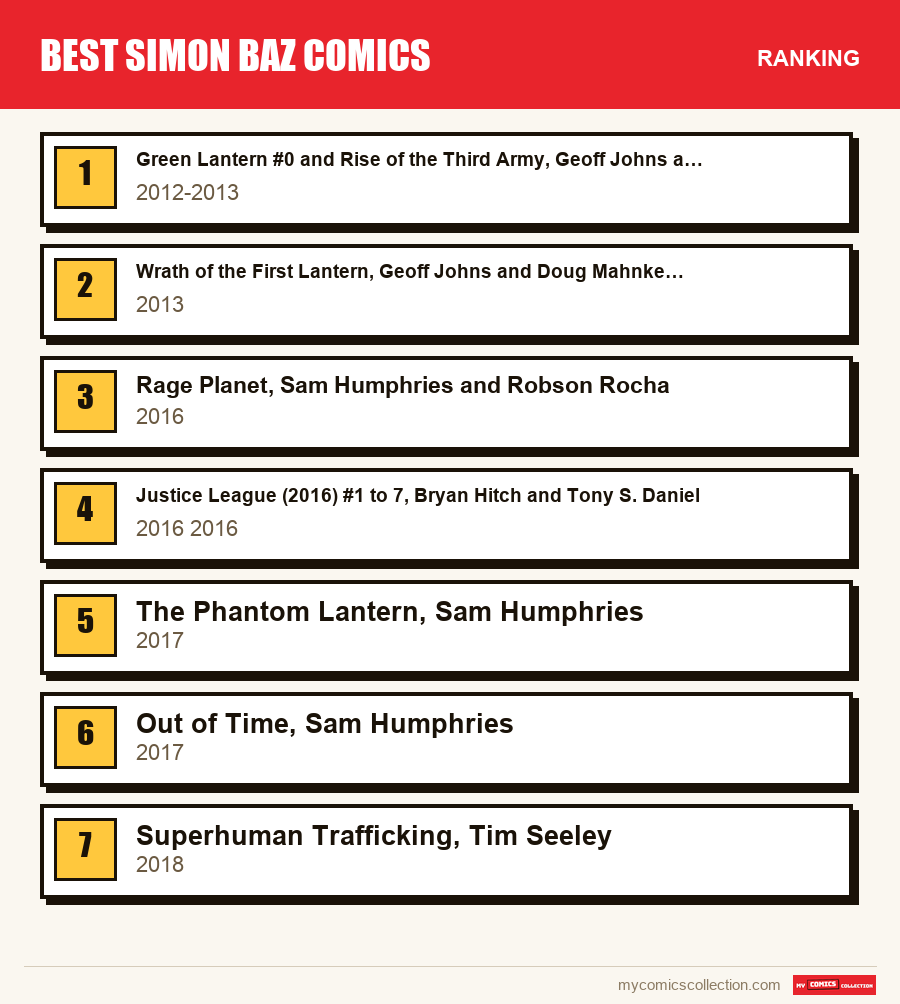
1: Green Lantern #0 and Rise of the Third Army, Geoff Johns and Doug Mahnke (2012-2013)
The best way to discover Simon Baz as his creators conceived him. Issue #0 lays down his origin; issues #13 to #16 of Green Lantern (December 2012 to March 2013) put him at the center of an event that runs across several Corps titles, Rise of the Third Army. Geoff Johns writes, Doug Mahnke draws the main series issues, with the crossovers handed to other teams.
What these issues establish for Baz: a stranger viewed with distrust, and a ring whose instruction manual he does not have. It suits the reader who wants to understand why Baz became a figure apart in the Corps. The hardcover collection of Rise of the Third Army contains issues #13 to #16 with their tie-ins, which makes it a dense volume: if you prefer the main line, read only the parent series.
2: Wrath of the First Lantern, Geoff Johns and Doug Mahnke, with other artists (2013)
The logical sequel, in Green Lantern #17 to #20 (April to July 2013), with chapters spread across several series. Geoff Johns writes the main series issues, Doug Mahnke draws at least issue #17, with Christian Alamy on inks, and other artists work on the tie-ins. Simon Baz appears there alongside the other Green Lanterns against Volthoom, the entity behind the ring that Jessica Cruz will later wear.
This arc is not centered on him alone: it is for the reader who wants to see him in a large-scale event, surrounded by Hal Jordan and the other bearers. The Wrath of the First Lantern collection gathers issues #17 to #20 and the related episodes; buy it after the previous volume, not before. It is also the close of the Geoff Johns period on the series, which then passes into the hands of Robert Venditti.
3: Rage Planet, Sam Humphries and Robson Rocha (2016)
This is the best entry point for the reader who has not read the 2012-2013 period. Green Lanterns #1 (August 2016), preceded by the one-shot Green Lanterns: Rebirth, sets up Simon Baz and Jessica Cruz as a duo. Sam Humphries writes, Robson Rocha draws and Jay Leisten inks. The Rage Planet arc covers issues #1 to #6 and pits them against Bleez and the Red Lanterns, with the agency A.R.G.U.S.
For Baz, issue #1 matters: he gains a precognition power there, the Emerald Sight, which sets him apart from the other ring bearers and makes him a character apart in the mythology. The American trade paperback gathers the one-shot and the six issues, with no need to have read any earlier series. Choose it if you want a self-contained and accessible story, with a partner who shares the spotlight from the first issue's cover.
4: Justice League (2016) #1 to 7, Bryan Hitch and Tony S. Daniel (2016)
After Rebirth, the Justice League is relaunched with Simon Baz and Jessica Cruz on the roster. Bryan Hitch writes, Tony S. Daniel draws most of the first issues, and Hitch himself draws the one-shot Justice League: Rebirth. The first trade paperback, The Extinction Machines, gathers issues #1 to #5; Outbreak then collects issues #6 to #11.
Baz is a team member there, not the protagonist: read it as proof that the character has reached the hard core of the DC Universe. This read suits anyone who likes big teams and wants to know how a secondary Green Lantern of 2012 became a League member in 2016. It requires little context, thanks to the opening one-shot.
Do you collect this series?
Track what you own, what you are missing and what your collection is worth. 7-day trial.
Start my trial →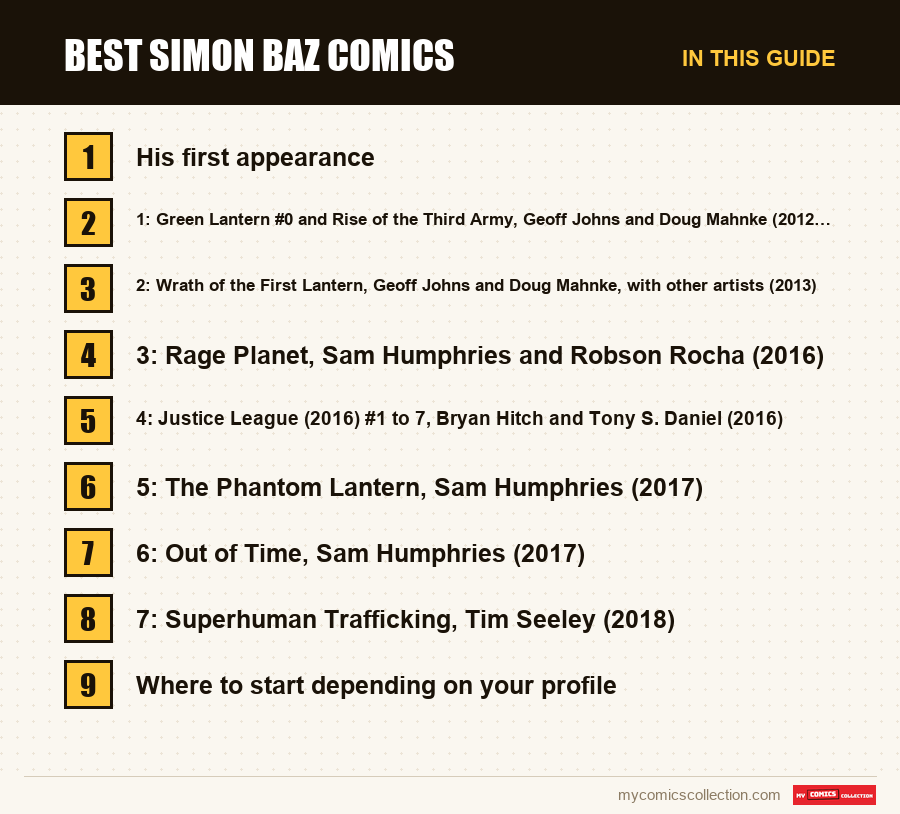
5: The Phantom Lantern, Sam Humphries (2017)
In Green Lanterns, the The Phantom Lantern arc takes up issues #10 to #15, from January to March 2017, and extends the setup of the duo. Sam Humphries stays on script; the American trade paperbacks name Robson Rocha and Eduardo Pansica among the artists. The matching volume, Phantom Lantern, covers issues #7 to #14.
This is the read to chain after Rage Planet if you like the dynamic between the two bearers. It deepens the collaboration between the two bearers, without requiring any knowledge from outside the series. Skip it if you are looking for a spectacular event: it is a character arc before it is an action arc.
6: Out of Time, Sam Humphries (2017)
Issues #27 to #32 of Green Lanterns, from September to December 2017, form Out of Time, which serves as the conclusion of the Humphries part. The matching American trade paperback is volume 5. Several artists follow one another, which means you should read the credit on each issue rather than assume a constant team.
What this read gives Baz: the end of a cycle of more than thirty issues written by the same author, after which the series changes hands. It is for the reader who has followed the earlier arcs and wants a conclusion, not for the one looking for an entry point. Between these two sets, issues #19 to #21 form Polarity, which completist readers will not want to miss.
7: Superhuman Trafficking, Tim Seeley (2018)
Starting with Green Lanterns #33 (December 2017), Tim Seeley takes over the scripts. The Superhuman Trafficking arc covers issues #40 to #43, from April to May 2018, and the collection of the same name adds the annual; the series runs through issue #57, in December 2018. Several artists take part in this period.
This is a read for anyone who wants to extend Simon Baz beyond the Humphries period and see how a new writer handles the duo. It is less essential than the previous five, but it is consistent with them. Begin with the first collection of the period, A World of Our Own (issues #33 to #39), if you want to cover it in full.
A collector's tip for the 2016 series: the American trade paperbacks split the period into numbered volumes, from the first (Rage Planet) to the seventh (Superhuman Trafficking), and each covers a precise range of issues. Draw up the list of those ranges before buying single issues one by one, so you do not end up with the same episode twice or with a gap between two arcs. Remember that the change of writer falls at issue #33.
Where to start depending on your profile
- You are new to Green Lantern: pick up Rage Planet, which contains the opening one-shot and six issues, then Phantom Lantern.
- You want his origins: read Green Lantern (2011) #0 then issues #13 to #20 of the same series, by Geoff Johns and Doug Mahnke. This is the source material.
- You follow the big events: choose Rise of the Third Army and Wrath of the First Lantern, using our overview of Green Lantern crossovers to help.
- You like teams: pick up Justice League (2016) and its first two trade paperbacks.
- You want to place the character: browse the history of Green Lantern and the portrait of Kyle Rayner, another Green Lantern who came after Hal Jordan.
The key issues to know
A method beats a figure: note several sold listings in the same condition, compare them, then tell a standard printing from a variant cover, because the gap between them weighs more than the age of the issue.
- New 52 Free Comic Book Day Special Edition #1 (2012): his unnamed appearance. It interests completists, not readers.
- Green Lantern (2011) #0 (2012): his full entrance and his origins, by Geoff Johns and Doug Mahnke. This is the reference issue.
- Green Lantern (2011) #13 to 16 (2012-2013): Rise of the Third Army, which consolidates his place in the Corps.
- Green Lantern (2011) #17 to 20 (2013): Wrath of the First Lantern, whose issue #17 is drawn by Doug Mahnke.
- Green Lanterns: Rebirth #1 and Green Lanterns #1 (August 2016): the launch of the duo, with the gain of the Emerald Sight.
- Green Lanterns #33 (December 2017): the arrival of Tim Seeley, a useful marker for separating the two writers of the series.
Before buying a copy that is already graded, check that the series is the right one: Green Lantern (2011) and Green Lanterns (2016) look alike on a label. Our Green Lantern issue count helps you keep them straight.
To file these issues, sort them by series rather than by date: Green Lantern (2011) first, then Green Lanterns (2016), then Justice League (2016). The same events are sometimes seen from two angles there, and this order keeps you from counting them twice on a want list.
Frequently asked questions
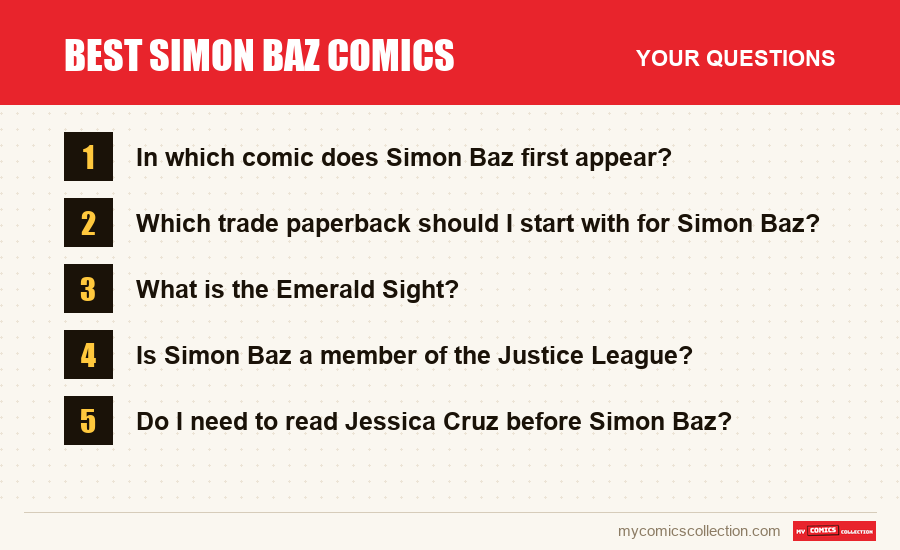
He is introduced in Green Lantern (2011) #0, published in 2012, by Geoff Johns and Doug Mahnke. An unnamed appearance preceded him in the New 52 Free Comic Book Day Special Edition #1, also in 2012; issue #0 is the reference.
With Green Lanterns Vol. 1: Rage Planet, which gathers the one-shot Green Lanterns: Rebirth and issues #1 to #6, by Sam Humphries and Robson Rocha. For his origins, go through Green Lantern #0 and Rise of the Third Army afterward.
It is a precognition power that Simon Baz gains in Green Lanterns #1, in 2016. It sets him apart from the other ring bearers and structures several of his stories in the series, including the arcs written by Sam Humphries.
He is a member in the 2016 relaunch: Justice League #1 to #7, by Bryan Hitch and Tony S. Daniel, puts him on the team with Jessica Cruz. He also appears in Justice League of America in 2013, notably during Trinity War.
No. Baz appears as early as 2012, Jessica Cruz in 2013 and 2014. The 2016 Green Lanterns series presents them together and is enough as a starting point for either one.
Own a Green Lantern #0 or a Green Lanterns #1? Assess its condition and value before deciding whether to keep it or sell it.
Estimate my comic