The ultimate Green Lantern grail is All-American Comics #16 (July 1940), the first appearance of Alan Scott by Martin Nodell and Bill Finger: a CGC 6.5 copy sold for $215,100 in 2018. For the Silver Age Hal Jordan version, Showcase #22 (October 1959, John Broome and Gil Kane) is the centrepiece: a CGC 9.2, the sole copy at that grade at the time, realised $149,375 at Heritage Auctions in November 2017.
Green Lantern is one of the few DC franchises to span every era of American comics without a break in concept: only the bearer of the ring changes. Alan Scott (Golden Age), Hal Jordan (Silver Age), John Stewart and Guy Gardner (Bronze Age), then Geoff Johns's 2000s revival: four eras, four distinct creative visions, and a continuity unlike anything else at DC.
This guide sticks to the verifiable: eBay medians from our estimator (eBay.fr + eBay.com, June 2026) and records documented by Heritage Auctions and the specialist press. The Golden Age grail (All-American Comics #16) and the Silver Age key (Showcase #22) belong to separate series not covered by our tool: auction records are the only price reference for both. For the main Green Lantern vol.2 series (1960), our estimator returns solid volumes on the Bronze Age keys (#76: 69 listings; #87: 66 listings), enabling reliable medians: though these aggregate all grades, which makes them very low for issues whose real value is driven by high-grade copies.
Martin Nodell and Bill Finger: the Golden Age origin (1940)
It was Martin Nodell, then a young illustrator, who conceived Alan Scott in 1940, drawing inspiration from mythology and tales of the Arabian Nights. Bill Finger, Batman's co-creator, wrote the debut script. All-American Comics #16 (July 1940) was published by All-American Publications, one of DC's direct predecessors. Alan Scott, a railroad engineer, wields a mystical lantern with no connection to the Guardians of the Universe: his power is magical, not technological: a detail that distinguishes him fundamentally from every later incarnation of the character.
In collector terms, All-American Comics #16 ranks among the rarest Golden Age DC keys. The CGC Census lists only a handful of unrestored copies, and none in high grade has appeared at public auction. The available market benchmark is a CGC 6.5 copy that sold for $215,100 in 2018: a remarkable figure for a mid-grade copy that underscores the title's extreme scarcity. Our eBay tool does not cover this series.
John Broome and Gil Kane: the Silver Age reinvention (1959-1964)
In 1959, editor Julius Schwartz assigned John Broome (writer) and Gil Kane (pencils, with Joe Giella on inks) the task of reinventing Green Lantern for the Silver Age. Showcase #22 (October 1959) introduces Hal Jordan, a US Air Force test pilot who receives the ring of a dying Guardian. No magic this time: it is galactic technology, rooted in the science-fiction sensibility of the era. Gil Kane's dynamic style would define the character's look for decades; he drew the three Showcase tryout issues (#22-24) and then the first 61 issues of the solo Green Lantern series launched in 1960.
In November 2017, a CGC 9.2 copy of Showcase #22, at the time the sole example at that grade in the census, sold for $149,375 at Heritage Auctions. Our eBay tool does not cover the Showcase series. Broome and Kane are also responsible for Green Lantern #40 (October 1965), which introduces Krona and establishes the origin of the Guardians of the Universe alongside the cosmological roots of the DC multiverse: our estimator returns 98 listings for this issue, with a blended median of €9.
Denny O'Neil and Neal Adams: the Bronze Age and social relevance (1970-1972)
In 1970, Green Lantern #76 marked a radical break. Writer Denny O'Neil and artist Neal Adams transformed the series into a vehicle for social commentary: pollution, racism, poverty: subjects almost unprecedented in mainstream superhero comics. The iconic cover of #76 shows an elderly Black man confronting Hal Jordan: "I been readin' about you… how you work for the blue skins, and how on a planet someplace you helped out the orange skins, and you done considerable for the purple skins! Only there's skins you never bothered with: the black skins!" The Green Lantern/Green Arrow run is universally cited as a founding act of the Bronze Age of American comics.
Within that same run, O'Neil and Adams introduced John Stewart in Green Lantern #87 (December 1971): DC's first Black superhero to join the Green Lantern Corps. The issue also contains Guy Gardner's first cameo. These two introductions cement the run's commitment to diversifying the DC canon. Our estimator returns 69 listings for #76 (median €9, high €11, all grades) and 66 listings for #87 (median €9). In high grade, a CGC 9.6 copy of #76 has sold for approximately $7,000: a stark contrast with the eBay median that reflects the full spectrum of circulating grades.
Geoff Johns and Ethan Van Sciver: the modern revival (2004-2011)
After the turbulent 1990s, during which Hal Jordan became the villain Parallax before dying and returning as the Spectre, writer Geoff Johns and artist Ethan Van Sciver rebuilt the character's legacy with Green Lantern: Rebirth (6 issues, December 2004: May 2005). Johns synthesised seven decades of continuity, repositioning Parallax as a fear entity that had possessed Jordan rather than a genuine corruption, and restoring Hal to the Corps. He then drove the main Green Lantern vol.4 series (2005 onwards), culminating in two landmark events: Sinestro Corps War (2007) and Blackest Night (2009), which expanded the mythology of the emotional spectrum and made the Corps one of the most elaborated concepts in DC fiction.
Green Lantern on screen: collector impact
The 2011 film directed by Martin Campbell and starring Ryan Reynolds as Hal Jordan underperformed commercially. The landscape is set to change significantly with Lanterns, an HBO series which premiered on 16 August 2026: Kyle Chandler plays Hal Jordan and Aaron Pierre plays John Stewart in a terrestrial thriller described by producer James Gunn as "True Detective with a couple of Green Lanterns who are space cops." Nathan Fillion reprises Guy Gardner, a role already introduced in James Gunn's 2025 Superman film. Collector interest in keys tied to these characters: particularly Showcase #22 and Green Lantern #87: has visibly increased ahead of the series premiere.
Key issue summary and market data
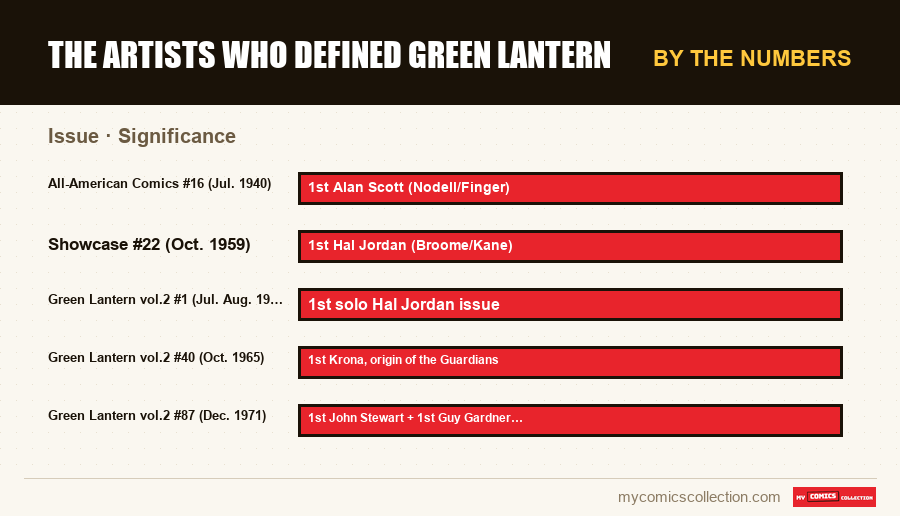
| Issue | Significance | eBay data (all grades) | Documented record |
|---|---|---|---|
| All-American Comics #16 (Jul. 1940) | 1st Alan Scott (Nodell/Finger) | Different series: not available | $215,100 (CGC 6.5, 2018) |
| Showcase #22 (Oct. 1959) | 1st Hal Jordan (Broome/Kane) | Different series: not available | $149,375 (CGC 9.2, Heritage Nov. 2017) |
| Green Lantern vol.2 #1 (Jul. Aug. 1960) | 1st solo Hal Jordan issue | Median €8 · 40 listings | |
| Green Lantern vol.2 #40 (Oct. 1965) | 1st Krona, origin of the Guardians | Median €9 · 98 listings | |
| Green Lantern vol.2 #76 (Apr. 1970) | O'Neil/Adams run begins, Bronze Age landmark | Median €9 · high €11 · 69 listings | ~$7,000 (CGC 9.6) |
| Green Lantern vol.2 #87 (Dec. 1971) | 1st John Stewart + 1st Guy Gardner cameo | Median €9 · 66 listings |
eBay median sources: mycomicscollection.com estimator, June 2026. Record sources: Heritage Auctions, sellmycomicbooks.com.
Own a Green Lantern comic? Get a free valuation with our tool based on real eBay sales to find its low, median, and high value.
Frequently asked questions
All-American Comics #16 (July 1940) introduces Alan Scott, by Martin Nodell and Bill Finger. It is the Golden Age grail. Showcase #22 (October 1959) introduces Hal Jordan, by John Broome and Gil Kane, and remains the centerpiece of the Silver Age.
Martin Nodell imagined Alan Scott in 1940, with writer Bill Finger. His lantern is a mystical artifact, unrelated to the Guardians of the Universe. Hal Jordan, by contrast, receives his ring from a dying Guardian, in a science-fiction spirit.
Denny O'Neil and Neal Adams turn the series into a social platform there, with subjects such as pollution and racism. The Green Lantern/Green Arrow run is cited as the founding act of the Bronze Age of American comics.
Green Lantern #87 (December 1971) introduces John Stewart, and also contains the cameo first appearance of Guy Gardner. The issue confirms the run's aim of diversifying the DC canon.
An estimator's medians aggregate all grades, so they look very low for issues whose value is carried by high grades. For the Golden Age and Silver Age grails, only auction sales are a reference.