
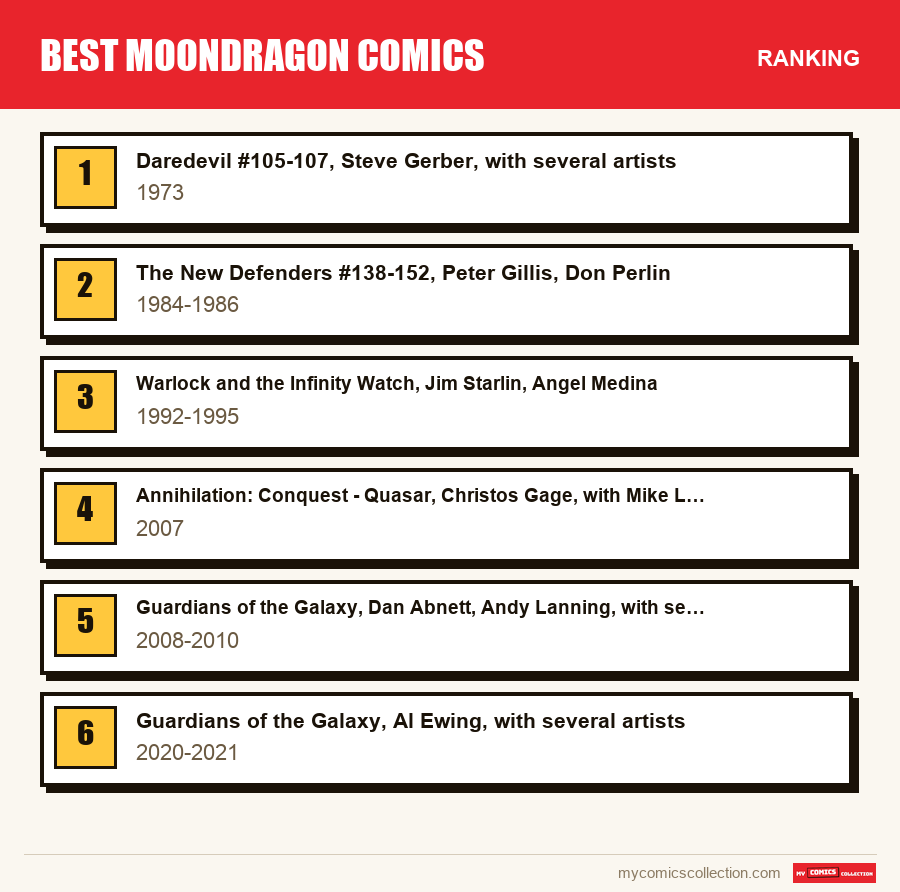
The best Moondragon comics start with Heather Douglas's debut as Madame MacEvil in Iron Man #54 (1973) and her real naming in Daredevil #105. Read Daredevil #105-107 by Steve Gerber first, then The New Defenders #138-152 by Peter Gillis and Don Perlin, then Jim Starlin's Warlock and the Infinity Watch. For modern key issues and reads, try Annihilation: Conquest, Quasar (2007), the 2008 Guardians of the Galaxy, and Al Ewing's 2020 run.
Moondragon is a character with layers: a telepath trained by monks on a moon of Saturn, she tries to control the population of a war-torn planet for the greater good, and her best stories grow out of that appetite for authority. Her history is woven together with Drax and Thanos, which ties her to Marvel's big cosmic saga without making her its most famous face. This page ranks six reads where she is the center or shares top billing, and leaves out the crossovers where she only shows up for a scene.
As always on this guide, we only state verified facts (creators, issue numbers, dates); the analysis is our own, with no reproduction of protected art or dialogue.
Her first appearance
Heather Douglas bursts onto the scene in Iron Man #54, cover-dated 1973, as Madame MacEvil, a bald woman at the controls of a heavily armed submarine. The issue is written by Mike Friedrich and drawn by George Tuska, from an idea by Bill Everett. She takes remote control of Tony Stark's armor and sends it to fight Namor so she can run an experiment on them. Nothing in this underwater adventure hints at the cosmic telepath she will become.
The name Moondragon only shows up later, in Daredevil #105, cover-dated November 1973, where she is introduced as an Earthwoman raised on Titan. In between, Iron Man #55 introduces Thanos and Drax, and that neighborhood is no accident: Drax is in fact her father, Arthur Douglas, whose mind was placed in a new body after Thanos attacked. To place that issue in the big picture, read our page on Iron Man #55.
For collectors, the interest is split: Iron Man #54 carries the character's first appearance, while Daredevil #105 carries her identity and her origin as readers know it. The first is the one you hunt for completeness, the second is the one you actually read.
How we ranked the six reads
Moondragon is rarely alone at the top of a series: she orbits a hero or a team. So we picked the stretches where her fate is the point of the story, where she drives the action or goes through the most striking transformation. The order follows publication chronology, because her psychology is built in successive layers and each series picks up elements from the previous ones: her father, the Dragon of the Moon, the temptation of control.
A quick identity recap helps. Heather loses her parents when Thanos destroys their car in the desert, her father Arthur Douglas has his mind placed in a new body and becomes Drax the Destroyer, and Mentor raises her on Titan with the Shao-Lom monks, where she learns martial arts, sciences and psionic powers. That upbringing feeds her certainty that she is right and everyone else is wrong.
1: Daredevil #105-107, Steve Gerber, with several artists (1973)
Steve Gerber writes this three-issue run. In issue 105, Moondragon arrives from Titan and drags Daredevil into the "Thanos war": she has been led to believe the Mad Titan holds San Francisco, Daredevil and the Black Widow in his grip. The real culprit is Kerwin J. Broderick, who wounds her with a ray gun at the end of the issue.
Issue 106 shows her dying and reveals that she created the adversaries Broderick manipulates, the Dark Messiah, Ramrod and Angar. In 107, as Terrex marches on downtown San Francisco, she restores Daredevil's sight in exchange for his radar sense. Bob Brown draws issue 107, where he begins as the series' regular artist, with Sal Buscema inking.
For Heather, the stakes here are about identity. This is where Heather becomes the authoritarian outsider, distant and convinced of her mission, and where her link to Thanos is set up. Who is it for? The curious reader who wants to see how a character sketched in one underwater adventure gets a cosmic origin within months. How to read it? As three issues in a row, without trying to tie it to anything else: the story stands on its own. Our pages on the history of Thanos and the Thanos reading guide place this moment in the cosmic cycle.
2: The New Defenders #138-152, Peter Gillis, Don Perlin (1984-1986)
Peter Gillis writes and Don Perlin draws this long descent. The Dragon of the Moon, an entity that has slumbered in Heather since her union with it on Titan, wakes up over the course of the issues and gradually takes control of the heroine. Freed from Odin's headband in issue 139, she is infected by spores in issue 141 and agrees to become the Dragon's host in order to survive, which precipitates the fall of the team around her.
The final issue, titled "The End of All Songs," is cover-dated February 1986: Heather, totally corrupted, is one with the Dragon, and Valkyrie, Andromeda, Interloper and Manslaughter give their lives to bring them down. It is a dark series finale that gives her the most spectacular death she has before her many resurrections.
Who is it for? Readers who love dysfunctional teams and finales that embrace loss. How to read it? Read issues 138 to 152 back to back: the Epic Collection The End of All Songs gathers them with the Gargoyle miniseries, and it is the most convenient way in. One detail helps set the stage: in The Avengers #220 (June 1982), Odin judges her and imposes the headband that restrains her powers, then The Defenders #124 (October 1983) puts her in Valkyrie's custody. The series takes the title The New Defenders with the next issue. Our pages on the best Defenders runs and Defenders #1 cover the series in detail.
3: Warlock and the Infinity Watch, Jim Starlin, Angel Medina (1992-1995)
Jim Starlin writes the series, which runs forty-two issues, and Angel Medina draws the early issues, starting with issue 1, cover-dated February 1992. After The Infinity Gauntlet, Adam Warlock entrusts the Infinity Gems to guardians and founds the Infinity Watch: Moondragon receives the Mind Gem, which amplifies powers that were already considerable.
Heather shifts gears here: as a member of a cosmic group, she moves away from the authoritarian figure of the Defenders years. Warlock only gives her the Mind Gem after adding safeguards, a sign of the distrust she still inspires, and the series later sees her badly wounded by Domitian.
Who is it for? The Copper Age reader coming from The Infinity Gauntlet who wants to know what happens to the gems. How to read it? After our page on the key issues of the Infinity Gauntlet, following the numbering from issue 1. Moondragon shares the spotlight with Warlock and the other guardians, and this is the series where you best see her role as a team player.
Do you collect this series?
Track what you own, what you are missing and what your collection is worth. 7-day trial.
Start my trial →
4: Annihilation: Conquest - Quasar, Christos Gage, with Mike Lilly (2007)
Christos Gage writes this four-issue miniseries; Mike Lilly draws it, with Bob Almond inking. Phyla-Vell, who carries the name Quasar, and Moondragon, now a couple, cross the edge of the Kree empire just as the Phalanx invades space. They track the "savior" to Morag IV, where they fight the Super-Adaptoid, from whom Phyla-Vell takes back the power he had stolen from her.
The tragedy comes next in the main series Annihilation: Conquest, in issue 2: as the two women try to recruit the High Evolutionary, Ultron, at the head of the Phalanx, kills Moondragon, who dies in Phyla-Vell's arms. What the miniseries brings to the character: her relationship with Phyla-Vell, which humanizes Heather and gives her an intimate stake rather than a cosmic one. Her death works here as a narrative trigger, and it is in the aftermath that Phyla-Vell goes looking for her.
Who is it for? Anyone who followed the Annihilation years and wants the most personal side of the cycle. How to read it? After our Annihilation reading guide, then keeping the history of Quasar page handy for issue references.
5: Guardians of the Galaxy, Dan Abnett, Andy Lanning, with several artists (2008-2010)
The duo of Dan Abnett and Andy Lanning relaunches the team in 2008 for twenty-five issues. Paul Pelletier draws the first ones, then Brad Walker and Wes Craig take over. Her return to life, told in issues 9 to 12, is tied to Phyla-Vell, who tears her away from the Dragon of the Moon: once resurrected, Heather joins her on Knowhere, the team's base, and becomes an unofficial member in issue 13.
Here, Moondragon holds the spot of support telepath on a team charged with watching over the galaxy, as an ally rather than a threat. The series thus extends the Quasar miniseries from entry 4: anyone who just read it already knows why Heather comes back.
Who is it for? The modern cosmic reader, drawn to a team relaunched from scratch. How to read it? Straight through from issue 1, with the best Guardians of the Galaxy runs page to place the team's other eras.
6: Guardians of the Galaxy, Al Ewing, with several artists (2020-2021)
Al Ewing writes this relaunch. Juann Cabal draws the first issues, including issue 5, cover-dated August 2020. Issue 5 centers on Moondragon: two versions of the character meet, the one from the main universe and a counterpart from another reality. The two Moondragons fight mentally, then merge into a single, more complete Heather.
This read rehabilitates the character. Ewing takes on the main-universe version, who had been left on the sidelines by the loss of Phyla-Vell. It is the most recent read in the selection, and the one that suits a single evening best: issue 5 can be understood on its own, as long as you know the starting situation.
Who is it for? The current reader, drawn to identity stories. How to read it? Take the series from issue 1 and push on at least to issue 8; the Al Ewing page lists the rest of his work at Marvel.
Where to start based on your profile
If you want the character at her origin, read Daredevil #105-107 (entry 1): three issues, one complete story, and Moondragon's identity set. The reader who prefers team tragedies should head straight for The New Defenders (entry 2), which fits in fifteen issues and ends on a turned page.
For anyone coming from the Infinity Gems, Warlock and the Infinity Watch (entry 3) gives her role as guardian of the Mind Gem. Whoever wants modern cosmic should choose the 2008 Guardians of the Galaxy (entry 5), then Al Ewing's (entry 6). The reader mostly interested in the couple she forms with Phyla-Vell should begin with the Quasar miniseries (entry 4). For the background around her father, the page on the best Drax comics is the logical route.
The key issues to know
For a character like this, an issue's value comes from the turning point it carries. Look for the first appearance, then the issues where the character's identity or fate changes.
- Iron Man #54 (January 1973): the first appearance, under the name Madame MacEvil.
- Iron Man #55 (February 1973): the introduction of Thanos and Drax, the latter being Heather's father.
- Daredevil #105 (November 1973): the name Moondragon and her origin on Titan.
- Captain Marvel #31 (March 1974): she joins the cast of Jim Starlin's series.
- The Avengers #220 (June 1982): Odin's judgment and the headband that restrains her powers.
- The New Defenders #141 (1985): infected, Heather becomes the Dragon of the Moon's host.
- The New Defenders #152 (February 1986): "The End of All Songs," the end of the series and of Heather.
- February 1992, Warlock and the Infinity Watch #1: Jim Starlin opens his series, and Heather keeps the Mind Gem there.
- Guardians of the Galaxy #5 (2020): the meeting of the two Moondragons.
To value a copy, compare the condition of the spine and corners against recently sold issues from the same era.
Frequently asked questions
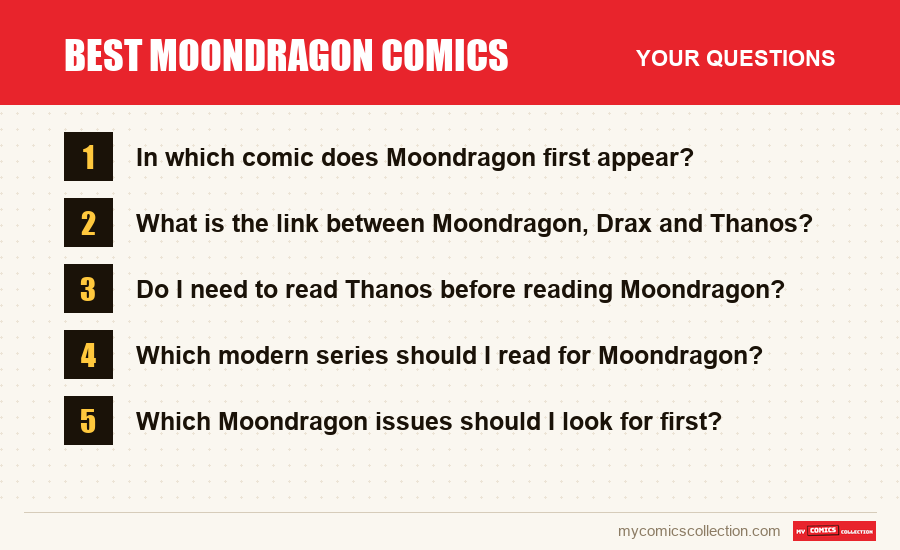
She appears in Iron Man #54, cover-dated 1973, as Madame MacEvil, by Mike Friedrich and George Tuska with Bill Everett. The name Moondragon arrives in Daredevil #105 in November 1973. For reading, go with that latter issue, which fixes her origin on Titan.
Thanos destroys the car of Heather Douglas's parents, and the mind of her father, Arthur Douglas, is placed in a new body: Drax the Destroyer is him. Mentor raises her on Titan, which puts her at the heart of Thanos's cosmic cycle. Heather and Drax debut one issue apart, in Iron Man #54 and #55.
No, it is not required. Daredevil #105-107 can be read with no prerequisites, and The New Defenders #138-152 tell their own story. A detour through our Thanos page only clarifies the references to her parents and Drax, which come back in several series.
Al Ewing's Guardians of the Galaxy, launched in 2020, is the most recent: issue 5 is devoted to a mental showdown between two versions of the character. For a more classic read, pick the 2008 series by Abnett and Lanning, in twenty-five issues.
Look first for Daredevil #105, which carries her name and origin, then Iron Man #54 for the first appearance. The New Defenders #141 and #152 matter too: Heather becomes the Dragon of the Moon's host there, then the arc closes. Compare conditions before you buy.
Is a 1973 Daredevil or an Iron Man #54 sitting in your boxes? Get it valued before deciding what to do with it.
Value my comic