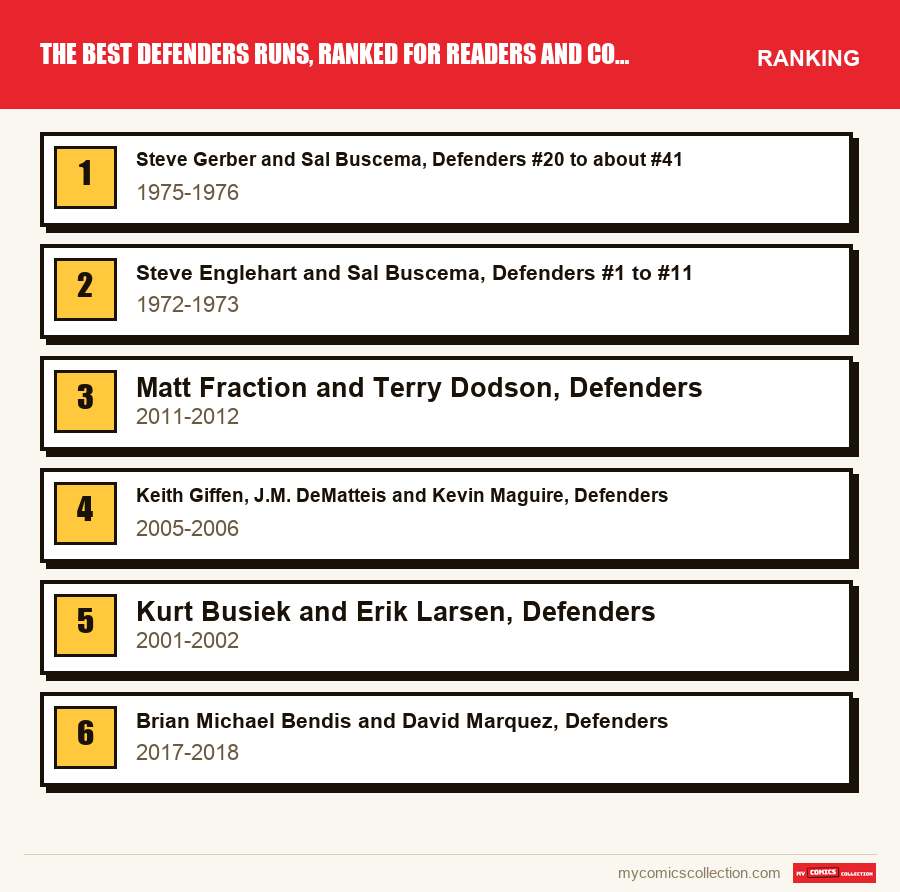
The best Defenders run is the one by Steve Gerber and Sal Buscema, from roughly #20 to #41 (1975-1976), where the team becomes a laboratory of black humor and strangeness. Next come the early days by Steve Englehart and Sal Buscema (1972-1973), Matt Fraction's 2011 relaunch, the miniseries by Keith Giffen, J.M. DeMatteis and Kevin Maguire (2005), the volume by Kurt Busiek and Erik Larsen (2001), then the one by Brian Michael Bendis (2017).
The Defenders have never had a headquarters, an official leader or a stable editorial line. Their history is therefore a succession of visions from different creators, each to be taken on its own, and a ranking by run is the only honest way to find your bearings.
As always on this guide, only verified information (creators, issue numbers, dates) is stated as fact; the analysis is our own, with no reproduction of protected pages or dialogue.
How to read a team that never had a leader
The lineage begins with Marvel Feature #1, dated December 1971, where Roy Thomas and Ross Andru bring together Doctor Strange, Hulk and Namor. The regular series then opens with Defenders #1 in August 1972 and runs until issue 152, in 1986. Successive relaunches follow in 2001, 2005, 2011 and 2017, each starting over from a number one.
Our method is simple: a run goes on the list if it reads as a self-contained story, with a stable creative team and a clear point of view on what the Defenders should be. Periods with no identity, those where the series merely follows the crossovers of the moment, were set aside. Market value counts only for the final section; a ranking that rewarded scarcity would put a 1972 issue at the top, even within a mediocre run.
A reading tip before entering the list: the lineup changes constantly. Doctor Strange, Hulk, Namor, Silver Surfer, Nighthawk and Valkyrie make up the pillars of the classic group, but the modern relaunches freely rearrange the roster. A reader looking for "the" right lineup will find at least five different ones.
Top 1: Steve Gerber and Sal Buscema, Defenders #20 to about #41 (1975-1976)
Steve Gerber takes over the scripts around #20 and keeps them for nearly two years, with Sal Buscema on pencils. This is the period when the series stops being an emergency alliance and becomes a story of atmosphere. The enemies revolve around the Headmen, a group of unbalanced scientists who swap heads, introduced around #21, and the series does not hesitate to push its heroes toward absurdity or melancholy.
This run matters because it fixes what is most singular about the Defenders: a collective where you do not always win and where Valkyrie's or Nighthawk's personal drama weighs as much as the threat of the month. Gerber, whom readers also know from other Marvel titles of the same decade, strikes a tone that the rest of the publisher's catalog rarely imitated.
This run pleases fans of auteur-driven series, patient with disjointed plots and humor that grates. It may put off those who want a well-driven grand cosmic arc: the pacing is uneven, and some episodes are worth mostly as curiosities. Sources also differ on Gerber's exact start and end issues; we give a window, to be cross-checked against the credits page of your copy.
To collect it: these issues from the second half of the 1970s circulate fairly easily in reading condition, and coherent lots can be found. Essential-type collections, in black and white, gather this period at a very low reading cost; the Epic Collections offer it in color.
Top 2: Steve Englehart and Sal Buscema, Defenders #1 to #11 (1972-1973)
The early days of the regular series belong to Steve Englehart, who writes them, and to Sal Buscema, who draws them. The first story sets up the three starting figures as reluctant allies; Valkyrie arrives within the very first months, then the group expands. The high point is the war against the Avengers, a crossover between the two series, whose Defenders episodes run from #8 to about #11, echoing Avengers #115 to #118.
It matters because the concept settles here: a team whose members do not choose one another, facing threats that touch on magic and the cosmos. Our profile of Defenders #1 details the first issue; this ranking judges the whole as a read, and finds it more convincing than its reputation as a mere starting point.
It suits anyone who wants the foundations and anyone who enjoys Bronze Age team stories: measured explanations, expressive characters, readable art. It may feel dated to the contemporary reader, as the episodes of this era sometimes stretch out their conflicts. To assemble it, original single issues exist in good numbers; the first issue remains the most sought after, and collecting the #1 to #11 block takes more patience than money. The Essential collection is fine for reading without burdening yourself with fragile single issues.
Top 3: Matt Fraction and Terry Dodson, Defenders (2011-2012)
Marvel's 2011 relaunch entrusts the series to Matt Fraction, with Terry Dodson on art for the first issues. The group brings together Doctor Strange, Red She-Hulk, Namor, Silver Surfer and Iron Fist, around a plot idea that resembles a game: "Indescribables" to be gathered, a mission that crosses eras. Twelve issues are enough to tell a complete journey.
This run matters because it is the most accessible of the modern series. You open it with no continuity baggage, and its humor stays warm: Fraction salutes the original Defenders without copying them. Fraction treats powers as a badly managed resource, which yields a light and ingenious story. The Matt Fraction hub gathers other series by the same writer.
It suits the reader who discovers the team through the modern door or who wants a short read. It disappoints anyone expecting the harsh tone of the 1970s. To collect it, the bound collection is the natural format; the 2011 and 2012 single issues turn up in quantity and do not justify a keepsake purchase.
Top 4: Keith Giffen, J.M. DeMatteis and Kevin Maguire, Defenders (2005-2006)
In 2005, Keith Giffen and J.M. DeMatteis, joined by Kevin Maguire, take the team on in a five-issue miniseries, according to the sources we consulted. This trio previously signed the comic register of the Justice League International, and applies it here to the Defenders: the idea is to find a band of misfits who bicker more than they fight.
It matters for its tone: the series takes the Defenders for what they have always been at heart, a comedy of characters against a backdrop of absurd threats. It makes you smile without betraying the characters, and the spirit of Doctor Strange, Hulk, Namor and Silver Surfer comes through intact. Maguire's expressive line serves the reading.
It suits anyone who likes funny comics and teams that quarrel. It is not for anyone who wants a cosmic saga: the structure is thinner, and the brevity means you close the book sooner than you would like. The collection fits in five single issues or one small collected edition; copies are easy to find, and buying the complete series poses no supply problem. Another miniseries of a similar tone, later on, did not find the same place in memory, which strengthens the case for this one.
Do you collect this series?
Track what you own, what you are missing and what your collection is worth. 7-day trial.
Start my trial →
Top 5: Kurt Busiek and Erik Larsen, Defenders (2001-2002)
The 2001 volume brings together Kurt Busiek on scripts and Erik Larsen on art, over twelve issues. The project is to put the Defenders back on the rails of a classic heroic adventure, with Doctor Strange, Namor, Hulk and Silver Surfer at the center, and a plot that reconnects with the mystical threats of the golden era. Larsen's art, massive and energetic, gives the battle scenes a scale that other periods lack.
It matters because it is the clearest attempt to bring the team back to a classic form, and because it tries to reconcile the group's cosmic tradition and its mystical tradition. It meets its limits in the construction: twelve issues are short for a project this ambitious, and the ending leaves the feeling of a construction site left unfinished. Our Erik Larsen page places this artist within the body of work.
It suits anyone who likes action comics from the 2000 period and broad drawing. It will disappoint a reader looking for the psychological subtlety of Gerber. To acquire it, the collected edition exists, and the single issues are cheap, because the series was never a publishing phenomenon.
Top 6: Brian Michael Bendis and David Marquez, Defenders (2017-2018)
The 2017 relaunch coincides with the television series The Defenders and entrusts the writing to Brian Michael Bendis, with art by David Marquez. The team brings together Doctor Strange, Luke Cage, Iron Fist, Jessica Jones and Daredevil, which shifts the group toward New York's street-level heroes, far from the original cosmic lineup. The series runs for ten issues.
It matters for its role as a stepping stone more than for its execution: it is the one that brings the name into the culture of the television audience. Bendis's heavily written dialogue finds its place there, but the plot tightens and does not always leave time to get attached to each character. The Brian Michael Bendis hub lets you compare with other team sagas by the same writer.
It suits the reader who has seen the Netflix series and wants to find its heroes here. It will surprise the faithful of the original lineup. The 2017 issues do not yet have an established value. Only ten issues exist, which limits supply; cover variants also play a part, though we cite no ratios, and a new appearance of Luke Cage, Jessica Jones or Daredevil on screen would renew attention, though no announcement confirms one.
Which one to start with, depending on your profile
If you are discovering the team, take Matt Fraction's volume: short, funny and with no prerequisites. If you want the foundations, start from Englehart's first eleven issues, then move on to Gerber. If you like character stories and humor, the 2005 miniseries is the quickest.
If you follow Doctor Strange, our ranking of the best Doctor Strange runs usefully completes the path; if you come by way of the green giant, open the ranking devoted to Hulk instead. If you want to find the heroes of the Netflix series again, Bendis's volume is the most direct, and the series-versus-comics comparison frames your expectations. If you collect before you read, focus on the #1 to #11 block, which concentrates the demand, and leave the modern relaunches to collected editions.
What these runs are worth in a collection
We give no amounts, because a dated price is quickly wrong. Here are instead the ratios that will help you decide.
First ratio: Marvel Feature #1 against Defenders #1. The first is the team's first appearance, the second opens the series; compare the two in the same condition, and the gap will show you what the market values. Second ratio: a single issue from the Gerber era, set against the price of a lot of ten neighboring issues. If the lot costs less than two single issues, you are paying for scattered supply rather than real scarcity. Third ratio: the issues of the 1972-1973 block against those of 1975-1976, where the former win out in demand, since they are the ones that serve as starting points for collectors of complete runs.
Fourth ratio: certified copy against raw copy. On launch issues, certification is defensible; on the 1975 mid-run issues, it rarely makes up for its own cost. For the 2001 to 2017 relaunches, the collected edition almost always beats buying single issues.
The estimation method we follow is the most cautious: record three completed sales of the same issue, in the same condition, then discard listings with no sale. Also check that you are buying the right series, because four volumes carry the same title and namesakes trip up hurried buyers.
Frequently asked questions
The one by Steve Gerber and Sal Buscema, from roughly #20 to #41 (1975-1976), is the most often cited for its black humor and its characters. For an easier read, Matt Fraction's 2011 volume is the most accessible of the modern series.
The monthly starts in August 1972 with number one; the trio's very first appearance goes back to Marvel Feature #1, in late 1971. To read without buying fragile single issues, a collected edition of the Englehart period is enough. The modern relaunches require no prior reading.
No: the 2017 miniseries borrows the name and the idea of an improvised alliance, but brings together different heroes from the original comics. Bendis's volume (2017-2018) is modeled on that lineup. Our comparison details the differences between the series and the comics.
The pillars of the classic lineup are Doctor Strange, Hulk, Namor and Silver Surfer, joined by Valkyrie and Nighthawk. Each relaunch rearranges the group: Iron Fist and Red She-Hulk in 2011, Luke Cage, Jessica Jones and Daredevil in 2017.
The first issue and Marvel Feature #1 are the most in demand, and the price climbs fast in high grade. The series' mid-run issues remain more affordable. To decide, line up three completed sales in the same condition instead of trusting a listing on display.
Do you own a 1970s Defenders or a 1971 Marvel Feature? Estimate it by comparing completed sales in its condition.
Estimate my comic