
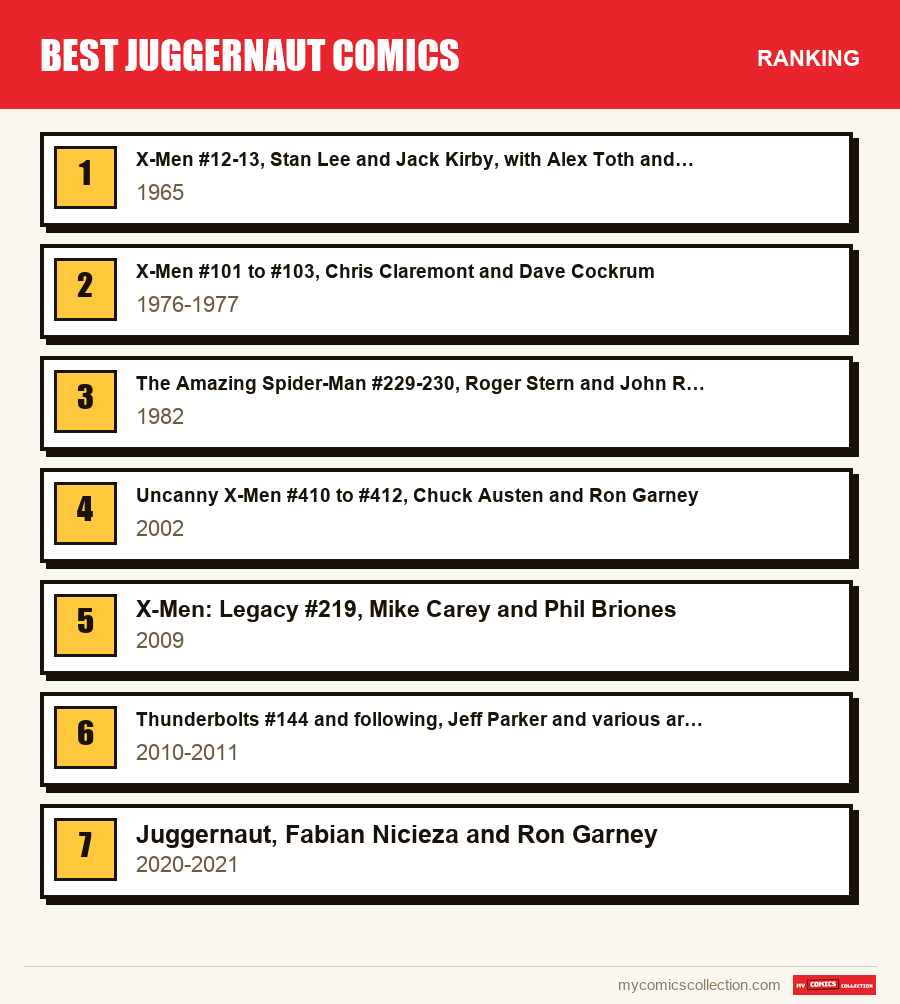
To find the best Juggernaut comics and where to start, open X-Men #12 (July 1965) by Stan Lee and Jack Kirby, the first appearance of Cain Marko, Charles Xavier's stepbrother. Follow with the two-parter The Amazing Spider-Man #229-230 (1982) by Roger Stern and John Romita Jr., then the Juggernaut miniseries (2020) by Fabian Nicieza and Ron Garney, which follows him after he leaves Krakoa.
Juggernaut is poorly summed up as a block of muscle thrown against a wall. Behind the helmet there is Cain Marko, a teenager humiliated by his stepfather, and the shadow of Charles Xavier, with whom he shares a blended family. Depending on the decade, Cain has been the X-Men's enemy, a clumsy ally, a Thunderbolts mercenary, then a man trying to break with the deity that powers him. This guide ranks seven reads to follow that trajectory.
As always in this guide, we only state verified information (creators, issue numbers, dates); the analysis is our own, with no reproduction of protected art or dialogue.
His first appearance
Juggernaut was born in The X-Men #12, dated July 1965, and his story concludes in issue 13, from September 1965. Stan Lee writes, Jack Kirby provides the layouts, finished by Alex Toth on #12 and by Werner Roth on #13. The issue is best known as the one that tells Professor Xavier's origin: we learn that Charles's mother remarried Kurt Marko, Cain's father, and that Cain grew up jealous of a stepbrother his father preferred.
The source of his power is laid down in this very issue. Cain finds a temple in Korea, touches a gem tied to the god Cyttorak, and comes out with a strength that keeps growing as long as he keeps moving. This detail governs the rest of his bibliography: a man who cannot be stopped once he is launched, but who can be bypassed, trapped, or talked down. To understand why this creative duo laid down so many lasting characters, our page on Jack Kirby traces his career at Marvel.
On the collecting side, this Silver Age issue is judged on spine condition, color freshness, and cover authenticity. Issue 13 completes the read, and the two are bought as a pair.
1: X-Men #12-13, Stan Lee and Jack Kirby, with Alex Toth and Werner Roth (1965)
Reading these two issues is not a collector's chore, it is the best introduction to the character. The first stages the discovery of the gem and the face-off with Xavier; the second continues the clash with the team and closes the story. This pair sets the rule that later writers would use: an adversary that force cannot stop obliges the heroes to look for another answer.
These issues are for the reader who wants the character in his pure state, without the later layers of events. The style is chatty and theatrical, as in 1960s comics, and Juggernaut remains an obstacle more than a complex being there.
To place these issues in the team's big picture, the page History of the X-Men gives the framework of the 1960s, and the key issues of the series situate the issue among the other turning points.
2: X-Men #101 to #103, Chris Claremont and Dave Cockrum (1976-1977)
Once the international team is in place, Juggernaut reappears in a three-issue arc that Chris Claremont writes and Dave Cockrum draws. The arc opens with issue 101, dated October 1976, which also marks the first full appearance of Black Tom Cassidy, the accomplice who will accompany Cain for years from now on. The castle of Cassidy Keep serves as the stage for the clash.
What changes is Juggernaut's function. Until now, he was an obstacle. With Claremont, he becomes half of a duo: he has a comrade, a personal motive, and we begin to understand that he cares about someone. The X-Men, for their part, do not win by beating him head-on, and the resolution rests on ingenuity more than on strength.
It is the right arc for anyone who enjoys the Claremont-Cockrum era without wanting to read dozens of issues in a row. It reads in sequence, in three issues. To understand the new team, see Giant-Size X-Men #1, then the page Chris Claremont: where to start to place the writer.
3: The Amazing Spider-Man #229-230, Roger Stern and John Romita Jr. (1982)
Often cited as Juggernaut's most memorable clash outside the X-Men, this two-part story is dated June and July 1982. Roger Stern writes, John Romita Jr. pencils, with Jim Mooney on inks. Black Tom Cassidy sends Cain to kidnap Madame Web, whose psychic powers he hopes will help him against the X-Men; Spider-Man realizes, too late, that none of his attacks slows his adversary down.
The interest lies in the mechanics: Spider-Man has neither the strength nor the mass to fight, and the story draws real suspense from that. The victory comes through a construction site and fresh concrete, a common-sense solution rather than a show of power. The reader sees how a hero without comparable power beats a colossus by playing on the terrain.
This two-parter is for those who enter through Spider-Man, not through the mutants. The context is thin: two issues, and the page Madame Web, reading guide sheds light on the victim's role. For the writer, the guide Roger Stern: where to start gives the rest of his work on the series.
4: Uncanny X-Men #410 to #412, Chuck Austen and Ron Garney (2002)
In 2002, Juggernaut stops being an antagonist for a time. In the cycle launched by Uncanny X-Men #410, Chuck Austen writes and Ron Garney pencils issues 410 to 412, before Sean Phillips takes over issues 413 to 415. The X-Men answer a distress call in Scotland, find Cain there, and the arc ends with him joining the team, alongside a young mutant named Sammy.
This read divides opinion. It pleases those who like to see an antagonist try another path, and it puzzles those who remember Juggernaut as the definitive enemy. It matters above all for understanding why, years later, so many stories play on the line between redemption and relapse: the ground is laid here. The tone is more intimate than in the arcs of the Claremont period.
It targets the reader already settled among the mutants, curious to see Cain on the heroes' side. The simplest approach is to read the three issues back to back before continuing with the rest of the series, using the X-Men reading guide for the context of the period.
5: X-Men: Legacy #219, Mike Carey and Phil Briones (2009)
Dated February 2009, this issue puts Cain Marko and Charles Xavier face to face. Mike Carey writes, Phil Briones draws, Cam Smith inks. It is not a team brawl but a two-person scene: Juggernaut confronts his stepbrother, and the question of what one can forgive the other becomes the real subject.
The strength of this issue is its focus. It requires almost no prior knowledge of the Legacy series: a reader who has already read X-Men #12 understands the original wound, that of a boy raised next to another whom his father favored. Reading the issue works like a late answer to the 1965 episode, half a century later, on the same family ground.
This issue is to be recommended to anyone who likes short stories centered on relationships. It does not replace a sustained read of the character, but it sheds light on why Cain's resentment goes beyond a pretext for violence. Xavier fans will find other leads in the page on Magneto and Xavier.
Do you collect this series?
Track what you own, what you are missing and what your collection is worth. 7-day trial.
Start my trial →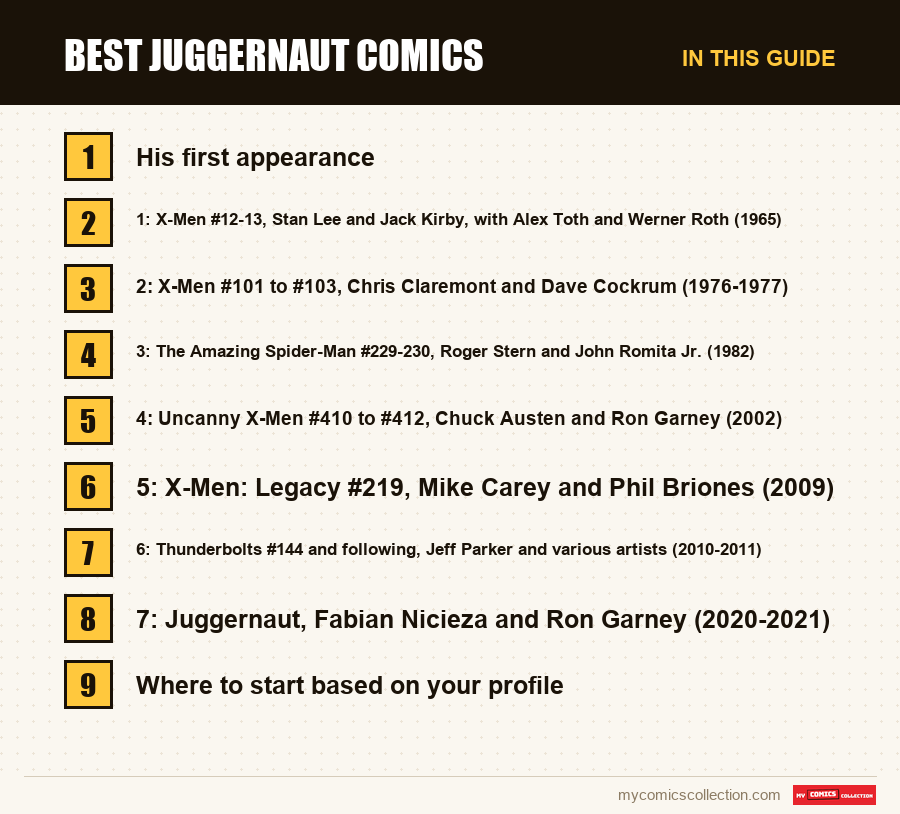
6: Thunderbolts #144 and following, Jeff Parker and various artists (2010-2011)
The Thunderbolts relaunch starting with issue 144, dated May 2010, places Juggernaut in a team of convicts: Jeff Parker writes, Kev Walker draws this first issue, and the opening lineup also includes Crossbones, Ghost, Moonstone, and Man-Thing, under the watch of Luke Cage at the Raft prison. For Cain, it is a new role as a contract worker, with superiors and rules.
The sequel, tied to the Fear Itself event, fills issues 158 to 162: a hammer falls on the Raft, Cain seizes it and becomes one of the Worthy of the Serpent, under the name Kuurth. Kev Walker and Declan Shalvey share the art on these issues. Juggernaut is transformed there in appearance and in role, with a power that is no longer Cyttorak's.
This read is for those who appreciate dark humor and lopsided teams more than classic heroism. It shows the character in a regular-series format, on a team, which none of the previous reads did. Plan to read issue 144 first, then jump straight to issues 158 to 162 if time is short.
7: Juggernaut, Fabian Nicieza and Ron Garney (2020-2021)
The five-issue miniseries, the first of which is dated September 2020, is written by Fabian Nicieza and drawn by Ron Garney. It arrives in the wake of House of X and picks Cain up at a moment when his powers are not what they were: he seeks to free himself from Cyttorak's tutelage, by obtaining the Crimson Bands of Cyttorak in the god's forge, in North Korea.
It is the best recent way in, because it is self-contained and short. It recalls what you need to know about the source of the power, the link with Xavier, and his relapses, then moves him forward. We see a character who must decide what he wants, once the god is set aside. Five issues are enough.
The series is for the reader who does not want to commit to sixty years of continuity and who is looking for a complete story. It reads in single issues as well as in a collected edition, and Ron Garney's art, rough and physical, suits the subject. For what the mutants were up to in this period, see House of X and Powers of X.
Where to start based on your profile
If you are discovering the X-Men and want a complete story, take Juggernaut (2020): five issues, a beginning, an end, and an implicit summary of what matters. If you come from Spider-Man, The Amazing Spider-Man #229-230 reads on its own and puts you face to face with the adversary with no prerequisites.
The reader of classics will start with X-Men #12-13, then move to the Claremont and Cockrum arc of 1976-1977 to see how the character becomes a duo. The one who likes second-tier teams will head for Thunderbolts #144, then issues 158 to 162. As for the collector, he will choose one piece per era: a first appearance, a 1970s arc, a 1982 two-parter, a recent relaunch. The 2002 and 2009 pieces are reader's complements more than collecting targets.
The key issues to know
The first landmark is X-Men #12 (July 1965), the first appearance of Cain Marko. The second is issue 13 (September 1965), which closes the story. The third is X-Men #101 (October 1976), the first full appearance of Black Tom Cassidy and the start of the three-issue arc with Cain.
The fourth is The Amazing Spider-Man #229 (June 1982), the opening of Roger Stern's two-parter. Next come Juggernaut #1 (April 1997), a one-shot devoted to the character, then X-Men: Legacy #219 (February 2009), and Thunderbolts #144 (May 2010). The last landmark is Juggernaut #1 (September 2020), the start of the Nicieza and Garney miniseries.
To decide among these landmarks, ask yourself what you are after: the character's story, or a collectible. An old, sought-after first appearance does not follow the same rules as a recent issue that is easy to find. Check the exact nature of your copy, compare equivalent grades, and keep in mind that an issue's value follows the attention paid to the character, not only its age. If one of these issues is sleeping in your boxes, the free valuation gives a first frame.
Reading in order or by jumping around
Juggernaut's bibliography requires no strict order. Each read above stands on its own, and the most practical approach is to choose two or three entry points, then go back if the character hooks you. Starting with the 1960s to finish in 2020 offers a chronological path, which brings out the contrast between the silent colossus of 1965 and the man of 2020 who seeks to shed his god.
In collected editions, the 1976-1977 and 1982 arcs are found in volumes devoted to their series, to be searched by the title of the starting issue. In single issues, the Spider-Man two-parter and the 2020 miniseries remain the easiest purchases to complete, since they only require two or five issues.
Frequently asked questions
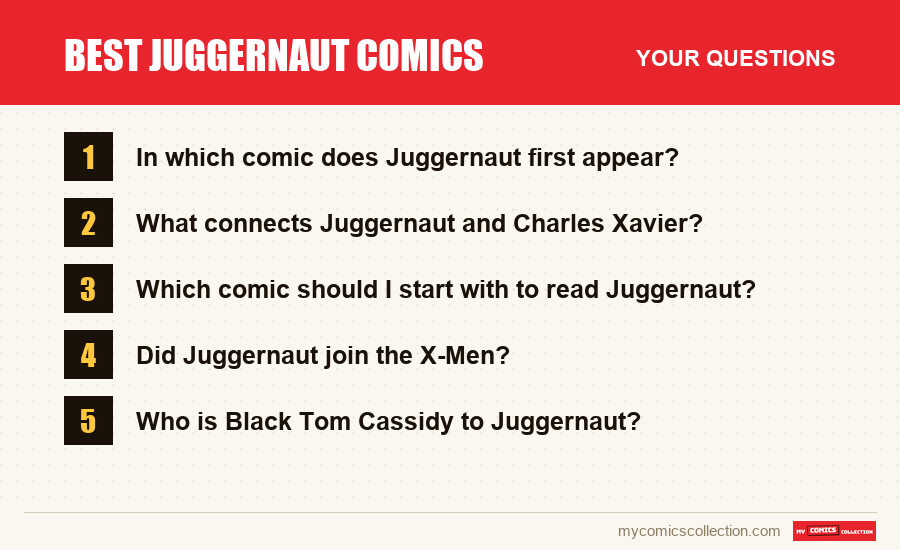
Cain Marko's debut goes back to The X-Men #12 (July 1965), the work of the tandem of Stan Lee and Jack Kirby. The story continues in issue 13, from September 1965. The same issue tells the origin of Professor Xavier, whose stepbrother is Cain Marko.
Cain Marko is the son of Kurt Marko, who marries Charles Xavier's mother: they are stepbrothers. This kinship is laid down in X-Men #12 (1965). It resurfaces in X-Men: Legacy #219 (February 2009), by Mike Carey and Phil Briones, where the two men face each other.
For a complete, recent story, read the Juggernaut miniseries (2020) by Fabian Nicieza and Ron Garney, in five issues. For the classic, open X-Men #12-13 (1965). From the Spider-Man universe, the 1982 two-parter (The Amazing Spider-Man #229-230) has Roger Stern on script and John Romita Jr. on pencils.
Yes, at a specific point: in the Uncanny X-Men #410 to #412 cycle (2002), by Chuck Austen and Ron Garney, Cain Marko joins the team. He was also a member of the Thunderbolts starting with issue 144 (May 2010). His side has varied depending on the series and the writers.
Black Tom Cassidy is Juggernaut's usual accomplice in the 1970s and 1980s. His first full appearance dates from X-Men #101 (October 1976), by Chris Claremont and Dave Cockrum. In The Amazing Spider-Man #229-230 (1982), he is the one who sends Cain to kidnap Madame Web.
An issue of X-Men or The Amazing Spider-Man sitting in your boxes? Get a first reference point before deciding what to keep.
Estimate my comic