Patrick Stewart and Ian McKellen reprise Professor X and Magneto in Avengers: Doomsday, expected on December 18, 2026 after a delay from May to December, then in Avengers: Secret Wars on December 17, 2027. On the paper side, their bond is collected as a single long object. It begins in X-Men #1 (September 1963, Stan Lee and Jack Kirby), where they appear together with no shared past whatsoever. That earlier friendship is a retrospective construction: it is dramatized for the first time nineteen years later, in Uncanny X-Men #161 (September 1982, Chris Claremont and Dave Cockrum). In between, and after, a handful of issues shift the balance of power: the Brotherhood of X-Men #4, the trial of Uncanny X-Men #200, the rupture of X-Men #25, the refounding of House of X #1.
A collection is almost always built around a character, a series or a period. You collect Magneto, you collect the X-Men, you collect the Claremont era. It is practical, it is legible, and it produces lists that are easy to check off. But it is not the only possible entry, and for these two particular characters, it is probably not the best one.
Because neither one really exists alone. Professor X without Magneto is a school principal. Magneto without Professor X is an angry man with powers. What has lasted sixty years, what feeds the films and what sells the issues, is the tension between the two: two survivors who want to protect the same minority and never agree on the method. Collecting that tension, rather than either man, completely changes the shopping list.
This article is written on October 1st, 2026, two and a half months before the film's release. No image of the duo has yet been seen in theaters, and nobody knows what exact place the script will give their relationship. What is perfectly verifiable, however, is the list of issues where this bond was built, and it is the basis used here.
Why a relationship can structure a collection
Collecting a theme instead of a character amounts to replacing a list with a story. The three consequences are concrete.
The list becomes finite and defensible. Magneto's appearances number in the hundreds, Professor X's too, and nobody can seriously decide where an "all Magneto" stops. The issues where their relationship changes state, on the other hand, can be counted on two hands. You can justify them one by one, which is precisely what is asked of a built collection: that it answer the question "why this one."
The budget is spread differently. A character collection concentrates spending on the first appearance and lets the rest follow. A relationship collection spreads spending over several decades, including the 1980s and 1990s, clearly more accessible than 1963. It is therefore workable on an average budget, provided you accept that the most expensive piece stays out of reach for a long time.
It withstands news better. An issue bought because an actor was announced loses its argument when the film comes out. An issue bought because it contains the moment a friendship fractures keeps its argument indefinitely. It is a difference of nature, not of degree, and it shows in price cycles: what rises on an announcement falls back after release, what rises on narrative importance moves more slowly but does not fade.
For the purposes of this list, an issue earns its place if it fills one of these four roles: it sets up the framework, it invents the shared past, it shifts the alliance, or it kills and brings back one of the two. Everything else, however pleasant to read, belongs to the reading guide and not to the targeted collection.
The starting point: two men who have never seen each other
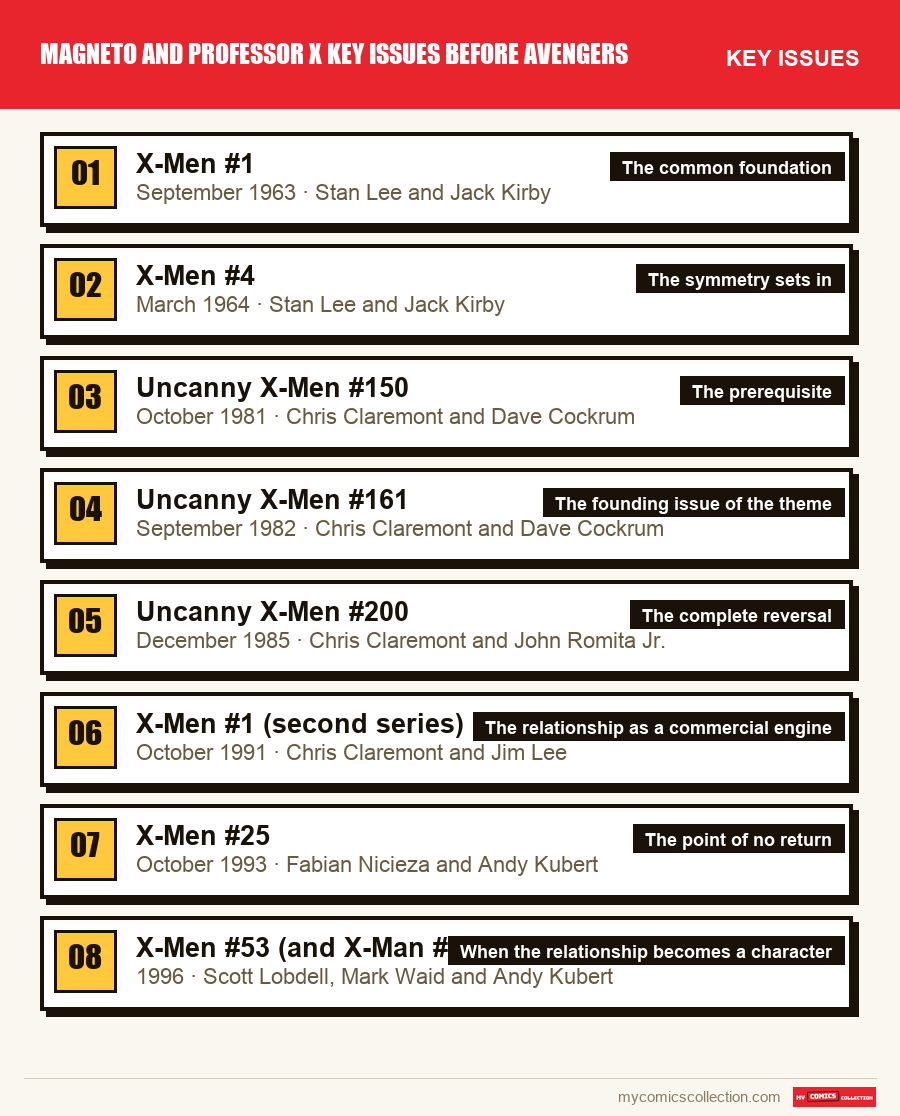
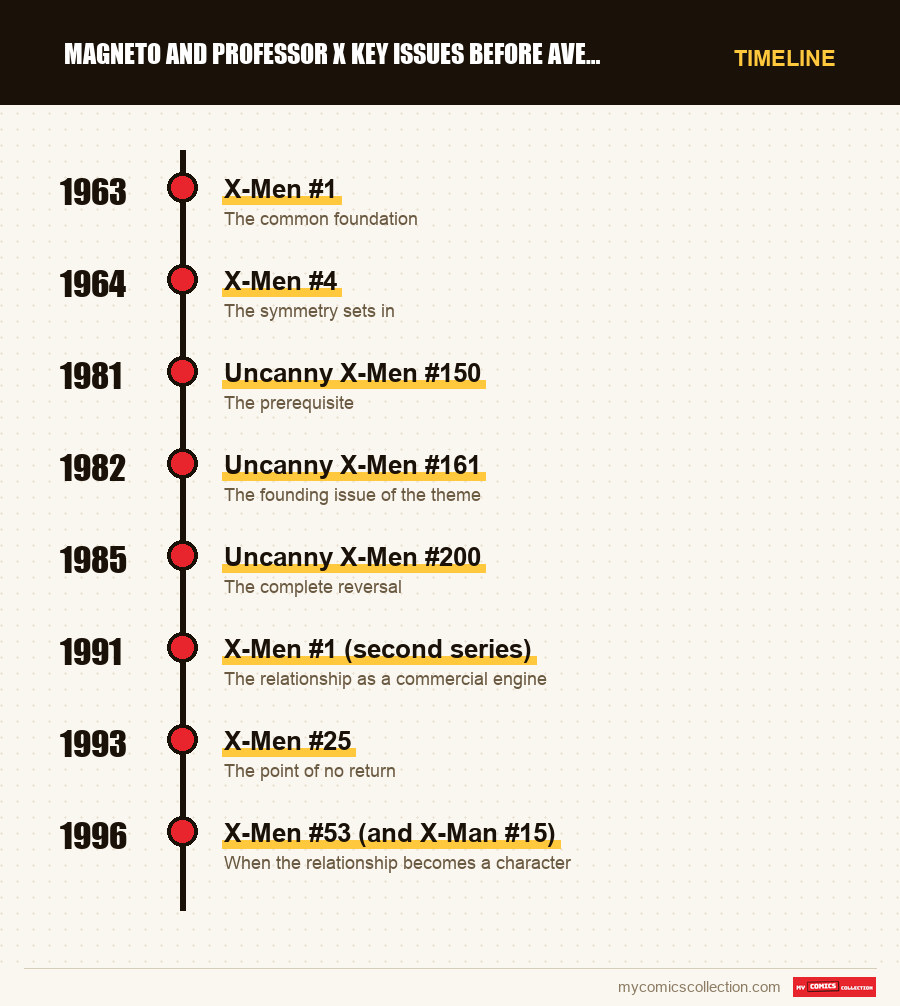
X-Men #1
The same issue introduces the school, the five students, the mentor and the adversary. For a relationship collection, it is a boon and a trap. A boon, because there is no ambiguity about point zero: the bond is born with the franchise, not after. A trap, because you must read this issue for what it really contains, and it contains no shared past. The two men face each other as strangers. Nothing in these pages suggests that they have already met, worked together or been close. The opposition is laid down as a given, in the manner of the time: a mentor, students, an adult threat.
X-Men #4
Six months after the first issue, Magneto stops acting alone and founds his own team. The issue introduces at once the Brotherhood of Evil Mutants, Toad, Mastermind and the future Quicksilver and Scarlet Witch. It is the real moment the relationship becomes a structure rather than a duel: facing a school that trains young mutants, there is now an organization that recruits them. The two men no longer just fight, they run competing institutions with the same talent pool. For anyone collecting the theme, this issue is the indispensable counterpart of the first.
The invention of the shared past, nineteen years later
This is the point most lists miss, and yet it is the most interesting of the file. The earlier friendship, the one the films made obvious, did not exist in 1963. It was added after the fact, by another writer, in another editorial context, and it took two steps to settle in.
Uncanny X-Men #150
In this anniversary issue titled "I, Magneto…," the adversary finally gives the reason for his intransigence. It is there that the reference to his Jewish origins and his childhood in the camps appears on the page for the first time. The effect on the relationship is immediate, even though Professor X is not at the center of the scene: from this issue on, the opposition stops being a disagreement of method between a teacher and a criminal, and becomes a disagreement between two readings of the same fear. The character acquires a reason, and therefore a possibility of being understood. Without this prerequisite, the next issue on our list would make no sense.
Uncanny X-Men #161
This is the issue every collection centered on this bond must own first, and it is also the one almost no key-issue list mentions. Titled "Gold Rush!," it tells in flashback the meeting of the two men well before the school's founding: they work in a psychiatric hospital in Israel that treats survivors of the Holocaust, they become friends, and they end up fighting side by side against the Hydra organization and Baron Strucker when Gabrielle Haller is kidnapped. The issue also provides the first appearance of that character, who matters greatly for the rest of the mutant mythology.
What makes this issue decisive is its status: it does not tell an episode of the relationship, it rewrites it entirely. Before it, two adversaries. After it, two former friends, and each of their past confrontations changes meaning on rereading. It is exactly what cinema will take up twenty years later, and what the public now knows as self-evident.
The shifts of alliance
From the mid-1980s, the two men stop occupying fixed camps. It is the richest period for our theme, and the cheapest to assemble.
Uncanny X-Men #200
"The Trial of Magneto!" puts the adversary on the stand in a courtroom, with Professor X on the defense side alongside Gabrielle Haller. The trial is interrupted by an attack, Xavier is gravely wounded, and before being taken far from Earth he asks Magneto to take his place at the head of the school. Magneto accepts.
No other issue of the series reverses the starting framework so radically. The man against whom the school was founded becomes its director, at the request of its founder. For a relationship collection, it is the narrative peak of the list: everything that follows, including the 2019 refounding, flows from the possibility opened here.
X-Men #1 (second series)
This issue holds the certified record for the best-selling comic in a single edition, with 8.1 million copies, spread across five Jim Lee covers, four of which assemble into a single image. This record has a thematic reading rarely made: to relaunch the franchise at the peak of its commercial power, the publisher did not choose a new character or a new threat, it put the two men face to face again and entrusted it all to the writer who had spent sixteen years building their bond. It is the best available indicator of the value the publisher places on this relationship.
The rupture, and what it engenders
X-Men #25
Everyone knows this issue for a single image: Magneto ripping the adamantium from Wolverine's skeleton. Seen from our angle, the essential lies elsewhere, in the pages that follow. Furious, Professor X mentally erases his former friend and leaves him in a coma. It is the first time Xavier does exactly what he has always reproached others for: using his power on a mind to settle a disagreement. The relationship does not break when Magneto maims an X-Man, it breaks when Xavier gives up his own rule.
X-Men #53 (and X-Man #15)
Three years after the mental erasure, the publisher draws the boldest consequence of this whole story: the anger left in Xavier's mind takes shape and becomes Onslaught, a psionic entity born of the meeting of the two consciousnesses. Literally, the antagonist of Marvel's biggest event of 1996 is the relationship itself, become autonomous and hostile. The character is first named in the series in 1995, glimpsed in shadow in X-Man #15 in May 1996, then shown in a full page in X-Men #53 the following month.
Deaths, returns, and refounding
The last third of the list covers thirty years in four steps, and it has a particularity: each of the two men dies there, and each comes back, but never thanks to the other.
Avengers vs. X-Men #11 (2012): Xavier dies, and not at Magneto's hand
The founder is killed by his first student, under the influence of the Phoenix. This detail matters enormously for our theme: after half a century of opposition, Professor X's death does not come from his designated adversary but from inside his own school. Magneto, at this point in the story, fights on the side of the mutants Xavier is facing. The issue is recent, abundant, and easy to find in very fine condition.
Astonishing X-Men #12 (2018): the return through the astral plane
Six years later, Xavier's mind, held on the astral plane, returns and takes possession of another body. He first has himself called X. It is an inexpensive and little-collected issue, but indispensable to the coherence of a thematic list: without it, the founder present in 2019 comes out of a hat.
House of X #1 (July 24, 2019): the two men on the same side of the table
Jonathan Hickman and Pepe Larraz do what sixty years of stories had made unthinkable: they install Xavier and Magneto as co-founders of a sovereign mutant nation. It is not a truce, it is a merger of projects. One brings the dream, the other the sovereignty, and the two take on the consequences together. For a relationship collection, it is the modern arrival point, and the issue remains clearly more affordable than its importance suggests.
X-Men Red #5 to #7 (2022), then Resurrection of Magneto (2024)
Magneto dies on Mars, his heart torn out by the Eternal Uranos, after having himself destroyed his mental backup to forbid any resurrection. He therefore dies, explicitly, for Xavier's dream, which closes the loop opened in 1963. Two years later, the four-issue miniseries by Al Ewing and Luciano Vecchio brings him back, and it is Storm who goes to get him, not Professor X. An attentive collector will note the symmetry: each of the two has come back without the other.
How to build this collection without going wrong
A thematic list is managed differently from a series. Four principles are enough.
Start in the middle, not at the beginning. Uncanny X-Men #161 and Uncanny X-Men #200 are the two pieces that make the theme exist, and both are accessible. The 1963 X-Men #1 is a long-term goal that conditions nothing: the list already tells its story without it, and it will wait.
Note the role, not just the issue. On a relationship collection, sorting by series is useless. What is useful is being able to reread the list in story order: setup, invention of the past, shifts, rupture, refounding. An issue-by-issue tracking with a label per role makes the collection legible to someone other than you, which is the real test of a built collection.
Distinguish the two markets. The 1963 and 1964 issues belong to the Silver Age market, where certified condition decides the price and where a half-point gap is paid dearly. The issues from 1981 to 1996 belong to the market of abundant print runs, where a fine ungraded copy is almost always the best purchase. Applying the logic of the first market to the second is the most common way to spend twice too much.
Beware of the film calendar. Avengers: Doomsday comes out on December 18, 2026 and Avengers: Secret Wars on December 17, 2027. Between the two, attention will stay high, then fall back. Issues whose value depends on news will move in both directions; those whose value depends on their place in the story, much less. Our reading selection around Doomsday and the update on the date and casting complete this framing.
What the film can change, and what it will not change
Two actors reprise roles they played for another studio, in a distinct cinematic continuity, and it is this return that puts the theme in the spotlight. You have to measure precisely what that implies for a collection.
What the film can change: the general public's attention, therefore demand for issues already identified as central, therefore lead times and prices on copies in very fine condition. It is mechanical and short-lived.
What the film will not change: the place of Uncanny X-Men #161 in the making of this relationship, nor the fact that the earlier friendship is an addition from 1982. An issue does not become more important because an actor returns. It only becomes more expensive, and sometimes harder to find in the condition you are looking for.
A caution must be added. We are before the release, and the real role of the two characters in the script is not known. An announced return can turn out to be a few minutes of screen time. If the list above holds, it is not because it anticipates the film, it is because it describes what was published. It is the only solid basis a collector has at this date. For the editorial background of the character himself, the article on the history of Magneto and the selection of key issues devoted to him take over, as do the Magneto hub and the X-Men hub.