To read Roger Stern, open Triumph and Torment first, the 1989 album where Doctor Strange faces Doctor Doom under Mignola's pencil. Then move on to Amazing Spider-Man #229 and #230 (the Juggernaut), then the Hobgoblin from #238, the Avengers "Under Siege" arc (#270 to #277), the rest of the Avengers run, and finally Captain America, Doctor Strange and the forays at DC. The order goes from the self-contained story to long-haul reading.
Roger Stern never had the flashy reputation of some contemporaries, and that is precisely what makes the work hard to approach: no title bears the writer's name, no "Stern saga" is displayed in a shop window. Yet at the turn of the 1980s, the writer held three of Marvel's most-read series. This guide does not tell a life story, it sorts the stories so that your first read lands on the right chapter.
As always in this guide, only verified information (creators, issues, dates) is stated as fact; the analysis is our own, with no reproduction of protected pages or dialogue.
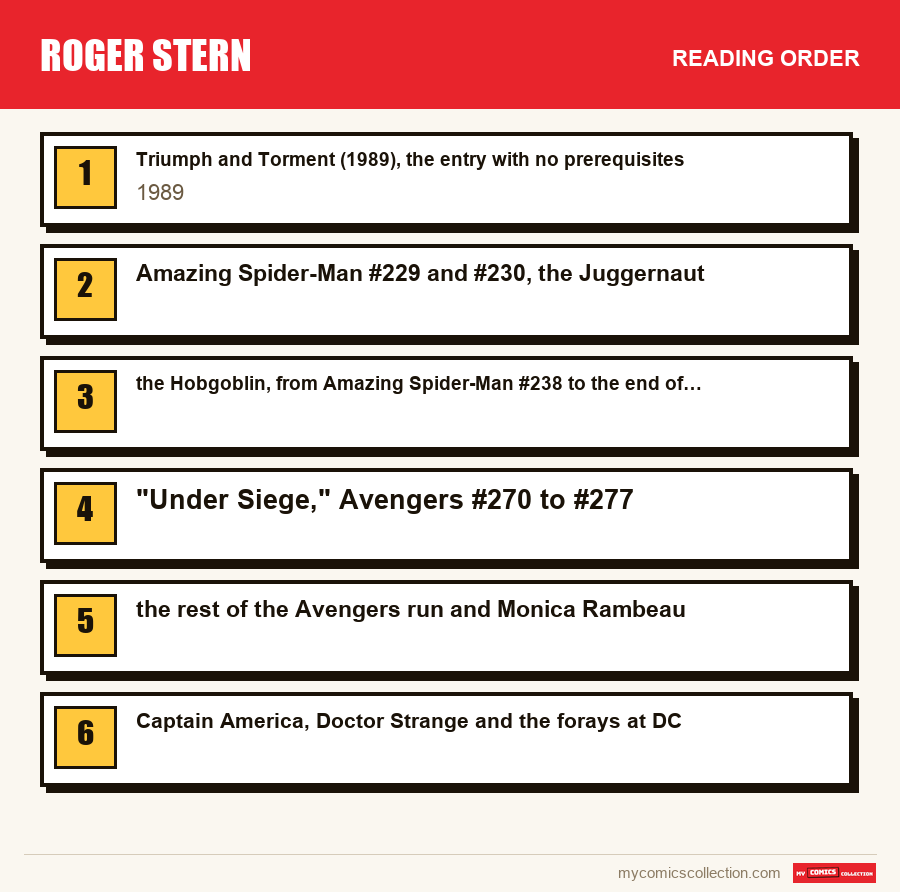
Step 1: Triumph and Torment (1989), the entry with no prerequisites
Triumph and Torment appeared in 1989 as a graphic novel: the text is Stern's, the pages are Mike Mignola's, and the duo brings together the Sorcerer Supreme and the master of Latveria. It is the best way in, for a structural reason: it begins and ends in the same volume. No continuity to catch up on, no previous issue to hunt down. The Sorcerer Supreme and the monarch of Latveria make a pact to go and wrest a soul from hell, and the story reads like a duel of courtesy between two prides.
What it teaches about Stern's writing comes down to one idea: characters speak according to their rank. Doom never lowers himself, Strange is never intimidated, and the tension arises from each knowing what the other thinks without the text needing to explain it. If this measured rhythm pleases you, you will like the rest of the work. If it bores you, better to know before investing in a long series.
For collectors, the book exists as a hardcover album and as a softcover collection, and there are no single issues to gather: it is one of the rare cases where the original form is already a volume. Doctor Doom fans will find a complement in our ranking of Doctor Doom runs, where this story naturally belongs.
Step 2: Amazing Spider-Man #229 and #230, the Juggernaut
The second rung is deliberately short: two issues of Amazing Spider-Man, drawn by John Romita Jr., that pit the hero against the Juggernaut in the "Nothing Can Stop the Juggernaut" arc. The story has a rare quality for a brute-force showdown: it poses a problem Spider-Man cannot solve with muscle, and the outcome rests on cunning rather than power. This is pure Stern, where the hero's intelligence is the real engine.
Why not start with #224, the beginning of the writer's run on the series? Because those introductory issues assume you know Peter Parker's life in the early 1980s, his jobs, his relationships, his supporting cast. The Juggernaut two-parter reads without knowing any of that, and it gives a reliable sample of Stern's manner in a single evening.
In single issues, these two numbers are easy to find and remain among the most affordable of the period. If you prefer collected editions, the two-parter appears in the volumes devoted to the Stern era of Amazing Spider-Man. Our Spider-Man reading guide places this period relative to the title's other great eras.
Step 3: the Hobgoblin, from Amazing Spider-Man #238 to the end of the run
With issue 238, dated March 1983, Stern and Romita Jr. launch a new adversary, the Hobgoblin, whose face is hidden under a mask and whose identity remains to be discovered. The idea is highly economical: a criminal who takes up the Green Goblin's weapons without being him, and whose voice, purchases and alliances leave everyone free to guess who hides behind the mask. The riddle sells the series for years and fuels debates among readers well after Stern's departure.
The reading runs continuously, from #238 to the last issues signed by Stern around #252, which marks the end of the run. You have to accept that the riddle is not solved by its creator on the series: the revelation comes later, under another pen. Stern would return to the character much later with a 1997 miniseries, Hobgoblin Lives, drawn by Ron Frenz, which we come back to in step 6.
For the collector, this is the most coveted rung of the path. #238 is the first appearance of the Hobgoblin, and the issues around it benefit from its fame. We detailed the issue in our Amazing Spider-Man #238 profile and the character in the ranking of Green Goblin runs. Read first, collect afterward: the value of these single issues is better appreciated once you know the plot's place.
Step 4: "Under Siege," Avengers #270 to #277
This is the summit of the reading, and the reason Stern is still cited in conversations among fans. Baron Zemo assembles a team of Masters of Evil and seizes Avengers Mansion. For eight issues, from 1986 to 1987, the base that has served as a quiet backdrop for twenty years becomes a battlefield. John Buscema, inked by Tom Palmer, draws this arc.
The dramatic principle is simple and relentless: the heroes defend their own home, and every room they lose is one the reader knew. The role of the butler Jarvis, whom we had never seen from this angle, gives the whole a human dimension. Stern conducts the eight episodes like a siege: rising pressure, loss of ground, counterattack.
Can you read this arc without knowing the rest of Avengers? Yes, with one caveat: it is better to know who is who on the team of the day, and our Avengers reading guide gives the list in a few lines. The "Under Siege" collected edition is easy to find and gathers all eight issues at once, which is the best format for an arc designed as a block.
Do you collect this series?
Track what you own, what you are missing and what your collection is worth. 7-day trial.
Start my trial →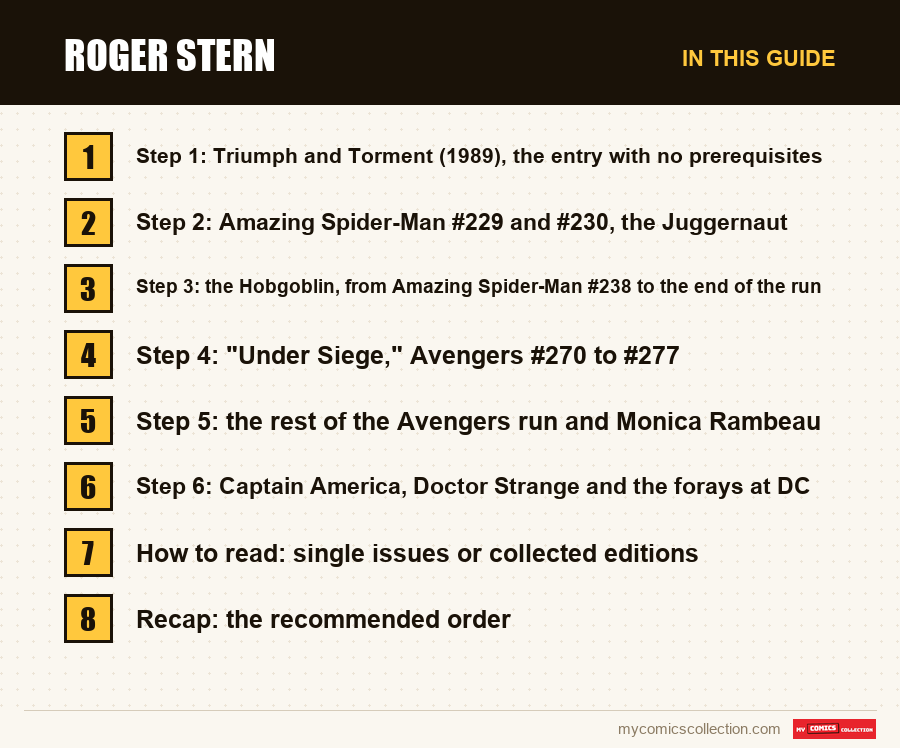
Step 5: the rest of the Avengers run and Monica Rambeau
If "Under Siege" has convinced you, work back up the thread. Stern takes the helm of Avengers at issue 227, dated January 1983, and keeps the series until 1987. The series sees Monica Rambeau settle in, created with John Romita Jr. in Amazing Spider-Man Annual #16 (1982), then promoted to Captain Marvel. Issue 279 sees her elected to lead the team: a milestone that fans of the heroine, now known as Photon, do not miss. Our article on Monica Rambeau details these issues.
Stern also launches, in 1984, a West Coast Avengers miniseries that gives birth to a satellite team based in Los Angeles. The regular series that follows will later pass to other hands. This step requires more patience than the previous ones: you are reading a long-haul series, with plots that answer one another from issue to issue, without a single big arc to carry everything.
In single issues, the period is affordable overall, except for Annual #16, sought after for the first appearance of Monica Rambeau. In collected editions, the Stern era of Avengers is published in chronological volumes, which makes continuous reading more comfortable than hunting for isolated issues.
Step 6: Captain America, Doctor Strange and the forays at DC
The last step gathers what lies off-center. At Marvel, first, Captain America #247 to #255, from 1980 to 1981, where Stern reunites with John Byrne on art for a short run that Captain America fans cite as one of the most successful of the series. The two-parter in #253 and #254 pits the hero against Baron Blood. Our Captain America reading guide places these issues in the series.
Next, the Doctor Strange run in the 1980s, with Marshall Rogers on art. It is a run appreciated by connoisseurs, best approached after Triumph and Torment, since it explains the power dynamics. Sources diverge on the exact issues at the start and end of this run, so we prefer not to list them: check the writer's credit before you buy.
Finally, two curiosities. The miniseries Hobgoblin Lives (1997), mentioned above, returns to the mystery that made the character famous. And at DC, Stern wrote Starman in 1988, with Tom Lyle, and was part of the team of writers brought together for The Death of Superman in 1992 and 1993. These reads are for those who have already exhausted the previous steps and want to gauge the breadth of the craft.
How to read: single issues or collected editions
It all depends on the story you are aiming for. The most compact stories, Triumph and Torment and "Under Siege," are best read in collected form: the first exists in no other way, the second fits in eight issues that read better in one go. The Juggernaut two-parter and the Hobgoblin series read just as well in single issues, whether period copies or reprints, as long as you do not skip any.
For the long periods, like Avengers from 1983 to 1987, chronological collected editions spare you the hunt for missing issues and put the episodes back in publication order. Keep single issues for those that are also keys, like Amazing Spider-Man #238. If you are building a Spider-Man collection, our Amazing Spider-Man collecting guide gives the landmarks of the period.
One last precaution: these series have been widely reprinted. A single issue presented as "period" must show the indicia and the advertising of the year in question. And if you discover a copy of #238 in an inherited box, have it graded or appraised before any decision: the free appraisal exists precisely for that.
Recap: the recommended order
Here is the path in one list, from the most accessible to the most demanding.
- Triumph and Torment (1989): a complete story, no prerequisites, drawn by Mignola.
- Amazing Spider-Man #229 and #230: the Juggernaut, in two issues.
- Amazing Spider-Man #238 to the end of the run: the Hobgoblin and the riddle.
- Avengers #270 to #277: "Under Siege," the summit of the path.
- Avengers from #227 to 1987: the complete run, with Monica Rambeau.
- Captain America, Doctor Strange, DC: the side trips for readers who want to see everything.
If you only have one evening, read step 1. If you have a weekend, add steps 2 to 4. The rest is for those who like series that reveal themselves slowly.
Frequently asked questions
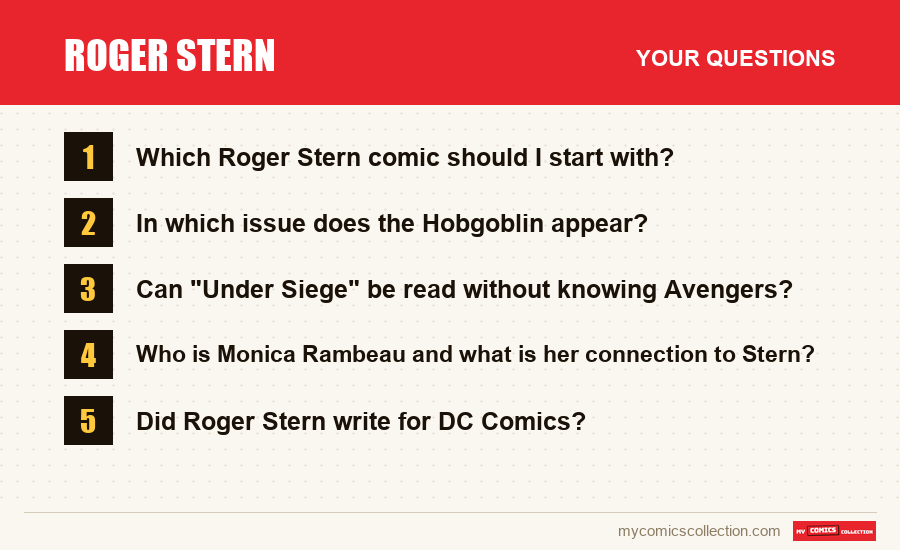
Open Triumph and Torment, the 1989 album that pits and then allies Doctor Strange and Doctor Doom, drawn by Mike Mignola. It is a complete graphic novel, with no prior reading to plan. If the style suits you, move on to Amazing Spider-Man #229 and #230, then the Hobgoblin from #238.
It is in issue 238 of Amazing Spider-Man, dated March 1983, that Stern and Romita Jr. introduce the character. The Hobgoblin is presented under a mask, and the identity remains a mystery that Stern sustains until leaving the series. This debut explains why that issue is the most coveted of the entire period.
Yes, the arc in issues 270 to 277 (1986-1987) is designed as a block: Baron Zemo and his Masters of Evil seize the mansion. It is enough to know the names of the main Avengers of the day, which our reading guide recalls. The "Under Siege" collected edition gathers all eight issues at once.
Monica Rambeau was born from Stern's pen and Romita Jr.'s pencil, in Amazing Spider-Man Annual #16 (1982). Having become Captain Marvel, she joins the Avengers when Stern takes over the series, and Stern then has her elected to lead the team in issue 279. She now goes by Photon.
Yes. Roger Stern wrote the Starman series in 1988, with Tom Lyle on art, and was part of the team of Superman-title writers brought together for The Death of Superman in 1992 and 1993. These reads come after the core of the Marvel work.
Is an Amazing Spider-Man #238 or an Avengers from the Stern era lying around in your boxes? Appraise it according to its real condition before keeping or selling it.
Appraise my comic