
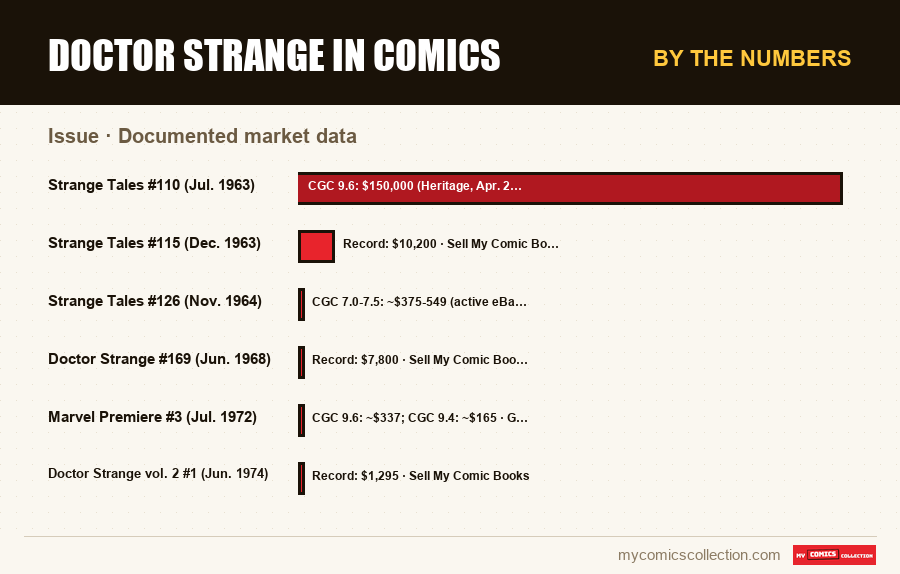
The single most essential Doctor Strange collectible is Strange Tales #110 (July 1963), the character's first appearance: a CGC 9.6 copy reached $150,000 at Heritage Auctions on April 7, 2024, a record confirmed by GoCollect. Our eBay estimation tool does not index the Strange Tales , Doctor Strange , or Marvel Premiere series: no eBay median from that tool is cited in this guide.
Doctor Strange was born in 1963 from the combined imagination of Steve Ditko and Stan Lee, appearing as a backup feature in Strange Tales, an anthology title that also hosted the Human Torch and later Nick Fury. Ditko brought the core concept, a broken surgeon who turns to the mystic arts, and Lee scripted it. What made the character immediately distinctive was Ditko's artwork: hallucinatory alternate dimensions, impossible geometries, a dreamlike atmosphere that had no equivalent anywhere in comics at the time. Doctor Strange is a Silver Age character (1963), which means his key issues span three collecting eras (Silver Age, Bronze Age, and Modern Age) with accessible entry points at every budget level.
This guide walks you through the character's essential reading in chronological and editorial order, from Ditko's first five pages through Jason Aaron's contemporary run, with a close look at the celebrated Steve Englehart and Frank Brunner renaissance of the 1970s. All market figures cited are drawn from verified sources (Heritage Auctions, GoCollect, Sell My Comic Books, ComicConnect); where no public number could be confirmed, we stay qualitative.
Key issues by era
Before diving into the runs worth reading, here are the issues whose collector value is documented. This site's eBay tool does not cover these series: all data below comes exclusively from auction houses and specialist aggregators.
| Issue | Significance | Documented market data |
|---|---|---|
| Strange Tales #110 (Jul. 1963) | 1st appearance of Doctor Strange, Ancient One, Wong, Nightmare | CGC 9.6: $150,000 (Heritage, Apr. 2024) · confirmed by GoCollect |
| Strange Tales #115 (Dec. 1963) | Doctor Strange origin story: first mention of Dormammu | Record: $10,200 · Sell My Comic Books |
| Strange Tales #126 (Nov. 1964) | 1st appearance of Clea and Dormammu | CGC 7.0-7.5: ~$375-549 (active eBay market); no high-grade public record found |
| Doctor Strange #169 (Jun. 1968) | 1st issue under the solo title: Strange Tales renamed | Record: $7,800 · Sell My Comic Books; CGC 9.8: $13,100 (ComicConnect, Sep. 2022) |
| Marvel Premiere #3 (Jul. 1972) | Bronze Age relaunch: art and plot by Barry Windsor-Smith, script by Stan Lee | CGC 9.6: ~$337; CGC 9.4: ~$165 · GoCollect |
| Doctor Strange vol. 2 #1 (Jun. 1974) | New solo series, Englehart/Brunner: 1st appearance of Silver Dagger | Record: $1,295 · Sell My Comic Books |
Sources: Heritage Auctions, GoCollect (Chartbusters blog, Apr. 2024), Sell My Comic Books, ComicConnect. This site's eBay tool does not cover the Strange Tales, Doctor Strange, or Marvel Premiere series.
Starting point 1: Steve Ditko (Strange Tales #110-146, 1963-1966)
The ideal reading journey starts where everything did: Strange Tales #110, five pages of Ditko that immediately establish the character's visual vocabulary: astral projection, the Sanctum Sanctorum, the Eye of Agamotto. Ditko draws these stories with a formal freedom that had no precedent in superhero comics: alternate dimensions are hallucinatory geometric spaces, without horizon or gravity. It is no coincidence that Tom Wolfe, in The Electric Kool-Aid Acid Test, describes Ken Kesey absorbed in Ditko's Doctor Strange pages with obvious fascination.
The essential issues in this run are #110 (first appearance), #115 (origin story, with the first mention of Dormammu), and the #130-146 block known as "The Eternity Saga": a seventeen-part epic in which Strange is hunted simultaneously by Baron Mordo and Dormammu, and one of the great narrative constructions of the Marvel Silver Age. The challenge with this era is price: high-grade copies are out of reach for most budgets. Copies in VG (4.0) to FN (6.0) condition, however, remain attainable and deliver the complete reading experience.
Starting point 2: Englehart and Brunner (Marvel Premiere #9-14, Doctor Strange vol. 2 #1-18, 1973-1976)
If the Ditko Silver Age run is the foundation, the Steve Englehart and Frank Brunner run across Marvel Premiere and then the new solo series is universally regarded as the character's absolute peak. Englehart, who researched actual occultism to write these stories, introduced a new philosophical dimension to Strange's adventures. Frank Brunner inherited Ditko's legacy with a different but equally ambitious style: composite page layouts, symbolically charged colors, and theatrical staging.
The essential episodes: Marvel Premiere #10 (death of the Ancient One, battle against Shuma-Gorath) marks the symbolic transfer of power that makes Strange the Sorcerer Supreme in full. Marvel Premiere #12-14 (the "Sise-Neg Genesis" cycle, featuring a 30th-century sorcerer traveling back to the moment of Creation) was so audacious that Stan Lee requested a published retraction in the following issue. The solo series Doctor Strange vol. 2 #1 (June 1974), with its Brunner cover and interiors, continues the storyline directly: the A Separate Reality trade paperback collects both series into a single coherent volume. This is the ideal entry point for anyone seeking a complete, affordable run to read.
Starting point 3: Jason Aaron and Chris Bachalo (Doctor Strange vol. 4, 2015-2017)
For the modern reader who wants a recent and self-contained series, the Jason Aaron and Chris Bachalo run (October 2015: June 2017, twenty issues plus an annual) is the perfect entry point. Aaron reimagines the character's constraints with an original angle: using magic has a concrete physical and psychological cost. Strange cannot eat non-magical food; his body carries the accumulated scars of decades of occult battles. The first arc, "The Way of the Weird" (#1-5), resets these foundations; the second, "The Last Days of Magic," pits Strange against a technological threat bent on eradicating magic from the Marvel universe entirely.
Chris Bachalo delivers some of his freest artwork here: fragmented panel layouts, saturated colors that deliberately evoke Ditko's aesthetic without imitating it. The first nine issues are consistently cited as the collaborative high point. The run is fully available in trade paperback and omnibus formats, making it the most financially accessible entry into the character for a new reader.
Other runs worth knowing
Between these three pillars, several sequences reward the serious collector. Roger Stern took over the character from 1978, producing a sustained long-form run that includes a six-issue confrontation with Dracula (#58-62) using the Montessi Formula: one of the series' great plotlines. Brian K. Vaughan and Marcos Martin produced The Oath (2006-2007, five-issue mini-series), unanimously cited as the finest standalone Doctor Strange story: Strange must find a cure for Wong's cancer, and the narrative interrogates his dual identity as physician and sorcerer. Doctor Strange: Triumph and Torment (1989, Roger Stern and Mike Mignola) is a graphic novel pairing Strange with Doctor Doom that appears on virtually every list of the best Marvel comics of the 1980s.
The MCU's effect on collector values
Marvel Studios' cinematic adaptation of Doctor Strange, with Benedict Cumberbatch as Stephen Strange, substantially amplified collector interest in Silver Age issues. Doctor Strange (2016) grossed $676.3 million worldwide; Doctor Strange in the Multiverse of Madness (2022) reached $955.8 million, making Strange one of the rare Marvel solo characters to approach $1 billion at the box office. His presence across Avengers: Infinity War , Endgame , and Spider-Man: No Way Home (2021) further embedded the character in mainstream culture. That sustained exposure is directly legible in the auction market: the $150,000 record for the CGC 9.6 of Strange Tales #110 in April 2024 reflects steady demand at the very top of the grade scale.
Own a Doctor Strange comic? Get a free valuation with our tool based on real eBay sales to find its low, median, and high value.
Frequently Asked Questions
Strange Tales #110 (July 1963) is the absolute entry issue: the character's first appearance, with the Ancient One, Wong and Nightmare. Doctor Strange was born from Steve Ditko and Stan Lee, with Ditko supplying the concept and Lee the script. In high grade this issue is out of reach for most budgets, hence the value of reading the runs first.
Strange Tales #110 for the first appearance, #115 for the origin with the first mention of Dormammu, and the #130-146 block, known as The Eternity Saga. This seventeen-episode epic has Strange hunted by both Baron Mordo and Dormammu. It is one of the great narrative constructions of the Marvel Silver Age.
In Strange Tales #126 (November 1964), the first appearance of Clea and Dormammu. Dormammu had already been alluded to in #115. It is an important intermediate key between the origin and Ditko's great sagas.
With Doctor Strange #169 (June 1968), the first issue under the solo title: Strange Tales was renamed. A new solo series then starts with Doctor Strange vol. 2 #1 (June 1974), by Steve Englehart and Frank Brunner, which contains the first appearance of Silver Dagger.
Marvel Premiere #3 (July 1972) relaunches Doctor Strange in the Bronze Age, with art and plot by Barry Windsor-Smith and a script by Stan Lee. It opens the 1970s renaissance, continued by Englehart and Brunner. It is a more accessible entry than the Silver Age issues.