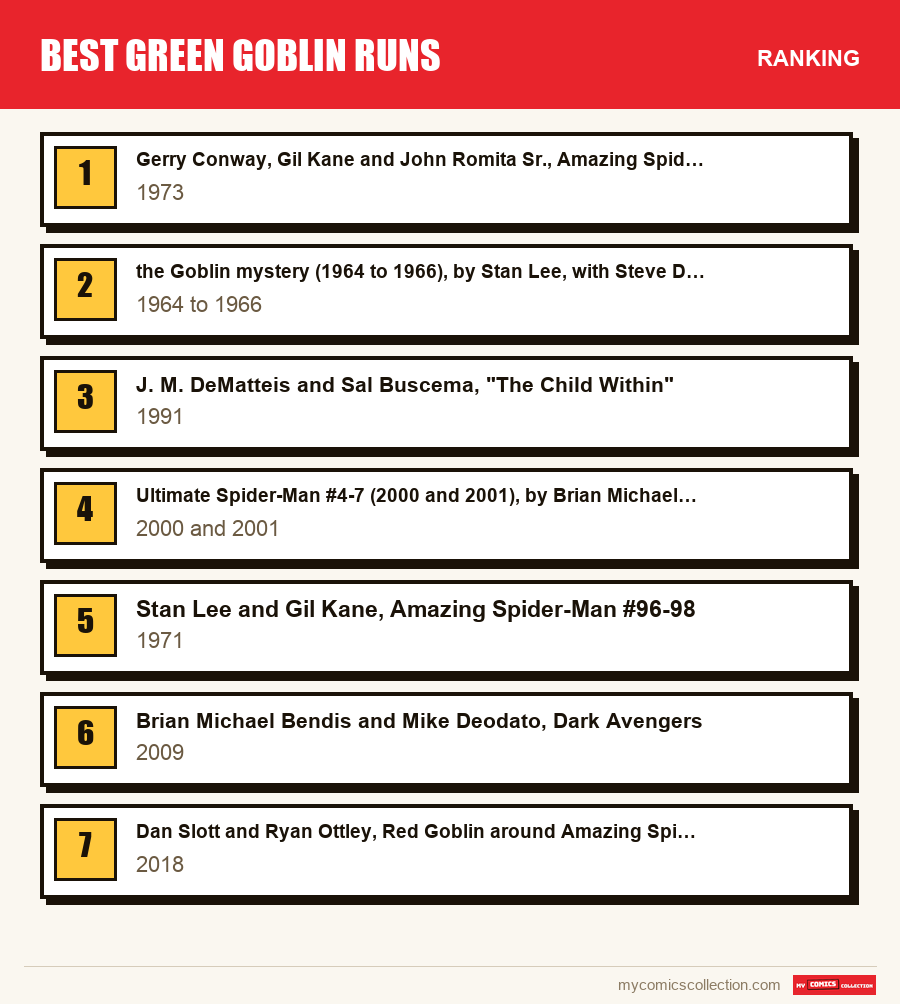
The best Green Goblin run is the two-part story by Gerry Conway, Gil Kane and John Romita Sr. in Amazing Spider-Man #121-122 (1973). It edges out the mystery Stan Lee wove from 1964 to 1966 (scripted by Lee, with Steve Ditko and then John Romita Sr. on art) and "The Child Within" by J. M. DeMatteis and Sal Buscema (1991). This ranking covers seven sets of issues, from the Silver Age to Red Goblin, with the format we suggest for each.
No monthly series carries the Green Goblin's name. His career unfolds inside the Spider-Man titles, in waves of a few issues, and passes from hand to hand: Norman Osborn first, his son Harry next, then Norman again with each relaunch. Ranking his "best runs" therefore means isolating specific sequences across three or four different series. This guide orders them by quality, not by publication date, which sets it apart from our reading path, which follows chronology.
As always in this guide, we state only verified facts (creators, issue numbers, dates); the analysis is our own, with no reproduction of protected artwork or dialogue.
How to rank a character with no series of his own
We asked each candidate one question: is the Green Goblin the subject of the story, or only its backdrop? One more fight with Spider-Man is not enough. The sequence has to change something in Osborn, or alter what the character means to the writers who come after. Two secondary criteria broke the ties: readability without prior knowledge, and how easy it is to get hold of the complete sequence today.
This ranking deliberately ignores what the single issues sell for. The first appearance, in Amazing Spider-Man #14, remains the most coveted issue on this list; yet it does not open this reading ranking, because it sets up a mask without yet telling the story of a man. On collecting, see the end of the article.
Rank 1: Gerry Conway, Gil Kane and John Romita Sr., Amazing Spider-Man #121-122 (1973)
The two-parter runs across two issues of the flagship title. The Green Goblin, Norman Osborn once again lucid, goes after Peter Parker's circle rather than the hero himself, and the story closes, in the second issue, on the Goblin's fate. Gerry Conway writes, Gil Kane pencils both issues, and John Romita Sr. inks them with Tony Mortellaro.
Why this pair of issues matters: it breaks the unspoken rule that the hero always arrives in time. For the first time, a loss is written into continuity and not undone in the next issue. The writers who return to the Green Goblin, decades later, all work from what these two issues fixed in place. We cover the first issue in a dedicated article on Amazing Spider-Man #121 and the second in the one on Amazing Spider-Man #122.
No prerequisites here: even someone who has never opened another Spider-Man comic will find their footing, since the story stands on its own. For collecting, there are two routes. The original two issues are the collector's piece; the collected edition, folded into volumes devoted to the Conway era, reads comfortably and keeps the full text. For the writer's biography, see the Gerry Conway page.
Rank 2: the Goblin mystery (1964 to 1966), by Stan Lee, with Steve Ditko and then John Romita Sr.
The sequence starts with Amazing Spider-Man #14 in 1964 and ends with #39-40 in 1966. In between, the Green Goblin returns on and off, masked, and the question of his identity stays open. Steve Ditko draws the first part, including the debut appearance that we detail in our entry on Amazing Spider-Man #14; John Romita Sr. takes over the pencils for the reveal. Norman Osborn's identity is unveiled in this second half.
What gives the run its value is its length: two years of suspense at the rhythm of a monthly serial, with no way for the readers of the day to know who was under the mask. No other Spider-Man antagonist has had such a buildup. For a reader in 2026, the trade-off is the style: frequent explanatory captions, heavily emphasized dialogue. It reads better in small doses.
It is meant for those who want to know where the character began. For collecting, mind one quirk: the episodes are scattered through the series, so chronological collections of the Lee and Ditko era are more practical than hunting down nine separate issues. That way you keep the in-between episodes, which the #14 and #39 pairing alone would leave out.
Rank 3: J. M. DeMatteis and Sal Buscema, "The Child Within" (1991)
This early-1990s arc appears in Spectacular Spider-Man, issues 178 to 184. It sets Norman aside to focus on Harry Osborn, who takes up his father's identity and struggles with it. J. M. DeMatteis delivers a story about inheritance and mental health; Sal Buscema draws it with a restraint that serves the subject.
This is where the Green Goblin stops being a villain and becomes a family burden. The run shifts the interest from action to psychology, and it makes Harry sympathetic where other stories show him as a threat. It speaks to readers who like family tragedy more than combat, and to anyone who wants to understand why the Osborn name weighs so heavily in Spider-Man mythology.
On format, go for the collected edition if you want to read it in one sitting: the arc is short and self-contained. The original issues are easy to find, since 1990s output was abundant, which makes this a reader's purchase rather than a speculator's. The natural follow-up is Harry's conclusion, in Spectacular Spider-Man #200 (1993).
Rank 4: Ultimate Spider-Man #4-7 (2000 and 2001), by Brian Michael Bendis and Mark Bagley
In the Ultimate line, the parallel universe launched in 2000, Bendis and Bagley rewrite the adversary. Norman Osborn is reimagined for a new audience, and his clash with Peter Parker fills issues 4 to 7. The story gives the Goblin a different face without betraying the original idea: a family man whose ambition has turned pathological.
This run matters because it proves the figure works outside the main continuity. It suits recent readers, who will find an entry point here without the sixty years of history behind the classic version. A useful reminder: this is not the same character as in the Amazing and Spectacular titles, so some of the collecting landmarks do not apply. See our page on Brian Michael Bendis to place the writer. On format, the first collected volumes of the series reprint these issues in a single book, and that is the format we advise.
Do you collect this series?
Track what you own, what you're missing and what your collection is worth. 7-day trial.
Start my trial →
Rank 5: Stan Lee and Gil Kane, Amazing Spider-Man #96-98 (1971)
Three issues of the flagship title whose reputation does not rest on the Green Goblin alone. Stan Lee tackles Harry Osborn's drug addiction, at the request of a US government agency, and does so without the approval of the Comics Code Authority, which makes it a moment in publishing history. The Green Goblin enters through the Osborn bloodline, and Gil Kane draws the whole thing.
It lands in fifth place because the Goblin is not its only subject: people read it as much for the break with the Code as for the character. But it explains the family turn that will make Conway's two-parter possible two years later. It is for the collector curious about the industry's history. For collecting, the value of these issues reflects the publishing event first, the character second.
Rank 6: Brian Michael Bendis and Mike Deodato, Dark Avengers (2009)
After the events of Secret Invasion, Norman Osborn takes charge of America's security apparatus and assembles his own team of Avengers. He dons an armor inspired by Iron Man and Captain America, the Iron Patriot, and the Green Goblin becomes an inner voice rather than a costume. Bendis writes, Mike Deodato draws the series that opens the period known as Dark Reign.
This run moves the character out of New York and away from Spider-Man. Osborn is a man of power here, not a night hunter, and the tension comes from one question: how long will the public man's mask hold? It speaks to Avengers readers as much as Spider-Man ones, and it requires a minimum of background on Secret Invasion. Collected editions are more practical than single issues here, because the series depends on satellite titles. Our page on the best Spider-Man runs helps place this moment.
Rank 7: Dan Slott and Ryan Ottley, Red Goblin around Amazing Spider-Man #800 (2018)
In the last major sequence on the list, Norman Osborn merges with the Carnage symbiote and becomes the Red Goblin. Dan Slott writes, Ryan Ottley draws the anniversary issue. The story blends the Goblin lineage with the symbiote one, and closes a long stretch during which Slott steered the series.
It counts for its attempt to renew the character without erasing his origins, but it stays at the bottom of the list because it assumes you know the series that came before. It is for readers who followed Amazing Spider-Man through the 2010s. A 2018 issue does not yet have a stable market value: how it moves will depend on lasting interest in Osborn, reprints and variant covers, on which we put no numbers, for lack of reliable data. For reading, a collected edition is the better route.
Which one to start with, depending on your profile
You're new to the character. Read the Conway and Kane two-parter (#121-122): it is self-contained, short and devastating, and it gives you the measure of what the adversary represents. Then work back to the Lee and Ditko mystery to see how the mask was born.
You like family drama. "The Child Within" is your read, with #96-98 as a historical prelude.
You prefer the modern world. Ultimate Spider-Man #4-7 if you want a fresh entry, Dark Avengers if power stories appeal to you, Red Goblin for a blockbuster approach.
You collect first and foremost. Start from the 1960s and 1970s single issues, then add collected editions for the recent periods. Our list of key issues helps you set priorities.
What these runs are worth as a collection
These seven sets do not follow the same logic, and that is the first thing to understand. The 1960s and 1970s sequences are decided by the condition of the issues: yellowed paper, split spines, faded covers. For them, the gap between a sound copy and an average one is wide, and the grade makes the difference. The 1990s and 2000s sequences were so widely distributed that the gap narrows; the reader gains, the speculator loses.
The valuation method is the same everywhere. First pull up completed sales for the issue and grade that concern you, then compare them with current listings: the gap shows whether the market is tight or slack. An issue that turns up every week does not trade like one that vanishes from the shelves for months. For the 1971 and 1973 episodes, also check for a restoration trim and the crispness of the staples; these flaws, invisible in a front-facing photo, change the outcome.
Two traps recur. The first is mistaking the original issue for a later printing or a reprint that reuses the cover: read the indicia and the barcode. The second is paying the price of a key issue for an in-between issue of the same run. In the 1964-1966 mystery, only #14 and #39-40 carry the premium; the issues in between remain reading copies.
Finally, keep an item-by-item inventory: single issue and collected edition are two separate lines, each with its date and page count. This precaution makes your valuation reliable and keeps you from counting the same story twice.
Frequently asked questions
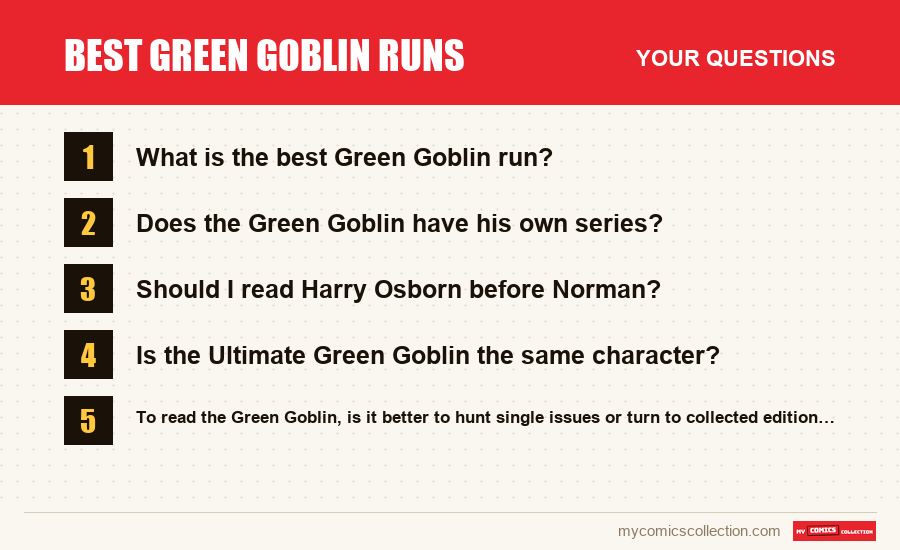
The two-part story by Gerry Conway, Gil Kane and John Romita Sr. in Amazing Spider-Man #121-122 (1973). It fixes a permanent loss in the series and serves as the reference for later writers. The Stan Lee and Steve Ditko mystery (1964-1966) comes second, for the way its suspense is built.
Not over the long term. The character lives in the Spider-Man titles and, now and then, in teams such as the Dark Avengers in 2009. Hence the choice of short sequences, a few issues each, instead of whole series.
No. The two lineages can be read separately. If you want to understand why Harry wears the mask, read the 1973 two-parter first, then "The Child Within" by DeMatteis and Buscema (1991), which explores his path in depth.
No: it is a parallel-universe variant, launched in 2000 under the Ultimate label, with Brian Michael Bendis writing and Mark Bagley drawing. It rewrites Norman Osborn without carrying over classic continuity, which makes it a simple entry point, but not a substitute for the issues of the main series.
It depends on the era. The original 1960s and 1970s issues are the collector's pieces, while the collected edition serves reading better. For the sequences from 2000 on, collected editions give you the complete read with far less wear and tear from handling.
Found an Amazing Spider-Man from the 1960s or 1970s in your boxes? Get its condition and market value estimated.
Estimate my comic