
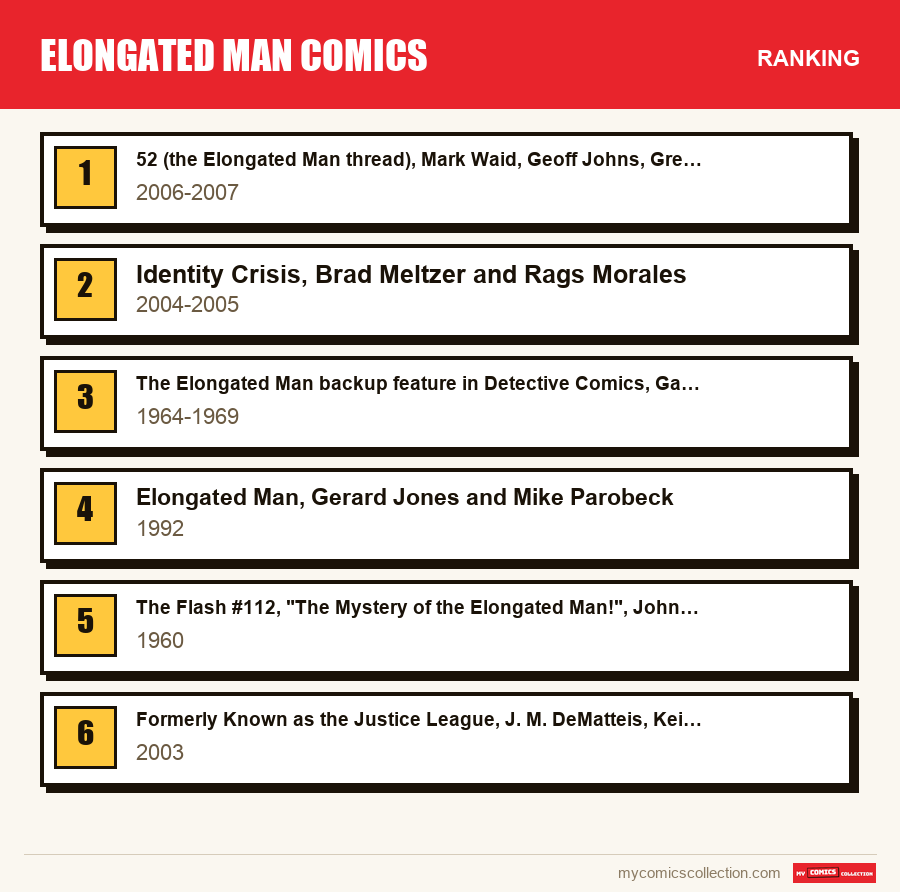
To read the best Elongated Man comics, Ralph Dibny, start with 52 (2006-2007), where his quest to get his wife back fills one of the main threads of the weekly series. It is best to arrive there after the 2004 miniseries by Brad Meltzer and Rags Morales, Identity Crisis, which sets it up. The lighthearted Detective Comics adventures of the 1960s and the 1960 source, The Flash #112 by John Broome and Carmine Infantino, come after.
Ralph Dibny is a rare case in Justice League history: a hero whose cheerfulness was long his whole identity, until a loss gave him a gravity nobody expected of him. An amateur detective and a devoted husband, he stretches like rubber and solves mysteries alongside his wife Sue. The contrast between these two eras is what makes his bibliography so interesting. Six reads are picked below: each comes with what it adds for Ralph, an audience and a reading order.
As always in this guide, we only state verified facts (creators, issue numbers, dates); the analysis is our own, with no reproduction of protected art or dialogue.
His first appearance
Ralph Dibny shows up in The Flash #112, dated 1960, as a guest in the lead story, "The Mystery of the Elongated Man!" John Broome writes, Carmine Infantino pencils and Joe Giella inks, under the direction of Julius Schwartz. The issue also contains a second Flash story: the book is therefore a double bill, but it is the first story that introduces the stretching man.
This first outing reads like a business card: Ralph is a guest in a Flash adventure, with a power that comes from a gingold drink. Broome and Infantino give him right away the temperament of a curious man who likes to show off, far from the lone vigilante. For more on the Broome and Infantino duo, the feature on the major Flash artists gives the context.
It then takes four years for the character to get his own run of stories: the Detective Comics backup feature described below. That is to say, this first appearance matters mostly as an origin, not as the best read.
1: 52 (the Elongated Man thread), Mark Waid, Geoff Johns, Greg Rucka and Grant Morrison (2006-2007)
Published weekly from May 2006 to May 2007, 52 brings together four writers, Johns, Morrison, Rucka and Waid, with Keith Giffen guiding the layouts. Ralph holds one of the threads from the first weeks. His storyline is one of the series' main ones: he searches for Doctor Fate's helmet, which promises to bring Sue back to life.
What this quest brings the character is decisive: the joker becomes a man willing to pay a steep price. Felix Faust, posing as Nabu, hands Ralph's soul to the demon Neron; before dying, Ralph casts a spell that locks Neron and Faust in the Tower of Fate. The couple is then reunited, now a duo of ghost detectives. It is an ending that answers directly the detective work of his early days.
This read is for anyone who wants the best of Ralph and is willing to follow an ensemble series: 52 interweaves several plots running in parallel. How to read it? After Identity Crisis, following the issues where he appears. For the helmet and Nabu, see the guide to Doctor Fate; for one of the writers, the Geoff Johns page.
2: Identity Crisis, Brad Meltzer and Rags Morales (2004-2005)
This seven-issue miniseries, written by Brad Meltzer, drawn by Rags Morales and inked by Michael Bair, opens with the event that upends Ralph's life. In issue #1, he talks about his marriage with Firehawk during a stakeout, while an intruder enters the apartment where Sue is, and kills her. At the funeral, Ralph and several former Justice League members suspect Doctor Light from the start.
Ralph's role is that of grief, not of an action protagonist: the series follows the whole hero community, but he supplies its emotional heart. The ending sets up Infinite Crisis.
It is for the adult reader curious to understand why Ralph changes tone after 2004. How to read it? In full, before 52, without expecting Ralph to be the star from start to finish. The Atom, Ray Palmer, is tied to the resolution of the investigation.
3: The Elongated Man backup feature in Detective Comics, Gardner Fox and Carmine Infantino (1964-1969)
This is where Ralph becomes himself: starting with Detective Comics #327 (1964), he carries a backup feature alongside the lead story, with Sue at his side. The inaugural episode is written by Gardner Fox, with Carmine Infantino on art, and the following issues line up long-winded titles in the style of the era.
The feature runs regularly until #383, dated January 1969, then returns sporadically in the 1970s. What it adds is a tone: detective work without violence, marital humor, the habit of solving crime by stretching. The couple of Ralph and Sue is built there as a model of stable affection, which gives the 2004 tragedy all its weight.
It is for the reader who enjoys light Silver Age and for the one who wants to measure what Identity Crisis took from Ralph. You read it in small doses, in a collected edition or in scattered single issues, and place it on the timeline of the Justice League.
4: Elongated Man, Gerard Jones and Mike Parobeck (1992)
Four issues came out from January to April 1992: Gerard Jones writes, Mike Parobeck draws and Ty Templeton inks. Its subtitle, "Europe '92," sets the scene: Western Europe is about to unify, and diplomats are being assassinated. Ralph investigates, with Sue at his side in several issues.
The series pits the couple against a gallery of European villains, against a backdrop of diplomatic conspiracy. It gives Ralph a setting of his own, and a travel plot where charm and humor come before the brawling.
It is for the reader looking for the modern version of the cheerful detective, without the suffering. It reads on its own, in an afternoon, at any point in the timeline, since its content is self-contained.
Do you collect this series?
Track what you own, what you are missing and what your collection is worth. 7-day trial.
Start my trial →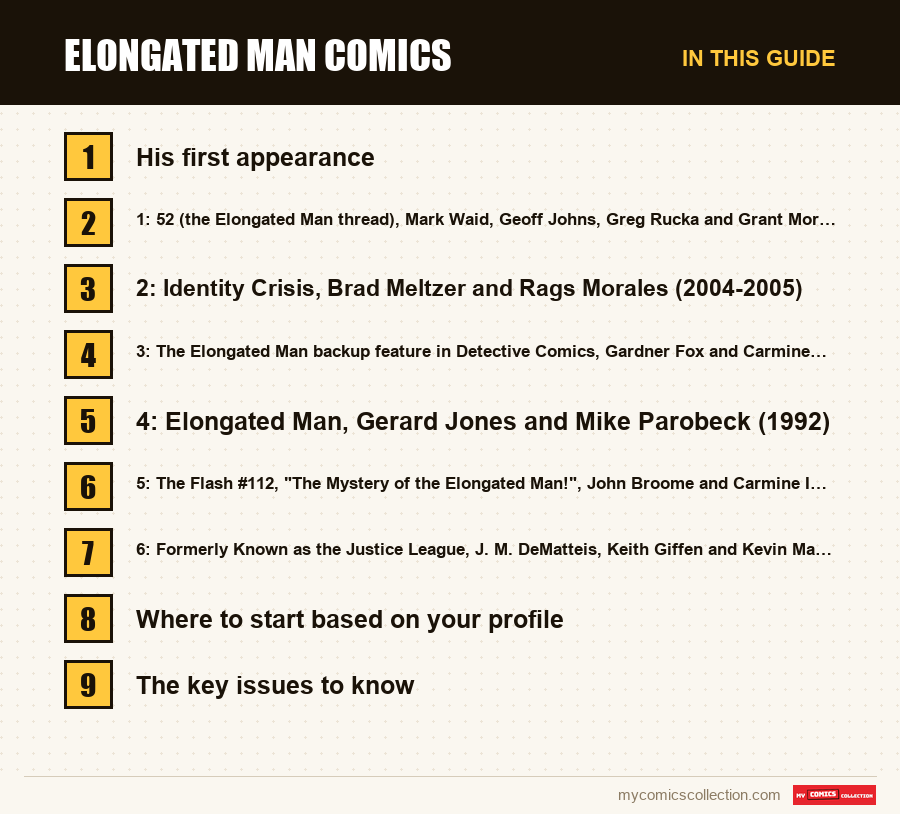
5: The Flash #112, "The Mystery of the Elongated Man!", John Broome and Carmine Infantino (1960)
The 1960 story is short and doesn't yet make Ralph the star: he is a guest, and the episode serves to introduce him. The inks are by Joe Giella, the cover by Infantino and Giella. This issue is for anyone who wants to go back to the source; reading it takes a few minutes.
What it brings is modest but foundational: a name, a power, a taste for mystery. Read it to know where the character starts rather than for its intensity. It is for collectors who follow first appearances, and it reads after the modern reads, never before you understand where Ralph's story leads.
6: Formerly Known as the Justice League, J. M. DeMatteis, Keith Giffen and Kevin Maguire (2003)
Six issues, the first dated September 2003: Keith Giffen and J. M. DeMatteis write, Kevin Maguire draws and Josef Rubinstein inks. Maxwell Lord gathers the Super Buddies, a team of second-stringers that includes Ralph and Sue. Ralph is an ensemble member here, not the center of the story: the series is worth it for its team humor, where he plays the good-natured guy nobody takes seriously.
The same creators sign a six-issue sequel, published in 2005 in JLA Classified, starting with #4, whose release was pushed back by Identity Crisis. In this sequel, Ralph brags that Sue is pregnant. She isn't, which casts a bitter irony over the pages in light of what follows.
It is for the reader who knows the Justice League and likes office comedy in tights. Read it before Identity Crisis if you want to measure the drop in tone, or after if you want a counterpoint.
Where to start based on your profile
If you want the best of Ralph, read Identity Crisis then 52. This sequence tells the loss, the quest and the end of the character in two series, without having to know the whole Justice League.
If you prefer the early Ralph, start from the Justice League reading guide, place The Flash #112 as the origin, then the 1964 Detective Comics episodes, then the 1992 miniseries. If you're after comedy, add Formerly Known as the Justice League.
If you collect, favor the 1960 first appearance, Detective Comics #327, which launches the backup feature, and the key issues of the 2004-2007 period, which are very plentiful and therefore easy to compare.
The key issues to know
Here are the issues that mark out Elongated Man's history. No figures here: you value a copy by comparing several completed sales of an issue in the same grade, not by trusting a single listing.
- The Flash #112 (1960): first appearance of Ralph Dibny, by John Broome and Carmine Infantino.
- Detective Comics #327 (1964): start of the Elongated Man backup feature, by Gardner Fox and Carmine Infantino.
- Invasion! #3 (1989): the character is revealed there as a metahuman.
- Elongated Man #1 (1992): start of the Europe '92 miniseries, by Gerard Jones and Mike Parobeck.
- Formerly Known as the Justice League #1 (2003): the Super Buddies comedy, by Keith Giffen, J. M. DeMatteis and Kevin Maguire.
- Identity Crisis #1 (2004): the death of Sue Dibny, by Brad Meltzer and Rags Morales.
- 52 #1 (2006): start of the weekly series where the character's last act plays out.
- Blackest Night #1 to #3 (2009): Ralph and Sue return temporarily as Black Lanterns; the key issues of Blackest Night place the event.
On a 1960 Flash or a 1964 Detective Comics, condition is what counts: corners, spine, paper. The issues from 2004 to 2007 are plentiful and separate on sharpness. The blog extends the topic.
Frequently asked questions
Ralph Dibny debuts in The Flash #112, dated 1960, in the story "The Mystery of the Elongated Man!" John Broome writes, Carmine Infantino draws and Joe Giella inks. This issue contains a second episode, where the stretching man is not the subject.
Chain the 2004 miniseries and then the 2006-2007 weekly series: that is the dramatic heart of the character. For his lighter side, open the Elongated Man (1992) miniseries by Gerard Jones and Mike Parobeck, which reads on its own with no preparation.
He is its emotional starting point: Sue is killed in the couple's apartment in issue #1, while he is on a stakeout. In this seven-issue miniseries, the investigation involves all the heroes, and he is not its sole pivot.
In 52, Ralph searches for Doctor Fate's helmet to bring Sue back. Felix Faust, posing as Nabu, hands him to the demon Neron. Before dying, Ralph traps both in the Tower of Fate, then he finds Sue: the two come back as ghost detectives.
Yes, for most of his best stories. The Detective Comics backup feature (1964-1969) and the 1992 miniseries read on their own. Identity Crisis and 52 are better with some idea of the cast, but their main plot stays accessible.
Do you own a 1960 Flash or a 1964 Detective Comics? A free estimate shows you where it stands.
Estimate my comic