
The best Atom comics to start with begin with Ray Palmer's debut in Showcase #34 to #36 (1961-1962), by Gardner Fox and Gil Kane, then move on to the 1962 The Atom series. Newer readers will prefer The All-New Atom (2006), centered on Ryan Choi. Al Pratt, the 1940 hero, is best discovered separately, in All-American Comics #19 and the Justice Society stories.
Three people have carried the name Atom for any length of time, and their stories cross without merging: Al Pratt, a powerless vigilante active from 1940, Ray Palmer, a physicist who shrinks at will since 1961, and Ryan Choi, a young professor who arrived in 2006. Seven reads are ranked below, each headed by the name of the character who wears the mantle, so you do not mix up 1940, 1961 and 2006.
As always in this guide, we only state what is verified (creators, issue numbers, dates); the analysis is our own, with no reproduction of protected art or dialogue.
His first appearance
You have to tell three dates apart. Al Pratt, the first Atom, is born in All-American Comics #19, dated October 1940, written by Bill O'Connor and penciled by Ben Flinton. This hero has no powers, which is what sets him apart from his successors. He is among the founding members of the Justice Society and the All-Star Squadron.
Ray Palmer, the Atom most readers are looking for, appears in Showcase #34, dated October 1961. Editor Julius Schwartz coordinates the story, Gardner Fox writes it and Gil Kane draws it. Palmer is a physics professor at Ivy University in Ivy Town; he discovers that a lens cut from white dwarf star matter can shrink objects, then builds a belt and a costume to control his own size. He later joins the Justice League.
Ryan Choi, finally, debuts in 2006 in the one-shot DCU: Brave New World. Gail Simone, with Grant Morrison on the concept and the costume, makes him a young professor who takes over the role at Ivy University. A fourth name exists, Adam Cray, introduced by John Ostrander in Suicide Squad #44 (August 1990), but he stays on the fringe of this ranking.
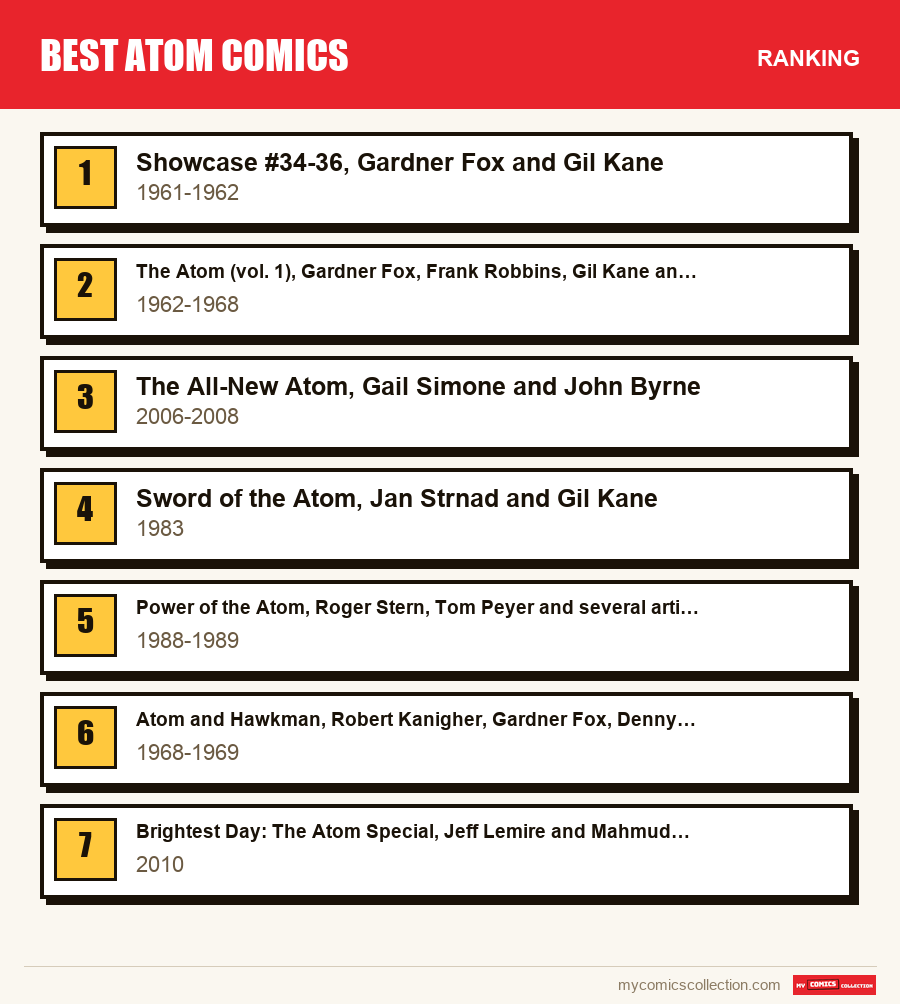
1: Showcase #34-36, Gardner Fox and Gil Kane (1961-1962)
Three tryout issues are enough to establish the character of Ray Palmer. The premise is simple and suits the science fiction of the era: an ordinary man, armed with a minimum of physics, goes from human size to insect size, and Gil Kane's art gives these changes of scale real clarity.
What this read gives Ray Palmer is his complete identity: the scientist, the lens, the belt, the taste for invention. It is for the Silver Age reader, for anyone who wants to understand why DC relaunched the 1940 heroes with new faces, and for those who collect tryout titles.
There are two ways to read it. The original single issues, rare and fragile, or a reprint: The Atom Archives volume 1 collects Showcase #34 to #36 and The Atom #1 to #5. If you want an entry point without hunting for back issues, this is the most direct.
2: The Atom (vol. 1), Gardner Fox, Frank Robbins, Gil Kane and Mike Sekowsky (1962-1968)
The regular series runs thirty-eight issues. Gardner Fox and Frank Robbins share the scripts; Gil Kane and Mike Sekowsky handle most of the pencils. Not every issue is equal, but the run as a whole explores what miniaturization allows: crossing an electric wire, slipping into a mechanism, changing scale in the middle of a fight.
The series extends the idea laid down in Showcase: Ray Palmer is a scientist before he is a crime fighter, and his adventures often mix laboratory work, trips to the microscopic scale and threats from elsewhere. It is for those who want to read the same voice over time, old-school, without a long arc.
Two black-and-white reprints exist: Showcase Presents The Atom volume 1 (Showcase #34-36 and Atom #1-17) and volume 2 (Atom #18-38). After these thirty-eight issues, the title merges with another hero, as the next entry explains.
3: The All-New Atom, Gail Simone and John Byrne (2006-2008)
This is the modern entry point. The All-New Atom runs twenty-five issues, published from 2006 to 2008, after the one-shot DCU: Brave New World (August 2006). Gail Simone writes the launch, John Byrne draws the first episodes, then Eddy Barrows and other artists take over; the final issues pass to other teams of writers and artists.
The series gives the Atom a fresh angle. Ryan Choi is not a younger Ray Palmer, he is a teacher at Ivy University who takes up the role in his turn. The stories use miniaturization to invent places, creatures and dangers on the scale of a campus.
The trade paperbacks follow a clear split: My Life in Miniature (#1-6 and Brave New World #1), Future/Past (#7-11), The Hunt for Ray Palmer (#12-16) and Small Wonder (#17-18 and 20-25). Issue #19 is in none of these volumes: keep that in mind if you are completing the series in single issues.
4: Sword of the Atom, Jan Strnad and Gil Kane (1983)
Twenty-two years before Ryan Choi, Gil Kane returns to the character he drew in 1961. Jan Strnad writes Sword of the Atom, a four-issue miniseries that opened in September 1983. Ray Palmer, after his divorce from Jean Loring, leaves civilization behind and becomes the protector of a small South American people, the Morlaidhans.
This read changes the register: instead of a lab hero, you follow a miniature warrior in a fantasy adventure, sword in hand. It will appeal to fans of remote lands who are curious to see Ray Palmer far from Ivy Town.
The 2007 reprint collects the four issues of the miniseries and Sword of the Atom Special #1. It is the most practical format for this read, since the single issues were published on separate dates.
Do you collect this series?
Track what you own, what you are missing and what your collection is worth. 7-day trial.
Start my trial →
5: Power of the Atom, Roger Stern, Tom Peyer and several artists (1988-1989)
DC relaunches an ongoing series in 1988, with issue #1 dated June 1988. It runs eighteen issues, written notably by Roger Stern and then Tom Peyer, with Dwayne Turner and Graham Nolan among the artists. Ray Palmer faces a conspiracy tied to the CIA, the Cabal, and its agents, including the Micro/Squad.
It offers a more earthbound and darker version of the hero, who stands against an organization rather than monsters. It is for readers of espionage and late-1980s series, less for fans of lighthearted science fiction.
It reads in single issues numbered 1 to 18, which makes it more of a collector's read than an introduction.
6: Atom and Hawkman, Robert Kanigher, Gardner Fox, Denny O'Neil, Murphy Anderson and Dick Dillin (1968-1969)
The Atom series turns into Atom and Hawkman after issue #38. Seven issues follow, written in turn by Robert Kanigher, Gardner Fox and Denny O'Neil, and drawn notably by Murphy Anderson and Dick Dillin. The duo pairs two Justice League heroes who seem to have nothing in common: one miniature and scientific, the other winged and warlike.
This read brings camaraderie: Ray Palmer is friends with Katar Hol and shares missions with him. It is for the collector who wants to complete the series from the end, or for the Hawkman reader looking for crossovers; our guide to the best Hawkman comics covers the other half of the duo.
7: Brightest Day: The Atom Special, Jeff Lemire and Mahmud Asrar (2010)
This July 2010 one-shot is written by Jeff Lemire and drawn by Mahmud Asrar, with John Dell III on inks. It revisits Ray Palmer's early days, with a conflict against the Colony and the Dwarfstar affair.
It offers a modern retelling of the hero's youth, useful if you have read Fox and Kane and want to see those elements picked up by a contemporary writer. It is short, needs no prerequisites, and reads in one evening. Find the writer on his dedicated page.
Where to start depending on your profile
You want the modern version without knowing the past: pick up My Life in Miniature, the first trade paperback of The All-New Atom. Ryan Choi is introduced on his own terms there, and the next volume, Future/Past, continues without requiring any earlier reading.
You collect the Silver Age: look for Showcase #34 first, then The Atom #1, whose cover is dated 1962. To place this period in the publisher's history, our page on The Brave and the Bold #28 tells the story of the other launch of the era.
You like out-of-the-ordinary adventures: Sword of the Atom is the obvious choice. You prefer conspiracy stories: Power of the Atom. And if your interest is in Al Pratt, start from All-American Comics #19, then extend to the team through the page on the history of the Justice League.
The key issues to know
The keys to a multi-bearer character are best sorted by wearer. For Al Pratt: All-American Comics #19 (October 1940). For Ray Palmer: Showcase #34 (October 1961), then The Atom #1, the first issue of the 1962 series. For Ryan Choi: DCU: Brave New World (August 2006), then The All-New Atom #1. For Adam Cray: Suicide Squad #44 (August 1990). For the far-future version, Atom One Million: DC One Million 80-Page Giant #1,000,000 (August 1999), conceived by Grant Morrison.
The story's turning points are found elsewhere: Al Pratt's death in Zero Hour, Ray Palmer's disappearance after Identity Crisis, then the search told in Countdown to Final Crisis, and Ryan Choi's return revealed in Convergence. As for Identity Crisis, by Brad Meltzer and Rags Morales, the miniseries is not ranked: the hero of the story is not the Atom, his ex-wife Jean Loring plays a central role in it, and Ray Palmer holds only a secondary place.
A method for judging the interest of an issue: check who wears the costume in the story, then ask yourself whether that wearer has a readable follow-up. A turning point whose consequences last several years, like the 2004-2005 disappearance, reads better than an isolated appearance. And for a Silver Age single issue, look at the spine, the corners and the freshness of the paper more than at the issue number.
Frequently asked questions
It depends on your taste. Ray Palmer, in Showcase #34 to #36, offers the historical read. Ryan Choi, in Gail Simone's The All-New Atom, offers a modern story that is more accessible, with no prior knowledge needed. Al Pratt suits those who love the Golden Age and the Justice Society.
It depends on the wearer. Al Pratt debuts in All-American Comics #19 (October 1940), Ray Palmer in Showcase #34 (October 1961), and Ryan Choi in DCU: Brave New World (2006). Each date matches a distinct character, with his own creators.
No. Identity Crisis explains why Ray Palmer disappears afterward, but the Atom is not its central subject. You can read Showcase, Sword of the Atom or The All-New Atom without this miniseries. It becomes useful if you follow the search for Ray Palmer.
Yes, in four volumes: My Life in Miniature (#1-6 and Brave New World #1), Future/Past (#7-11), The Hunt for Ray Palmer (#12-16) and Small Wonder (#17-18 and 20-25). Issue #19 is not reprinted in any of them, so you have to look for it as a single issue.
Showcase #34 is Ray Palmer's first appearance; The Atom #1 opens his ongoing series in 1962. Compare several listings of the same issue, then the exact condition, before deciding to buy.
Own a copy of All-American Comics or Showcase at home? Get it appraised before you sell it or insure it.
Estimate my comic